

A pool project that goes smoothly is rarely the result of luck. It’s the result of decisions made well in advance — before the contract is signed, before the permit is filed, before the excavator arrives. The homeowners who run into expensive mid-project problems almost always made one of the same predictable mistakes early on.
These aren’t obscure gotchas. They’re patterns that show up repeatedly in Toronto pool builds, and that are largely avoidable once you know to look for them. If you’re in the early stages of planning a pool, this list is worth reading before you start collecting quotes.
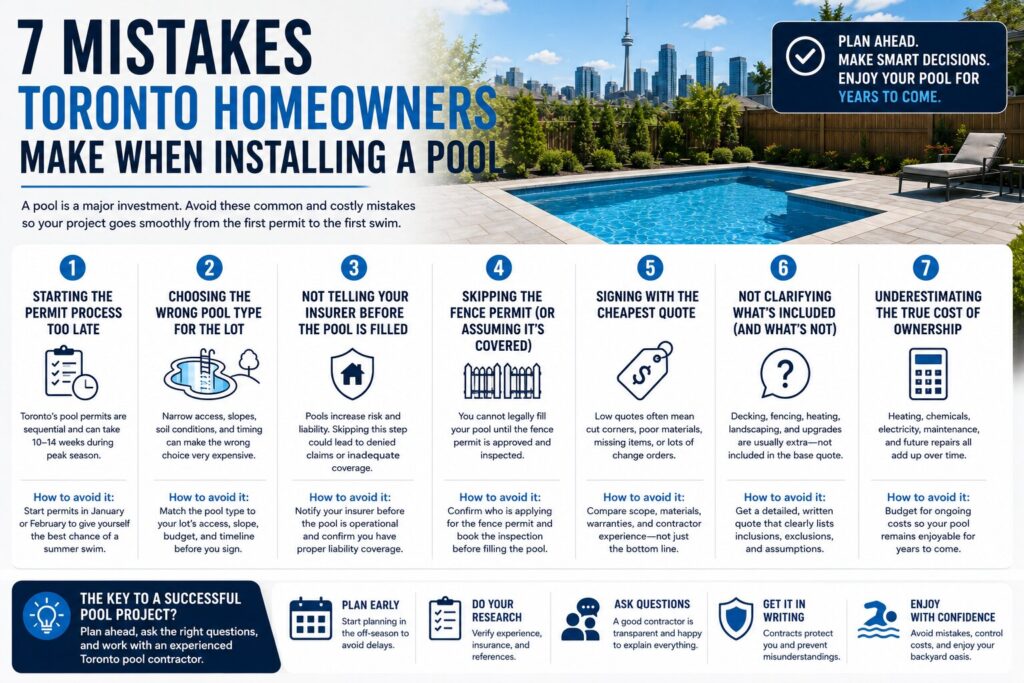
Mistake 1: Starting the Permit Process Too Late
Toronto’s pool permit process is sequential and takes longer than most homeowners expect. Before a shovel goes in the ground, you need a Zoning Applicable Law Certificate (applied to Toronto Building) and — only after that’s approved — a Pool Fence Enclosure Permit (applied to Municipal Licensing and Standards). These two approvals run sequentially, not simultaneously, and during peak application season (March through June), the full process can take 10–14 weeks.
A homeowner who calls a pool contractor in April with the expectation of swimming by July is typically not accounting for this. A fibreglass pool with permits already in hand can realistically be built in 2–4 weeks — but getting the permits takes longer than the build. Starting the permit process in January or February gives you a realistic path to an early summer completion. Starting in May means you’re swimming in August at the earliest, and more likely not until the following season.
The mistake isn’t the permit process itself — it’s treating it as something that happens after a contractor is signed, rather than something that needs to begin almost simultaneously with design finalization.
→ Related reading: Pool Permits Toronto | Best Time to Install a Pool in Ontario
Mistake 2: Choosing the Wrong Pool Type for the Lot
The pool type that works best on paper isn’t always the pool type that works best on your specific property. Toronto lots have characteristics that make certain choices more or less practical — and discovering a mismatch after you’ve signed a contract is an expensive place to find out.
Fibreglass pools and narrow lots: fibreglass shells arrive pre-formed on a flatbed truck and require crane access to lift them into the excavated hole. That crane needs to reach from the street or your driveway. A lot with a narrow side yard, overhead utility lines along the access path, or a street with low-clearance trees can complicate or significantly increase the cost of a fibreglass installation. This is a question that has to be answered during the site visit — before a shell is on order.
Concrete pools and time expectations: concrete pools take 6–12 weeks to build in Ontario, including a mandatory curing period that can’t be shortened. A homeowner who chooses concrete expecting a 4-week build timeline is going to be disappointed. If swimming this season is a priority, fibreglass or vinyl may be more realistic.
Above-ground or semi-inground on sloped lots: a sloped backyard changes the calculation for every pool type. What looks like a suitable site from the house can require $15,000–$20,000 in retaining walls for a full inground pool, while a semi-inground option might work with the slope rather than against it.
The right question to ask before choosing a pool type isn’t “which pool do I want?” — it’s “which pool types does my lot actually support well, and at what realistic cost?”
→ Related reading: Best Pool Type to Install | Pool Installation on a Slope
Mistake 3: Not Telling Your Insurer Before the Pool Is Filled
A pool changes your home’s risk profile. It’s a drowning risk, a liability exposure, and a property feature that an insurer needs to know about. The appropriate time to notify your insurer is before the pool is operational — not after an incident reveals that you didn’t.
In practice, two things can go wrong if you skip this step. First, your insurer may deny a claim on the basis that you failed to disclose a material change to the property. Second, your standard homeowner’s policy may not provide adequate liability coverage for a pool-related injury — particularly if the injured party is a guest or, in some circumstances, a trespasser.
The cost impact is real but manageable: most Toronto homeowners see a premium increase of $150–$400 per year after disclosing a pool, sometimes more depending on pool type and insurer. Some insurers also require an umbrella liability policy above a certain pool size or property value. Getting this sorted before the pool opens is significantly less expensive than dealing with a claim on an undisclosed pool.
Mistake 4: Skipping the Fence Permit (or Assuming It’s Covered)
The Pool Fence Enclosure Permit is a separate approval from the pool itself — and it’s the one that governs whether your pool can legally be filled with water. In Toronto, you cannot legally fill a pool or allow water to collect in it until a Municipal Licensing and Standards inspector has confirmed that the enclosure is compliant with the bylaw.
There are two versions of this mistake. The first is a homeowner who assumes that since the contractor pulled “the permits,” the fence permit is covered — when in fact the contractor only submitted the Zoning Certificate and left the fence permit to the homeowner to handle. The second is a homeowner who builds the fence but doesn’t know to schedule the inspection, or schedules it too late during peak inspection season and delays the pool opening by weeks.
The fence itself also needs to actually comply with Toronto’s requirements: minimum 1.2 metres in height, self-closing and self-latching gate with the latch on the pool side, and a configuration that isolates the pool area on all four sides — including from the dwelling itself if a door opens toward the pool. See Toronto Pool Fence Bylaws for the full specification.
Confirm explicitly with your contractor: who is responsible for the Pool Fence Enclosure Permit application, who manages the inspection booking, and whose responsibility is it to ensure the fence design meets the bylaw before it’s built?
Mistake 5: Signing with the Cheapest Quote
This one is counterintuitive to write plainly, so here it is: the cheapest pool quote is almost never the best pool quote. That’s not a position designed to benefit expensive contractors — it’s the result of how pool projects actually work in practice.
Low quotes in Toronto’s pool market typically represent one or more of the following: inferior materials (cheaper pump, thinner liner, lower-grade equipment package), work that will be subcontracted to the lowest-bidding trades rather than a retained crew, exclusions that will surface as change orders after signing, or a contractor who has underpriced to win the contract and plans to recover margin through extras.
A more useful approach is to collect three itemised quotes — line-by-line breakdowns, not lump sums — and compare them at the component level. When a quote is meaningfully cheaper than the others, the productive question is “what is this quote not including?” rather than “did I find a deal?” Often you’ll discover that one quote excludes decking, or includes a pump package that’s a different grade, or doesn’t account for permit management.
The goal isn’t to choose the most expensive contractor. It’s to choose the contractor whose quoted scope most accurately reflects what you’re actually going to get.
→ Related reading: Pool Contractor Red Flags | How to Choose a Pool Contractor in Toronto
Mistake 6: Underbudgeting for Add-Ons
A pool quote covers the pool. It does not typically cover the fence, the decking, the heater, any electrical upgrades, gas line extensions, landscaping restoration, or permit management. These items collectively represent 30–40% of the total all-in project cost on most Toronto builds — which means a $90,000 pool quote is realistically a $130,000–$150,000 project once everything is included.
This isn’t a secret, but it’s routinely under-communicated at the initial quote stage. Homeowners who plan to the quoted number often find themselves making forced compromises mid-project: cheaper decking than they wanted, no heater installed initially, a fence that meets code minimums rather than the design they envisioned.
The fix is straightforward: before signing any contract, ask for written estimates on every item likely to be excluded from the base quote — fencing, decking, heating, and any site-specific work — and budget to the sum of all of them, not to the pool quote alone.
→ Full breakdown: The Real Cost of a Pool in Toronto | Pool Installation Cost Toronto
Mistake 7: Not Having the Yard Assessed Before Finalising the Design
Every backyard has constraints that affect what can be built, at what cost, and on what timeline. Some of these constraints are obvious — a small yard, a significant slope, a large tree. Others are invisible until a professional looks: clay soil with a high water table that adds to excavation cost, an easement running through the middle of the yard that limits pool placement, a buried utility line exactly where the equipment pad was planned.
A homeowner who finalises a pool design — including shape, size, features, and position — without an on-site assessment by an experienced contractor is designing around assumptions. When those assumptions turn out to be wrong, the result is either design changes that the homeowner didn’t want, cost increases that weren’t in the budget, or both.
The solution is to insist on a site visit before any design is finalised and before any contract is signed. The site visit should explicitly check for: side-yard access width (which determines what excavation equipment can get in), soil type, the presence of protected trees (Toronto’s Private Tree Bylaw protects any tree with a trunk diameter over 30cm), easements visible on the survey, and utility locations confirmed by Ontario One Call.
None of these things take long to assess. All of them can derail a project if they’re discovered after signing.
→ Related reading: How to Prepare Your Yard for Pool Installation | Pool Excavation Toronto
What Good Planning Actually Looks Like
Every mistake on this list is avoidable with early, thorough planning. The homeowners who have the smoothest pool projects are the ones who start permits before construction, match pool type to lot characteristics, get insurance sorted before filling, confirm fence compliance is explicitly scoped, compare quotes at the line-item level, build full project budgets rather than pool-only budgets, and insist on a site visit before any contract is finalised.
None of that requires specialised knowledge — it just requires asking the right questions at the right time, which is a lot easier to do before you sign than after excavation has started.
Starting to plan your pool? What to Know Before Installing a Pool covers the complete pre-signing checklist. For help evaluating contractors, start with How to Choose a Pool Contractor in Toronto.