

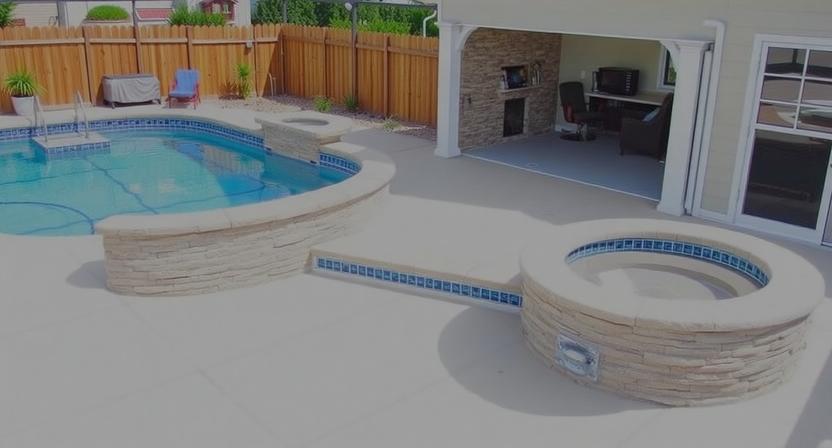
Most pool renovations in Toronto aren’t about replacing the pool — the structure itself (concrete shell, fibreglass shell, or vinyl wall panels) typically lasts decades. What ages is the surface finish, the liner, the surrounding coping and deck, and the equipment. A renovation project addresses these elements specifically, rather than excavating and starting over. This guide covers the full scope of what renovation involves, what each type costs, and when a full renovation is warranted versus targeted repairs.
What Pool Renovation Actually Covers
“Pool renovation” describes a broad range of work, from a straightforward liner swap to a full surface, coping, deck, and equipment overhaul. The common thread is that renovation improves or restores an existing pool structure rather than rebuilding it.
| Renovation Type | What It Involves | Typical Cost |
| Plaster resurfacing | Removing old plaster; applying new plaster, pebble, or quartz | $6,000 – $18,000 |
| Vinyl liner replacement | Removing old liner; installing new custom-fitted liner | $4,000 – $10,000 |
| Coping replacement | Removing and replacing the pool edge material | $3,000 – $8,000 |
| Deck renovation | Resurfacing or replacing surrounding hardscape | $5,000 – $20,000+ |
| Equipment upgrade | Replacing pump, filter, heater, or adding automation | $2,000 – $8,000+ |
| Feature additions | Tanning ledge, water features, LED lighting, saltwater conversion | $1,500 – $15,000+ |
| Safety upgrades | Anti-entrapment drain covers, fence compliance, new ladders | $500 – $3,000 |
| Full renovation | Resurfacing + coping + deck + equipment | $20,000 – $60,000+ |
When a Pool Needs Renovation
Surface Finishes (Concrete Pools)
Plaster, pebble, and quartz finishes have a finite lifespan:
- Standard plaster: 7–12 years; signs of aging include etching, chalking, staining, rough texture, and difficulty maintaining water chemistry
- Pebble and quartz: 15–20+ years; signs include pebble loss, widespread staining, or surface deterioration
Toronto’s hard municipal water accelerates calcium scaling on aging plaster — an already-rough surface accumulates scale faster than a smooth one, which is one reason older plaster pools in Toronto tend to need resurfacing on the shorter end of the typical lifespan. Resurfacing at the right time prevents a pool that looks merely dated from becoming one that’s genuinely difficult to maintain. See Pool Liner Replacement Toronto for the liner-specific version of this question.
Vinyl Liners
Liners typically last 7–12 years; signs that replacement is due include visible fading, brittle or cracking vinyl, persistent small leaks despite patching, and widespread wrinkling. A liner that’s fading around the waterline specifically is UV-affected and may be approaching the end of its structural life even if it hasn’t yet leaked.
Coping
Coping cracks and lifts in Toronto due to freeze-thaw cycles more consistently than in milder climates. A coping section that’s cracked or visibly heaved may be a safety concern for bare feet around the pool edge, and loose coping allows water to infiltrate behind the shell, potentially accelerating structural damage.
Decking
Pool decks crack, stain, settle, and become dated. A deck that’s structurally sound but cosmetically poor (old brush-finish concrete, faded interlocking that can’t be cleaned to look acceptable) can be resurfaced, overlaid, or replaced. A deck with significant frost heave damage or drainage problems typically needs full replacement rather than resurfacing.
Equipment
Pool equipment has finite service lives:
- Variable speed pumps: 8–12 years
- Filters: 10–15 years
- Gas heaters: 7–12 years
- Heat pumps: 10–15 years
- Salt cells: 3–7 years
Aging equipment that requires increasing repairs — a pump that trips breakers, a heater that needs the igniter replaced repeatedly, a filter that can’t maintain pressure — is often more economical to replace than repair. Equipment replacement is frequently the trigger for a broader renovation, since the pool is already being serviced and the opportunity to upgrade is there.
The Renovate vs. Replace Question
True pool replacement — excavating the existing pool and building a new one — is rare and expensive. In most cases, renovation is significantly more cost-effective:
Renovation makes sense when:
- The pool structure is sound but the surface, coping, or equipment needs updating
- You want to add features (a tanning ledge to a concrete pool, new lighting, a saltwater system)
- The pool’s size and placement still work for how you use your yard
Replacement might make sense when:
- The pool is positioned poorly relative to the house, sun exposure, or how the yard has changed
- A concrete pool has severe structural cracking — through-cracks that water infiltrates, rather than surface crazing — that would require more work to repair than to rebuild
- You want a dramatically different pool type (replacing a concrete pool with fibreglass, for example, sometimes makes more sense than a full concrete renovation if the shell has reached end of life)
- The pool footprint needs to change significantly
For the vast majority of Toronto pools — concrete pools from the 1980s–2000s, vinyl liner pools that need their second or third liner, fibreglass pools with aging equipment — renovation is the right answer.
Feature Additions During Renovation
Renovation is often the ideal time to add features that couldn’t be added to the original build, particularly for concrete pools:
Tanning ledge: can be broken out of an existing concrete pool and rebuilt — more expensive than building in from the start, but achievable. Typically $5,000–$12,000 for this modification.
Saltwater conversion: adding a salt chlorinator to an existing pool is a straightforward equipment addition. Most pools can be converted; cost is typically $1,500–$3,000 for the unit and installation.
LED lighting: replacing existing halogen fixtures with LED is one of the simplest and most impactful renovation upgrades. See Pool Light Installation Toronto.
Automation: adding a smart control system to existing equipment is often possible if equipment is compatible; otherwise, equipment upgrade and automation installation happen together.
Updated deck and coping: coping and deck replacement during a resurfacing project is significantly more cost-effective than two separate projects, since the pool area is already disrupted and equipment is staged.
Toronto-Specific Renovation Factors
Freeze-Thaw Surface Damage
Toronto’s winter freeze-thaw cycles are harder on pool surfaces than most homeowners realize. Concrete pools develop micro-cracking in plaster and tile grout over many winters; the water that infiltrates these small cracks expands on freezing and widens them progressively. This is why Toronto pools typically need resurfacing on the shorter end of the typical 7–15 year range — conditions here are harder than in Southern Ontario or Sunbelt pool markets.
Calcium Scaling on Aging Surfaces
Toronto’s hard water (120–140 mg/L total hardness) creates visible calcium carbonate deposits on waterline tile, aging plaster, and rough pool surfaces. These deposits are manageable on a smooth new surface but become increasingly difficult to address as the surface ages and roughens. Resurfacing a heavily scaled plaster pool restores a surface that can be kept clean.
Drain Safety Upgrades
Many Toronto pools built before 2010 have single main drain configurations or drain covers that pre-date current anti-entrapment standards. These are worth updating as part of any renovation — the work isn’t expensive relative to the overall renovation scope, and it brings the pool into compliance with current safety expectations. See Pool Repair Toronto for specifics on structural and safety work.
Frost Heave in Coping and Deck
Frost heave is so consistent in Toronto that cracked or lifted coping and deck are essentially universal in pools over 15–20 years old. A renovation that includes coping replacement and deck work restores the visual and functional condition of the pool surround and addresses the safety issue of cracked or unstable coping at the pool edge.
Frequently Asked Questions
How much does pool resurfacing cost in Toronto?
Standard plaster resurfacing typically runs $6,000–$10,000 for a smaller pool, $10,000–$18,000 for larger pools. Premium finishes (pebble, quartz) run $8,000–$15,000+. Full tile interiors start at $20,000+.
How do I know if my pool needs resurfacing or just cleaning?
If the surface is rough to the touch, etching and staining persist despite regular chemical treatment, or the finish is chalking (white powder in brushed debris), resurfacing is likely needed. Surface cleaning and acid washing can help a pool that’s stained but still smooth.
Is it worth renovating an old pool in Toronto?
Usually yes — concrete and fibreglass pool structures are very long-lasting, and the cost of renovation is typically 20–40% of building a new pool. The exceptions are pools with severe structural damage or poorly placed pools that no longer fit the yard.
Can I add a tanning ledge to my existing concrete pool?
Yes — it requires breaking out a section of the shallow end and rebuilding it, which is a meaningful renovation project ($5,000–$12,000) but significantly cheaper than a new pool. This isn’t possible for fibreglass (the shell is fixed) and is limited for vinyl pools.
What upgrades make the most impact during a renovation?
Resurfacing + coping + LED lighting + saltwater conversion is one of the most impactful combinations for a dated pool — it changes the look, feel, and daily maintenance experience significantly.
Get a Renovation Assessment
What your pool needs depends on its age, material, and current condition.
Contact Easy Pools at (647) 449-9512 for a free, no-obligation renovation assessment.