

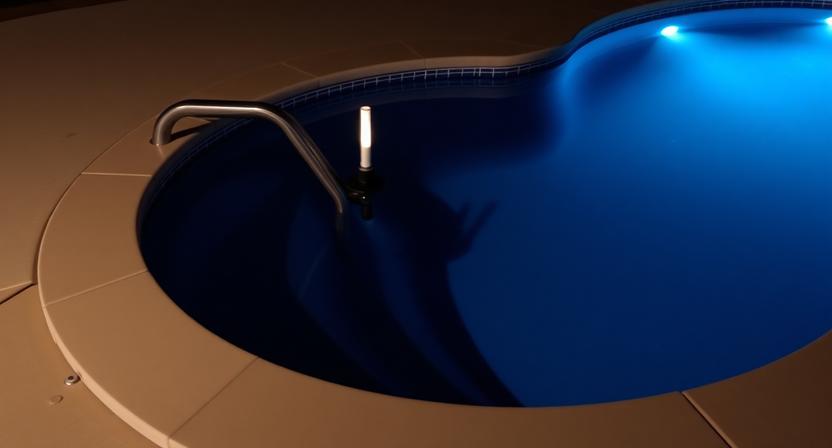
After dark, a well-lit pool is a completely different space from an unlit one — the water glows from within, the surrounding landscape reads differently, and the pool becomes usable and visually interesting well past sunset. This guide covers the types of pool lighting, how they’re installed, what safety and electrical requirements apply in Ontario, and the design choices that determine how your pool actually looks when the sun goes down.
LED vs. Halogen: Why the Transition Matters
Most pools built before the mid-2010s used halogen bulbs in incandescent fixtures — energy-intensive, hot-running, and requiring frequent bulb replacement. LED has almost entirely replaced halogen in new pool installations, and for good reason:
- Energy use: LED uses approximately 80% less electricity than an equivalent halogen fixture for the same light output
- Lifespan: LED fixtures are typically rated for 25,000–50,000 hours, compared to 1,000–3,000 hours for halogen bulbs
- Heat: LED runs cool in the water; halogen generates significant heat that must dissipate
- Colour: LED enables colour-changing and programmable effects that incandescent cannot match
Converting an existing halogen pool to LED: most existing wet niches (the mounting system for underwater lights) can accept a direct LED replacement bulb or a new LED fixture, making the conversion straightforward for most pools. If your pool has an existing light niche, an LED upgrade is one of the most cost-effective improvements you can make.
Types of Pool Lighting
Underwater Pool Lights
The primary pool lighting element — fixtures mounted in the pool wall below the waterline, facing into the pool interior.
Wet niche fixtures: the traditional installation method. A sealed housing (the niche) is built into the pool wall during construction, with the electrical conduit running from the niche to a junction box above the water line. The light fixture inserts into the niche and can be serviced and replaced by pulling it to the surface on its cord, without draining the pool. Most concrete and vinyl pools use wet niche fixtures.
Nicheless fixtures: LED-specific fixtures that install directly into a small hole in the pool wall without a niche housing — lower profile, simpler to install, and increasingly common in new construction. Servicing requires draining the pool to the light level, unlike a niche fixture. Popular in fibreglass installations where cutting a full niche is impractical.
Number and placement: pool industry guidelines typically suggest one underwater light for every 20–25 linear feet of pool perimeter, or one light per 250–300 square feet of pool surface. A standard 14’x28′ pool typically has 1–2 lights; a larger pool benefits from 3 or more. Placement on the longer walls rather than the ends provides the most even illumination.
Deck and Coping Lighting
Low-voltage LED fixtures installed in the deck surface or integrated into coping provide safety lighting around the pool perimeter — illuminating steps, edges, and the path from the house to the pool.
Step lights: recessed fixtures in pool steps or the pool wall at waterline height, marking the step edge for nighttime safety.
In-deck fixtures: round or linear recessed LED fittings set flush in the deck surface. Create a warm, low ambient glow at deck level without glare.
Coping-integrated strip lighting: continuous LED strip or channel lighting integrated into the underside of cantilevered coping, creating a halo effect around the pool’s edge.
Landscape and Feature Lighting
Uplighting of specimen trees, plants, water features, and fence lines extends the visual space of the backyard beyond the pool’s immediate surround. From a design standpoint, this is often the lighting layer that has the greatest effect on the perceived size and character of the pool area — a dark fence 15 feet away visually closes the space; an uplighted hedge opens it.
Above-ground post lights or bollards provide path lighting between the house and pool without requiring deck installation.
Safety Requirements in Ontario
ESA permit required: all pool electrical work in Ontario — including new lighting, lighting upgrades, and automation — requires an Electrical Safety Authority (ESA) permit and inspection. This applies to new installations and to retrofits. Your electrician obtains this permit; confirm it’s included in your scope before work begins.
GFCI protection: all outlets and circuits within the specified distance of the pool edge must be GFCI-protected (Ground Fault Circuit Interrupter). This prevents electrical shock if water contacts a circuit.
Equipotential bonding: every residential pool in Ontario must have an equipotential bonding grid — a network of bare copper conductor connecting all metal elements of the pool and equipment to prevent voltage differences in and around the water. This is particularly important for pools being upgraded with new lighting; the bonding grid must include new lighting fixtures and conduit.
Low-voltage underwater fixtures: residential pool lights are typically 12-volt systems, powered by a low-voltage transformer. This is a code requirement for underwater fixtures — standard line-voltage (120V) fixtures cannot be installed in or near pool water.
Minimum distances: standard outdoor lighting fixtures that are not specifically rated for pool use must maintain minimum distances from the pool edge — confirm with your electrician for your specific fixture selection.
Design Options: What Actually Looks Good
Fixed Warm White vs. Colour-Changing LED
Warm white (2700–3000K) creates a golden, inviting glow in the water — works particularly well with lighter pool interiors and warmer finish colours. The water reads as warm turquoise to blue-green.
Cool white (4000–5000K) creates a crisp, bright, more contemporary effect. Popular in modern geometric pools with darker interiors.
Colour-changing RGB LED allows the pool to be set to any colour — from the familiar blue, to green, purple, red, or white — and can cycle through colour sequences programmatically. The full-colour effect is most dramatic in a pool with a light interior; a dark interior absorbs colour and produces a more subtle effect.
Interior Finish and Colour Interaction
This is the detail most pool lighting guides skip: the pool’s interior finish colour directly affects how any light source reads in the water.
- White or light plaster + warm white LED: classic, warm turquoise water
- White or light plaster + RGB blue: bright, vivid blue — the “Caribbean resort” look
- Dark interior (charcoal pebble, dark plaster) + warm white: navy to deep teal — the contemporary luxury look
- Dark interior + RGB: subtler effect; the colour is absorbed by the dark finish rather than reflected
If you’re designing with colour-changing capability, discuss your interior finish choice with your contractor specifically around lighting — the two interact significantly.
Lighting Pool Water Features
LED-lit deck jets, waterfalls with integrated backlighting, and spillover spas with lit channels transform water features dramatically at night — a glowing laminar jet crossing the pool in colour is a completely different experience from the same feature in daylight. Most water feature lighting runs on the same controller as the pool lights. See Pool Water Features Toronto.
Automation and Control
Pool lighting is typically the first pool system homeowners want to automate — turning lights on at sunset, adjusting colour from a phone app, or programming lighting sequences for entertaining. Most residential pool automation systems (Pentair IntelliCenter, Hayward OmniLogic, similar) include lighting control as a standard feature.
Automation adds $2,000–$6,000+ to the overall pool equipment cost but simplifies daily operation significantly. See Energy-Efficient Pool Systems for the full automation discussion.
Costs at a Glance
| Lighting Element | Typical Installed Cost |
| Single underwater LED (fixed colour) | $400–$800 |
| Single colour-changing RGB LED | $800–$1,500 |
| Full colour-changing system (3–4 lights) | $2,000–$4,000 |
| Halogen-to-LED retrofit (per light) | $300–$600 |
| In-deck LED step/path lighting | $500–$2,000+ (scope-dependent) |
| Landscape/feature uplighting | $500–$2,500+ |
| Low-voltage transformer (for full system) | $300–$700 |
Frequently Asked Questions
Do pool lights need to be installed during pool construction, or can they be added later?
For niche fixtures, the niche is built into the pool wall during construction — retrofitting a niche into an existing pool is possible but disruptive. Nicheless LED fixtures and deck lighting can be added at any time. Plan for lights during construction to avoid later complications.
What is pool bonding and why does it matter for lighting?
Equipotential bonding connects all metal pool components to prevent voltage differences in and around the water. Any new lighting installation must include the fixture and conduit in the bonding grid. Confirm this is included in your electrician’s scope.
Can I convert my existing halogen pool light to LED?
Usually yes — most existing wet niches accept a direct LED replacement. The conversion typically costs $300–$600 per light and dramatically reduces energy use and future bulb replacement.
How does pool interior colour affect lighting?
Significantly. Light finishes reflect colour; dark finishes absorb it. A colour-changing LED system produces vivid, saturated colour in a white-interior pool; the same system in a dark-interior pool produces a subtler, moodier effect. Discuss the two together when making finish decisions.
Do I need an ESA permit for pool lighting in Ontario?
Yes — all pool electrical work, including lighting installation and retrofits, requires an ESA permit and inspection in Ontario.
Get Pool Lighting Designed Into Your Build
Lighting decisions are easiest to integrate at the design stage — particularly for niche fixtures and conduit routing that can’t be added without disruption later.
Contact Easy Pools at (647) 449-9512 for a free, no-obligation consultation on lighting options for your pool.