

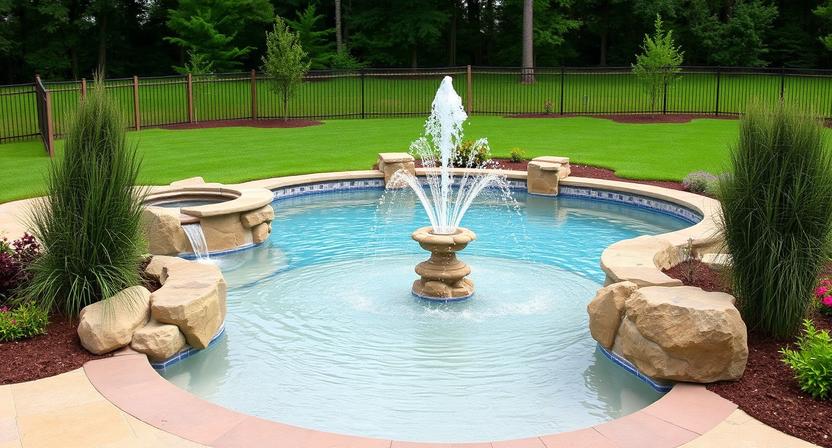
Water features are the element that shifts a pool from functional to theatrical. They add sound, movement, and visual interest — and at night, particularly with integrated LED lighting, they transform a pool surround completely. This guide covers the main residential water feature types, how each one works, what they cost, and which pool types they’re compatible with.
Why Water Features Work
The appeal of a water feature is partly psychological: moving water is calming, masks ambient urban noise, and changes the acoustic character of a backyard in ways that are disproportionate to the feature’s size. A pair of deck jets costs $1,600–$5,000 installed and produces a sound and visual effect that draws visitors’ attention immediately. A full rock waterfall can cost $10,000–$20,000 and become the architectural anchor of the entire backyard.
Most residential water features run off a dedicated pump and return loop rather than the main pool filtration system — an important practical detail, since it means the feature can run independently of the filter pump, and pump sizing can be matched to the feature’s specific flow requirement.
Waterfalls
Sheet/Blade Waterfall
A precise horizontal sill or weir over which water flows in a continuous thin sheet, creating a glassy, curtain-like effect. The blade waterfall (a thinner, more precise version) is popular in contemporary designs for its clean architectural line. Both types mount to a pool wall or raised feature wall and connect to a dedicated pump and return line.
Visual effect: a continuous translucent sheet of water, particularly striking at night when lit from behind or below. Sound is moderate — a soft rushing white noise.
Typical cost: $1,000–$4,000 installed, depending on width and height.
Rock or Stone Waterfall
Water cascades over natural or manufactured stone in a more organic, irregular flow pattern. Popular in lagoon and resort-style pools, and suits properties with significant garden landscaping. Rock waterfalls can range from a modest stone-set feature to a full architectural grotto.
Visual effect: natural, textured, resembles a stream or mountain spring. Louder than blade waterfalls — may be a consideration in dense Toronto neighbourhoods with close neighbours.
Typical cost: $3,000–$15,000+ depending on scale, materials, and engineering complexity.
Fire and Water
A wall-mounted feature combining a waterfall below with a gas-fuelled fire element above — typically a linear fire trough or a series of fire bowls. Increasingly common in GTA luxury builds.
Visual effect: dramatic contrast; the interaction of fire and water creates a focal point that functions day and night.
Typical cost: $5,000–$20,000+ depending on the fire element, waterfall width, and whether gas plumbing must be extended to the location.
Retaining Wall Spillway
On sloped lots with a retaining wall adjacent to or above the pool, water can be routed through the wall and spill into the pool below — creating a purpose-built waterfall from an element that was going to be built anyway. See Pool Installation on a Slope.
Deck Jets (Laminar Jets)
Deck jets are among the most popular water features in contemporary GTA pool design — and one of the most visually surprising to people who haven’t seen them in person.
How they work: low-profile fittings installed flush in the pool deck create a precisely laminar (non-turbulent) arcing stream of water that appears as a solid glass rod in the air as it travels from the deck into the pool. Unlike a garden hose arc (which breaks up into droplets), a properly calibrated laminar jet maintains a crystalline, unbroken appearance across the arc.
With LED lighting: the stream can be lit from the fitting, creating a glowing, coloured line of light at night — particularly striking when multiple jets are synchronized.
Sound: near-silent compared to a waterfall. Deck jets are the right choice when you want visual drama without the sound of moving water.
Typical cost: $800–$2,500 per jet installed, including the fitting, plumbing connection, and LED lighting if specified.
Bubblers
Bubblers are the most understated water feature — low-profile jets installed in the shallow floor of a tanning ledge or bench, from which water gently rises as if from a natural spring.
How they work: a small jet fitting is installed flush in the tanning ledge or bench floor, connected to a dedicated pump or the return system. The flow rate is adjustable — from a gentle percolation to a more visible bubbling effect.
Experience: pleasant tactile sensation for anyone sitting or lying on a tanning ledge in shallow water; children particularly enjoy them; the visual effect is subtle from a distance but immediately noticeable up close.
Typical cost: $300–$600 per bubbler installed. Most tanning ledge designs include 2–4 bubblers.
Spillover Spas (Spillways)
When a pool includes an integrated raised spa, the spillway — the opening or weir through which spa water flows into the pool below — is itself a water feature.
Design variations:
- Overflow weir: a notched section of the spa wall through which water spills in an uncontrolled sheet
- Scupper: a formal, architectural opening (square or rectangular) that directs a precise stream of water
- Slot drain: a linear slot across the full width of the spa wall, creating a thin uniform sheet
The spillway height determines the sound level and visual impact. A 12-inch drop creates a gentle visual effect with quiet sound; a 24-inch drop creates a more dramatic visual with more audible flow.
Typical cost: $1,000–$3,000 for the spillway component, typically included in an integrated spa build.
Scuppers and Rain Curtains
Scuppers: formal, wall-mounted spouts — square or lion-head — that project from a raised wall or planter and arc water into the pool or basin below. Very common in Mediterranean and formal design styles.
Rain curtains: a row of small individual streams arranged horizontally, creating the appearance of falling rain. Most effective as a screen or privacy element that water passes through.
Both are typically $600–$2,500 per element installed.
Pool Material Compatibility
Not all water features are compatible with all pool types — an important consideration when designing features alongside the pool itself:
| Feature Type | Concrete | Vinyl | Fibreglass |
| Waterfalls (any type) | Yes — fully integrated or deck-mounted | Deck-mounted only | Deck-mounted only |
| Deck jets | Yes — deck mounted regardless of pool type | Yes | Yes |
| Bubblers | Yes — integrated into tanning ledge | Limited — tanning ledge must be in pool design | Limited — must be factory-specified in shell |
| Spillover spa | Yes — fully integrated | Possible but limited | Rare — factory specifications required |
| Scuppers | Yes | Deck/wall mounted | Deck/wall mounted |
The fibreglass constraint: features that must be built into the pool shell (integrated spas, built-in tanning ledge bubblers) must be factory-specified before the shell is manufactured — they can’t be added after. Deck-mounted features (deck jets, wall-mounted waterfalls, scuppers) can be added to a fibreglass pool at any time, since they don’t require modification to the shell.
Combining Features
Water features work well in combination — the most considered pool designs typically layer two or three complementary types rather than one dramatic statement element:
- Deck jets + tanning ledge bubblers: visual drama at pool level plus a tactile feature on the ledge — different effects, different zones
- Sheet waterfall + deck jets: the waterfall anchors one end of the pool; jets frame the opposite end; the pool becomes a composed visual composition from both directions
- Spillover spa + blade waterfall: the spa provides the elevated water source; a separate blade element on the opposite end creates symmetrical visual interest
Avoid combining features that fight for the same acoustic space — two loud waterfalls on a small pool create noise rather than atmosphere.
Practical Considerations
Sound and neighbours: in Toronto’s densely-built neighbourhoods, a loud waterfall running continuously can create friction with adjacent properties, particularly in evenings. Consider whether a feature is variable-speed or can be turned off easily, and position louder features on the house side of the pool rather than the fence side.
Winterisation: all water features must be fully drained before the first hard frost. Features with complex internal plumbing (laminar jets, bubblers) need to have water blown out with compressed air. Leaving water in lines through freeze-thaw can crack fittings.
Pump sizing: water features add to the hydraulic load of the pool system. Most features run on a dedicated small pump rather than the main filtration pump — confirm that your electrical service and equipment pad have capacity for the additional circuits.
Frequently Asked Questions
What’s the most popular water feature for Toronto pools right now?
Deck jets (laminar jets) and tanning ledge bubblers are the most commonly added features in current GTA builds — deck jets for their visual drama with minimal sound; bubblers for the tactile experience on a tanning ledge.
Can I add water features to an existing fibreglass pool?
Deck-mounted features (jets, wall-mounted waterfalls, scuppers) can be added to any pool. Built-in features that require shell modification (integrated bubblers, in-floor returns) typically can’t be added to a fibreglass pool after manufacture.
How much do pool water features typically cost?
Individual bubblers: $300–$600. Deck jets: $800–$2,500 each. Simple sheet waterfalls: $1,000–$4,000. Rock waterfalls: $3,000–$15,000+. Fire and water features: $5,000–$20,000+.
Do water features run continuously or can they be turned off?
Most water features are connected to a separate pump with its own switch or timer. Automation systems can control water features independently from the main pool pump and lighting. See Energy-Efficient Pool Systems for integration options.
Get Water Features Designed Into Your Pool Quote
Water features are easiest and most cost-effective to design in from the start — particularly for concrete pools where the plumbing must be planned before construction begins.
Contact Easy Pools at (647) 449-9512 for a free, no-obligation consultation that includes water feature options for your design.