

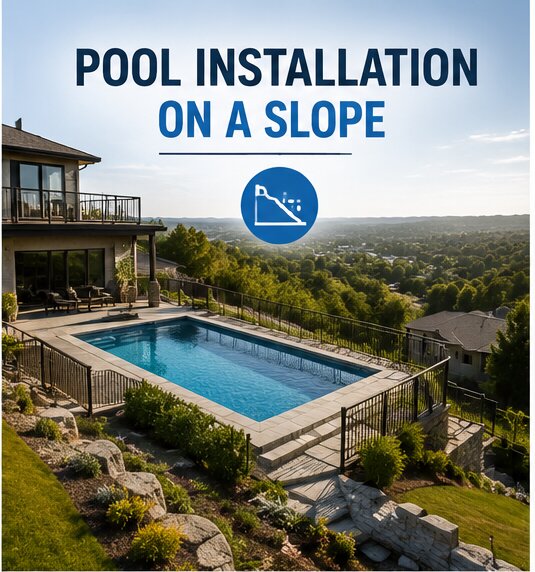
A sloped backyard doesn’t prevent pool installation — but it fundamentally changes how the project is designed, what it costs, and what your options are. Done thoughtfully, a slope can actually become a design asset rather than an obstacle, creating opportunities for multi-level terracing, elevated views, and water features that a flat yard simply doesn’t offer. This guide covers when a slope requires a retaining wall, how drainage is managed, and the design approaches that work best.
How Much Slope Is Too Much?
Slope is measured as a percentage: a 10% grade means 1 foot of vertical rise for every 10 feet of horizontal distance. In practical terms:
| Grade | What It Looks Like | Typical Pool Approach |
| Under 5% | Gentle, barely perceptible slope | Grading and minor earthwork usually sufficient |
| 5–15% | Noticeable slope; water drains visibly | Often manageable with cut-and-fill or semi-inground |
| 15–30% | Clearly sloped yard; landscaping typically terraced | Retaining wall almost always required; semi-inground a strong option |
| 30%+ | Steep; may have existing walls or terracing | Significant structural engineering required; specialized design |
There’s no slope so steep that a pool is impossible — but the cost and engineering complexity increase significantly above 15–20%. A site assessment by an experienced contractor is the most reliable way to assess what your specific slope actually requires.
The Three Main Approaches
Cut and Fill
The high side of the yard is excavated down, and the removed soil is used to build up the low side, creating a level pad for the pool. This is the most common approach for moderate slopes — it uses the excavated material rather than hauling it away, which can reduce cost.
The critical constraint: fill soil is less stable than undisturbed native soil. A pool structure placed directly on fill that hasn’t settled and compacted can shift as the fill settles over years. Retaining walls are almost always needed on at least one side of a cut-and-fill installation to hold the graded area in place.
Retaining Walls
A retaining wall holds back the slope, creating a flat, stable area for the pool without needing to fill the low side. The wall acts as a structural boundary between two different grade levels — pool area on one side, natural slope on the other.
Retaining walls are the most structurally robust solution for significant slopes, but they add meaningfully to cost and require engineering for taller installations. They’re also the approach most likely to double as a design element — a well-built natural stone or concrete wall can become one of the best-looking features of the finished backyard.
Semi-Inground Pools
A semi-inground pool is specifically designed to step with a slope rather than fight it — recessed into the ground on the high side while the wall sits above grade on the low side. This approach often eliminates the need for a retaining wall entirely, since the pool structure itself manages the grade transition.
Semi-inground pools are the most cost-effective slope solution for moderate grades, typically running $20,000–$50,000 installed. See Semi-Inground Pools for the full treatment of how they work on sloped lots.
Retaining Walls: Types and Costs
Not all retaining walls are equal — the right type depends on your wall height, your design aesthetic, and your engineering requirements.
| Wall Type | Typical Cost (per sq ft of face) | Best Suited For |
| Segmental block (modular systems) | $20–$40 | Walls under 4–5 ft; accessible DIY for low walls |
| Engineered poured concrete | $40–$80+ | Taller walls; high-load situations; long lifespan |
| Natural stone (fieldstone, limestone) | $50–$100+ | Premium aesthetic; excellent durability; skilled labour required |
| Gabion (wire cage with stone fill) | $30–$60 | Contemporary industrial look; excellent drainage; increasingly popular |
| Timber (pressure-treated) | $15–$30 | Lower cost; limited lifespan; generally avoided near pool structures |
Engineering requirements: in Ontario, retaining walls over approximately 1.0–1.2 metres (about 4 feet) in height typically require an engineer’s stamp — higher walls need to be designed to resist the soil load behind them, which changes based on soil type, water content, and surcharge load (what’s sitting behind and above the wall). A pool placed close to or above a retaining wall adds significant surcharge load that must be accounted for in the wall’s design.
Confirm your municipality’s specific threshold with your contractor — some require engineering at lower heights, particularly in TRCA regulated areas or near ravines.
Weeping tile at the base: every retaining wall on a sloped lot should have a perforated drainage pipe (weeping tile) at its base, wrapped in filter fabric, to relieve hydrostatic pressure from water that accumulates behind the wall. Walls built without drainage eventually fail from the inside out as water pressure builds.
Drainage: The Most Critical Design Element on a Slope
Water management on a sloped lot is more complex than on a flat one — and the pool installation changes the drainage patterns that existed before construction. Getting this right matters for the pool structure, the surrounding hardscape, and the house foundation.
The fundamental principles:
- Deck surface water must drain away from the pool and away from the house. Pool deck is typically graded at a 1–2% slope toward the yard perimeter. On a sloped lot, this means understanding where “away from the pool” actually directs water — which isn’t always obvious when the yard itself slopes back toward the house.
- A perimeter drain uphill of the pool collects surface water flowing down the slope before it reaches the pool deck. This is essentially a channel drain or trench drain installed at the high side of the pool area, collecting runoff and directing it to a proper outlet.
- Weeping tile at the base of retaining walls — as noted above — prevents hydrostatic pressure buildup that can cause wall failure and chronic wet conditions against the pool shell.
- Water cannot flow onto neighbouring properties. A slope installation that redirects surface drainage toward an adjacent lot creates a bylaw issue. Drainage design must account for where water goes after it leaves your property’s managed surfaces.
The upside of a slope for drainage: when properly designed, a sloped lot actually drains better than a flat one. Natural grade naturally carries surface water away from the pool and house without requiring as much engineered surface slope — the land does some of the work. A well-designed slope installation can result in better post-construction drainage than a flat lot with pooling issues.
Design Opportunities a Slope Creates
This is the counterintuitive part of sloped lot pool installation: a slope well-used is better than a slope fought. Several design options become available on a sloped lot that don’t exist on a flat one.
Multi-level terraced decks: the grade change creates a natural opportunity to place a dining or lounge area at one level, the pool deck at another, and perhaps a lower garden area below — connected by steps or a gentle ramp. This layered design often looks more intentional and architectural than a single flat pool deck could.
Infinity or vanishing edge: a sloped lot provides exactly the condition an infinity edge needs — a grade change that creates a view-line the pool edge can visually spill into. See Infinity Pools for how the slope interacts with the engineering of an infinity edge.
Built-in waterfall or spillover feature: a retaining wall on the high side of a pool creates a natural location for a spillway or waterfall feature — water cascades from the higher grade level into the pool below. This works particularly well with natural stone retaining walls where the water can be routed through or along the face.
Natural terracing: rather than treating the slope as a problem to eliminate, a pool installation can be designed to work with the existing grade, creating terraced planting areas between levels that feel like a designed landscape rather than engineered earthworks.
What to Budget for Sloped Lot Installation
Beyond the pool itself, sloped lots typically add:
| Element | Typical Added Cost |
| Retaining wall (per 10 linear feet, moderate height) | $3,000–$8,000+ |
| Grading and cut-and-fill earthwork | $3,000–$15,000+ |
| Perimeter/trench drain system | $1,500–$5,000 |
| Engineering drawings for walls | $1,500–$4,000 |
| Additional excavation for levelling | Varies with site |
These are added costs on top of the pool itself — see Pool Installation Cost Toronto for the base pool cost by type. On a significantly sloped lot, earthwork and retaining can represent 20–40% of the total project cost, which is why getting a full-scope quote before committing to a pool type or design matters.
Frequently Asked Questions
Can a pool be installed on a steep slope?
Yes, though the complexity and cost increase significantly above 15–20% grade. Semi-inground pools and retaining wall installations are the most common approaches; structural engineering is typically required for steeper lots.
What’s the difference between cut-and-fill and a retaining wall?
Cut-and-fill uses the excavated soil from the high side to level the low side, creating a level pad. A retaining wall holds back the natural slope without moving the grade. Both approaches often appear on the same project.
Do retaining walls need an engineer in Ontario?
For most residential pools, walls over approximately 1.0–1.2 metres require an engineer’s stamp in Ontario. Walls closer to or above a pool structure carry additional surcharge load that must be designed for. Confirm the exact threshold with your contractor and local municipality.
Is a sloped lot better or worse for drainage than a flat one?
A slope that’s well-managed is often better — natural grade carries surface water away without as much engineered surface slope. The key is controlling where that water goes after it leaves your property.
What design advantage does a slope create?
Multi-level terracing, infinity edge potential, and natural waterfall features from a higher retaining wall into the pool — design options that don’t exist on a flat lot.
Get a Slope-Specific Assessment
The right approach depends on your specific grade, soil, and what design outcome you’re looking for.
Contact Easy Pools at (647) 449-9512 for a free, no-obligation site assessment of your sloped yard.