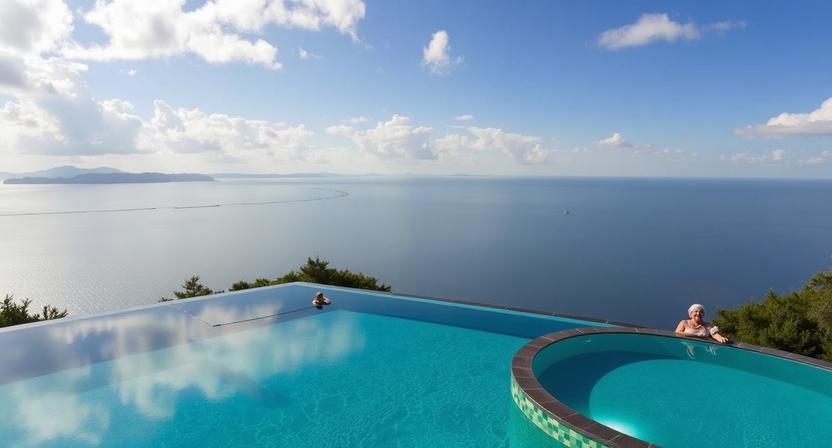
Infinity pools are swimming pools with one or more overflow edges that let water flow over a lowered weir wall into a hidden catch basin, overflow trough, or balance tank. A recirculation pump then moves the water back into the main pool. This edge system creates the visual effect of pool water meeting the horizon, sky, lake, ravine, garden, or skyline.

Infinity pools are chosen for view lots, sloped properties, raised patios, luxury landscapes, modern architecture, and strong visual connection between pool water and the surrounding view. The design works best when site elevation, view direction, and edge alignment support a clean vanishing-edge effect.

The right infinity pool depends on site elevation, view direction, edge length, catch-basin size, hydraulic design, structural engineering, drainage, equipment access, fencing, permits, and long-term maintenance. The catch basin needs enough capacity for overflow water, swimmer displacement, wind effects, and recirculation needs.

Quick Answer

What are infinity pools?

Infinity pools are pools with a lowered edge, called a weir wall or vanishing edge, where water spills into a catch basin and returns to the main pool through a pump and hydraulic system.

What makes infinity pools different?

Infinity pools differ from standard pools because they need an overflow edge, catch basin, recirculation system, precise levelling, structural support, and hydraulic planning.

Are infinity pools expensive?

Infinity pools usually cost more than standard inground pools because they need a catch basin, extra plumbing, stronger engineering, precise edge construction, additional pumps, and more maintenance. Toronto project examples place high-quality infinity-edge pool projects around $150,000 to $500,000+, depending on design, site preparation, engineering, construction, plumbing, electrical work, finishes, and maintenance.

Quick Overview
Decision FactorInfinity Pool Detail
Best forView lots, sloped yards, raised patios, luxury landscapes, modern homes
Not best forLowest budget, flat yards with no view, simple low-maintenance pool use
Main edge systemWeir wall, vanishing edge, negative edge, or perimeter overflow
Main support systemCatch basin, balance tank, overflow trough, recirculation pump, hydraulics
Main design valueVisual connection between pool water and the view
Main site needElevation, open view, drainage, structural support, equipment access
Main cost driverEngineering, catch basin, edge length, hydraulics, site slope, finishes
Long-term focusCatch-basin cleaning, water level, pumps, evaporation, edge alignment, water care

What Are Infinity Pools?

Infinity pools are swimming pools with one or more lowered edges where water flows over a weir wall into a catch basin, overflow trough, or balance tank. A recirculation pump then returns that water to the main pool through a hydraulic system. This creates the visual effect of pool water extending toward the horizon.

How do infinity pools work?

Infinity pools work by keeping the main pool water level slightly above one edge. Water flows evenly over the weir wall, drops into a lower catch basin, and returns to the pool through a recirculation pump.

The system works as a closed loop. The hydraulic system controls water movement, flow rate, overflow collection, and return flow. Precise edge levelling keeps the water sheet even across the vanishing edge. Pump intakes in the catch basin return captured overflow water to the main pool.

What is a vanishing edge?

A vanishing edge is the lowered pool edge that lets water flow over the wall. It is also called an infinity edge or weir edge.

The edge appears to disappear when the waterline aligns with a lake, ravine, skyline, garden, or open horizon. The visual effect depends on pool elevation, view direction, water level, edge finish, and precise levelling.

What is a negative edge?

A negative edge is another name for a vanishing edge or infinity edge. The term describes a pool edge where the visible wall seems removed because water spills over it.

A negative edge pool needs an overflow edge, lower collection area, return pump, and hydraulic control. The edge effect works best on raised or sloped sites with open views.

What is a catch basin?

A catch basin is the lower reservoir that collects water flowing over the infinity edge. It may sit below the weir wall, behind the wall, or in a hidden trough system.

The catch basin holds overflow water before the pump returns it to the main pool. Some designs use a balance tank to hold surge water, swimmer displacement, and water in transit. Design sources describe infinity pools as systems that use overflow edges, catch basins, balance tanks, and continuous recirculation.

What makes infinity pools different?

Infinity pools are different because they need an overflow edge, catch basin, balance tank or trough, recirculation pump, hydraulic system, structural engineering, precise water level, and precise edge levelling. A standard pool usually keeps water inside visible pool walls.

The difference is both visual and mechanical. The visual design creates a clean horizon line. The mechanical design collects and returns overflow water without flooding, uneven edge flow, pump strain, or water-level failure.

What Benefits Do Infinity Pools Offer?

Infinity pools offer view alignment, a strong edge effect, architectural integration, immersive swimming, outdoor living value, and premium landscape impact. They also need precise engineering, higher construction budgets, and more maintenance than standard pools.

Why do views matter?

Views matter because infinity pools use the pool edge to connect water with a lake, ravine, skyline, garden, or horizon. The best effect happens when the vanishing edge faces an open view.

A strong view turns the pool edge into a visual line. The water appears to continue beyond the pool wall instead of stopping at a standard coping edge.

Why does the edge effect matter?

The edge effect matters because it creates the main visual value of an infinity pool. Water flows over a lowered weir wall, collects in a catch basin, and returns through a pump system.

This design needs precise construction. The lowered edge must sit at the correct level so water flows evenly across the full edge. Design sources describe the effect as a result of careful engineering, catch-basin collection, and recirculation, not a simple pool-wall detail.

Why does property elevation matter?

Property elevation matters because raised sites and sloped lots support the vanishing-edge effect. A pool placed above a lake, ravine, valley, skyline, or lower garden creates a stronger visual drop-off.

Flat yards need extra design work. Raised walls, terracing, feature backdrops, or designed landscape views help create the effect where natural elevation is limited.

Why does modern design matter?

Modern design matters because infinity pools fit clean lines, geometric layouts, glass railings, stone patios, outdoor lighting, and minimal landscape styles. The edge system works well with modern architecture because it creates a clear waterline and simple visual plane.

The pool, patio, house, and view need one design direction. Poor alignment weakens the horizon effect and makes the edge feel disconnected from the property.

Why does outdoor living value matter?

Outdoor living value matters because infinity pools create a focal point for patios, lounge areas, terraces, gardens, and view-facing entertainment spaces. A well-built pool supports property appeal when the design matches the lot, view, and maintenance plan.

Real-estate data shows that homes with pools held a higher listing-price position in April 2025, but the result depends on market, home size, location, and buyer demand. Infinity pools add the most value where the view, structure, permits, edge quality, and long-term maintenance records support buyer confidence.

What Edge Designs Are Available for Infinity Pools?

Infinity pools use edge designs such as single infinity edges, double infinity edges, perimeter overflow edges, mirror edges, raised-wall edges, and spa spillover edges. The right edge design depends on the view direction, site elevation, pool shape, patio level, wind exposure, catch-basin space, and hydraulic design.

Edge DesignMain UseSite Fit
Single infinity edgeOne view-facing overflow edgeSloped or raised lots
Double infinity edgeTwo overflow sidesCorner views and open lots
Perimeter overflow edgeWater spills around multiple sidesModern level-deck designs
Mirror edgeReflective water surface with subtle overflowLuxury patios and courtyards
Raised-wall edgeWater spills from a raised wall sectionTerraced yards and feature walls
Spa spillover edgeSpa water spills into pool or basinIntegrated spa designs

What is a single infinity edge?

A single infinity edge has one overflow side facing the main view. This edge suits sloped yards, raised patios, ravine lots, lake views, and skyline views.

The single-edge design works best when the pool waterline aligns with the visual horizon. It needs a weir wall, lower catch basin, recirculation pump, and precise edge levelling.

What is a double infinity edge?

A double infinity edge has two overflow sides. This design suits corner views, open lots, and pool settings where two sightlines matter.

A double-edge design needs more hydraulic planning than a single edge. Two overflow sides increase edge length, catch-basin capacity, pump demand, waterproofing work, and maintenance access.

What is a perimeter overflow edge?

A perimeter overflow edge lets water spill around multiple sides of the pool into a trough or hidden channel. This creates a level-deck look where the water surface aligns closely with the surrounding patio.

A perimeter overflow pool suits modern homes, courtyards, and level-deck designs. It needs precise levelling, channel drainage, recirculation control, and careful debris management.

What is a mirror edge?

A mirror edge creates a calm reflective water surface with subtle overflow. This design suits luxury patios, courtyards, garden rooms, and modern landscape settings.

A mirror-edge pool relies on stable water level, low turbulence, clean finishes, and good wind control. Strong wind, heavy use, and poor levelling reduce the reflective effect.

What is a raised-wall edge?

A raised-wall edge lets water spill from a raised wall section into a lower basin, trough, or pool zone. This edge suits terraced yards, feature walls, raised patios, and properties with level changes.

A raised-wall design needs structural support, waterproofing, overflow control, and safe edge-drop planning. It also needs access for basin cleaning and pump service.

How Does the Edge System Work in Infinity Pools?

Infinity pool edge systems move water over a level weir wall, collect it in a catch basin, and return it to the main pool through a recirculation pump and hydraulic system. The system needs correct water level, basin capacity, flow rate, drainage, and edge levelling to keep the overflow smooth and controlled.

Edge-System PartFunction
Weir wallAllows water to flow evenly over the edge
Catch basinCollects overflow water below the edge
Balance tankHolds surge and overflow water where used
Recirculation pumpReturns overflow water to the main pool
Overflow troughDirects water into the basin
Auto-fill systemReplaces water lost through evaporation or splash-out
Water-level sensorHelps maintain correct operating level
Drainage systemManages rainwater and surrounding runoff

What does the weir wall do?

The weir wall creates the vanishing edge. Water flows over this lowered edge in a thin, even sheet before dropping into the catch basin or overflow trough.

Precise edge levelling matters. Small height differences along the weir create uneven flow, dry spots, noisy sections, or heavy spillover in one area.

What does the catch basin do?

The catch basin collects water that flows over the infinity edge. It holds overflow water before the recirculation pump sends it back to the main pool.

The catch-basin volume needs enough capacity for water in transit, swimmer displacement, splash-out, wind movement, and edge flow. An undersized basin overflows during use and strains the hydraulic system.

What does the pump do?

The recirculation pump moves water from the catch basin back to the main pool. The pump keeps the edge flowing and maintains the visual sheet of water over the weir wall.

Pump sizing affects edge performance. Weak flow creates an uneven edge. Excess flow increases splash, noise, evaporation, and energy use.

What does the balance tank do?

The balance tank stores surge water and overflow water where the system design includes one. It helps manage water level changes from swimmers, wind, rain, and pump cycling.

A well-sized balance tank protects the pool from water loss, basin overflow, and pump starvation. It also supports steady recirculation during normal pool use.

What controls water level?

Water level is controlled by the catch basin, balance tank, auto-fill system, water-level sensor, drainage system, and hydraulic design. Correct water level keeps the infinity edge active without flooding the basin or starving the pump.

Rainwater, evaporation, splash-out, wind, and swimmer displacement all affect operating level. The design needs enough storage, drainage, and sensor control to keep the edge effect stable.

What Views Work Best for Infinity Pools?

Infinity pools work best with open views, natural elevation, and a clear visual endpoint beyond the vanishing edge. Strong views help the pool water connect with the horizon, lake, ravine, skyline, garden, or terraced landscape.

View TypeInfinity Pool Fit
Lake viewStrong fit when the edge aligns with the waterline
Ravine viewStrong fit where elevation creates a drop-off effect
City skyline viewStrong fit for raised urban properties
Garden viewGood fit when landscape creates a visual endpoint
Backyard slope viewGood fit with terraced design
Flat fenced yardWeaker fit unless a raised structure or designed backdrop creates the effect
No open viewWeak fit for true infinity-edge value

Do lake views work?

Lake views work well for infinity pools when the overflow edge aligns with the lake’s waterline. The pool water appears to continue into the lake when elevation, sightline, and edge height are planned correctly.

A lake-facing vanishing edge needs careful drainage, wind review, structural design, and catch-basin sizing. Wind over open water increases evaporation, splash, and basin-volume needs.

Do skyline views work?

Skyline views work well for infinity pools on raised urban properties. The edge effect connects the pool water with high-rise buildings, rooflines, and the open sky.

A skyline-facing infinity edge needs precise sightline planning. The pool height, deck level, seating position, and edge line all affect the final view.

Do ravine views work?

Ravine views work well for infinity pools because elevation creates a natural drop-off effect. The edge appears stronger when the pool sits above trees, slopes, valleys, or lower landscape levels.

A ravine-side infinity pool needs engineering and setback review. Soil stability, drainage, retaining needs, tree protection, and access affect the final design.

Do garden views work?

Garden views work for infinity pools when the landscape creates a clear visual endpoint. A planted slope, feature wall, reflecting garden, lower terrace, or water feature helps create depth beyond the edge.

A garden-facing infinity pool works best when the pool, planting, lighting, patio, and edge material share one design direction. Dense fences or close walls reduce the vanishing-edge value unless the backdrop is designed as part of the view.

Do flat yards work?

Flat yards are weaker sites for true infinity pools unless a raised structure, terraced wall, or designed backdrop creates the effect. The pool needs visual drop, depth, or a strong view line to make the edge feel meaningful.

A flat fenced yard may suit a perimeter overflow pool, mirror-edge pool, or raised-wall feature better than a true view-facing infinity edge.

What Properties Suit Infinity Pools?

Infinity pools suit properties with natural elevation, open views, stable soil, strong drainage, structural support, and enough space for a catch basin, equipment, fencing, and service access. Sloped lots, raised patios, and open view lots usually create the strongest vanishing-edge effect.

Property ConditionInfinity Pool Fit
Sloped lotStrong fit because elevation supports the vanishing-edge effect
Raised patioStrong fit with structural design
Open view lotStrong fit
Ravine lotStrong fit with engineering and setback review
Flat lotSite-dependent; may need raised walls or a designed backdrop
Small lotSite-dependent; basin, equipment, and setbacks need space
Tight-access propertySite-dependent; excavation, concrete, and equipment access matter

Do sloped lots suit infinity pools?

Sloped lots suit infinity pools because elevation supports the vanishing-edge effect. A pool placed above a lower landscape level makes water appear to flow into the view.

Sloped sites need careful engineering. A hillside pool design source states that sloped sites often need geotechnical assessment, retaining-wall design, drainage planning, and soil review before construction.

Do raised lots suit infinity pools?

Raised lots suit infinity pools when the pool edge faces a lower view, terrace, garden, ravine, lake, or skyline. The raised position gives the weir wall a clear visual drop.

A raised pool needs structural support for the pool shell, water load, edge wall, catch basin, patio, and soil pressure. Drainage planning also matters because runoff and groundwater increase pressure behind pool walls and retaining structures.

Do view lots suit infinity pools?

View lots suit infinity pools because the edge effect depends on sightline alignment. Lake views, ravine views, skyline views, and open garden views create stronger visual value than enclosed flat yards.

The vanishing edge should face the main view. Pool height, deck level, seating position, and edge length all affect how well the pool water connects with the horizon.

Do small lots suit infinity pools?

Small lots suit infinity pools only when the site has enough space for the pool, catch basin, equipment, fencing, setbacks, drainage, and service access. The hidden basin and recirculation system need space beyond the visible pool shell.

A small lot may suit a compact plunge-style infinity pool better than a large standard pool. The design still needs access for basin cleaning, pump service, valves, sensors, and winter care.

Do flat lots suit infinity pools?

Flat lots are site-dependent for infinity pools because they lack the natural drop that strengthens the visual effect. A flat property may need a raised wall, terraced patio, designed backdrop, or perimeter overflow design to create visual depth.

Flat sites often increase design work. The project may need raised structures, engineered walls, drainage control, and a landscape feature that creates a clear endpoint beyond the water.

What Design Options Are Available for Infinity Pools?

Infinity pool design options include shape, depth, finish, edge material, water features, lighting, and decking. The best design connects the vanishing edge with the property view while supporting safe access, clean water flow, strong drainage, and long-term maintenance.

Design OptionInfinity Pool Examples
ShapeRectangle, geometric, freeform, lap-style, plunge-style
DepthShallow lounge area, sport profile, deeper custom profile
FinishTile, plaster, pebble, aggregate, glass tile
Edge materialTile, stone, concrete, stainless steel channel where specified
FeaturesSpa, fire feature, tanning ledge, deck jets, raised wall
LightingUnderwater lights, edge lighting, landscape lighting
DeckingStone, concrete, porcelain pavers, composite, slip-resistant surfaces

What shapes work best?

Infinity pool shapes work best when they support a clean view line and even edge flow. Rectangle and geometric shapes suit most infinity pools because straight edges help create a clear horizon line.

Freeform shapes suit natural landscapes and garden views. Lap-style designs suit fitness and long view corridors. Plunge-style designs suit smaller sites, raised patios, and compact luxury spaces.

What depths work best?

Infinity pool depths work best when they match pool use, site structure, and edge performance. Shallow lounge areas support tanning ledges, seated use, and social areas. Sport profiles support general swimming and family use. Deeper custom profiles suit larger pools with engineered structures.

Depth affects water volume, structural load, heating demand, and catch-basin capacity. Deeper pools need stronger design control because the pool shell, weir wall, and surrounding structure carry more water load.

What finishes work best?

Infinity pool finishes work best when they support water clarity, edge detail, and long-term surface care. Common finishes include tile, plaster, pebble, aggregate, and glass tile.

Glass tile and smooth tile create a reflective edge and precise waterline. Pebble and aggregate finishes suit textured outdoor designs. Plaster gives a cleaner pool finish but needs strong water balance to reduce staining, scale, and surface wear.

What water features work best?

Infinity pool water features work best when they support the main edge effect instead of competing with it. Good options include an integrated spa, tanning ledge, deck jets, raised wall, and controlled spillover feature.

A spa spillover adds movement and sound. A raised wall adds structure and visual height. Deck jets and fire features add design value, but they increase plumbing, electrical work, maintenance, and energy use.

What lighting works best?

Infinity pool lighting works best when it defines the waterline, edge, steps, deck, and view-facing side. Useful lighting includes underwater lights, edge lighting, and landscape lighting.

Edge lighting highlights the vanishing edge after dark. Underwater lighting improves visibility and swimmer safety. Landscape lighting connects the pool with patios, planting, retaining walls, and view corridors.

What Affects Infinity Pool Cost?

Infinity pool cost depends on edge length, catch-basin size, hydraulics, site slope, soil condition, groundwater, engineering, finish choice, decking, equipment access, and permits. Design-cost guidance places many infinity pool builds about 30% to 50% higher than comparable standard pools because they need a catch basin, extra pumping, added plumbing, and specialized filtration. Treat this as source-stated guidance, not a fixed Canadian quote.

Cost FactorWhy It Affects Price
Edge lengthLonger edges need more precise construction and more overflow capacity
Catch basinExtra structure, waterproofing, plumbing, and cleaning access add cost
HydraulicsPumps, sensors, lines, valves, and controls add system cost
Site slopeExcavation, retaining walls, and structural support change scope
Soil and groundwaterPoor soil or high water pressure adds engineering and drainage
FinishTile, glass tile, pebble, or stone changes material and labour cost
DeckingPatio, coping, drainage, and safety surfaces affect budget
Equipment accessHidden basins and pumps need service access
PermitsZoning, pool enclosure, structural, electrical, and inspection costs apply

Does edge length affect cost?

Edge length affects infinity pool cost because a longer overflow edge needs more precise construction, more levelling, more waterproofing, and more overflow capacity. A longer weir wall also needs stronger hydraulic control to keep water flowing evenly across the full edge.

Long edge designs raise cost through extra tile, coping, concrete work, pump capacity, basin volume, and maintenance access.

Does catch-basin size affect cost?

Catch-basin size affects infinity pool cost because the basin needs structure, waterproofing, plumbing, drains, cleaning access, and recirculation equipment. The basin must hold overflow water, water in transit, swimmer displacement, splash-out, and wind-driven water movement.

A small catch basin raises overflow risk. A larger catch basin adds construction cost but protects edge flow, pump performance, and water-level control.

Does slope affect cost?

Slope affects infinity pool cost because sloped lots need more excavation, retaining support, drainage, access planning, and structural design. A slope creates the best vanishing-edge effect, but it also adds construction complexity.

Steep sites often need retaining walls, soil review, drainage systems, and engineered support for the pool shell, weir wall, catch basin, deck, and surrounding patio.

Does engineering affect cost?

Engineering affects infinity pool cost because the pool needs structural support, precise edge levelling, hydraulic design, drainage control, and safe load transfer. The hydraulic system must move overflow water from the basin back to the main pool without uneven edge flow or pump strain.

Complex sites need more review. Poor soil, groundwater pressure, retaining walls, raised patios, ravine edges, and tight access all increase engineering scope.

Does finish choice affect cost?

Finish choice affects infinity pool cost because tile, glass tile, pebble, aggregate, stone, and custom edge materials have different material and labour needs. The vanishing edge needs precise finish work because uneven edges disrupt water flow.

Premium finishes also raise long-term care needs. Glass tile, stone coping, textured surfaces, and overflow-edge details need water-balance control, scale prevention, cleaning, and inspection.

How Are Infinity Pools Installed?

Infinity pools are installed through site review, engineering, utility locates, permits, excavation, catch-basin construction, weir-wall construction, waterproofing, plumbing, pumps, sensors, electrical bonding, finish installation, decking, fencing, inspection, water filling, and edge-flow testing. The installation needs more planning than a standard pool because the overflow edge and basin must work as one hydraulic system.

What happens during site review?

Infinity pool site review checks the view, elevation, slope, soil, drainage, access, setbacks, equipment location, and edge direction. A topographic survey helps confirm grades, waterline height, edge alignment, retaining needs, and the best sightline for the vanishing edge.

The review also includes utility locates before any excavation. Ontario One Call states that homeowners must submit a locate request at least 5 business days before digging, and utility owners mark buried lines based on that request.

What happens during engineering?

Infinity pool engineering sets the structural design and hydraulic design. The structural plan covers the pool shell, weir wall, catch basin, retaining support, soil loads, water loads, deck loads, and drainage. The hydraulic plan covers basin volume, pump sizing, pipe sizing, valves, sensors, auto-fill, overflow routes, and edge-flow rate.

Engineering also checks soil and groundwater risk. Poor soil, slope movement, high groundwater, ravine edges, or raised patios increase the need for structural review, drainage design, and waterproofing detail.

What happens during excavation?

Infinity pool excavation creates space for the main pool, catch basin, equipment area, plumbing routes, drainage, and retaining structures. The excavation stage includes base preparation, soil removal, grading, compaction, access management, and groundwater control where needed.

Sloped or raised sites need careful excavation control because the pool shell, basin, and edge wall must stay level and stable. Poor excavation or weak drainage increases settlement, leaks, edge-flow problems, and structural risk.

How is the edge built?

The infinity edge is built with a precise weir wall, waterproofing, overflow trough, and lower catch basin or balance tank. The edge must be level across its full length so water flows evenly over the wall.

The build includes concrete or structural forming, reinforcement, waterproofing, plumbing, recirculation lines, pumps, valves, water-level sensors, coping, tile or finish installation, and edge-flow testing. Small level errors create dry spots, uneven spillover, excess noise, and poor visual effect.

What happens before startup?

Infinity pool startup happens after waterproofing, finish installation, coping, decking, fencing, electrical bonding, inspections, filling, and system testing. The startup checks the pump, filter, valves, sensors, auto-fill, drainage, catch-basin volume, water level, and edge flow.

Pool electrical work needs careful review. Electrical Safety Authority guidance states that electrical equipment within 3 m of the inside walls of a pool needs GFCI protection unless suitably separated.

Final startup includes water filling, water balancing, circulation testing, leak checks, catch-basin testing, and edge-flow testing. In Toronto, a pool also needs the required pool fence process before construction and filling under City rules.

What Engineering Is Required for Infinity Pools?

Infinity pools need engineering for precise levelling, structural support, hydraulics, catch-basin sizing, drainage, wind exposure, and service access. The overflow edge, catch basin, and recirculation system must work together to create even edge flow without leaks, overflow, pump strain, or structural movement.

Engineering FactorWhy It Matters
Precise levellingSupports even sheet flow over the edge
Structural supportSupports pool shell, edge wall, basin, soil, and water loads
HydraulicsMoves overflow water back to the main pool correctly
Catch-basin sizingHandles water displacement, wind, and water in transit
DrainageReduces water pressure and runoff problems
Wind exposureAffects splash, evaporation, and basin volume needs
AccessAllows service to pumps, valves, sensors, and basin

Why does levelling matter?

Levelling matters because the weir wall must let water flow evenly across the full infinity edge. A small height difference creates dry spots, heavy spillover, uneven sound, and a weak vanishing-edge effect.

Precise levelling also protects the hydraulic design. Uneven edge flow sends too much water to one part of the catch basin and reduces control across the rest of the edge.

Why does structure matter?

Structure matters because an infinity pool carries the load of the pool shell, edge wall, catch basin, water, soil, deck, and nearby retaining systems. Sloped lots and raised patios add more load and movement risk.

Structural engineering sets the reinforcement, wall design, soil support, waterproofing details, and load transfer. Weak structure leads to cracking, leaks, settlement, edge movement, and failed water flow.

Why does hydraulics matter?

Hydraulics matter because overflow water must move from the catch basin back into the main pool at the right rate. The system needs correct pump sizing, pipe sizing, valves, sensors, flow control, and return placement.

Poor hydraulic design creates noisy flow, pump strain, low edge flow, basin overflow, pump starvation, and uneven water movement. A well-designed system keeps the vanishing edge active and stable.

Why does drainage matter?

Drainage matters because rainwater, groundwater, slope runoff, and splash-out create pressure around the pool and basin. Drainage protects the pool shell, edge wall, retaining areas, deck, and equipment space.

A good drainage system moves water away from the structure and manages surrounding runoff. Poor drainage increases hydrostatic pressure, soil movement, leaks, staining, and structural damage.

Why does wind exposure matter?

Wind exposure matters because wind pushes overflow water, increases evaporation, and affects how much water reaches the catch basin. Strong wind can move water past the basin or increase splash-out.

Wind review helps set basin size, edge flow, auto-fill needs, cover planning, and landscape screening. Exposed lake, ravine, and skyline sites often need extra basin capacity and water-level control.

What Maintenance Is Needed for Infinity Pools?

Infinity pool maintenance needs regular water testing, catch-basin cleaning, pump care, edge cleaning, water-level control, filter care, leak checks, and winter care. Infinity pool technology is more complex than standard pool technology because water flows over the edge, collects in a catch basin, and recirculates through pumps, lines, valves, and filters.

Maintenance AreaInfinity Pool Requirement
Water testingSanitizer, pH, alkalinity, calcium hardness
Catch-basin cleaningRemoves leaves, debris, sediment, and algae
Pump careChecks recirculation, flow, baskets, and valves
Edge cleaningKeeps the overflow lip clear and even
Water-level controlMaintains correct edge flow and basin volume
Filter careSupports water clarity and circulation
Leak checksReviews basin, edge, plumbing, and fittings
Winter careProtects basin, lines, pumps, edge, cover, and equipment

What water testing is needed?

Water testing is needed for sanitizer, pH, total alkalinity, and calcium hardness. Health Canada states that pool owners need to test water balance daily for these items to keep swimmers safe.

Infinity pools also need steady water balance because water moves over the weir wall, through the catch basin, and back through the recirculation system. Poor water balance increases scale, staining, corrosion, cloudy water, and edge-surface wear.

What catch-basin care is needed?

Catch-basin care needs regular cleaning to remove leaves, grit, sediment, algae, insects, and other debris. The catch basin collects overflow water below the vanishing edge before the pump returns it to the main pool.

A dirty catch basin reduces flow, blocks drains, raises filter load, and weakens edge performance. Infinity edge maintenance guidance notes that the catch basin or balance tank needs regular inspection and cleaning to prevent debris buildup and blockages.

What pump care is needed?

Pump care is needed because the recirculation pump keeps overflow water moving from the catch basin back to the main pool. The pump, baskets, valves, flow rate, sensors, and return lines need routine checks.

Weak pump flow creates uneven edge flow. Blocked baskets or valves strain the system. Infinity pool system guidance explains that pump intakes in the catch basin recirculate captured overflow water back into the main pool as part of a closed-loop circulation system.

What edge cleaning is needed?

Edge cleaning keeps the overflow lip clear, level-looking, and smooth. The edge needs cleaning because scale, algae, dirt, leaves, and mineral deposits disrupt the thin water sheet over the weir wall.

A clean vanishing edge helps water flow evenly. Uneven buildup causes dry sections, noisy spillover, staining, and weak visual effect.

What water-level care is needed?

Water-level care keeps the pool and catch basin at the correct operating level. The system needs enough water for edge flow, pump intake, bather displacement, and basin volume.

Water flowing over an infinity edge increases evaporation compared with a typical pool. Wind exposure, splash-out, warm water, and long pump runtime increase water loss. A working auto-fill system and water-level sensor help keep the edge flowing without basin overflow or pump starvation.

What Water-Care Issues Matter for Infinity Pools?

Infinity pool water-care issues include evaporation, splash-out, water-level control, wind exposure, catch-basin volume, filter load, water balance, scale, and edge staining. The overflow edge adds more moving water than a standard pool, so the system needs steady testing, cleaning, and level control.

Does evaporation increase?

Evaporation increases in infinity pools because water moves over the weir wall and exposes more surface area to air. Wind, heat, low humidity, warm water, and long recirculation time increase water loss.

The U.S. Department of Energy states that pool covers minimize evaporation and that covering a pool when not in use is the most effective way to reduce pool heating costs. It also lists possible heating-cost savings of 50% to 70% from pool covers.

Does splash-out increase?

Splash-out increases when edge flow, wind, swimmer movement, and basin sizing are not managed correctly. Water spilling over the vanishing edge must land in the catch basin instead of moving onto slopes, patios, walls, or landscaping.

A correct catch-basin volume accounts for water in transit, swimmer displacement, wind movement, splash-out, and recirculation needs. Poor sizing leads to water waste, pump strain, filter load, and chemical loss.

Does water level matter?

Water level matters because the infinity edge needs enough water to flow evenly over the weir wall and enough basin volume to protect the pump. Low water creates weak edge flow and pump-starvation risk. High water creates basin overflow and wasted treated water.

Water-level sensors and an auto-fill system help maintain the operating level. These controls replace water lost through evaporation, splash-out, backwashing, leaks, or drainage events.

Does wind affect water loss?

Wind affects water loss because moving air increases evaporation and pushes overflow water away from the catch basin. Exposed lake, ravine, skyline, and hillside sites often face stronger wind loads than enclosed backyards.

Wind exposure affects catch-basin sizing, edge-flow rate, auto-fill demand, cover choice, and landscape screening. Wind also increases water cooling, heating demand, and chemical loss.

Does the catch basin affect chemistry?

The catch basin affects chemistry because it holds and recirculates pool water after overflow. Leaves, dust, sediment, algae, insects, and runoff increase filter load and affect sanitizer demand.

Health Canada states that pool owners need daily water-balance testing for sanitizer levels, pH, total alkalinity, and calcium hardness. This testing matters for infinity pools because moving water, evaporation, and basin debris affect water balance, scale risk, and edge staining.

What Problems Happen With Infinity Pools?

Infinity pool problems usually come from poor edge levelling, undersized catch basins, weak hydraulic design, wind exposure, clogged basin drains, low water level, pump failure, leaks, poor waterproofing, and poor water balance. These issues affect edge flow, water loss, maintenance cost, equipment life, and the visual vanishing-edge effect.

Can edge flow become uneven?

Edge flow becomes uneven when the weir wall is not level, the water level is too low, pump flow is weak, or scale builds up on the overflow lip. Uneven flow creates dry spots, noisy spillover, and weak visual alignment with the view.

Precise edge levelling, steady pump flow, and regular edge cleaning keep the water sheet even across the full overflow edge.

Can the catch basin overflow?

A catch basin can overflow when it is too small, drains are clogged, rainwater enters the system, wind pushes water past the basin, or swimmers displace more water than the basin holds. Overflow wastes treated water and increases drainage problems.

Correct catch-basin volume accounts for water in transit, swimmer displacement, wind exposure, splash-out, and rainfall. The system also needs drainage, auto-fill control, and service access.

Can pumps fail?

Infinity pool pumps can fail when baskets clog, valves close, flow drops, water level falls, or the pump runs dry. Pump failure stops recirculation and breaks the infinity-edge effect.

Routine pump care includes basket cleaning, valve checks, flow checks, sensor checks, and water-level monitoring. The recirculation pump needs enough water in the basin to avoid pump starvation.

Can leaks occur?

Leaks can occur in the pool shell, weir wall, catch basin, overflow trough, plumbing, fittings, valves, and waterproofed joints. Infinity pools have more water paths than standard pools, so leak detection needs careful inspection.

Poor waterproofing increases leak risk. Structural movement, cracked finishes, failed joints, and weak pipe connections also create hidden water loss and soil pressure issues.

Can evaporation increase cost?

Evaporation can increase cost because water flows over the vanishing edge and exposes more water to air. Wind, warm water, sun exposure, and long pump runtime increase water loss, heating demand, and chemical demand.

A fitted pool cover, wind screening, correct edge flow, and water-level control reduce avoidable water and heat loss. Regular testing also protects water balance and reduces scale, staining, and corrosion.

What Safety Rules Matter for Infinity Pools?

Infinity pool safety rules focus on pool enclosure, self-closing gates, self-latching gates, edge-drop protection, guardrails where required, slip-resistant decking, lighting, secure equipment access, pool covers, and supervision. The vanishing edge adds a drop-off area, so the pool design needs both water safety and fall protection.

Do infinity pools need fencing?

Infinity pools need fencing when local pool enclosure rules apply. Toronto states that a swimming pool is anything on private property used for swimming, wading, or bathing with water depth of 60 cm or more at any point. Toronto also states that a pool cannot be constructed and filled with water without a fence installed under the City’s fence rules.

Health Canada recommends a pool fence at least 1.2 m high, a self-closing gate, a self-latching gate, and a latch placed beyond a child’s reach.

Do edge drops need barriers?

Edge drops need barriers where the infinity edge, raised patio, retaining wall, basin wall, or surrounding deck creates a fall risk. The design may need guardrails, glass barriers, fencing, retaining-wall protection, or other edge-drop controls where required by local code.

The vanishing edge should not create an unprotected fall zone. Raised lots, ravine lots, terraced yards, and skyline-facing decks need careful review because pool views and fall protection must work together.

Do decks need slip control?

Infinity pool decks need slip control because wet stone, concrete, tile, porcelain pavers, and composite surfaces create fall risk. Safer decks use slip-resistant surfaces, clear drainage, stable coping, lighting, and safe walking routes.

Deck layout also matters around the catch basin, overflow edge, steps, ladders, seating ledges, and service areas. Water flowing over the edge increases wet zones near the pool, so drainage and surface texture need early design.

Do covers improve safety?

Pool covers improve safety when they are rated for safety use, fitted correctly, and closed when the infinity pool is not in use. A cover helps restrict access to open water and also reduces debris, evaporation, and heat loss.

A pool cover does not replace fencing, gate hardware, supervision, or local permit rules. Health Canada recommends locked gates, controlled access, and keeping climbable objects away from pool fences.

Do equipment areas need secure access?

Equipment areas need secure access because infinity pools use pumps, valves, sensors, auto-fill systems, filters, drains, electrical equipment, and catch-basin components. These areas need lockable or restricted access, clear service space, safe lighting, and protection from children and unsupervised users.

Secure equipment access also protects the pool system. Pump rooms, valve boxes, basin access points, electrical panels, and automation controls need safe placement for inspection, repair, winter care, and emergency shutoff.

What Permits Apply to Infinity Pools?

Infinity pool permits include a Zoning Certificate, Pool Fence Enclosure Permit, setback review, site plan, grading review, structural drawings, electrical inspection, utility locates, and final inspection. Infinity pools often need more review than standard pools because the project may include retaining walls, a raised patio, a catch basin, pumps, drainage, and engineered edge structures.

Are pool permits needed?

Pool permits are needed when an infinity pool meets the local definition of a regulated swimming pool. Toronto defines a swimming pool as anything on private property used for swimming, wading, or bathing with a water depth of 60 cm or more at any point.

A Zoning Certificate comes before the Pool Fence Enclosure Permit in Toronto. The City states that applicants must obtain a Zoning Certificate before applying for a Pool Fence Enclosure Permit.

Are pool fences needed?

Pool fences are needed before an infinity pool is constructed and filled with water. Toronto states that a pool cannot be constructed and filled with water without a fence installed under Toronto Municipal Code Chapter 447 – Fences.

A pool enclosure plan should show fence location, gate location, fence height, materials, and restricted-access details. Self-closing gates and self-latching gates help control access to the pool area.

Are setbacks checked?

Setbacks are checked during zoning and site-plan review. An infinity pool site plan should show property lines, pool location, catch basin, equipment area, fencing, gates, retaining walls, grading, drainage, and distance from lot lines.

Setback review matters for sloped lots, ravine lots, raised patios, and tight-access properties. Edge walls, basin structures, retaining walls, and equipment pads may affect the final approved layout.

Are structural drawings needed?

Structural drawings are needed when the infinity pool includes engineered pool walls, a weir wall, catch basin, retaining walls, raised patios, complex grading, or load-bearing structures. These drawings show reinforcement, concrete design, soil support, waterproofing details, drainage, and load transfer.

Structural review matters because an infinity pool carries pool water, overflow water, soil pressure, deck loads, basin loads, and edge-wall loads. Poor structural planning increases cracking, leaks, settlement, and edge-flow failure.

Are inspections needed?

Inspections are needed for the pool enclosure, structural work, electrical work, equipment setup, grading, and final completion where local rules require them. Ontario One Call also states that homeowners must submit a locate request at least 5 business days before digging, and buried infrastructure owners mark underground lines based on that request.

A complete infinity pool permit plan includes the Zoning Certificate, Pool Fence Enclosure Permit, setbacks, site plan, grading details, retaining-wall details, structural drawings, utility locates, electrical inspection, fencing, and final inspection before filling and regular use.

How Do Infinity Pools Compare?

Infinity pools compare by edge design, pool structure, pool shape, pool location, and sanitation system. Infinity describes the visual overflow edge. Other terms, such as concrete, lap, plunge, indoor, and saltwater, describe construction, use, location, or water treatment.

ComparisonInfinity Pool Difference
Infinity vs standard poolInfinity pools add an overflow edge, catch basin, and recirculation system
Infinity vs concrete poolInfinity describes edge design; concrete describes structure
Infinity vs lap poolInfinity describes edge effect; lap describes fitness shape
Infinity vs plunge poolInfinity describes visual edge; plunge describes compact use
Infinity vs indoor poolInfinity describes edge design; indoor describes enclosed location
Infinity vs saltwater poolInfinity describes structure and edge; saltwater describes sanitation

How do they compare with standard pools?

Infinity pools add an overflow edge, catch basin, and recirculation system to a pool design. Standard pools usually keep water inside visible pool walls.

An infinity pool needs precise edge levelling, hydraulic planning, extra plumbing, basin access, water-level control, and more maintenance. A standard pool has simpler construction and lower system complexity.

How do they compare with concrete pools?

Infinity pools describe edge design. Concrete pools describe pool structure.

A concrete infinity pool combines a site-built concrete shell with a vanishing edge, weir wall, catch basin, and hydraulic system. Concrete suits custom edge designs because it supports complex shapes, raised walls, structural reinforcement, and premium finishes.

How do they compare with lap pools?

Infinity pools describe the edge effect. Lap pools describe a long, narrow fitness shape.

An infinity lap pool combines both ideas. It gives straight-line swimming with a view-facing overflow edge. This design needs enough swim length, precise edge flow, catch-basin space, pump capacity, and safe deck access.

How do they compare with plunge pools?

Infinity pools describe a visual edge system. Plunge pools describe compact pool size and use.

An infinity plunge pool suits small luxury patios, raised terraces, and compact view lots. It keeps the water area smaller while still creating a vanishing-edge view effect.

How do they compare with indoor pools?

Infinity pools describe edge design. Indoor pools describe enclosed location.

An indoor infinity pool needs both edge-system engineering and pool-room moisture control. The design needs a catch basin, recirculation pump, dehumidification, ventilation, drainage, vapour control, and corrosion-resistant finishes.

Who Are Infinity Pools Best For?

Infinity pools are best for homeowners with view lots, sloped yards, raised patios, luxury landscapes, and modern architecture. They are a weak fit for flat no-view yards, lowest-budget projects, and low-maintenance ownership.

Homeowner NeedFit
View lotStrong fit
Sloped yardStrong fit with engineering
Raised patioStrong fit
Luxury landscapeStrong fit
Modern architectureStrong fit
Flat no-view yardWeak to site-dependent fit
Lowest budgetWeak fit
Low-maintenance ownershipWeak fit

Are they best for view lots?

Infinity pools are best for view lots because the vanishing edge connects the pool water with a lake, ravine, skyline, garden, or open horizon. The view gives the edge effect its main design value.

A strong infinity pool layout places the weir wall toward the main view. Pool height, deck level, seating position, and edge alignment all affect the final visual result.

Are they best for sloped yards?

Infinity pools are best for sloped yards when the project includes proper engineering. Natural elevation supports the drop-off effect that makes the negative edge look open and continuous.

A sloped-yard infinity pool needs structural support, drainage, retaining design, soil review, basin access, and hydraulic planning. These details protect the pool shell, catch basin, edge wall, and surrounding landscape.

Are they best for luxury design?

Infinity pools are best for luxury design because they combine water, view, architecture, and landscape into one visual feature. They suit modern homes, raised patios, terraces, glass railings, stone decks, outdoor lounges, and view-facing gardens.

Luxury value depends on execution. The edge needs even flow, clean finishes, correct lighting, strong drainage, safe access, and reliable recirculation.

Are they best for flat yards?

Infinity pools are not usually best for flat yards with no open view. A flat fenced yard weakens the vanishing-edge effect because the water has no natural horizon or visual drop.

A flat lot may still support a perimeter overflow pool, mirror-edge pool, raised-wall edge, or designed garden backdrop. These options need extra structure and landscape planning.

Are they best for low budgets?

Infinity pools are not best for low budgets because they need a catch basin, overflow edge, hydraulics, added plumbing, waterproofing, structural engineering, pumps, sensors, drainage, permits, and extra maintenance.

A standard inground pool, plunge pool, or simple rectangular pool usually fits lower-budget projects better. An infinity pool fits projects where view quality, architecture, and premium outdoor living matter more than minimum cost.

What Mistakes Increase Infinity Pool Cost?

Infinity pool mistakes increase cost when homeowners compare only pool size and ignore view alignment, edge length, catch-basin sizing, hydraulic design, structural engineering, drainage, wind exposure, equipment access, fencing, permits, and long-term maintenance. A larger pool does not create better value when the edge system, site, and view do not work together.

Is ignoring the view a mistake?

Ignoring the view is a costly infinity pool mistake because the vanishing edge needs a clear visual endpoint. Lake views, ravine views, skyline views, garden views, and sloped backyard views create stronger results than flat fenced yards with no open sightline.

View alignment affects pool position, edge direction, deck height, seating areas, edge length, and landscape design. Poor alignment weakens the main purpose of an infinity pool.

Is undersizing the catch basin a mistake?

Undersizing the catch basin is a costly mistake because the basin must hold overflow water, water in transit, swimmer displacement, splash-out, wind movement, and rainwater. A small catch basin overflows, starves the pump, wastes treated water, and reduces edge performance.

Correct basin sizing supports smooth recirculation. It also reduces water loss, pump strain, flooding risk, and maintenance problems.

Is skipping engineering a mistake?

Skipping engineering is a major mistake because an infinity pool needs structural support, precise levelling, waterproofing, hydraulic design, and drainage control. The weir wall, catch basin, deck, pool shell, soil, and water loads all need safe design.

Weak engineering leads to cracking, leaks, uneven edge flow, settlement, pump strain, drainage problems, and repair work. Sloped lots, raised patios, ravine lots, and retaining walls need special review.

Is ignoring wind a mistake?

Ignoring wind is a mistake because wind increases evaporation, splash-out, water movement, and catch-basin demand. Exposed lake, ravine, hilltop, and skyline sites often need more wind planning than sheltered backyards.

Wind affects edge-flow rate, basin capacity, auto-fill demand, cover design, heater load, and landscape screening. Poor wind planning raises water loss, heating cost, and chemical demand.

Is comparing quotes poorly a mistake?

Comparing quotes poorly is a mistake because the lowest pool price may exclude key infinity edge requirements. A full quote needs edge design, edge length, catch-basin size, hydraulic plan, structural drawings, waterproofing, drainage, equipment access, pumps, sensors, auto-fill, fencing, permits, and warranty terms.

Poor quote comparison leads to change orders, hidden costs, weak maintenance access, water-loss problems, and unclear responsibility for edge-flow performance.

How Do You Compare Infinity Pool Quotes?

Infinity pool quotes need comparison across edge design, edge length, catch basin, hydraulics, structure, site conditions, waterproofing, finish, decking, equipment, permits, and warranty coverage. A complete quote shows how the vanishing edge, catch basin, and recirculation system work together, not only the pool shell price.

Quote ItemWhat to Check
Edge designSingle edge, double edge, perimeter overflow, mirror edge
Edge lengthLinear length and flow requirements
Catch basinSize, depth, waterproofing, access, drains, and cleaning method
HydraulicsPumps, lines, valves, sensors, flow rate, and controls
StructureConcrete, steel, reinforcement, retaining needs, and engineering
Site conditionsSlope, soil, groundwater, wind, drainage, and access
WaterproofingPool shell, basin, edge wall, joints, and penetrations
FinishTile, plaster, pebble, aggregate, stone, or glass tile
DeckingCoping, drains, slip resistance, patio, and guardrails where needed
EquipmentPump, filter, heater, sanitizer, auto-fill, automation, and cover
PermitsZoning, pool enclosure, structural, grading, electrical, inspections
WarrantyStructure, finish, waterproofing, equipment, hydraulics, and labour

What edge details matter?

Edge details matter because the infinity edge creates the main visual effect and controls overflow performance. Compare the edge type, edge length, edge material, weir-wall height, levelling method, flow rate, finish detail, and waterline alignment.

A quote should state whether the design uses a single infinity edge, double infinity edge, perimeter overflow edge, or mirror edge. Longer edges need more precise construction, more basin capacity, more plumbing, and more maintenance access.

What basin details matter?

Basin details matter because the catch basin collects overflow water before it returns to the main pool. Compare basin size, depth, waterproofing, drain layout, cleaning access, overflow route, water-level sensor, and auto-fill setup.

The basin must hold water in transit, swimmer displacement, wind-driven water movement, rainfall, and splash-out. An undersized catch basin increases overflow risk, pump starvation, water loss, and service calls.

What hydraulic details matter?

Hydraulic details matter because the recirculation system keeps water moving evenly over the edge. Compare pump size, pipe sizing, valves, return lines, sensors, flow rate, controls, and access to mechanical parts.

Weak hydraulic design causes uneven edge flow, noisy spillover, pump strain, basin overflow, or low water return. The quote should show how the system controls water level, recirculation, basin volume, and edge flow.

What engineering details matter?

Engineering details matter because infinity pools often involve slopes, raised patios, retaining structures, soil pressure, groundwater, and edge-wall loads. Compare structural drawings, reinforcement, concrete details, retaining-wall design, drainage design, waterproofing method, and geotechnical review where needed.

Permit scope also matters. Toronto requires a Zoning Certificate before a Pool Fence Enclosure Permit, and the City states that a pool cannot be constructed and filled with water without a fence installed under its fence rules. Ontario One Call states that homeowners need to submit a locate request at least 5 business days before digging.

What warranty details matter?

Warranty details matter because infinity pools include structure, finish, waterproofing, hydraulics, equipment, and labour. Compare coverage for the pool shell, weir wall, catch basin, waterproofed joints, tile, coping, pumps, valves, sensors, auto-fill system, automation, and labour.

Electrical scope also needs written detail. Electrical Safety Authority guidance states that electrical equipment located within 3 m of the inside walls of a pool needs GFCI protection unless suitably separated. A strong quote states who handles permits, inspections, utility locates, electrical work, bonding, edge-flow testing, leak checks, winter care, and warranty service.

How Do Infinity Pools Affect Comfort?

Infinity pools affect comfort through edge sound, wind exposure, water level, and deck layout. A comfortable infinity pool keeps the overflow sound balanced, the water level stable, the deck safe, and the seating areas protected from strong wind.

Does the edge sound matter?

Edge sound matters because water flows over the weir wall and drops into the catch basin. A soft, steady sound supports a calm pool setting. Loud or uneven spillover signals too much flow, poor levelling, shallow basin design, or hard surface echo.

Good hydraulic design controls pump speed, flow rate, basin depth, and edge alignment. This keeps the vanishing edge smooth without harsh water noise.

Does wind affect comfort?

Wind affects comfort because moving air cools wet skin, increases evaporation, and pushes water away from the catch basin. Exposed lake, ravine, skyline, and hilltop sites often need more wind planning than sheltered yards.

Wind control uses planting, privacy screens, glass guards, raised walls, and correct basin sizing. These details reduce splash, heat loss, water loss, and uneven edge flow.

Does water level affect use?

Water level affects use because the infinity edge needs enough water for even overflow and enough basin capacity for safe recirculation. Low water weakens the edge effect and risks pump starvation. High water raises overflow and splash-out risk.

A water-level sensor and auto-fill system help keep the operating level stable. Correct level control supports comfort, edge performance, pump protection, and water clarity.

Does deck layout affect comfort?

Deck layout affects comfort because users need safe walking space, dry seating zones, clear steps, and good view angles. A strong infinity pool deck uses slip-resistant surfaces, drainage, lighting, seating space, and safe access around the edge.

Raised patios and view-facing decks need extra care. Guardrails, edge-drop protection, lighting, and secure access to equipment areas improve comfort and safety without weakening the view.

How Do Infinity Pools Affect Energy Use?

Infinity pools affect energy use through recirculation, evaporation, heating demand, pump sizing, and cover use. The overflow edge needs extra water movement, so the pump system, hydraulic design, and water-loss control shape long-term operating cost.

Does recirculation use more energy?

Recirculation uses more energy because an infinity pool must move overflow water from the catch basin back to the main pool. The recirculation pump runs the edge system, while the filtration system keeps water clean.

Energy use depends on pump size, flow rate, edge length, pipe design, valve settings, basin level, and runtime. Efficient hydraulics reduce pump strain and keep the vanishing edge active without wasted flow.

Does evaporation increase heating demand?

Evaporation increases heating demand because water moving over the infinity edge exposes more water to air. Wind, warm water, sun exposure, and long edge runtime increase heat loss.

Natural Resources Canada lists evaporation, convection, long-wave radiation, and conduction as key pool heat-loss routes. More moving water and more exposed surface area increase energy demand in heated infinity pools.

Does a cover reduce heat loss?

A pool cover reduces heat loss by limiting evaporation when the infinity pool is not in use. Less evaporation reduces water loss, chemical loss, and heater runtime.

The U.S. Department of Energy states that covering a pool is the most effective way to reduce pool heating costs, with possible savings of 50% to 70%. It also states that indoor pool covers reduce evaporation and reduce the need to replace conditioned indoor air with unconditioned outdoor air.

Does pump sizing affect cost?

Pump sizing affects cost because an oversized pump wastes energy and an undersized pump creates weak edge flow. The infinity pool pump system needs enough flow for the weir wall, catch basin, filter, heater, valves, sensors, and returns.

ENERGY STAR states that certified in-ground pool pumps use 20% less energy than standard pool pumps, while certified above-ground pool pumps use 11% less energy than standard models. Right-sized variable-speed pumps help match flow to filtration, edge flow, and heating needs.

How Do Infinity Pools Affect Resale?

Infinity pools affect resale through view quality, edge quality, maintenance history, and permit compliance. A well-built infinity pool supports buyer interest when the view, structure, edge flow, equipment, safety, and documentation reduce future repair risk.

Does the view matter?

The view matters because infinity pools create resale appeal through the visual link between the pool water and the surrounding horizon. Lake views, ravine views, skyline views, and raised garden views give the vanishing edge a clear purpose.

Pool value depends on market, location, home size, buyer demand, and pool condition. Realtor.com reported that homes with pools had about a 54% listing price premium in April 2025, while also noting that homes with pools are often larger and located in higher-priced areas.

Does edge quality matter?

Edge quality matters because the vanishing edge is the main feature buyers notice. Even edge flow, clean tile lines, stable water level, strong waterproofing, and quiet recirculation support buyer confidence.

Poor edge quality raises concerns about leaks, uneven flow, basin overflow, pump strain, and future repair costs. A strong infinity pool resale presentation should show the weir wall, catch basin, pumps, valves, sensors, and water-level controls working correctly.

Does maintenance history matter?

Maintenance history matters because buyers often check pool condition before making a decision. CREA advises buyers to review pool condition, possible cracks, major repairs, and expected remaining life when buying a home with a pool.

A resale-ready infinity pool needs service records for water testing, edge cleaning, catch-basin cleaning, pump care, filter care, leak checks, winterization, and equipment repairs. Clear records reduce buyer concern about hidden maintenance costs.

Does permit compliance matter?

Permit compliance matters because buyers, inspectors, insurers, and lenders review pool safety and legal status. Toronto requires an approved Zoning Certificate and Pool Fence Enclosure Permit for a pool enclosure, and the City states that a pool cannot be constructed and filled with water without the required fence installed.

A resale-ready infinity pool should have records for zoning, pool enclosure, setbacks, structural drawings, grading, retaining walls, electrical inspection, utility locates, final inspection, and maintenance. Missing documents create resale delays, correction costs, and buyer concern.

How Do Infinity Pools Affect Winter Care?

Infinity pools affect winter care through the vanishing edge, catch basin, recirculation pumps, plumbing lines, waterline, cover system, and equipment protection. Freezing conditions make winterization more complex than a standard pool because the overflow system holds water in more places.

What happens to the edge?

The infinity edge needs cleaning, waterline control, and freeze protection before winter. The weir wall, overflow lip, tile, coping, and edge finish need debris removal and scale checks before closing.

Ice pressure damages edge finishes when water freezes against tile, stone, grout, or exposed joints. A correct closing plan protects the overflow edge, lowers water where specified, and keeps the edge area covered or protected from freeze-thaw stress.

What happens to the catch basin?

The catch basin needs cleaning, draining or winter-level control, and plumbing protection. Leaves, sediment, algae, and debris should be removed before closing because the basin collects overflow water below the edge.

The basin also needs protection from freezing water, blocked drains, and trapped runoff. Catch-basin lines, drains, sensors, and auto-fill parts need winter care because they support the edge system during the swimming season.

What happens to the pumps?

The recirculation pumps need shutdown, draining, and protection before freezing weather. Pumps, filters, valves, sensors, strainers, and exposed plumbing need water removal to reduce freeze damage risk.

The infinity edge system often has more pump and valve work than a standard pool. Pump baskets, recirculation lines, valve positions, and control systems need clear closing steps and service access.

What happens to the waterline?

The waterline needs winter control to protect tile, plaster, pebble, coping, fittings, skimmers, basin walls, and edge finishes. Water expansion during freezing damages surfaces when the level sits too high against finishes or fittings.

Winter care usually includes water balancing, surface cleaning, water-level adjustment, line protection, plugs, equipment draining, and a winter cover. A well-closed infinity pool protects the main pool, catch basin, weir wall, pumps, plumbing, and finishes until spring opening.

FAQs About Infinity Pools

Are infinity pools worth it?

Infinity pools are worth it for properties with strong views, raised patios, sloped yards, modern architecture, and premium outdoor living plans. They offer less value on flat yards with no open view because the vanishing-edge effect depends on sightline, elevation, and edge alignment.

Infinity pools are expensive compared with standard inground pools because they need a weir wall, catch basin, extra plumbing, recirculation pumps, sensors, structural engineering, waterproofing, and precise edge construction. Toronto project examples place high-quality infinity-edge pool projects around $150,000 to $500,000+, depending on size, site work, engineering, finishes, plumbing, electrical work, and maintenance.

An infinity pool is a pool with one or more lowered overflow edges. Water flows over the edge into a hidden catch basin, overflow trough, or balance tank, then returns to the main pool through a recirculation system.

A vanishing edge pool is another name for an infinity pool. The lowered edge makes the water appear to continue into the horizon, lake, ravine, skyline, or garden view.

A negative edge pool is another term for an infinity-edge pool. The water spills over a lowered wall, which reduces the visible stop line at the edge.

An infinity pool works by sending water over a level weir wall into a catch basin. A pump then sends the water back into the main pool through plumbing and hydraulic controls.

Infinity pools need a catch basin, overflow trough, or balance tank to collect water that flows over the edge. The basin needs enough volume for edge flow, swimmer displacement, wind effects, splash-out, and water in transit.

Infinity pools need a strong view for the best visual effect. Lake views, ravine views, skyline views, raised garden views, and sloped backyards give the vanishing edge a clear visual endpoint.

Infinity pools are built on flat yards when the design adds a raised wall, terraced structure, mirror edge, perimeter overflow, or designed backdrop. A flat no-view yard has weaker true infinity-edge value.

Infinity pools need more maintenance than standard pools because they include a catch basin, overflow edge, recirculation pump, sensors, added plumbing, and water-level controls. Maintenance includes water testing, basin cleaning, edge cleaning, pump care, filter care, leak checks, and winter care.

Infinity pools lose more water when edge flow, wind, splash-out, and evaporation increase water movement over the vanishing edge. Pool covers reduce evaporation and heat loss; the U.S. Department of Energy states that covers are the most effective way to reduce pool heating costs, with possible savings of 50% to 70%.

Infinity pools use more energy than many standard pools because the edge system needs recirculation pumps, water-level control, and extra water movement. Energy use depends on pump size, edge length, flow rate, heating demand, cover use, wind exposure, and automation.

Infinity pools are good for Canadian winters only with correct winterization. The weir wall, catch basin, pumps, plumbing lines, waterline, cover, sensors, and equipment need freeze protection before winter.

Infinity pools need permits when local rules require pool enclosure, zoning, structural, grading, electrical, or inspection approval. Toronto requires a Zoning Certificate before a Pool Fence Enclosure Permit, and the City states that a pool cannot be constructed and filled with water without a fence installed under Municipal Code Chapter 447 – Fences.

The best property for an infinity pool has elevation, an open view, stable soil, safe drainage, structural support, equipment access, and enough space for the catch basin. Sloped lots, raised patios, ravine lots, lake-view lots, and skyline-view properties create the strongest fit.

Scroll to Top

    Your Name *

    Email Address *

    Preferred method of communication*

    Enter you phone number *

    Your address*

    Your demands and expectations