

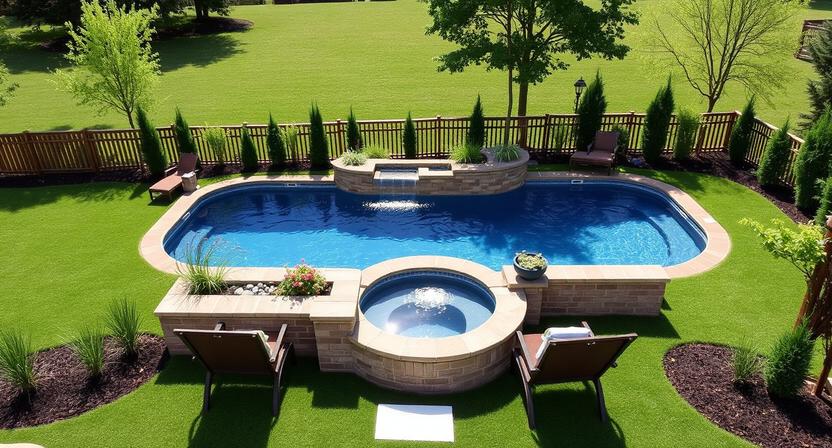
Pool design starts with a shape and ends with how everything connects to the rest of your backyard — but the decisions in between, finishes, coping, decking, features, and how the pool relates to your house, are where most of the character comes from. This guide introduces the main design decisions and what drives them, from the first sketch to the finished space. For a dedicated look at any single topic, the linked pages go deeper.
Shape: The First and Most Consequential Decision
Shape determines more about a pool’s design than almost anything else — it affects how the pool reads in the yard, how efficiently it uses space, and (depending on material) what options are available.
Rectangular and Geometric
The most versatile and widely used shapes in residential pool design. A rectangle creates a strong architectural line, works well with modern and contemporary houses, and is the most efficient shape for lap swimming. L-shapes and offset rectangles allow the pool to step around existing features — a tree, a deck, a garage corner — while maintaining clean geometry.
Freeform and Lagoon
Curved, organic shapes that read as more natural and relaxed. Popular with resort-style and tropical-inspired backyards, and tend to suit properties with existing mature landscaping that a geometric form would contrast against. Freeform shapes are only fully achievable with concrete — fibreglass pools offer some curves from the manufacturer’s catalogue, but true freeform is concrete’s territory.
Grecian and Roman
Classic geometric shapes with softened ends — a Grecian pool has angled corners; a Roman pool has curved or scalloped ends. Both read as formal and traditional, well-suited to heritage and Victorian-era homes that dominate many of Toronto’s established inner neighbourhoods.
Oval and Kidney
Oval pools are a softer alternative to the rectangle, with proportional symmetry. Kidney shapes — a classic freeform curve — are rarely specified new today but remain common in renovation and renovation-adjacent contexts.
The material constraint to know: fibreglass pools are available in defined shapes from a manufacturer’s catalogue — the range is wider than people expect (from classic rectangles to freeform lagoon-style), but it’s a catalogue, not a design-from-scratch process. Concrete pools can take any shape. Vinyl pools are highly flexible within a wall-panel system, covering everything from rectangles to freeform curves.
Interior Finish: The Look of the Water
The pool’s interior finish is what gives the water its colour, and it changes significantly with lighting conditions, time of day, and the surrounding landscape. This isn’t just an aesthetic decision — different finishes have different maintenance requirements and lifespans.
Light plaster and quartz finishes create sky-blue to turquoise water, particularly in bright sun. These are the most familiar pool colours and suit contemporary and resort aesthetics equally.
Darker finishes — dark plaster, charcoal pebble, dark quartz blends — create water that reads as deep navy or midnight blue. The effect is striking, particularly on modern geometric pools where the water doubles as a reflecting surface. Darker finishes also absorb more heat from sunlight, which can modestly extend swimming season.
Pebble and aggregate finishes add visual depth and texture that flat plaster doesn’t have. The variation in aggregate colour creates a more complex, natural-looking water tone rather than a uniform blue.
Full tile interiors offer the widest range of colour and pattern options — from classic white subway tile to Mediterranean mosaic to black glass tile — and the longest finish lifespan. More common in luxury or resort-style builds where the visual impact justifies the cost.
Interior finish is a concrete-pool decision. Fibreglass’s interior is the gelcoat colour chosen at manufacturing; vinyl’s interior is the liner pattern.
For more on interior finish options and costs: Cost to Install a Concrete Pool.
Coping: The Pool’s Frame
Coping is the edge material that caps the pool wall and creates the transition from water to deck — functionally important for structure, aesthetically important because it frames the pool the way a frame frames a painting.
Pre-cast concrete coping is the most common and most affordable option. Wide range of profiles (square edge, bullnose, cantilevered) and colours. Can be painted or stained to coordinate with surrounding decking.
Natural stone coping (limestone, travertine, bluestone, granite) elevates the visual quality of any pool surround and holds up exceptionally well to Ontario’s freeze-thaw cycle when properly installed. Travertine is a particular favourite for its warm tones and natural texture; bluestone suits more contemporary or Arts and Crafts-influenced designs.
Brick coping suits traditional and Victorian-influenced homes where the pool’s edge should read as part of an established landscape rather than a modern addition.
Cantilever concrete creates a flush, overhung edge — the deck appears to float over the pool’s edge — and is popular in modern minimal designs where the visual boundary between pool and deck is softened.
Decking: The Surface That Connects Pool to Yard
The deck around the pool is often where homeowners underinvest relative to what they spend on the pool itself — and where the visual quality of the finished space is most determined, since it’s the surface you actually see and walk on.
Concrete (poured and finished) is the most affordable and durable option. Broom or brushed finishes add slip resistance; exposed aggregate finishes add visual texture; stamped concrete can approximate stone patterns at a lower material cost.
Interlocking paving stone (permeable paving) is the most popular decking choice in Toronto’s established residential neighbourhoods. Wide range of styles and colours; permeable options help with the soft landscaping calculation under Toronto’s zoning by-law.
Natural stone (limestone, travertine, porcelain pavers designed for outdoor use) is the premium option and one of the best choices for the overall visual quality of the finished space. Sets naturally when wet due to its surface texture.
Composite or wood decking is used around raised pools, elevated sections, or where a warmer, residential material reads better than stone or concrete.
Built-In Features That Shape the Design
Features built into the pool structure define its character as much as its shape:
- Tanning ledge (Baja shelf): a shallow, flat platform (typically 8–12 inches deep) for lounging in a few inches of water. Has become one of the most requested features in Toronto pool design and suits both modern and resort-style pools.
- Integrated spa: a raised hot tub that overflows or connects to the main pool, creating a single visual composition. Almost always concrete.
- Beach or zero entry: a gradually sloping entry that mimics a natural shoreline — the widest entry type and the most accessible for children and older adults.
- Built-in seating and benches: underwater ledges used for socializing and relaxing in the pool rather than having to hold the wall or tread water.
- Sun shelf: similar to a tanning ledge but deeper (12–18 inches), sometimes used for chairs rather than lounge-style use.
For water features — deck jets, bubblers, spillover spas, waterfalls — see Pool Water Features Toronto. For lighting, see Pool Light Installation Toronto.
How Pool Design Relates to Your House
The strongest pool designs in Toronto echo the house’s own architectural character rather than introducing a foreign aesthetic. A few principles:
Modern and contemporary homes: geometric rectangles, dark interior finishes, minimal coping, large-format natural stone or concrete decking.
Victorian and heritage homes: Grecian or Roman shapes with stone coping and brick accents; warmer deck materials; freeform pool shapes softened to read as garden features rather than architectural elements.
Craftsman and Arts and Crafts: natural stone throughout, organic shapes, integration with mature planting.
Suburban contemporary: rectangular or L-shaped, paving stone, tanning ledge, typically the full-feature family pool with integrated spa.
The pool’s position relative to the house matters too — a pool that sits directly visible from the main living space is treated differently (as a view and visual anchor) than one positioned at the end of a longer garden.
Toronto-Specific Considerations
Toronto’s residential lot sizes span a wide range — from 20-foot-wide Victorian rowhouse lots in the inner city to 60-foot-wide suburban lots in North York and Scarborough. Lot width directly determines what shapes and sizes are feasible (see Small Yard Pool Installation for the constraints on tight lots) and affects how much visual weight a pool can carry relative to the surrounding yard.
For design ideas tailored specifically to small or narrow backyards: Small Backyard Pool Designs Toronto.
Frequently Asked Questions
What pool shapes work best for small Toronto lots?
Compact rectangles, long narrow pools, and plunge pools tend to work best on tight lots. A pool that runs parallel to the longest dimension of the yard maximises swimming space without overwhelming the surroundings.
What interior finish makes the water look the deepest blue?
Light quartz and light plaster finishes create a bright, sky-blue water colour. For deeper, richer tones, dark pebble or charcoal quartz finishes create navy to midnight-blue water.
Does the pool have to match the house’s architecture?
Not strictly, but pools that echo their house’s character tend to age better visually. A modern geometric pool on a Victorian property can work — but it reads as a deliberate design statement rather than a natural extension of the landscape.
What’s the most popular pool design in Toronto right now?
Rectangular pools with tanning ledges, natural stone coping, paving stone decking, and integrated LED lighting represent the most common combination currently installed in the GTA — functional, durable, and visually neutral enough to work with a wide range of house styles.
Explore the Full Design Picture
This guide introduces the main design decisions — for help bringing them together for your specific property:
Contact Easy Pools at (647) 449-9512 for a free, no-obligation design consultation tailored to your yard and style.