

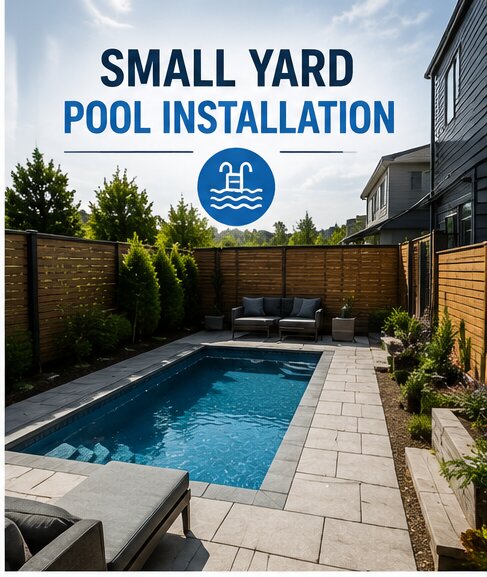
On a small lot, the question of what pool you can install isn’t primarily about what you want — it’s about what fits after setbacks, equipment access, and construction logistics are factored in. This guide covers the physical and process constraints of installing a pool on a tight urban lot: what pool types remain viable, how access limits your equipment options, and why construction costs don’t shrink as much as the pool does. For design ideas and layout inspiration on small properties, see Small Backyard Pool Designs Toronto.
How Setbacks Shrink Your Usable Footprint
The setback requirements that apply to every pool project don’t change based on lot size — which means they consume a much larger proportion of a small lot than a large one. Here’s the math on a typical inner-city Toronto lot of 25 feet wide:
| Element | Width Consumed |
| Required side-yard setbacks (both sides) | ~8 ft total (zone-specific) |
| Remaining usable width | ~17 ft |
| Less: pool-to-fence clearance (1.2m each relevant side) | ~8 ft more (if fence runs both sides) |
| Minimum pool width remaining | ~9–17 ft, depending on configuration |
A 25-foot lot with zone-specific setbacks typically leaves 12–17 feet of practical width for the pool structure itself — enough for a plunge pool, a compact fibreglass shell, or a narrow lap pool, but not a standard 16-foot-wide rectangular inground pool.
On a 30-foot lot, the situation is more workable: roughly 17–22 feet of usable width, which accommodates more compact fibreglass shells and narrow vinyl builds.
This math is why pool type selection on a small lot is a constraint problem first and a preference problem second. Confirm the applicable setbacks for your specific zoning category before committing to a pool size — see Toronto Pool Setback Requirements for how this varies by zone.
Pool Types That Remain Viable on Small Lots
| Pool Type | Minimum Practical Footprint | Notes |
| Plunge pool | 8′ x 10′ | The smallest-footprint option; purpose-built for tight lots |
| Compact fibreglass shell | 10′ x 20′ or less | Shell selection limited to compact models; confirm transport and crane access |
| Narrow lap pool | 6–8′ wide x 30–40′ long | Works on deep, narrow lots; long axis runs with the property depth |
| Semi-inground | Variable | Suits sloped tight lots; less excavation than full inground |
| Above-ground | 10–15′ round | No excavation; smallest footprint; easiest access |
Standard rectangular inground pools (14’x28′ and larger) are typically ruled out on lots under 30–35 feet wide once setbacks are applied — not by preference but by geometry.
Equipment Access: The Construction Constraint Most People Miss
Access for construction equipment is often the binding constraint on tight lots — not the pool’s dimensions, but whether excavation and delivery equipment can physically reach the backyard.
Excavation equipment minimums:
- Compact/mini excavator: minimum 5–6 feet clear width along the full access path
- Standard excavator: minimum 8–10 feet
- Hand excavation: any width, but adds significant labour cost and time
Fibreglass shell crane access: the crane doesn’t necessarily need to fit through your side yard — it typically positions on the street or driveway and lifts the shell over the fence line. What matters is overhead clearance along the lift path (no low utility lines, eave overhangs, or mature tree canopy) and street positioning (road occupancy permit required). On tight lots, fibreglass is sometimes more accessible than concrete or vinyl, precisely because the crane can work from the street.
Concrete and vinyl on tight lots: both require excavation equipment in the yard for longer than fibreglass does, since the structure is built on site rather than craned in. A tight lot that accepts crane access for fibreglass may not provide enough working room for the extended excavation and construction period that vinyl or concrete requires.
Rear lane access: many Toronto lots — particularly in older inner-city neighbourhoods — back onto a public lane. Equipment entering from the lane can completely bypass the side-yard access problem. Check whether your property has lane access before assuming the side yard is the only option.
Soil Staging and Removal: The Tight-Lot Logistics Problem
A pool excavation produces significant soil volume — typically 40–100+ cubic metres — that needs somewhere to go. On a large lot, soil can be temporarily stockpiled in a corner of the yard while construction proceeds. On a tight lot, there often isn’t room to stockpile, which means:
- Same-day haul-out: excavated soil must be loaded and removed the same day it’s dug, rather than staged and removed later. This requires coordinating the excavation crew and the haul truck simultaneously, which adds scheduling complexity.
- No space for material staging: concrete formwork, backfill material, and equipment are easier to manage when there’s room to set them down. On a tight lot, materials arrive and are used immediately rather than staged — which tends to make the construction process feel more pressured and leaves less room for on-site problem-solving.
Confirm explicitly with your contractor how soil removal and material delivery will be handled on a tight property before excavation day.
The Fixed Cost Floor
Small lots don’t produce proportionally smaller installation costs — which is one of the most important things to understand before deciding that a smaller pool solves a budget problem.
The costs that don’t scale down with pool size:
- Permits: flat fee regardless of pool dimensions
- Mobilization: getting equipment on site costs roughly the same whether digging a small or large hole
- Equipment minimums: a pump, filter, and electrical hookup have a baseline cost that doesn’t change based on pool volume
- Enclosure fence: fence perimeter is driven by lot configuration and safety requirements, not pool footprint
- Access surcharges: on tight lots, equipment and access difficulties add cost regardless of pool size
In practice, a small pool on a tight lot often costs $10,000–$20,000 less than a standard-size pool on the same lot — not 50% less. The saving comes from smaller shell/structure cost and less excavation, but the fixed costs remain. See Cost to Install a Small Pool for a full breakdown of how cost scales (and doesn’t) with pool size.
Permit Considerations: Small Lots Face Higher Soft Landscaping Risk
Toronto’s zoning by-law requires a minimum percentage of every lot to remain as soft (permeable) landscaping. On a larger lot, a pool plus surrounding deck still leaves most of the lot permeable. On a small lot that’s already partially built up, adding a pool, deck, and fence hardscape can push total hard-surface coverage over the required threshold — triggering a Minor Variance process.
The pool’s water surface counts as soft landscaping (it’s permeable), which helps. But surrounding concrete, paving, and fencing doesn’t — which is the risk on tight, already-developed lots. Raise this explicitly with your contractor before finalizing deck dimensions. See Pool Zoning Rules Toronto for the full soft landscaping framework.
What to Confirm Before Committing to Any Pool on a Small Lot
- Accurate setback distances for your specific zoning category (not a general rule of thumb)
- Residual pool width after setbacks and fence clearance are applied
- Side-yard access width measured at the narrowest point along the full path
- Whether rear lane access is available as an alternative
- Lot coverage calculation including any existing hardscape (existing patio, driveway, shed)
- Equipment access plan for excavation and any crane work
Frequently Asked Questions
What’s the smallest inground pool that can be installed in Toronto?
There’s no fixed minimum, but practical limits emerge from setback requirements and excavation access. Plunge pools starting around 8’x10′ are typically the most compact fully inground option. Above-ground pools can go smaller still.
Can a standard 16’x32′ pool fit on a narrow Toronto lot?
On a typical 25-foot-wide inner-city lot, usually not once setbacks are applied. A standard 16-foot pool width plus setbacks on both sides typically exceeds the lot width. Compact shells, narrow lap pools, and plunge pools are more realistic choices.
Does a smaller pool cost proportionally less?
Not as much as most people expect. Fixed costs — permits, mobilization, equipment, fence — remain similar regardless of pool size. A smaller pool typically saves $10,000–$20,000 compared to a standard-size version, not 50%.
What if my side yard is too narrow for excavation equipment?
Options include: compact/mini excavator (works in 5–6 feet), hand excavation for specific sections, rear lane access if available, or — for fibreglass — a street-positioned crane that lifts the shell over the fence line.
Does the soft landscaping rule apply harder on small lots?
Yes — on a small lot with existing hardscape, adding a pool deck can more easily push total hard-surface coverage over the required limit, triggering a Minor Variance. Raise this with your contractor before finalizing your deck design.
Get a Site-Specific Assessment for Your Lot
What’s achievable on a small lot depends on your specific setbacks, access path, and existing coverage — numbers that only a site visit can confirm.
Contact Easy Pools at (647) 449-9512 for a free, no-obligation assessment of what’s possible on your property.