

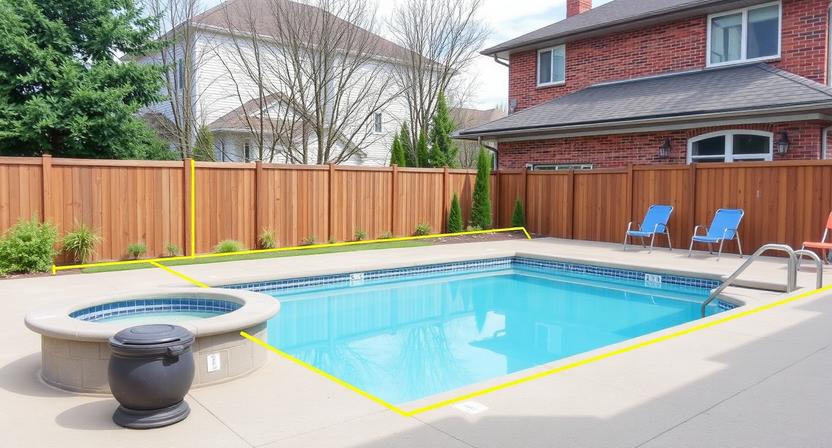
Setbacks are the minimum distances a pool must maintain from property lines, the dwelling, utilities, and other features on your lot. In Toronto, the exact distances are set by the zoning category that applies to your specific property — there’s no single number that applies across all residential zones, which is why this page focuses on the four categories of setbacks that affect pool projects and what each one means, rather than a distance that may or may not apply to your address.
The First Thing to Know: Measure From Survey Lines, Not Fences
Setbacks are measured from legal property lines as shown on your survey — not from your fence, your neighbour’s fence, or any landscaping. Fences aren’t always placed exactly on property lines, and the difference matters when you’re calculating whether a pool location complies. If you don’t have a current survey showing your property boundaries, your site plan submission for the Zoning Applicable Law Certificate will require one.
The Four Setback Categories That Affect Pool Projects
1. Pool to Property Line
Every pool must maintain a minimum distance from the rear and side lot lines. The exact minimum varies by your zoning category within By-law 569-2013 — Toronto’s residential zones include Residential (R), Residential Semi-Detached (RS), Residential Detached (RD), and others, each with zone-specific yard depth requirements. In Toronto, the minimum pool setback from a property line can be as low as 0.6 metres in some zones, while other zones and lot configurations require more — which is exactly why confirming your specific zone via Toronto’s Zoning By-law Viewer tool (or your contractor during a site visit) matters more than any general rule of thumb. The Zoning Certificate review will flag the applicable requirement for your address specifically.
2. Pool to Dwelling
The pool must also maintain a minimum separation from the principal building itself — not just from the property lines. This protects the home’s foundation from excavation pressure and drainage impact. The required distance typically varies by zone alongside the property-line setback, and in some configurations may also be affected by the location of your home’s basement windows, utility connections, or existing walkway structures.
3. Pool Enclosure (Fence) to Pool
This is the one setback that applies consistently across residential properties in Toronto: the fence surrounding a pool can’t be built any closer than 1.2 metres from the edge of the pool. This minimum clearance between the pool’s edge and the enclosure fence is a safety requirement, not a zoning one — it’s enforced through the Pool Fence Enclosure Permit rather than the Zoning Certificate. For the full fence specification including height, materials, and gate requirements, see Toronto Pool Fence Bylaws.
4. Easements
Easements signify an area which is part of the property but cannot be built upon, as rights of usage have been allocated to a utility or other authority. You cannot construct a building, pool, or pool deck in an easement. Common easements include those for hydro lines, gas, water and sewer, drainage, and telecommunications. They show up on your property survey and aren’t always obvious from above-ground inspection alone — a buried sewer easement running through the middle of your backyard can directly limit where a pool can be placed, regardless of how the rest of your setbacks work out. Mark all easements on your site plan before finalizing pool placement.
Special Situations That Affect How Setbacks Work
Corner Lots
A corner lot has two street-facing frontages rather than one, which changes how setback rules apply. The exterior side yard — the lot side that faces a street — typically has a larger required setback than a standard interior side yard, since it’s more prominent and more regulated from a streetscape perspective. If you’re on a corner lot, confirm both frontage setbacks specifically before finalizing your pool location.
Equipment Pads
The pool’s equipment pad — pump, filter, heater — needs its own clear space on your property, and it has its own setback considerations that interact with but aren’t always identical to the pool shell’s setbacks. Decks, stairs, equipment pads, and pool houses all count toward lot coverage and can affect setbacks — this catches homeowners by surprise. Plan the equipment pad location at the same time as the pool position, not as an afterthought.
Accessory Structures
Pool houses, pergolas, cabanas, and sheds are typically treated as accessory buildings and have their own setback requirements under the by-law, which can interact with the pool’s required clearances. If your design includes any of these alongside the pool, confirm each element’s required setback separately — not just the pool shell itself.
Above-Ground Pools
Above-ground pools are viewed by the City as permanent once they stay year-round or exceed depth limits — that means an above-ground swimming pool in Toronto still triggers fencing, setback, and equipment clearance rules. The fact that the pool sits above grade rather than below it doesn’t exempt it from the property-line setback calculations, and the pool-to-fence clearance of 1.2 metres applies regardless of pool type.
How Setbacks Show Up in the Site Plan
Your Zoning Applicable Law Certificate submission requires a scaled, fully dimensioned site plan showing the pool’s exact position relative to all property lines, the dwelling, and any easements. This is where the setback compliance review actually happens — the site plan has to show every required dimension, and reviewers check each one against the applicable by-law requirements for your zone.
Many homeowners plan the pool shell perfectly, but draw the fence after, squeezing it into space that violates clearance. Reviewers treat fence errors as safety failures, not cosmetic ones. The right approach is to place the pool, deck, fence, and equipment together on the site plan from the start — since these elements interact with each other and collectively affect coverage and setbacks — rather than positioning the pool first and fitting everything else around it.
For the full permit process and how the Zoning Certificate review fits into it, see Pool Permits Toronto. For the broader zoning framework — soft landscaping, lot coverage, and the Minor Variance path if setbacks can’t be met — see Pool Zoning Rules Toronto.
What Happens If Setbacks Can’t Be Met
If a proposed pool location can’t meet the required setbacks, a homeowner can apply for a Minor Variance through the Committee of Adjustment. A successful variance grants formal permission to build closer to a property line or structure than the by-law would normally allow. The process involves a hearing with notice to neighbouring properties, typically takes several months, and costs several thousand dollars including filing fees and often a planning consultant.
The practical alternative — adjusting the pool’s position, reducing its size, or reconfiguring the surrounding hardscape on paper — is almost always the more efficient path when a compliance issue is caught at the design stage. See Pool Zoning Rules Toronto for the full variance process.
Frequently Asked Questions
What is the setback for a pool in Toronto?
It depends on your specific zoning category — there’s no single number that applies across all residential zones. The pool-to-property-line setback can be as low as 0.6 metres in some zones and higher in others. Confirm the requirement for your specific address through Toronto’s Zoning By-law Viewer tool or your contractor.
How close can a pool fence be to the pool edge?
The enclosure fence must be at least 1.2 metres from the pool’s edge — this applies consistently across residential properties in Toronto, regardless of zone.
Can a pool be built in an easement?
No. A pool, pool deck, or any permanent structure cannot be built within a utility or drainage easement. Easements show up on your property survey and must be shown on your site plan submission.
Do above-ground pools have the same setback requirements as inground?
Yes, once an above-ground pool stays year-round or exceeds 600mm in depth, the City treats it as a permanent installation subject to the same setback and enclosure rules as an inground pool.
Where do I find the setback requirements for my specific property?
Toronto’s Zoning By-law Viewer at the City’s website shows your property’s zoning designation. Once you know your zone, the applicable minimum yard depths and setback requirements are listed in By-law 569-2013 for that zone category. Your contractor can also confirm this during an initial site visit.
Get a Setback Review Before You Finalize Your Design
A pool position that fails setback review means a redesign, a delayed permit, and often a missed swim season. Catching it before your site plan is submitted costs nothing.
Contact Easy Pools at (647) 449-9512 for a free, no-obligation site assessment that includes a setback review for your property.