

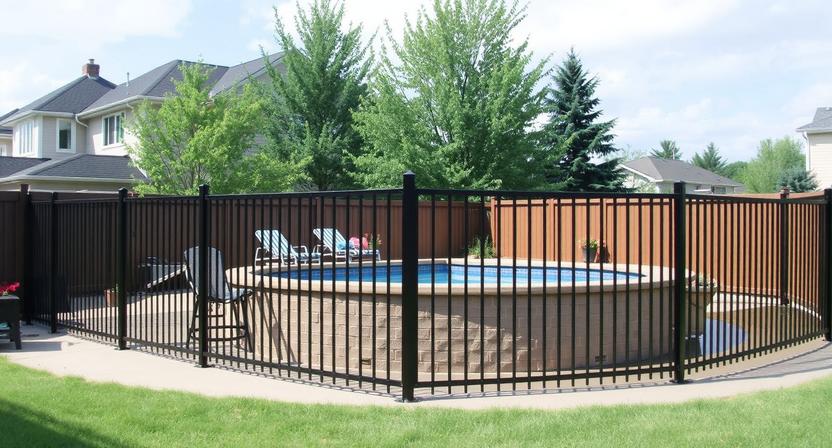
Every rule in Toronto’s pool enclosure bylaw traces back to one goal: preventing a young child from reaching pool water unsupervised. That’s worth keeping in mind, because it explains why the standard goes further than most homeowners expect — an existing property-line fence often isn’t enough on its own, since the bylaw is specifically about isolating the pool, not just enclosing the yard. This guide covers exactly what’s required: height, materials, gates, and the isolation rule that trips up more homeowners than any other part of the code.
What Counts as a “Pool” Under the Bylaw
The enclosure requirement applies to any structure on private property intended for swimming, wading, or bathing with a depth greater than 600mm (about 24 inches) at any point. This covers inground and above-ground pools, hot tubs, whirlpools, and similar structures — the bylaw doesn’t distinguish by pool type, only by depth.
One exemption: a hot tub, whirlpool, or spa doesn’t need a Pool Fence Enclosure Permit if it has a cover permanently attached that can be locked to prevent access when not in use.
The Core Rule: Complete, Four-Sided Isolation
This is the part of the bylaw that’s most often misunderstood. The requirement isn’t simply “have a fence around your yard” — it’s that the pool area itself must be completely isolated, including from your own house. If a door from your home opens directly onto the pool area with nothing separating them, that configuration doesn’t comply, regardless of how good your perimeter fencing is.
The City recognizes a few permitted configurations:
- A four-sided isolation fence between the house and the pool, even if the exterior door technically opens toward the pool area — the isolation fence creates the required separation.
- A four-sided fence that completely surrounds the pool, where your property’s boundary fence makes up part of that enclosure, as long as there’s no access to the pool area through the boundary fence itself.
- An exterior door that opens to the side of the house (not toward the pool), combined with a four-sided fence that fully surrounds the pool area.
What doesn’t comply: an exterior door that opens directly onto the pool area with no separating barrier between the door and the water.
This matters most for homeowners adding a pool to an already-fenced yard. A standard backyard fence around your property line is not automatically a compliant pool enclosure — if your back door opens onto the same yard as the pool, you likely need an additional isolation fence specifically separating the house from the pool, even though your yard is already fenced. Confirm this with your contractor or the City before assuming your existing fence covers you.
Height Requirements
| Property Type | Minimum Fence Height |
| Single residential properties | 1.5 metres (about 5 ft) |
| Multiple residential properties | 1.8 metres (about 6 ft) |
Approved Materials
The bylaw permits several fence types for pool enclosures:
- Chain-link fencing (small gauge)
- Wood fencing (vertical or horizontal boards)
- Metal picket fencing
- Glass panel fencing
- Masonry walls
Not permitted: barbed wire, chicken wire, or any other barbed or sharp material. More generally, fencing can’t be built from material not normally used for fence construction, and can’t be a conductor of electricity.
Gate Requirements
The gate is usually where compliance actually gets tested at inspection, since it’s the one deliberate opening in an otherwise sealed enclosure:
- Supported on substantial hinges
- Self-closing and self-latching
- Latch mechanism positioned on the pool side of the gate, out of easy reach from outside the enclosure
- Kept locked at all times except when the pool area is actively in use
Placement: Avoiding Climbable Objects
A compliant fence can still fail inspection if something next to it effectively defeats its purpose. Air conditioning units, BBQs, woodpiles, or anything else a child could climb shouldn’t be placed directly against or near the enclosure, since that creates an alternate way over the barrier. This is a common, easily overlooked issue worth planning around at the design stage, not discovering at inspection.
This Is an Ongoing Obligation, Not Just a Construction Requirement
Compliance doesn’t end once your enclosure passes its initial inspection. Property owners are required to maintain pool fences and enclosures in good repair, structurally sound, and free from hazards for as long as the pool exists — a damaged gate latch, a leaning fence section, or a broken self-closing mechanism can all become compliance issues years after installation, not just construction-phase concerns.
Before You Can Fill Your Pool
You cannot legally fill a pool with water, or allow water to collect or remain in it, until the City has inspected and confirmed that a permanent, fully compliant pool enclosure is in place. Using the pool before this inspection can result in fines. Book the inspection through 311, and plan for it well before you expect to swim, since inspectors are typically busiest during peak season in June and July.
If Your Design Can’t Comply
If you’d like to install a fence that doesn’t meet the standard bylaw requirements — an unusual material or configuration, for example — property owners can request an exemption through their local Community Council. This is a separate process from the Minor Variance route used for broader zoning issues (covered in our permits guide), specific to fence design itself.
How This Fits Into the Broader Permit Process
The fence enclosure standard covered here is enforced through the Pool Fence Enclosure Permit, which is the second step in Toronto’s two-step pool approval process — applied for only after your Zoning Applicable Law Certificate is approved. For the full process, current fees, and the other approvals that may apply to your property (TRCA, tree protection, soft landscaping), see Pool Permits Toronto and Pool Enclosure Permit Toronto for the application steps specifically.
Frequently Asked Questions
How tall does a pool fence need to be in Toronto?
A minimum of 1.2 metres for single residential properties and 1.8 metres for multiple residential properties.
Does my existing yard fence count as a pool enclosure?
Not automatically. The bylaw requires the pool area itself to be isolated, including from your house — if a door opens directly onto the pool area, a standard perimeter fence alone usually isn’t sufficient without an additional isolation barrier.
What if my house door opens directly onto the pool area?
You’ll need a four-sided isolation fence specifically separating the door from the pool, even though your yard may already be fenced around its perimeter.
What materials are allowed for a pool fence in Toronto?
Chain-link, wood, metal picket, glass panel, and masonry wall are all permitted. Barbed wire, chicken wire, and other sharp materials are not.
Can I get an exemption if my fence design doesn’t comply?
Yes — property owners can request an exemption through their local Community Council for fence-specific non-compliance, separate from the Minor Variance process used for broader zoning issues.
Get Your Enclosure Designed Right the First Time
A compliant enclosure that’s also well-integrated into your backyard design is easier to plan from the start than to retrofit after a failed inspection.
Contact Easy Pools at (647) 449-9512 for a free, no-obligation consultation on your pool and enclosure design.