

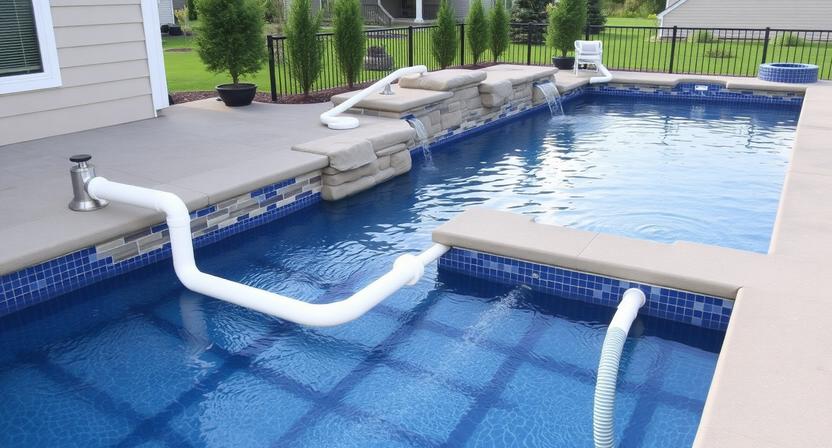
A typical residential pool in Ontario costs $1,500–$4,000 per year to operate — electricity for the pump, fuel for heating, chemicals, and seasonal service. Three equipment choices determine most of that number: your pump type, whether you use a cover, and your heating system. This page covers all three, plus how smart automation can reduce operating costs further. For a detailed comparison of heating system types, see Pool Heating Systems.
What Drives Pool Operating Cost
Understanding where the cost comes from clarifies which upgrades actually move the number:
| Operating Cost Category | Typical Annual Range | Main Lever |
| Pump electricity | $80–$1,200 | Variable vs. single-speed pump |
| Heating (gas or electricity) | $600–$2,400 | Heating system type + cover use |
| Chemicals | $500–$1,200 | Cover use; water balance |
| Opening and closing | $350–$800 | Service provider |
| Water replacement (evaporation) | $50–$200 | Cover use |
| Total | $1,580–$5,800 |
The three biggest levers — in order of typical impact — are: heating system choice, variable speed pump, and pool cover. Each of these is addressed below.
Variable Speed Pumps: The Biggest Electrical Saving
A pool pump is typically the second-largest electricity consumer in a home after HVAC. The difference between a traditional single-speed pump and a variable speed pump (VSP) is one of the most significant and fastest-payback equipment upgrades available.
How Traditional Pumps Work
A single-speed pump runs at full speed (typically 3,450 RPM) whenever it’s on. The on/off cycle means it’s either running at full power or not at all — no middle ground.
How Variable Speed Pumps Work
A VSP can operate at any speed across a wide range. The efficiency gain comes from a fundamental hydraulic principle: power consumption varies with the cube of pump speed. This means:
- Running at half speed uses approximately one-eighth the energy (not one-half)
- Running at one-third speed uses approximately one-twenty-seventh the energy
In practice, the same daily filtration turnover that a single-speed pump achieves in 8 hours at full speed can be accomplished by a VSP running 12–14 hours at lower speed — using 60–80% less electricity to do the same job.
Real-World Savings
A 1.5 HP single-speed pump running 8 hours daily at full speed typically uses 9–12 kWh per day — roughly $400–$700 per year at Ontario electricity rates. The same filtration through a VSP running longer at lower speeds typically uses 2–3 kWh per day — roughly $80–$150 per year.
Annual savings: $250–$550 in electricity, depending on pool size, run time, and local rates.
Upfront premium: a quality VSP costs $600–$1,500 more than a comparable single-speed pump.
Payback period: typically 1–3 years through electricity savings alone — one of the fastest-payback equipment upgrades in pool ownership.
Additional benefits: VSPs run significantly quieter at low speeds than single-speed pumps at full speed; lower-speed operation also reduces wear on seals, impellers, and filter media, potentially extending equipment life.
Pool Covers: The Biggest Thermal Saving
A pool loses 70–80% of its heat through evaporation at the water surface — not through the pool walls or floor. A cover is the most direct intervention available for heat retention, and its effect on both heating cost and chemical cost is significant.
Types of Pool Covers
Solar covers (bubble covers): the lightweight polypropylene “bubble wrap” style cover that floats on the pool surface. Reduces evaporation by 50–70%, retains daytime solar heat absorbed by the water, and prevents heat loss overnight. Covers of this type cost $150–$400 and must be deployed and stored manually.
Solid thermal blankets: foam-core covers with higher insulation value than a solar cover. Better overnight heat retention; also reduce evaporation effectively. Cost $300–$800; also manual.
Automatic safety covers (motorized): a tracked motor system that deploys and retracts a solid pool cover at the touch of a button. These serve double duty as a safety cover (meets enclosure requirements in some configurations) and an efficient thermal barrier. Cost $8,000–$20,000 installed, depending on pool size and system.
Standard safety covers (manual, seasonal): the woven winter covers used for pool closing. Not intended for in-season use, but they do contribute to off-season heat and chemical retention.
What a Cover Actually Saves
Heating cost: reducing evaporation by 50–70% reduces the heater’s workload proportionally. For a pool spending $300/month on gas heating, a consistent cover use could reduce that to $150–$200/month during the heating season — saving $600–$1,200 per year on heating alone.
Chemical use: evaporating water takes dissolved chemicals with it. A cover reduces chemical consumption by 35–60%, which at $600–$1,200 per year in chemical costs represents savings of $200–$700 annually.
Water replacement: an uncovered pool in summer loses 1–2 inches of water per week to evaporation — roughly 3,000–6,000 litres per week on a standard residential pool. A cover reduces this to 1–2 inches per month.
Combined annual savings from a solar cover: typically $800–$2,000 between heating and chemical savings — on a cover that costs $200–$400 to buy. The payback on a basic solar cover is measured in weeks, not years.
Heating System: The Largest Single Operating Cost
The heating system is typically the largest operating cost category, and the choice between gas, heat pump, and solar has the greatest effect on annual operating cost. See Pool Heating Systems for the full comparison.
The key numbers: a heat pump running during Ontario’s warm season costs $50–$150 per month to operate, compared to $150–$600 per month for a gas heater. Over a 4–5 month active season, the difference can reach $400–$2,000 in annual savings. Pairing a heat pump with a good pool cover is the most cost-effective combination for most Ontario residential pools.
Pool Automation: Smart Scheduling for Further Savings
A pool automation system doesn’t directly make equipment more efficient — it ensures efficient equipment runs at the right time and isn’t wasted running at the wrong time.
Time-of-use rate shifting: Ontario’s time-of-use electricity rates mean off-peak hours (typically overnight, on weekends) cost significantly less per kWh than on-peak hours. Scheduling the filtration pump to run primarily during off-peak hours — which an automation system makes easy — can reduce the annual electricity bill by $50–$200.
Smart heating schedules: programming the heater to maintain lower temperatures when the pool is unused and to pre-heat before use, rather than running continuously, can reduce heating fuel use by 10–20%.
Remote monitoring: catching equipment faults early — a clogged filter raising pump pressure, a heater fault, a low chemical reading — prevents problems from running undetected and wasting energy or chemicals.
System cost: a full residential automation system (Pentair IntelliCenter, Hayward OmniLogic, or similar) typically costs $1,500–$6,000 installed, depending on the scope of integration. Most new pool equipment is designed with automation compatibility; retrofit on existing equipment is possible but may require equipment upgrades.
Stacking Efficiency Upgrades: What the Savings Actually Add Up To
| Upgrade | Annual Saving | Upfront Cost | Payback |
| Single-speed → VSP | $250 – $550 | $600 – $1,500 | 1–3 years |
| Add solar cover (consistent use) | $800 – $2,000 | $200 – $400 | 1–3 months |
| Gas heater → heat pump (warm season) | $400 – $2,000 | $1,000 – $3,000 (premium) | 1–4 years |
| Automation (time-of-use scheduling) | $50 – $200 | $1,500 – $6,000 | 10–30 years |
The fastest paybacks are the cover and the VSP upgrade — both of which return their cost within a season or two. The heat pump upgrade’s payback depends heavily on how much the pool is heated and how much gas is currently being used. Full automation has the longest payback in direct energy savings, though its convenience value is real.
Frequently Asked Questions
What’s the single best efficiency upgrade for an existing pool?
A pool cover, if you don’t already use one — it has the shortest payback of any pool efficiency measure, often recouping its cost in the first season. For a new build, specifying a variable speed pump from the start adds minimally to the build cost and saves consistently every year.
How much does a variable speed pump save per year?
Typically $250–$550 per year in electricity, depending on pool size, run time, and local electricity rates. Most VSP upgrades pay for themselves in 1–3 years.
Do pool covers actually make a significant difference?
Yes — significantly. A pool loses 70–80% of its heat through evaporation; a cover addressing evaporation reduces heating cost by a similar proportion. Most homeowners with consistent cover use save $800–$2,000 per year between heating and chemical costs.
Is pool automation worth the cost?
The direct energy savings from automation are real but modest — primarily from off-peak scheduling. The main value proposition is convenience and early fault detection, not energy payback alone.
What combination of systems produces the lowest operating cost?
A heat pump (for primary heating) paired with a solar cover (for heat retention) and a variable speed pump (for filtration) is the most cost-effective combination for most Ontario residential pools. Add automation for convenience and off-peak scheduling.
Get an Efficiency Assessment With Your Pool Quote
Specifying the right equipment from the start is far more cost-effective than retrofitting later.
Contact Easy Pools at (647) 449-9512 for a free, no-obligation consultation that includes efficiency system options for your pool.