

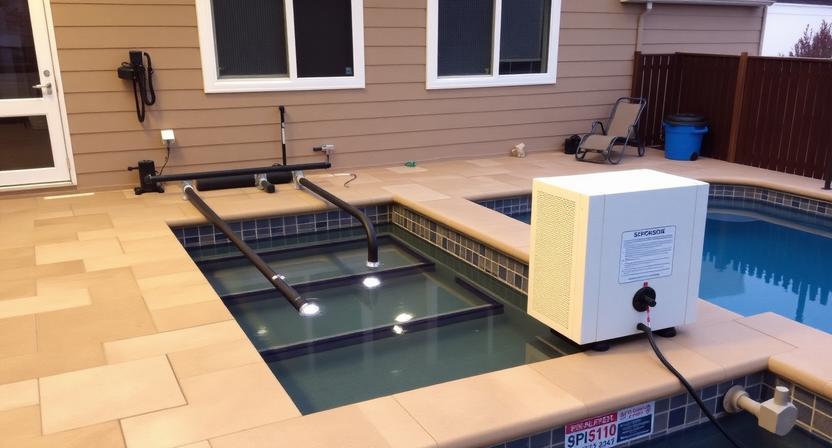
Adding a heater extends Ontario’s outdoor swim season meaningfully — typically 4–8 additional weeks across spring and fall, turning a 10-week peak-summer pool into a 15–18 week one. The right heating system depends on how you use your pool, what you’re willing to spend to run it, and a characteristic of Ontario’s climate that significantly affects heat pump performance. This guide covers all four main options side by side.
Quick Comparison
| System | Upfront Cost | Monthly Running Cost | Ontario Season Performance | Best For |
| Gas (natural gas or propane) | $1,500 – $6,000 | $150 – $600 | Excellent — works in any temperature | Occasional use; fastest heating; shoulder season |
| Heat pump (air-source) | $2,000 – $7,000 | $50 – $150 | Good May–Sept; limited in cold shoulder weeks | Primary heater for warm-season swimming |
| Solar | $3,000 – $8,000 | ~$0 operating | Effective May–Sept in good sun; weather-dependent | Supplemental heating; low operating cost priority |
| Electric resistance | $400 – $1,500 | $400 – $900+ | Excellent — works in any temperature | Not recommended for full pool — operating cost prohibitive |
Gas Heaters
How They Work
A gas heater burns natural gas (from your home’s existing gas supply) or propane (from a separate tank), heating a copper or cupronickel heat exchanger through which pool water circulates. Water picks up heat from the exchanger and returns to the pool warmer.
Key Advantages
Speed: a gas heater raises pool temperature faster than any other residential option — 1–2°F per hour on a standard residential pool. This makes gas the right choice for pools used occasionally or spontaneously rather than maintained at a constant temperature, since you heat just before use rather than continuously.
Temperature-independent performance: unlike heat pumps, gas heaters perform identically at 5°C as at 25°C. This makes gas effective for shoulder-season swimming — May in Ontario, September–October — when overnight air temperatures drop below the range where heat pumps work efficiently.
No sizing complexity: gas heater output is consistent regardless of weather; sizing is straightforward based on pool volume and target temperature rise.
Key Disadvantages
Operating cost: gas is the most expensive option to run on a per-BTU basis among practical options. At typical Ontario natural gas rates, running a gas heater to maintain 28°C consistently costs $150–$600 per month depending on pool size, target temperature, and how much the heater cycles.
Efficiency ceiling: residential gas heaters typically operate at 82–85% thermal efficiency (AFUE) — the rest of the energy is lost through combustion exhaust. Heat pumps, by comparison, produce 4–6 units of heat for every unit of electricity consumed.
Best For
Occasional use pools, pools where rapid temperature recovery after a cold night matters, shoulder-season swimming, or as a backup system paired with a heat pump as primary.
Heat Pumps (Air-Source)
How They Work
A pool heat pump doesn’t generate heat — it transfers it. The system extracts thermal energy from the surrounding air using a refrigerant cycle (the same principle as a refrigerator, running in reverse) and transfers that energy to pool water through a heat exchanger. For every 1 kWh of electricity consumed, a heat pump moves 4–6 kWh of heat into the pool — a Coefficient of Performance (COP) of 4–6.
Key Advantages
Lowest operating cost of any fuel-based system: at typical Ontario electricity rates, running a heat pump costs $50–$150 per month — roughly one-quarter the operating cost of gas for equivalent pool heating.
Quiet operation: heat pumps run quietly and produce no combustion exhaust.
Saltwater compatibility: titanium heat exchangers resist the corrosive effect of chloride in saltwater pool systems — specify titanium if you’re running a salt chlorinator. See Saltwater Pools.
The Critical Ontario Limitation
This is the most important thing to understand about heat pumps before specifying one for a Toronto pool: heat pump efficiency drops significantly as ambient air temperature falls. Most residential pool heat pumps have an operational minimum of approximately 7–10°C (45–50°F) — below which they either shut down or operate at dramatically reduced efficiency.
In the Toronto area, this means:
- May: overnight lows regularly drop below 10°C. A heat pump runs poorly or not at all overnight in early May, even if daytime temperatures are warm. Pool temperature drops overnight and the heat pump struggles to recover it the next day.
- June through August: heat pump territory. Overnight lows rarely drop below the operational threshold; the system runs efficiently.
- September: similar to May — the heat pump works well during warm stretches but underperforms on cold nights. Late September can see overnight lows that effectively shut the system down.
- October: a heat pump is largely ineffective for extending the season.
Cold-climate heat pump models are designed to operate at lower temperatures (some rated to -15°C), though efficiency at extreme temperatures is still significantly reduced. These models cost more upfront but extend the effective season modestly.
The practical implication: if shoulder-season swimming in May and September/October is your goal, a heat pump alone may not reliably deliver it. Gas or a hybrid system is the more reliable choice for shoulder-season performance.
Best For
Primary heating from late May through September; homeowners prioritizing low operating cost over maximum season extension; pools used regularly during the warm season.
Solar Heating
How They Work
Pool water is pumped through simple, unglazed polypropylene collectors — typically installed on a roof — where it’s heated by solar radiation before returning to the pool. Unlike solar thermal (which produces domestic hot water) or solar PV (which generates electricity), pool solar collectors are low-temperature, high-flow systems specifically designed for pool heating.
Key Advantages
Near-zero operating cost: once installed, solar heating costs essentially nothing to run — the existing circulation pump handles the flow, and no fuel is consumed.
Long collector lifespan: properly installed polypropylene collectors last 10–20 years with minimal maintenance.
Simple system: no refrigerant, no combustion, no complex controls — solar pool heating is one of the simpler pool systems to install and maintain.
Key Disadvantages
Weather-dependent output: solar heating only works when the sun shines. In a cloudy Ontario spring or during a stretch of overcast summer weather, output drops significantly.
Cannot maintain overnight temperature: solar collectors produce no heat at night. Pool temperature drops overnight unless a good pool cover is used to retain heat. In practical terms, solar heating is best understood as a temperature booster rather than a maintainer.
Collector area requirement: effective solar heating requires significant collector area — typically 50–100% of the pool’s surface area in panels. A 14’x28′ pool (392 sq ft) needs 200–400 sq ft of solar panels. This requires roof space, south-facing orientation, and minimal shading.
Aesthetic impact: rows of polypropylene panels on the roof are visible from the street and not considered attractive by most homeowners. Ground-mounted systems are possible but require additional space.
Best For
Supplemental heating alongside another system; homeowners with south-facing unshaded roof space; low operating cost as the top priority; cottage-style or recreational pools where temperature variability is acceptable.
Electric Resistance Heating
Electric resistance heaters pass electricity through a resistive element — essentially a large immersion heater. Unlike a heat pump, which transfers heat at a 4–6:1 ratio, an electric resistance heater converts electricity to heat at a 1:1 ratio. At Ontario electricity rates, this makes running costs $400–$900+ per month for a full-size pool — significantly higher than gas and prohibitively higher than a heat pump.
Electric resistance is generally not recommended for full pool heating in Ontario. The exception is small spas or hot tubs (where the water volume is small enough that operating cost is manageable) and some portable above-ground heating applications.
The Hybrid Approach: Heat Pump + Gas Backup
The most flexible residential heating configuration pairs a heat pump as the primary heater with a gas heater as backup and boost:
- Heat pump handles the bulk of the season (June through August) at low operating cost
- Gas heater kicks in during early spring and late fall when the heat pump can’t maintain temperature, and provides rapid recovery after a cold night or period of pool disuse
- Net operating cost is lower than gas alone; season extension is greater than heat pump alone
This approach requires more upfront equipment cost but is increasingly popular in the GTA for pools where owners want both low operating cost and genuine shoulder-season capability.
Sizing and Installation Considerations
Pool heater sizing is based on pool volume, target temperature rise, and heat loss rate (affected by pool cover use, wind exposure, and climate). Undersized heaters run continuously without reaching target temperature; oversized heaters cycle frequently and waste fuel. Confirm sizing with your contractor based on your specific pool’s volume.
All pool heating equipment requires appropriate gas connections (for gas heaters), electrical connections, and proper venting (for gas). In Ontario, an ESA permit is required for electrical connections to pool heaters, and a licensed gas technician must make gas connections.
Frequently Asked Questions
What’s the cheapest pool heating system to run in Ontario?
Solar has the lowest operating cost but is weather-dependent and requires significant roof space. Among fuel-based systems, heat pumps cost roughly one-quarter of gas per month during the warm season.
Do heat pumps work in Ontario’s spring and fall?
Partially. Most heat pumps operate effectively above 10°C ambient, limiting their performance in May and September–October when overnight temperatures drop. If shoulder-season swimming is a priority, gas or a hybrid system is more reliable.
How much does it cost to heat a pool with a gas heater?
Typically $150–$600 per month during active use, varying with pool size, target temperature, natural gas prices, and how often the heater runs.
Can I pair a heat pump with solar heating?
Yes — a heat pump handles cold days and nights; solar panels boost temperature on sunny days with essentially zero additional operating cost. Both connect to the pool’s plumbing in sequence.
What size heater do I need for my pool?
Sizing depends on pool volume, target temperature, and your local climate. Most residential pools require a 100,000–400,000 BTU gas heater or a 90,000–130,000 BTU heat pump. Confirm sizing with your contractor.
Get a Heating System Recommendation for Your Pool
The right heating choice depends on how you use your pool and what season extension you’re actually targeting.
Contact Easy Pools at (647) 449-9512 for a free, no-obligation consultation on heating options for your pool.