

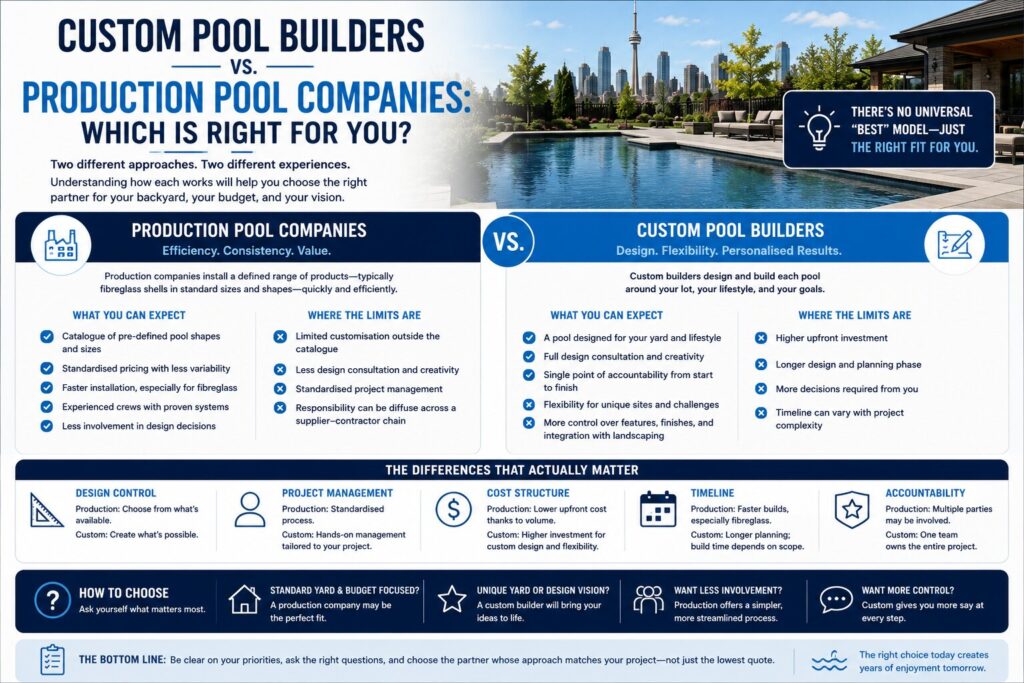
If you’ve been collecting quotes or doing research on Toronto pool contractors, you’ve probably noticed that companies fall into two broad categories — though they rarely advertise themselves that way. Some operate as production-style pool companies, offering a defined menu of products and installing them efficiently at volume. Others operate as custom builders, treating each project as a bespoke design and construction problem.
The difference matters more than most buyers realise — not because one model is universally better, but because they suit different buyers with different priorities. Understanding how each works will help you recognise which kind of company you’re dealing with and whether it’s the right match for your project.
How Production Pool Companies Work
A production pool company typically operates around a catalogue of pre-defined products — usually fibreglass shells in standard sizes and shapes, sometimes a limited range of vinyl pool configurations. Their value proposition is efficiency and predictability: they know how to install these specific products quickly, their crews are experienced with a narrow range of builds, and their pricing is relatively standardised.
This model works well. It’s how a large share of fibreglass pools in the GTA get installed, and when it’s well-executed, it produces a quality result in a compressed timeline. The economics are real: a company that installs the same fibreglass shell model fifty times per season has a material cost and labour efficiency advantage that a custom builder doing one-off concrete designs simply can’t match.
What a production model typically offers:
- A defined catalogue of pool shapes, sizes, and configurations
- Standardised pricing with less variability between projects
- Faster installation timelines, particularly for fibreglass
- Crew experience with specific products they install repeatedly
- Less involvement from the buyer in design decisions
Where a production model typically has limits:
- Limited ability to customise shape, depth, or features outside the catalogue
- Less design consultation — you’re selecting from options, not co-creating
- Project management tends to be standardised alongside the product
- When something goes wrong, responsibility can be diffuse across a supplier-contractor chain
How Custom Pool Builders Work
A custom pool builder — sometimes called a design-build contractor — approaches each project individually. Rather than selecting from a catalogue, the builder works with you to design a pool that fits your specific lot, your budget, your use patterns, and your aesthetic goals. The result is typically a poured concrete or bespoke vinyl pool, though custom builders also install fibreglass when the right shell fits the design brief.
The design-build model comes with more variables than production installation — the process involves more back-and-forth, more decisions to be made, and more coordination across trades. It also tends to cost more, both because the work is genuinely more complex and because the builder is allocating more time and expertise to each individual project.
What a custom model typically offers:
- A pool designed specifically for your yard, not a catalogue match
- Full design consultation — shape, depth, features, materials, layout
- A single point of accountability for the project from design through final inspection
- Greater flexibility to respond to site-specific conditions
- More involvement in feature selection, finish choices, and integration with surrounding landscaping
Where a custom model has limits:
- Higher upfront cost than equivalent production builds
- Longer planning and design phase before construction begins
- More decisions required from the buyer
- More variability in timeline depending on project complexity
The Differences That Actually Matter
Design Control
This is the clearest distinction. A production company’s design conversation typically starts with “which shell do you want?” A custom builder’s design conversation typically starts with “what do you want this space to feel like?”
If you have a standard rectangular lot, want a straightforward pool without unusual features, and are primarily choosing based on material type and price, a production approach may serve you perfectly well. If your lot is irregular, your design vision involves specific features, or the integration between the pool and the surrounding yard is central to your goals, a production catalogue is likely to be limiting.
The degree to which design matters to you is probably the clearest single indicator of which model fits.
Project Management
In a production model, project management is typically standardised alongside the product. The crew knows the build sequence, the materials are the same as last time, and the project moves through defined phases with relatively little variation.
In a custom model, project management is more involved — coordinating trades across a bespoke build, managing design decisions that arise during construction, and maintaining communication with a homeowner who has more input and more questions. A good custom builder considers project management a core part of what they offer. A custom builder with weak project management is one of the more challenging experiences a homeowner can have.
When evaluating a custom contractor, ask specifically: who is my point of contact throughout the project? How often will I receive updates? Who coordinates the plumber, the electrician, and the concrete crew?
Accountability
When something goes wrong in a production model — a fitting that leaks, a shell that was backfilled incorrectly, a finish that doesn’t match expectations — the accountability question sometimes involves a conversation between the contractor and the manufacturer. If the pool is a branded fibreglass product installed by a certified dealer, warranty claims may run through a manufacturer process rather than being resolved directly by the contractor.
In a custom model, accountability tends to be more direct — the contractor designed and built the specific pool, so there’s no manufacturer intermediary to involve in most disputes. Whether this is an advantage depends on the contractor’s willingness to stand behind their work, but the chain of responsibility is shorter.
Either way, the questions to ask are: what is covered under the contractor’s workmanship warranty, what is covered under the manufacturer’s product warranty, and who do I call if something fails in the first two years?
Pricing Model
Production companies typically price from a menu — a defined cost for each shell size, with defined add-on prices for upgrades. This makes quoting faster and comparison between contractors more straightforward.
Custom builders typically quote per-project, with pricing that varies based on design complexity, site conditions, material selections, and trade coordination requirements. This makes quotes harder to compare apples-to-apples and requires more work from the buyer to understand what they’re actually comparing.
An itemised quote is important in both models — but in custom building, it’s essential. Without a line-by-line breakdown, you have no way to understand whether you’re comparing equivalent scopes.
Who’s Responsible When Something Goes Wrong
In a production model, the contractor installs a product largely as designed by someone else. If that product has a defect, the manufacturer is the first line of recourse. If the installation was poor, that’s the contractor. The distinction matters in a dispute.
In a custom model, the contractor built what they designed. There’s rarely a manufacturer to point to. This means disputes are more directly resolved between homeowner and contractor — which can be faster and cleaner, or more contentious, depending on the contractor’s character.
Which Is Right for You?
Consider a production approach if:
- You want a fibreglass pool and the available shells in the right size and shape meet your needs
- Speed of installation is a priority
- Budget is the primary decision driver and you’re less focused on customisation
- You’re comfortable selecting from defined options rather than co-designing
Consider a custom approach if:
- Your lot has unusual dimensions, slope, or access constraints that a catalogue shell can’t accommodate
- Your design vision involves specific features — an unusual shape, a tanning ledge configured a particular way, an integrated spa, a concrete finish matched to surrounding architecture
- The relationship between the pool and the rest of your backyard is a significant design consideration
- You want a single point of accountability throughout the project
Most homeowners in Toronto with standard suburban lots and a clear preference for a specific fibreglass shell are well-served by a production approach. Homeowners with concrete pools, custom designs, or lots that present site-specific challenges tend to be better served by a custom builder with the design and project management capacity to handle more complexity.
How to Tell Which Kind of Company You’re Dealing With
The clearest signal is how the initial conversation goes. A production company will move quickly toward product selection — “have you thought about fibreglass, here are the shells we carry.” A custom builder will spend more time asking about your yard, your goals, and your timeline before discussing specific products.
Neither approach is wrong. But it should be matched to what you’re actually looking for.
When comparing options, also ask: do you provide a site visit before quoting? Do you offer a design consultation, and is it included in the project? Who manages the permit process? Who is my day-to-day contact during construction?
The answers will tell you as much about how a company operates as any amount of research.
For more on evaluating pool contractors in Toronto, see How to Choose a Pool Contractor in Toronto and Pool Contractor Red Flags. If you’re ready to explore a design-build approach for your project, see our Pool Design and Build Toronto and Custom Pool Installation Toronto pages.