

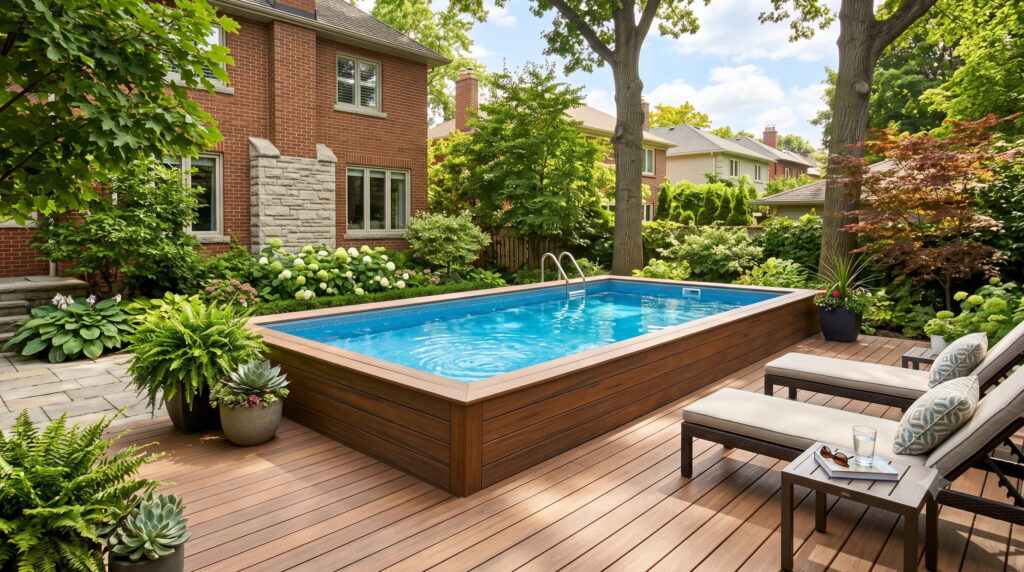
When most people start researching pools for their Toronto backyard, they think they’re choosing between two categories: above-ground (cheaper, temporary-looking) or inground (permanent, expensive). That mental model skips an entire product category that, for a meaningful share of GTA lots, is actually the most practical answer.
Semi-inground pools sit partly above grade and partly recessed below it — and they solve two problems that neither of the other options handles well. This post explains what they are, who they’re actually for, and why they’re far more common on Toronto lots than most homeowners realise.
What “Semi-Inground” Actually Means
A semi-inground pool uses a reinforced panel or frame structure — built to heavier specifications than a standard above-ground pool — with some portion of the wall recessed into the ground and the rest standing above grade. The ratio of buried to exposed wall depends on your specific site; on a sloped lot, the high side of the yard might have the pool fully recessed while the low side has several feet of wall exposed.
This isn’t an above-ground pool that happens to be sitting in a hole. Semi-inground pools are engineered specifically to handle the asymmetric soil pressure that comes from being buried on one side and exposed on the other — something a standard above-ground structure can’t safely manage.
The construction requires partial excavation (less than a full inground build), which keeps costs meaningfully lower than a fully inground pool, and the finished product — particularly once decking is added — reads as considerably more built-in than a standard above-ground structure.
The Sloped Yard Problem (and Why Semi-Inground Solves It)
Here’s a scenario that’s common across the GTA: a homeowner with a backyard that slopes significantly from one side to the other wants a pool. They get quotes from pool contractors, and the news isn’t great. Installing a standard inground pool on a sloped lot often requires:
- Retaining walls: to hold back the slope and create a level installation area, typically adding $15,000–$25,000 to the project cost depending on height and length
- Significant grading work: cutting the high side and filling the low side, with all the drainage considerations that entails
- Potential structural engineering: for retaining walls above approximately 1.2 metres in Ontario
All of this adds cost before the pool itself has even been priced.
A semi-inground pool takes a different approach. Instead of forcing the yard to be flat, the pool structure is positioned to work with the slope. On a sloped lot, the pool can be set so the high side of the yard meets the pool at or near grade, while the low side has the wall exposed above grade — the pool “steps” with the natural grade of the land. In many cases, this configuration requires no retaining wall at all.
For a homeowner who was looking at a $110,000 full inground pool plus $20,000 in retaining walls to make a sloped yard work, a $35,000–$50,000 semi-inground pool that works with the slope without additional earthwork is a genuinely different financial proposition. Not a compromise — a better solution for that specific site.
The Sloped Lots of the GTA
Toronto and the surrounding GTA have no shortage of sloped residential lots. The geography explains why:
- Ravine-adjacent properties throughout the old city and inner suburbs — Humber Valley, Don Valley, Taylor-Massey, Lawrence Park — regularly slope toward the ravine system
- North York and Scarborough have significant grade variation across established neighbourhoods
- Many mid-century suburban lots in Etobicoke, North York, and Markham were built on varying terrain with yards that slope in one or more directions
- Lots near major creek systems throughout Mississauga, Brampton, and the eastern GTA commonly have natural grade changes of several feet
This is a meaningful share of the Toronto-area housing stock. And for many of these lots, the honest answer to “what pool type makes sense here?” is semi-inground — not because it’s the cheapest option, but because it’s the most practical one.
Who Else Benefits From Semi-Inground
The sloped-lot scenario is the most compelling use case, but semi-inground pools make sense in several other situations:
Budget-conscious inground buyers. A well-designed semi-inground pool, with proper decking and landscaping, reads as a genuine inground installation. At $20,000–$50,000 installed, it occupies a middle ground that doesn’t exist with the other two standard categories. For a buyer who wants the appearance and permanence of an inground pool but can’t stretch to a $65,000+ fibreglass or $100,000+ concrete build, a semi-inground can be a legitimate alternative — not a fallback.
Homeowners with partially limited budgets who still want a real pool. An above-ground pool in the $5,000–$15,000 range is genuinely cheap but reads as temporary and provides limited design flexibility. A semi-inground pool for $25,000–$40,000 provides meaningfully more permanence, more design integration potential, and better decking options than an above-ground structure.
Properties where full excavation is complicated. Semi-inground pools require partial excavation — significantly less than a full inground pool. On sites where soil conditions, underground utilities, or tight access make extensive excavation expensive, partial excavation can be a meaningful cost advantage.
What Semi-Inground Pools Look Like When Done Well
This is where most people have a mental image problem. “Semi-inground pool” can conjure a picture of an above-ground pool sitting in a shallow hole with exposed walls. That’s the baseline version. Here’s what the better version looks like.
A well-designed semi-inground pool has decking built to pool wall height — either wrapping around the full perimeter or creating a defined entry platform — that visually integrates the pool into the yard as a permanent feature. The exposed wall below the decking is finished with skirting, stone veneer, or landscaping that hides the structure and makes the pool read as part of the landscape rather than sitting on top of it.
On a sloped lot where the high side of the yard is at grade and the low side has 2–3 feet of wall exposed, a well-designed installation puts the deck at pool-wall height on the exposed side, uses the grade change creatively to create a stepped or tiered backyard layout, and incorporates the pool into the overall landscape design rather than working against it.
The honest truth: a semi-inground pool with good decking often looks more considered and deliberate than a standard full-inground pool with minimal surrounding design. The grade change it accommodates can become a design feature rather than a problem to be solved.
For design ideas on making a semi-inground pool work visually, see Semi-Inground Pools.
What Semi-Inground Pools Cost in Toronto
Installed semi-inground pool costs in the GTA typically run $20,000–$50,000, depending on:
- Pool size and shape (round is more economical than oval or rectangular)
- Exposure ratio — how much of the wall sits above grade
- Site conditions — how much excavation is needed and what soil conditions are like
- Decking scope — the decking is typically the single largest add-on cost, and on a semi-inground pool it’s more structurally involved than surrounding an above-ground pool
The deck on a semi-inground pool deserves its own budget consideration. Because the pool has exposed wall above grade, the deck has to bridge that height difference — which is more structurally involved than a flush deck around a full-inground pool. Budget $3,000–$10,000+ for a properly designed semi-inground deck depending on materials and extent.
Total realistic all-in cost for a semi-inground pool with appropriate decking: $25,000–$60,000 in the GTA, depending on scope. Compare this to the cost of the equivalent full-inground pool plus retaining walls and grading on a sloped site, and the math often shifts significantly in the semi-inground’s favour.
How to Know If Semi-Inground Is Right for Your Lot
Ask yourself:
- Does your backyard slope more than a few inches across the pool footprint? Semi-inground may be a better slope solution than a full inground with retaining walls.
- Is your target budget in the $25,000–$60,000 range? Semi-inground sits where nothing else does in the pool market.
- Do you want something more permanent and designed-looking than an above-ground pool, without the full cost of an inground build?
- Are you on a lot where soil conditions or access make extensive excavation expensive?
If any of these describe your situation, a semi-inground pool is worth getting a site assessment for. The right contractor will be able to look at your specific yard and give you an honest answer about whether it’s the better solution — or whether the full inground option makes more sense despite the additional cost.
Frequently Asked Questions
Is a semi-inground pool permanent?
More permanent than a standard above-ground pool but not as structurally permanent as a full inground. A quality semi-inground installation can last many years, but the structure doesn’t have the same permanence as a concrete or fibreglass shell set fully below grade.
Does a semi-inground pool need a fence in Toronto?
Yes — the same pool enclosure rules apply as for any pool with a water depth over 600mm (about 24 inches). See Toronto Pool Fence Bylaws.
What pool shapes are available?
Round pools are the most common and most affordable semi-inground configuration. Oval and rectangular shapes are available at a higher cost. Round pools are the easiest shape to deck effectively.
Can I build a deck around a semi-inground pool?
Yes — and a deck is usually what makes the installation look finished and intentional. The deck needs to be designed to meet the pool wall at the appropriate height, which is a somewhat more involved design exercise than decking a full-inground pool but is standard work for experienced builders.
How does the installation differ from a full inground pool?
Semi-inground requires partial excavation — enough to recess the desired portion of the wall below grade — but significantly less than a full inground build. The construction timeline is also shorter, typically days to a week for the pool structure itself, with decking taking additional time.
Interested in exploring semi-inground for your property? Our Semi-Inground Pools page covers the full design and construction detail. For a site-specific assessment of whether your yard is a good candidate, contact Easy Pools for a free consultation.