

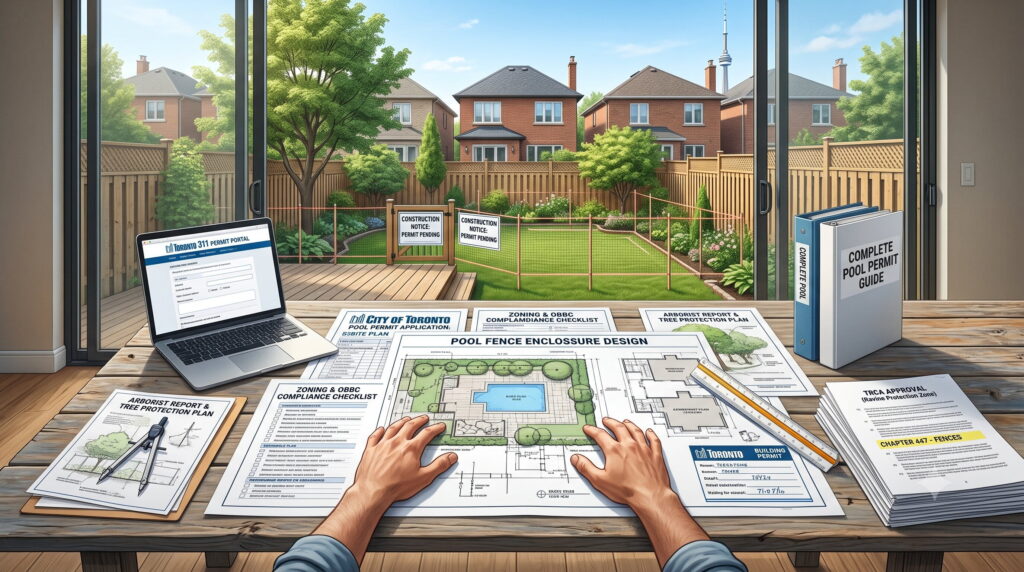
If you search for pool permit information in Toronto, you’ll find a lot of content that gets the fundamentals wrong. The most common error — repeated on contractor websites, home improvement forums, and even some municipal guides — is stating that you need a building permit for a swimming pool in Toronto. You don’t. The pool structure does not require a standard building permit under the Ontario Building Code’s application to Toronto.
What you do need is a specific two-step approval process that’s different from a standard building permit, involves different departments, and has sequencing rules that most sources don’t explain correctly. Getting this right before construction starts determines whether your pool opens on schedule or sits empty waiting for paperwork.
This guide covers the actual Toronto pool permit process, accurate fees, real timelines, and the additional approvals that can apply depending on your property.
The Most Important Thing to Know: No Building Permit Required
Let’s address the misconception directly. Under the Ontario Building Code, a swimming pool is not classified as a structure that triggers the standard building permit process for the pool shell itself. Toronto Building does not require a standard building permit for:
- A fibreglass pool installation
- A vinyl liner inground pool
- A concrete (gunite/shotcrete) pool
- An above-ground pool
This surprises homeowners who assume that a project of this scale would require a standard building permit. It also surprises some contractors who haven’t done extensive work within Toronto specifically, since other Ontario municipalities do require building permits for pool structures.
If a contractor or any other source tells you that you need a building permit for your pool structure in Toronto, that information is incorrect. What you actually need is described below.
The Two Approvals You Do Need
Toronto’s pool approval process involves two specific applications, applied to two different City departments, in a specific order:
Step 1: Zoning Applicable Law Certificate (ZALC) Applied to Toronto Building
Step 2: Pool Fence Enclosure Permit (PFEP) Applied to Municipal Licensing and Standards (MLS)
These are not interchangeable and they are not simultaneous. The Pool Fence Enclosure Permit application cannot be submitted or processed until the Zoning Certificate is approved. This sequencing is the most common procedural mistake homeowners and contractors make — submitting both at the same time or attempting to submit the fence permit first.
Step 1: Zoning Applicable Law Certificate
What It Does
The Zoning Applicable Law Certificate confirms that your proposed pool complies with Toronto’s zoning by-law — specifically: setbacks from property lines and the dwelling, overall lot coverage, and soft landscaping requirements. It also confirms that no other applicable law (TRCA, heritage overlay, etc.) creates an issue with the proposed location.
Where to Apply
Toronto Building — online through the City’s portal or in person at a Toronto Building counter.
What You Submit
- A completed application form
- A scaled, dimensioned site plan in PDF format showing:
- Your property boundaries
- All existing structures on the lot
- The proposed pool location with dimensions
- All setback distances (from property lines, dwelling, utilities)
- The pool’s relationship to any significant trees
The application includes up to three plan reviews, so minor revisions don’t require starting over from scratch.
Current Fee
$198.59 (as of the 2026 fee schedule; fees are reviewed annually — confirm the current amount at toronto.ca before applying).
What It Checks
The reviewer assesses your submission against:
- Setback requirements: minimum distances from property lines and the dwelling — these are zone-specific and vary by your property’s zoning designation. Look up your zone using Toronto’s Zoning By-law Viewer at the City’s website, then confirm the applicable setback distances with your contractor or the City before finalising pool placement.
- Soft landscaping: Toronto’s zoning by-law requires a minimum percentage of most residential lots to remain as soft (permeable) landscaping — typically 50% or more in most residential zones. Your pool’s water surface counts as soft landscaping; surrounding decking, paving, and hardscape doesn’t. On smaller lots that are already partially built up, a pool plus extensive surrounding hardscape can push total hard-surface coverage over the allowable limit, triggering a Minor Variance requirement. This is worth checking before finalising deck dimensions.
- Lot coverage: the percentage of the lot covered by all structures combined, including the pool.
Step 2: Pool Fence Enclosure Permit
What It Does
The Pool Fence Enclosure Permit confirms that your safety enclosure — the fence and gate system that isolates the pool — meets Toronto’s Municipal Code Chapter 608 requirements. This is the approval that governs construction of the physical safety barrier.
Where to Apply
Municipal Licensing and Standards (MLS) — a separate department from Toronto Building. Your contractor typically submits this; confirm explicitly who is responsible.
When to Apply
Only after the Zoning Applicable Law Certificate is approved. Do not submit the PFEP application before ZALC approval — it will not be processed.
What You Submit
- Proof of ZALC approval
- A site plan showing pool location, enclosure configuration, gate locations and swing directions, latch placement, and how the enclosure achieves four-sided isolation of the pool area (including any doors from the dwelling that face the pool area)
- Fence specifications: material, height, post spacing, gate mechanism
- The applicable fee
Current Fee
$214.79 (as of the 2026 fee schedule; confirm current amount before applying).
Review Timeline
Site plan reviews for the Pool Fence Enclosure Permit are typically completed within 10–20 business days of a complete application. During peak season (June–July), this can extend beyond that range. Submitting in fall, winter, or early spring — when application volumes are lower — typically produces faster reviews.
What the Fence Must Meet
Key bylaw requirements for the enclosure itself:
- Minimum height: 1.2 metres for single residential properties; 1.8 metres for multi-residential
- Gate: self-closing and self-latching, with the latch on the pool side of the gate and positioned to prevent reach-around
- Four-sided isolation: the pool area must be isolated on all sides, including from the dwelling. If a door from your home opens directly onto the pool area without any separating barrier, that configuration requires an additional isolation fence between the door and the pool — your perimeter fence alone is not sufficient
- No climbable adjacencies: objects like air conditioning units, BBQs, or storage bins placed against or near the fence create an effective bypass for young children and must be planned away from enclosure placement
For the complete fence specification, see Toronto Pool Fence Bylaws.
The Final Inspection: Required Before You Fill
This is the step that most homeowners don’t know about until their contractor tells them — and that, if ignored, results in fines.
You cannot legally fill your pool with water, or allow water to collect in it, until a Municipal Licensing and Standards inspector has confirmed that the completed enclosure meets the bylaw. Using the pool before this inspection has passed is a bylaw violation with potential fines.
How to book: call 311 to schedule an inspection after the enclosure is physically complete. Build adequate lead time — inspectors are busiest during June and July, and scheduling can take longer during peak season than you’d expect.
At inspection, the officer checks:
- Fence height around the full perimeter
- Gate self-closing and self-latching function (no propping)
- Latch placement and accessibility from outside the gate
- Four-sided isolation is complete with no unbarriered access from the dwelling to the pool area
- No climbable objects placed against the fence
A failed inspection means corrections and a re-inspection before the pool can be used. Common failure points include gates that don’t fully self-latch under their own weight, latches positioned at the wrong height or on the wrong side, or a climbable object placed against the fence after the fence was built.
Additional Approvals That May Apply
TRCA Approval
Toronto has an unusually large proportion of residential properties within Toronto and Region Conservation Authority (TRCA) regulated areas — land near rivers, ravines, streams, and the Lake Ontario shoreline. Pool construction on a TRCA-regulated property requires TRCA approval in addition to the City process. TRCA has online mapping tools to check whether your specific address is affected; check before assuming your property is clear.
Tree Protection
Toronto’s Private Tree Bylaw protects any tree with a trunk diameter of 30cm or more — including trees on neighbouring properties whose root zones extend into your yard. Excavation within the Tree Protection Zone around a protected tree requires a permit or deposit to the City. This can affect pool placement and needs to be assessed during the site visit, not discovered during excavation.
ESA Electrical Permit
All pool electrical work in Ontario — pumps, heaters, lighting, automation — requires an ESA (Electrical Safety Authority) permit and inspection. This is separate from all municipal approvals and is handled through the ESA, typically by your licensed electrician. Confirm that the ESA permit is included in your contractor’s scope or separately quoted.
Minor Variance (If Triggered)
If your project doesn’t comply with Toronto’s zoning by-law — setbacks, lot coverage, or soft landscaping — you can apply for a Minor Variance through the Committee of Adjustment. This involves a hearing, notice to neighbouring properties, and typically costs several thousand dollars including filing fees and often a planning consultant. The better approach is catching the issue at the design stage and adjusting pool placement or hardscape scope before it becomes a variance requirement.
Realistic Timeline for the Full Permit Process
Working backward from when you want to swim:
| Target swim date | Start ZALC application by | Expected PFEP approval | Excavation start |
| July 1 | Mid-February | Mid-April | Late April |
| August 1 | March | Early May | Mid-May |
| September (fall) | April–May | June | June–July |
During peak application season (March–June), the sequential process — ZALC, then PFEP — commonly takes 10–14 weeks total. In fall and winter, processing is faster. The most reliable way to achieve an early summer swim date is to start the ZALC application in January or February.
What Your Contractor Should Handle vs. What You Handle
Most established Toronto pool contractors manage the permit process as part of the project — preparing and submitting the ZALC application, coordinating the fence permit after ZALC approval, and booking the final MLS inspection. Confirm this explicitly before signing a contract, as some contractors treat permits as the homeowner’s responsibility.
When comparing contractors, ask directly:
- Who submits the Zoning Certificate application?
- Who manages the Pool Fence Enclosure Permit application after zoning is cleared?
- Who books the final MLS inspection?
- Are permit fees included in the contract price, or passed directly to me?
A contractor who handles all of this as part of the project is also one who understands the correct sequencing — a useful signal about their overall familiarity with Toronto’s specific process.
The Cost of Getting This Wrong
An unpermitted pool, or a pool with a non-compliant enclosure, creates real financial and legal exposure: fines from Municipal Licensing and Standards, complications at property sale (disclosure obligations apply), potential insurance claim denials on pool-related incidents, and in some cases orders to modify or remove non-compliant elements. The permit process in Toronto, once you understand it correctly, is straightforward and not especially expensive — the two core fees total approximately $413. Getting it right from the start is significantly less costly than addressing non-compliance after the fact.
→ For the consequences of skipping permits in detail: What Happens If You Install a Pool Without a Permit?
Frequently Asked Questions
Do I need a building permit for a pool in Toronto?
No — the pool structure itself does not require a standard building permit in Toronto. The required approvals are a Zoning Applicable Law Certificate and a Pool Fence Enclosure Permit, applied to different departments and in a specific order.
How long does the Toronto pool permit process take?
During peak season (March–June), the full sequential process typically takes 10–14 weeks. During fall and winter, processing is faster. Start the Zoning Certificate application in January or February for a summer swim target.
How much do pool permits cost in Toronto?
The Zoning Applicable Law Certificate is $198.59 and the Pool Fence Enclosure Permit is $214.79, for a total of approximately $413 in core permit fees. Additional fees may apply for TRCA review, Minor Variance, or other situational approvals.
Can I submit the fence permit at the same time as the zoning certificate?
No — the Pool Fence Enclosure Permit application cannot be submitted or processed until the Zoning Certificate is approved. Attempting to submit both simultaneously is one of the most common procedural mistakes.
Can I fill my pool before the final inspection?
No — filling the pool or allowing water to collect in it before the MLS inspector confirms enclosure compliance is a bylaw violation with potential fines.
For the zoning rules behind the Zoning Certificate process, see Pool Zoning Rules Toronto. For the enclosure standard the Pool Fence Enclosure Permit governs, see Toronto Pool Fence Bylaws and Pool Enclosure Permit Toronto.