

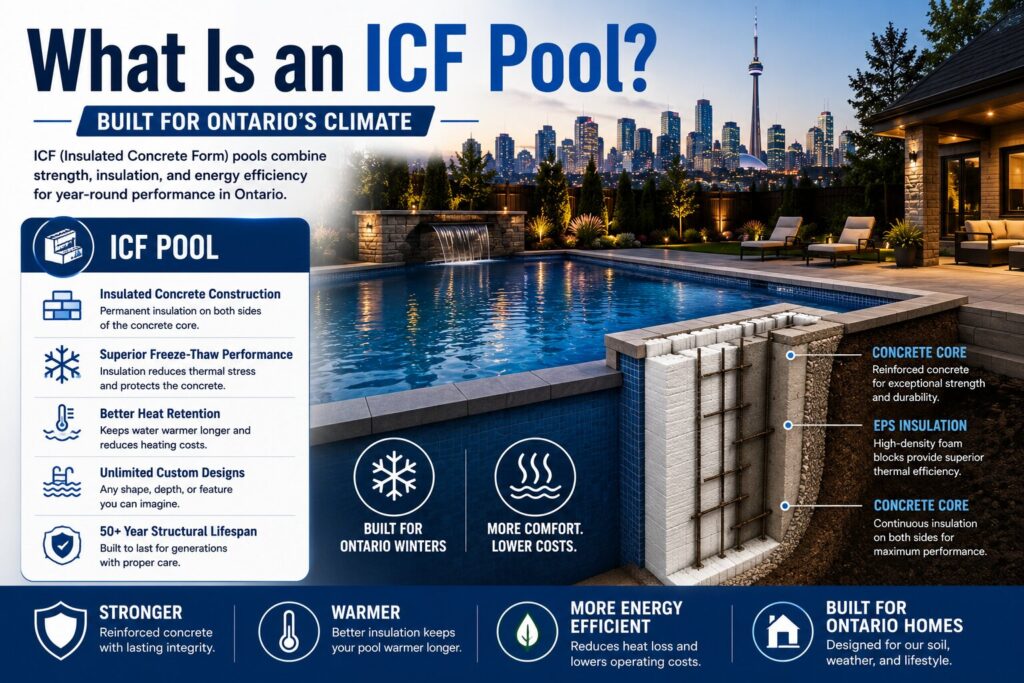
If you’ve been researching pool types in Toronto and keep seeing “ICF” mentioned in passing without a clear explanation, you’re not alone. ICF pools remain one of the best-kept secrets in the GTA pool market — not because they’re rare or experimental, but because almost no pool contractor takes the time to explain them properly.
This post covers everything you need to understand what an ICF pool is, why it performs particularly well in Ontario’s climate, how it compares to a standard concrete pool, and whether it might be the right choice for your project.
What ICF Actually Stands For — and What It Means
ICF stands for Insulated Concrete Form. The name describes the construction method precisely: instead of building a concrete pool shell using temporary formwork that gets removed after the concrete cures, ICF construction uses permanent insulated foam forms that stay in place forever.
Here’s how it works in practice. The pool’s shape is built by stacking and interlocking hollow foam blocks — made from expanded polystyrene (EPS), the same dense foam used in high-performance building insulation — into the outline of the pool. The blocks interlock like Lego bricks and can be cut to follow curves, creating any shape the design requires. Steel rebar is threaded through the hollow centres of the forms for structural reinforcement, exactly as with standard rebar-and-gunite concrete construction.
Then concrete is poured into the hollow cores of the assembled blocks, filling the structure and curing around the rebar. Once it cures, you have a reinforced concrete shell — but sandwiched permanently on both sides by a continuous layer of insulation.
That insulation layer is what stays, what distinguishes an ICF pool from any other type, and what makes it worth discussing.
How This Differs From Standard Concrete Pool Construction
In standard gunite or shotcrete concrete pool construction, concrete is applied under pressure directly onto a rebar skeleton. When it cures, you have a reinforced concrete shell — structurally excellent, but with no insulation. The concrete itself is in direct thermal contact with the surrounding soil, groundwater, and whatever temperature swings the ground around it experiences.
ICF construction produces the same reinforced concrete core, but with an important addition: the insulation on both sides of the concrete creates a thermal break between the pool water and the surrounding environment.
The practical result:
- The pool’s water temperature is buffered from temperature swings in the surrounding ground
- The concrete core itself experiences less thermal stress — the temperature differential between the water inside and the soil outside is moderated by the insulation
- Heat loss through the pool walls and floor is meaningfully reduced compared to standard concrete
This is why ICF is sometimes described as “concrete with a built-in advantage” — you get everything concrete offers in terms of design freedom and structural longevity, plus a physical characteristic that standard concrete pools simply don’t have.
Why ICF Is Particularly Relevant in Ontario
This is where the Toronto and Ontario context becomes important. ICF construction is used in pool markets across North America, but its advantages are more pronounced in climates like ours than in warmer, milder regions.
Freeze-Thaw Resilience
Ontario’s freeze-thaw cycle is one of the most demanding conditions a pool structure faces — not because of extreme cold temperatures, but because of the repeated cycling between frozen and thawed states across a typical GTA winter.
Concrete is vulnerable to this cycling because temperature differentials create stress within the material. Water infiltrates micro-cracks in the surface, freezes and expands, then thaws and contracts — widening the crack slightly with each cycle. Over many winters, this manifests as surface deterioration, which is why concrete pool plaster finishes in Ontario typically need resurfacing on a shorter cycle than in warmer climates.
The insulation layer in an ICF pool reduces the temperature differential the concrete core experiences. The soil-side face of the concrete is buffered from the coldest ground temperatures; the pool-side face is buffered from temperature swings in the water. The concrete core is thermally more stable than an uninsulated shell — and thermally stable concrete experiences less stress-related micro-cracking over time.
This isn’t a minor technical distinction. It’s one of the reasons ICF pool structures in cold climates routinely outlast their expected lifespans — the concrete is simply subjected to less stress across its life.
Heating Efficiency in Ontario’s Swim Season
Ontario’s outdoor pool season is real but limited — roughly May through September for comfortable unheated swimming, with shoulder seasons on either end that require heat to be usable. Heating costs are a meaningful ongoing expense for most GTA pool owners.
ICF’s insulation layer reduces heat loss through the pool walls and floor. It’s worth being precise about what this means in practice: the majority of a pool’s heat loss (estimates consistently run at 70–80%) happens through evaporation at the water surface, not through the walls and floor. A pool cover addressing evaporation has a larger impact on heating costs than any structural approach.
But the wall and floor heat loss component — the portion ICF addresses — is real. A pool that loses less heat through its structure requires less energy from the heater to maintain target temperature, particularly during cooler overnight periods and shoulder-season weeks when ground temperatures are lower than pool water temperature.
The result in practical terms: an ICF pool, particularly when paired with a quality pool cover, holds its temperature more consistently between heating cycles. For owners who want to swim comfortably in May and October — the weeks that standard uninsulated pools are marginal — ICF’s thermal performance is a genuine advantage.
Design Flexibility: Identical to Standard Concrete
One of the most common misconceptions about ICF pools is that the foam block system limits design options compared to standard gunite construction. It doesn’t.
ICF blocks can be cut, stacked, and formed to create any shape the design requires — curves, irregular geometry, multi-level designs, or any standard pool shape. Built-in features that are achievable in standard concrete (tanning ledges, integrated spas, built-in bench seating, beach entries, infinity edges) are equally achievable in ICF. The concrete core that results from ICF construction is structurally equivalent to gunite for the purposes of any standard residential pool feature.
Interior finish options are identical to standard concrete: standard plaster, quartz aggregate, pebble finishes, tile, or any combination. The finish choice consideration for ICF is the same as for standard concrete in Ontario’s climate — pebble or quartz finishes hold up better through freeze-thaw conditions than standard plaster, regardless of whether the shell beneath them is ICF or conventional gunite.
The design conversation for an ICF pool is exactly the same as for a concrete pool. If your design vision involves a shape, depth, or feature set that’s achievable in concrete, it’s achievable in ICF.
Cost: What to Expect
ICF pools typically cost 10–20% more than a comparable standard concrete pool. On a mid-size residential project, this premium reflects the cost of the insulated form system relative to standard formwork and the somewhat more deliberate block-assembly process compared to freeform gunite application.
In the GTA market, ICF pools typically run $110,000–$200,000+ installed, depending on pool size, features, and finish level — placing them at the higher end of the concrete cost range. For the full breakdown, see ICF Pool Installation Toronto.
Whether the premium is worth it depends on how you weight the advantages:
- If you plan to heat your pool aggressively and want to extend your season into shoulder months, the reduced heating cost over a decade-plus of ownership begins to offset the construction premium
- If long-term structural durability and reduced thermal stress on the concrete structure matter to you, ICF delivers this at a premium that many concrete pool buyers consider reasonable
- If you’re building a feature-forward custom pool with a significant construction budget, the ICF premium represents a smaller percentage of the total project cost
It’s worth noting that ICF also eliminates one of the recurring cost categories in other pool types: there’s no liner to replace (unlike vinyl) and the thermal-stress reduction extends the interval before concrete resurfacing is needed compared to standard gunite pools in Ontario conditions.
ICF vs. Standard Concrete: The Side-by-Side
| Standard Concrete | ICF | |
| Construction method | Gunite/shotcrete on rebar skeleton | Concrete poured into permanent insulated forms |
| Design flexibility | Unlimited | Unlimited (identical) |
| Structural lifespan | 50+ years | 50+ years (potentially longer due to reduced thermal stress) |
| Surface lifespan (Ontario) | 7–10 yrs (plaster); 15–20 yrs (pebble) | Same — determined by interior finish choice |
| Freeze-thaw resilience | Good | Excellent — insulation reduces thermal stress on core |
| Heating efficiency | Standard | Better — insulation reduces heat loss through walls/floor |
| Cost premium | Baseline | 10–20% above standard concrete |
| Best suited for | Any custom pool project | Custom projects where thermal performance and longevity are priorities |
Is an ICF Pool Right for You?
ICF makes the most sense when two or more of the following apply to your project:
You want concrete’s design freedom — unusual shapes, built-in features, multi-level designs — and you’re already in the concrete cost range where the ICF premium is a smaller percentage of the total project.
Heating cost and season extension matter to you. If your goal is to swim comfortably in May and October, and you’re committed to heating the pool to achieve it, ICF’s contribution to holding temperature and reducing heater cycling is a real, ongoing advantage.
You’re building a long-term property investment. ICF’s structural advantages are most fully realised over the decades-long lifespan of the pool. If this is a forever home or a significant long-term property, the longevity case for ICF is strong.
You’ve experienced the frustration of concrete resurfacing cycles on an existing pool and want to extend the interval on your next build. The reduced thermal stress in Ontario’s freeze-thaw climate translates directly to longer time between surface maintenance.
If you’re choosing between fibreglass (lowest maintenance, limited design) and concrete (maximum design, more maintenance), ICF sits at the top end of the concrete category — offering everything concrete offers, with meaningful advantages in thermal performance and long-term structural stability.
Frequently Asked Questions
Is an ICF pool the same as a regular concrete pool inside?
Yes. The interior surface, finish options, and construction experience for the swimmer are identical. ICF is a construction method for the shell — what you see and touch inside the pool is the same finish (plaster, pebble, tile) as any concrete pool.
Does the foam in ICF pools degrade over time?
Expanded polystyrene is chemically stable and doesn’t degrade in the ground environment — it has been used in building foundations and below-grade applications for decades with consistent performance.
Can any pool contractor build an ICF pool?
ICF construction requires familiarity with the block system and the specific concrete-pour approach it uses. It’s not interchangeable with standard gunite technique. Ask specifically whether a contractor has built ICF pools previously and whether they have supplier relationships for the ICF block system.
How does ICF compare to fibreglass for energy efficiency?
Fibreglass has some inherent insulating properties in the shell material but less than a purpose-built ICF system. ICF is specifically designed to maximise thermal performance of an inground pool structure; fibreglass’s insulating advantage is secondary to its other characteristics.
Ready to explore ICF for your project? Our ICF Pool Installation Toronto page covers the build process, cost range, and design considerations in detail. For a broader comparison of pool types, see Fibreglass vs Vinyl vs Concrete Pools or Best Pool Type to Install.