

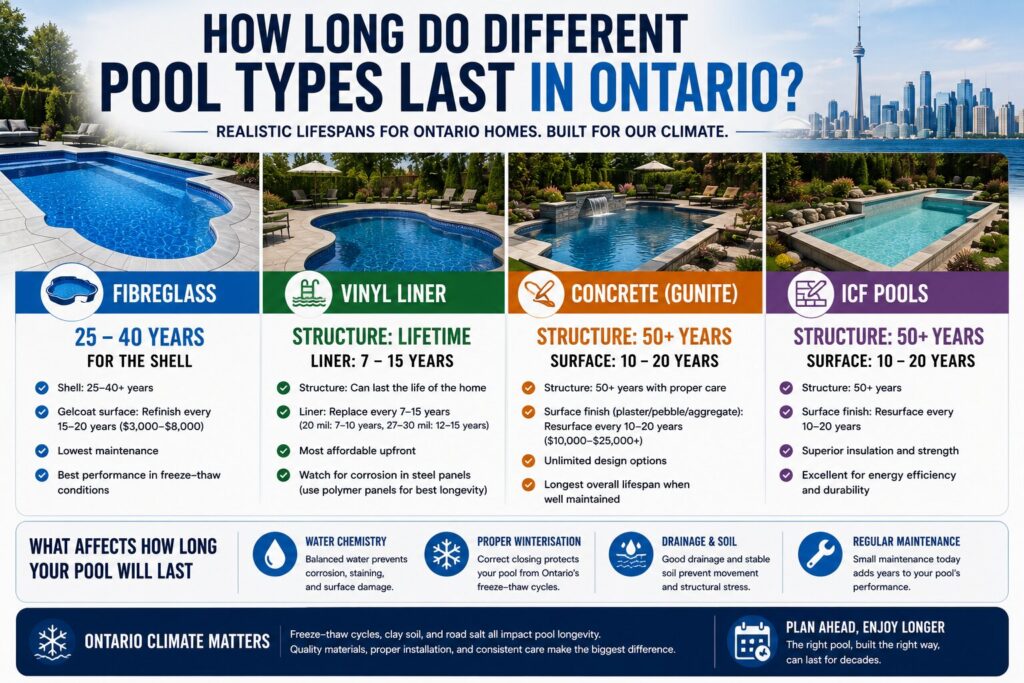
Pool lifespan is one of those topics where most online guides give you the national average and stop there. In Ontario, that’s only part of the story. Our freeze-thaw winters, clay soils, road salt exposure, and the specific way our summers heat pool water all affect how long a pool performs — and where in the lifespan range your specific pool lands.
This post covers real lifespans for each major pool type, what “lifespan” actually means for each (because a pool’s structure and its surface age on very different timelines), and the Ontario-specific factors that move the number up or down.
First: What Does “Lifespan” Actually Mean for a Pool?
Pool lifespan means different things depending on what component you’re measuring. The structural shell of almost any well-built inground pool can last for decades. What ages faster — and what most homeowners actually experience as “the pool’s lifespan” — is the surface finish or the wear item.
For vinyl pools, the wear item is the liner. For concrete pools, it’s the plaster or pebble finish. For fibreglass pools, it’s the gelcoat surface. The structure beneath these surfaces typically outlasts them significantly.
Understanding this distinction matters for budgeting: you’re not replacing a pool every 10 years, but you may be replacing a liner, or scheduling a resurfacing, on roughly that cycle.
Ontario’s Climate: What Makes Lifespan Calculations Here Different
Three Ontario-specific factors affect every pool type’s longevity in ways that generic national guides don’t capture:
Freeze-thaw cycling. Toronto and the broader GTA don’t experience deep sustained freezes the way northern Ontario does. Instead, the ground cycles repeatedly through freezing and thawing across a typical winter — sometimes multiple times in a single week during shoulder-season. This repeated movement stresses pool surfaces, grout, tile adhesive, and coping far more than a single deep freeze would.
Clay soil. Toronto’s prevalent glacial clay holds moisture, expands when wet, and contracts when dry. Soil movement around a pool shell — particularly in drought conditions followed by wet seasons — creates stress at connections and can accelerate surface cracking in rigid materials.
Road salt and de-icing chemicals. Ontario’s municipalities apply significant quantities of road salt each winter. Salt migrates through soil and groundwater; in established neighbourhoods, it reaches pool systems through water that contacts pool components. Salt is corrosive to steel wall panels in vinyl pools and to metal fittings, pool equipment, and certain finishes across all types.
Fibreglass Pools: 25–40 Years for the Shell
A properly manufactured and correctly installed fibreglass pool shell typically lasts 25–40 years in Ontario conditions. Some installations exceed this range. The shell itself — the fibreglass laminate structure — is the most durable component of any pool type when it comes to the actual pressure-holding structure.
What limits fibreglass longevity in Ontario:
- Improper backfill. In Toronto’s clay soil conditions, the critical maintenance of correct gravel backfill around the shell is what determines whether the shell remains stable through decades of freeze-thaw cycles. Clay backfill — a common installation shortcut — allows uneven pressure to develop against the shell over time.
- Gelcoat surface. The interior gelcoat finish needs refinishing every 15–20 years at a typical cost of $3,000–$8,000. This is not a sign that the pool is failing — it’s scheduled maintenance on the wear surface, while the structural laminate behind it remains sound.
- Osmotic blistering. In some fibreglass pools, water infiltrates the gelcoat and creates blistering in the laminate layers beneath. This is more a manufacturing quality issue than a climate issue, but it appears most visibly in pools that have experienced prolonged chemical imbalance or certain UV exposure patterns. Quality shells from established manufacturers have significantly reduced this issue.
What extends fibreglass lifespan in Ontario: quality installation with proper gravel backfill, consistent water chemistry, correct winterisation every fall, and addressing any osmotic blistering early rather than letting it progress.
→ Related: Fibreglass Pools | Cost to Install a Fibreglass Pool
Vinyl Liner Pools: Structure Indefinitely, Liner 7–15 Years
The vinyl pool structure — steel or polymer wall panels and their supporting components — can last the life of the home with proper care. This is an important distinction: when a vinyl pool “needs to be replaced,” what’s almost always being replaced is the liner, not the pool.
The liner itself lasts 7–15 years in Ontario depending on:
- Liner thickness. A 20-mil liner typically lands in the 7–10 year range. A 27–30 mil liner, with all else equal, commonly reaches 12–15 years.
- Water chemistry. Low pH is the single biggest accelerator of liner aging — it degrades the vinyl’s plasticizers, causing brittleness and cracking, particularly at the waterline band. Pools with consistently balanced chemistry outlast pools where chemistry fluctuates.
- Winterisation quality. Ontario’s freeze-thaw cycle doesn’t have to touch the liner at all if the pool is properly closed — water level correctly lowered, ice prevented from forming directly against the vinyl surface. Liners in pools that have experienced multiple poor winterisations age significantly faster.
- UV exposure. A south-facing pool receiving direct sun all day will fade and age its liner faster than a partially shaded one.
Steel vs. polymer panels in Ontario: Steel panels are the standard and durable in most conditions, but in very wet clay soils or in areas where road salt is particularly prevalent, polymer/resin panels hold up better over decades because they don’t corrode. When a liner is replaced on an older pool, the wall panels are inspected — and it’s at this stage that corrosion in steel panels is most commonly discovered.
What extends vinyl pool lifespan in Ontario: consistent water chemistry (especially pH management), a 27–30 mil liner, thorough winterisation every fall, and addressing small liner damage with patches before they propagate.
→ Related: Vinyl Liner Pools | Pool Liner Replacement Toronto
Concrete Pools: 50+ Years for the Structure, 7–20 Years for the Surface
A well-built concrete pool shell can last 50 years or more — it’s the most structurally durable pool type by a significant margin, which is why concrete pools from the 1970s are still in active use across the GTA. The structure rarely fails. What cycles through predictable lifespans is the interior finish.
Plaster (marcite): The most common concrete pool finish and the most vulnerable to Ontario’s freeze-thaw cycle. Water infiltrates hairline cracks in the plaster surface, freezes, expands, and widens the crack. Over many winters, this produces surface roughness, staining difficulty, and eventually etching and delamination. Standard plaster in Ontario typically needs resurfacing every 7–10 years — shorter than the 12–15 year range commonly cited for warmer climates.
Pebble and quartz finishes: Significantly more durable in freeze-thaw conditions because they’re denser and less porous than plaster. Pebble surfaces typically last 15–20 years in Ontario conditions before requiring attention, and quartz aggregate falls in a similar range. The higher upfront cost of these finishes versus plaster is substantially justified by the extended resurfacing interval.
Tile interiors: The most durable finish, lasting 20–30+ years in most conditions, though grout lines require maintenance and individual tile failures can occur from freeze-thaw expansion. Tile is also the most expensive interior option.
Ontario freeze-thaw and concrete: The surface vulnerability is real but manageable with finish choice. A concrete pool owner who selects pebble or quartz rather than plaster, and maintains consistent water chemistry (particularly calcium hardness, which prevents plaster leaching), will see a significantly longer surface lifespan than one who chose plaster and runs chemistry loosely.
What extends concrete pool lifespan in Ontario: Choosing pebble or quartz over standard plaster, managing calcium hardness within target range to prevent plaster degradation, thorough winterisation, addressing surface cracks early rather than late, and resurfacing before the existing surface begins to fail structurally (rather than just aesthetically).
→ Related: Concrete Pools | Pool Renovation Toronto
ICF Pools: Exceptionally Long Lifespan
ICF (insulated concrete form) pools are built using insulated foam blocks that stay permanently in place around the concrete core. This construction approach benefits longevity in two specific ways relevant to Ontario’s climate:
Reduced thermal stress. The insulation layer buffers the temperature differential between the water inside the shell and the surrounding ground. In Ontario’s freeze-thaw conditions, this matters — a less thermally stressed concrete core develops fewer stress-related micro-cracks over time than an uninsulated concrete shell experiencing the same temperature swings.
No liner or panel to replace. Like standard concrete, ICF has no liner to replace on the vinyl pool schedule and no steel panels subject to corrosion in Ontario’s salt-affected groundwater.
The structural lifespan of a well-built ICF pool in Ontario is realistically 50+ years, potentially exceeding that of standard concrete due to the reduced thermal stress. Surface finishes follow the same cycle as standard concrete — pebble and quartz for Ontario conditions, on a 15–20 year resurfacing interval.
→ Related: ICF Pools | ICF Pool Installation Toronto
Above-Ground Pools: 7–20 Years Depending on Type
Above-ground pools have the shortest lifespan of any category, with significant variation between product tiers:
- Standard steel or resin above-ground pools: typically 7–15 years for the structure before the frame, uprights, and wall show meaningful corrosion or fatigue
- Premium wood-sided or heavy-gauge models: can reach 15–20+ years with proper maintenance
- Liners: 6–10 years, similar to inground vinyl but typically thinner material
Ontario’s road salt is particularly relevant for above-ground pools — salt spray from driveways and roads accelerates corrosion of steel-framed structures. Resin and composite frames hold up better in salt-exposed environments.
What Determines Where In the Range You Land
Across every pool type, the same factors move longevity toward the longer end of the range:
- Quality of initial installation — particularly backfill material for fibreglass, drainage design for all types, and finish quality for concrete
- Consistent water chemistry — especially pH control for vinyl liners and calcium hardness management for concrete
- Thorough winterisation every fall — Ontario’s freeze-thaw cycle extracts maximum cost from inadequate closing
- Prompt attention to early damage — a patched liner tear, an early-stage concrete crack filled, a loose tile replaced promptly all prevent small problems from compounding
Lifespan Summary
| Pool Type | Structural Lifespan | Wear Item | Wear Item Cycle (Ontario) |
| Fibreglass | 25–40 years | Gelcoat finish | 15–20 years |
| Vinyl liner | Indefinite (life of home) | Vinyl liner | 7–15 years |
| Concrete | 50+ years | Plaster finish | 7–10 years (plaster); 15–20 years (pebble/quartz) |
| ICF | 50+ years | Plaster/pebble finish | 15–20 years (pebble/quartz) |
| Above-ground | 7–20 years (structure) | Liner | 6–10 years |
For a full comparison of pool types on cost, maintenance, and design, see Fibreglass vs Vinyl vs Concrete Pools. For the renovation decisions that arise at the end of a surface’s lifespan, see Pool Renovation Toronto.