

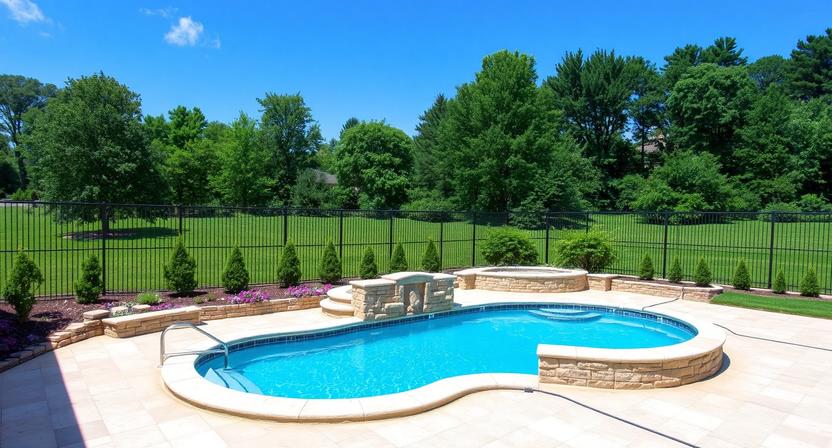
ICF (insulated concrete form) construction takes everything concrete already offers — unlimited design freedom, structural durability — and adds a layer of built-in insulation that standard poured concrete doesn’t have. For Ontario homeowners thinking about heating costs and swim season length, that one difference is worth understanding properly before you decide between ICF and standard concrete.
What Is an ICF Pool?
ICF pools are built using hollow, interlocking foam blocks that are stacked into the shape of the pool, then filled with reinforced concrete. Unlike traditional concrete construction, where formwork is removed once the concrete cures, ICF blocks stay permanently in place — becoming a continuous layer of insulation sandwiching the concrete core on both sides.
Costs at a Glance
ICF pools typically run $110,000–$200,000+ installed — generally somewhat more than standard poured concrete, reflecting the added form materials and insulation. Some of that premium is offset over time by avoided costs standard concrete and vinyl both carry: there’s no liner to ever replace, and no metal wall panels that can corrode.
Benefits of ICF Pools
- Continuous built-in insulation. This is the headline difference from standard concrete, covered in detail below.
- No liner, no corrosion-prone panels. Like standard concrete, ICF has nothing to replace on a liner’s schedule and no steel wall panels exposed to ground moisture.
- The same unlimited design freedom as standard concrete. Because the structural core is still poured concrete, ICF supports custom shapes, depths, and built-in features the same way standard concrete does.
- Better resistance to cracking and shrinkage. The insulated forms provide a stable, consistent mold during the pour and reduce the thermal stress concrete experiences from temperature swings — a genuine advantage in Ontario’s freeze-thaw climate specifically.
- A construction process that tolerates more weather variability. ICF assembly combines several steps that traditional concrete formwork handles separately, and can often proceed in a wider range of weather conditions than standard formwork-and-pour construction.
Energy Efficiency: The Defining ICF Advantage
The continuous insulation layer on both sides of the concrete core meaningfully reduces heat transfer through the pool’s walls and floor — the main path (besides surface evaporation) through which a standard concrete pool loses heat to the surrounding ground and air. In practice, this means your pool holds its temperature more consistently between heating cycles, and your heater doesn’t have to work as hard to maintain it.
It’s worth being precise about what this does and doesn’t mean: most of a pool’s heat loss happens through evaporation at the water’s surface, not through the walls — so ICF construction alone isn’t a complete heating-cost solution. The real value shows up when ICF is paired with a quality pool cover (which addresses the evaporation side) and an efficient heater, typically a heat pump. That combination is where homeowners see the most realistic and meaningful reduction in seasonal heating costs — not from the insulated walls in isolation.
For Toronto’s climate specifically, this combination can help stretch the comfortable swim season a few extra weeks into the spring and fall shoulder seasons, since the pool retains heat better overnight and between uses. See Pool Heating Systems and Energy-Efficient Pool Systems for the full picture on maximizing this advantage.
Design Options
Because ICF shares concrete’s structural approach, it carries over the same broad design freedom: custom shapes, multi-level layouts, integrated spas, and the full range of plaster, pebble, quartz, or tile finishes. See Concrete Pools for the complete design deep-dive — nearly everything covered there applies equally to ICF construction. The one practical difference worth discussing with your contractor is that very tight, sharp geometric corners can sometimes require more planning with block-based forms than with free-poured concrete — not a real limitation for most residential designs, but worth raising early if your design includes unusual angles.
Long-Term Use: What to Expect Over the Years
- Structural lifespan: similar to, and potentially exceeding, standard concrete — commonly 50+ years — partly due to reduced thermal stress on the structure over time.
- Surface finish: still needs resurfacing on the same schedule as any concrete pool, since the insulation benefit applies to the structure, not the surface finish. See our concrete cost guide for resurfacing cost by finish type.
- No liner or panel corrosion to manage, simplifying long-term ownership compared to vinyl.
- Day-to-day maintenance: essentially the same as standard concrete — regular brushing and water chemistry management, since the surface itself is the same plaster, pebble, or tile finish either way.
Is ICF Right for You?
ICF makes the most sense if you want concrete’s design freedom but also want to actively manage heating costs and extend your usable swim season — or if freeze-thaw durability is a specific concern for your property. If design freedom is your only priority and energy efficiency isn’t a major factor, standard concrete delivers the same design flexibility at a somewhat lower cost. See Concrete Pools for the full comparison point, or Best Pool Type to Install for the broader decision framework.
Frequently Asked Questions
What makes an ICF pool different from a standard concrete pool?
ICF pools are built with insulated foam forms that stay permanently in place around the concrete core, creating continuous built-in insulation that standard poured concrete doesn’t have.
How much does an ICF pool cost?
Typically $110,000–$200,000+ installed — somewhat more than standard concrete, reflecting the additional insulated form materials.
Does ICF actually reduce pool heating costs?
Yes, meaningfully, though not in isolation — the insulated walls reduce heat loss through the structure, but most pool heat loss happens through surface evaporation. Pairing ICF with a quality pool cover and an efficient heater is where the real heating-cost savings show up.
Can I get the same design freedom with ICF as standard concrete?
Yes, in almost every respect — shapes, depths, and built-in features all carry over the same way they do with standard poured concrete, since both use a reinforced concrete core.
How long does an ICF pool last?
Commonly 50+ years structurally, similar to or potentially exceeding standard concrete, with the same resurfacing schedule for the finish itself.
Get an ICF-Specific Quote
The right call between ICF and standard concrete depends on how much you value the energy efficiency trade-off against the modest cost premium.
Contact Easy Pools at (647) 449-9512 for a free, no-obligation quote on your ICF pool project.