

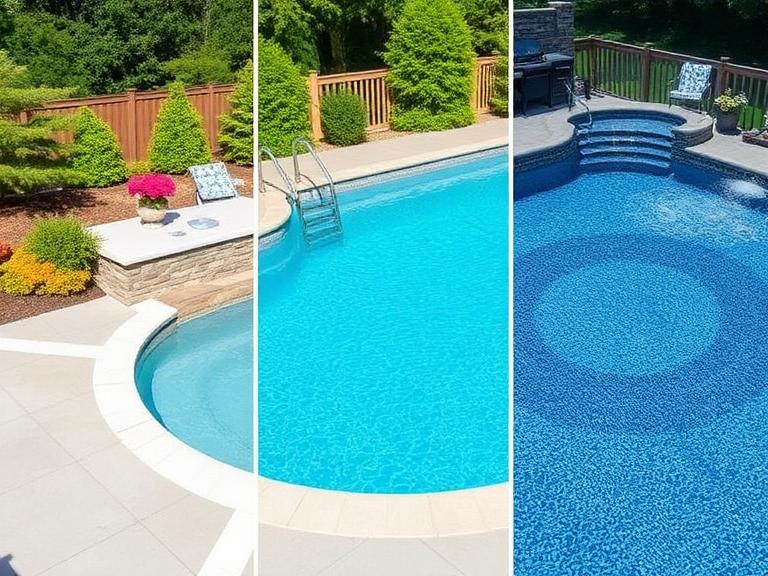
There’s no single “best” pool material — fibreglass, vinyl, and concrete each win on different priorities. Fibreglass wins on low maintenance and fast installation. Vinyl wins on upfront cost and design flexibility for the price. Concrete wins on unlimited customization and structural longevity. This guide compares all three head-to-head so you can match the material to what actually matters for your project.
Quick Comparison at a Glance
| Fibreglass | Vinyl Liner | Concrete | |
| Typical installed cost | $65,000 – $120,000 | $50,000 – $90,000 | $100,000 – $220,000+ |
| Installation time | 2–4 weeks | 4–8 weeks | 6–12 weeks |
| Maintenance level | Lowest | Low–moderate | Highest |
| Structure lifespan | 25+ years (often the life of the home) | Often the life of the home (walls) | Decades, with periodic resurfacing |
| Surface replacement | Gelcoat refinish every 15–20 years | Liner replacement every 7–12 years | Resurfacing every 7–20 years (finish-dependent) |
| Design flexibility | Limited to manufacturer shell shapes/sizes | Considerable — custom shapes and features | Unlimited — any shape, depth, or feature |
| Underwater feel | Smooth | Smooth | Can be textured/abrasive, finish-dependent |
| Algae resistance | Best (non-porous gelcoat) | Good (smooth liner surface) | Weakest (porous surface) |
Cost Compared
Concrete costs the most because it’s engineered and built entirely on site. Vinyl costs the least upfront because the wall system and liner are simpler to manufacture and install. Fibreglass sits in the middle, trading a higher shell cost for a faster, more predictable installation. For full pricing detail by size and finish, see Cost to Install a Fibreglass Pool, Cost to Install a Vinyl Pool, and Cost to Install a Concrete Pool.
It’s worth noting the cost ranges overlap more than people expect: a large, feature-rich fibreglass shell can cost more than a small, basic concrete pool. Get quotes for your actual size and feature list before assuming one material is automatically cheaper.
Maintenance Compared
- Fibreglass has the smoothest, most non-porous surface of the three, which makes it the most algae-resistant and the easiest to keep clean — typically just routine vacuuming and chemical balancing.
- Vinyl is also smooth and fairly algae-resistant, but the liner itself is the maintenance vulnerability: it can be punctured by sharp objects, pet claws, or rough play, and fades or stiffens with sun and chemical exposure over time.
- Concrete is the most maintenance-intensive. Its porous surface needs regular brushing — often 2–3 times a week — to prevent algae from taking hold, and water chemistry needs closer attention than the other two materials.
One chemistry-specific note: saltwater chlorination systems are popular for their lower day-to-day maintenance, but they can accelerate wear on basic plaster finishes in concrete pools. Pebble and quartz finishes handle saltwater systems better — see our concrete pool design options for the full finish comparison.
Lifespan Compared
The structure and the surface age on different timelines for each material, which is easy to overlook when comparing sticker prices alone:
- Fibreglass: the shell itself is extremely durable and commonly lasts 25+ years — often the life of the home — with only a gelcoat refinish needed every 15–20 years ($3,000–$8,000).
- Vinyl: the wall structure can also last the life of the home, but the liner is a wear item, typically replaced every 7–12 years at $4,000–$6,500 in the GTA. See Pool Liner Replacement Toronto.
- Concrete: the structural shell can last decades, but the surface finish needs resurfacing on a schedule tied to finish choice — every 7–10 years for basic plaster, stretching to 15–20+ years for pebble or tile, at $6,000–$18,000+ per resurfacing.
The practical takeaway: vinyl and concrete both have a recurring surface-renewal cost built into ownership; fibreglass is the only one of the three where the original surface is realistically expected to outlast a decade or two without major work.
Design and Comfort Differences
- Shape flexibility: concrete is unlimited — any shape, depth, or built-in feature is possible. Vinyl offers considerable flexibility within standard wall-panel systems. Fibreglass is the most constrained, limited to a manufacturer’s catalogue of shell shapes and sizes (and capped at roughly 40–45 feet in length — see our lap pool cost guide for why that matters if length is a priority).
- Underwater feel: fibreglass and vinyl both have smooth surfaces that are gentle on skin and swimsuits. Concrete’s feel depends on finish — some are smooth, but textured finishes can be noticeably more abrasive underfoot.
- Colour and finish options: fibreglass colour is set at the factory (gelcoat); vinyl liners offer wide pattern and colour choice and can be changed at each replacement; concrete finish (plaster, pebble, quartz, tile) is chosen at construction and changes only at resurfacing.
Which Pool Type Fits Which Priority?
| If your top priority is… | Consider |
| Lowest upfront cost | Vinyl |
| Lowest ongoing maintenance | Fibreglass |
| Fastest installation | Fibreglass |
| Unlimited custom shape or features | Concrete |
| Longest stretch before major surface work | Fibreglass |
| Budget-friendly customization | Vinyl |
Smart Tips Before You Decide
- Get quotes for all three at your actual size and feature list. Cost ranges overlap more than generic comparisons suggest, especially once you add features.
- Think in ownership cycles, not just sticker price. A cheaper pool with a recurring surface-renewal cost can cost more over 20 years than a pricier, lower-maintenance option.
- If a saltwater system matters to you, factor that into your finish choice — particularly with concrete, where plaster and pebble/quartz respond differently to salt.
- If you want serious length for swimming laps, check fibreglass’s length ceiling early — it’s the one material with a hard cap.
Frequently Asked Questions
Which is cheapest: fibreglass, vinyl, or concrete?
Vinyl typically has the lowest upfront installed cost, usually $50,000–$90,000 in the GTA, though it carries a recurring liner replacement cost that fibreglass doesn’t have.
Which pool material lasts longest?
Fibreglass shells commonly last 25+ years with only periodic gelcoat refinishing. Vinyl’s wall structure and concrete’s shell can both last decades too, but each needs surface renewal (liner replacement or resurfacing) on a shorter cycle than fibreglass’s gelcoat.
Which requires the least maintenance?
Fibreglass, by a clear margin — its non-porous gelcoat resists algae and needs the least routine attention. Concrete requires the most, including regular brushing to manage its porous surface.
Can I add a saltwater system to any of these?
Yes, all three are compatible with saltwater chlorination, but concrete pools with basic plaster finishes can see accelerated wear from salt exposure — pebble or quartz finishes hold up better.
Which is best for a Toronto climate?
All three are built to handle Ontario winters when properly installed and winterized. ICF (insulated concrete form) construction offers an additional edge for freeze-thaw resilience if that’s a specific concern — see our ICF pool guide for details.
Get Quotes Across All Three Materials
The right material depends on your budget, your maintenance tolerance, and how much design freedom you want — not a generic ranking. The most useful next step is comparing real quotes for your specific yard.
Contact Easy Pools at (647) 449-9512 for a free, no-obligation quote across any pool material you’re considering.