

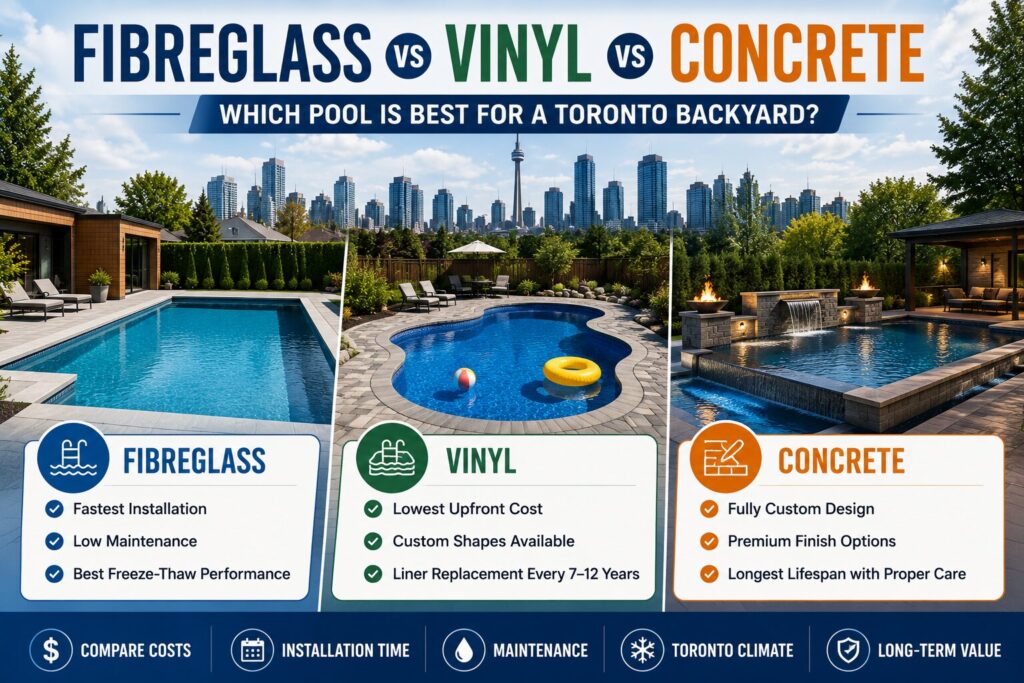
The national pool comparison posts you’ll find online cover fibreglass, vinyl, and concrete in ways that are broadly accurate but almost completely useless for Toronto homeowners. They don’t mention what clay soil does to each type. They don’t address freeze-thaw performance. They don’t account for crane access on a 25-foot-wide lot in Riverdale or the fact that your street might have overhead utility lines that rule out the shell you were planning to order.
This post does. If you’re comparing pool types for a GTA property specifically, here’s the comparison that accounts for where you actually live.
The Basics, Briefly
Before getting into what makes Toronto different, a quick summary of how the three types compare at a national level — because the fundamentals still apply.
Fibreglass pools arrive as a pre-formed shell manufactured off-site, lowered into an excavated hole by crane, and connected to plumbing and equipment. They’re the fastest to build (2–4 weeks of active construction), the lowest-maintenance, and the most predictably priced. The trade-off is design constraint: you’re choosing from a manufacturer’s catalogue of shapes and sizes, not designing a custom footprint.
Vinyl liner pools are the most accessible entry point into inground pool ownership. A steel or polymer wall panel system is assembled in the excavation and lined with a custom-fitted vinyl liner. Lower upfront cost than fibreglass or concrete, with a recurring liner replacement cost roughly every 7–12 years.
Concrete pools (gunite or shotcrete) are built entirely on site — rebar skeleton, concrete shell, interior finish — which gives complete design freedom at the cost of a longer build time (6–12 weeks), a higher initial price, and more intensive ongoing maintenance.
For the full head-to-head on costs, maintenance, and lifespan, see Fibreglass vs Vinyl vs Concrete Pools. What follows is everything that comparison doesn’t tell you about building a pool in Toronto.
Toronto Variable 1: Clay Soil
Toronto’s ground is predominantly glacial clay — heavy, slow-draining, and responsive to moisture in ways that affect every pool type differently.
Fibreglass in Clay
Clay soil creates specific obligations for fibreglass installation that less experienced contractors sometimes skip. A fibreglass shell depends on its surrounding backfill for structural support — the shell is flexible, designed to work in partnership with the material around it. The correct backfill material in clay conditions is gravel or crushed stone, not the excavated clay itself.
Here’s why this matters: clay holds water. Clay-heavy backfill around a fibreglass shell creates a zone of retained moisture that fluctuates with seasons. As that moisture freezes and thaws (more on that below), it can exert uneven pressure on the shell and, over years, cause warping or structural distortion. Proper gravel backfill, by contrast, drains freely and doesn’t expand under freeze-thaw.
The question to ask any fibreglass contractor in the GTA: what material goes back around the shell? If the answer is “the excavated soil,” that’s a shortcut that saves them material cost and will eventually cost you structural problems.
Vinyl in Clay
Clay soil affects vinyl pools primarily through two mechanisms: drainage and panel longevity.
Toronto’s clay drains slowly. A vinyl pool in a clay-heavy environment needs adequate drainage designed around the wall panel system — if water accumulates behind the liner or against the panels, it creates hydrostatic pressure that can buckle the walls or lift the liner floor. This is manageable with proper drainage design but requires intentional attention at installation, not as an afterthought.
Steel wall panels are the most common material in vinyl pool construction and are specifically vulnerable in persistently wet conditions — the kind that clay soils create. Galvanized steel holds up well for many years, but in very wet Toronto clay with drainage issues, panel corrosion is one of the most common long-term problems in older vinyl pools. Polymer/resin panel systems are the corrosion-resistant alternative and are worth specifying if your site assessment indicates persistently wet soil conditions.
Concrete in Clay
Of the three types, concrete is the most compatible with clay soil from a pure structural standpoint. Poured concrete doesn’t need the specific backfill material fibreglass requires — it’s formed against the clay itself and the concrete shell is structurally self-sufficient. Toronto’s clay actually provides fairly stable support once it compacts.
The clay interaction that matters for concrete isn’t structural — it’s drainage. A concrete pool in clay needs a well-designed drainage plan for the surrounding hardscape and equipment area, because the impermeable clay doesn’t naturally carry surface water away from the pool shell. Poor drainage design leads to water pooling against the pool structure, which accelerates plaster wear and can contribute to the shell cracking discussed in the next section.
Toronto Variable 2: Freeze-Thaw Performance
Toronto’s winters don’t stay cold — they cycle. The ground freezes, thaws, refreezes, and thaws again across a typical winter season. This repeated cycling is harder on pool structures and surfaces than the sustained deep freeze of colder northern climates, and each material handles it differently.
Fibreglass: Best Freeze-Thaw Performance
Fibreglass handles freeze-thaw better than the other two types. The shell has a small degree of inherent flexibility — it can accommodate minor ground movement as the surrounding soil contracts and expands without cracking the way rigid materials can. This characteristic, combined with the fact that fibreglass has no interior surface to absorb and retain water, makes it the most freeze-thaw-resilient of the three.
The main freeze-thaw vulnerability in fibreglass pools is improper backfill (clay instead of gravel) as discussed above — the shell itself performs well; the installation decisions around it determine long-term outcomes.
Vinyl: Moderate Freeze-Thaw Vulnerability
Vinyl liners themselves are somewhat vulnerable to cold temperatures — below approximately 10°C, vinyl becomes less flexible, which is why liner replacement should never happen in cold conditions, and why pools that aren’t properly winterised can experience liner damage from ice forming directly against the vinyl surface.
The wall panels in a vinyl pool are the other vulnerability. Steel panels that experience repeated freeze-thaw cycles in wet clay conditions develop surface corrosion over years — typically visible first as rust shadows on the liner surface. This doesn’t necessarily compromise the structural integrity immediately, but it’s a deterioration pattern that becomes visible at liner replacement time and sometimes requires panel repair or replacement as part of a liner swap.
Proper winterisation — water level correctly lowered, lines blown out, liner protected from ice contact — mitigates most of this. The freeze-thaw risk in vinyl is largely a maintenance and winterisation risk rather than a material design flaw.
Concrete: Most Freeze-Thaw Vulnerable
Concrete is the most susceptible of the three to Toronto’s freeze-thaw climate, and this is reflected in real maintenance patterns across the GTA.
Water infiltrates the micro-pores and hairline cracks that inevitably develop in plaster finishes over time. When that water freezes, it expands — widening the crack slightly. When it thaws, it contracts. Repeated over dozens of cycles across many winters, this process progressively deteriorates the surface. It’s why concrete pools in Toronto typically need resurfacing on the shorter end of the 7–15 year typical lifespan, and why the quality of the initial plaster application matters enormously for long-term surface performance.
The mitigation is choosing the right finish. Standard plaster is the most vulnerable — its porosity makes it the easiest entry point for water infiltration. Pebble and quartz finishes are denser, more durable, and significantly more resistant to freeze-thaw surface cycling. The higher upfront cost of a pebble finish versus plaster is partly justified specifically by its superior performance in Ontario’s climate. Tile interiors are the most durable of all but also the most expensive.
If you’re building a concrete pool in Toronto, discuss finish selection explicitly in the context of the local climate — not just aesthetics or cost.
Toronto Variable 3: Crane Access and Lot Constraints
This is the Toronto-specific variable that national comparison posts almost never mention, and it’s genuinely important for fibreglass buyers specifically.
The Crane Reality on Established Toronto Lots
A fibreglass shell arrives on a flatbed truck and is lifted by crane into the excavated hole — typically in a single dramatic operation that takes a few hours. The crane must position itself close enough to the excavation to reach the shell and lower it in. In a rural or newer suburban setting with wide streets and open properties, this is straightforward.
In established Toronto neighbourhoods, it’s a real constraint. Consider:
- Street width: many inner-city Toronto streets are narrow. A crane truck plus a flatbed truck positioned for a lift requires enough road width to operate safely. Some residential streets in older neighbourhoods require a road occupancy permit and partial lane closure.
- Overhead utility lines: Toronto’s established neighbourhoods have overhead electrical, telephone, and cable lines running along streets and sometimes diagonally across properties. The crane boom must clear these on its swing path from the street to the excavation.
- Tree canopy: mature boulevard and front-yard trees are common in established Toronto neighbourhoods. A tree with a canopy extending over the delivery path can block the crane’s clearance even when the overhead utilities are clear.
- Side-yard access: if the crane can’t reach the pool from the street or driveway and must work from behind the house, the side yard must be wide enough for the truck and equipment — typically 10+ feet.
None of these issues automatically disqualify fibreglass on a given lot, but they must be assessed before a shell is selected and ordered. A contractor who commits to a fibreglass pool without a thorough site visit to confirm crane access has not done their job.
Rear lane access is worth checking specifically for inner-city properties: many Toronto lots in the old city back onto public lanes that can provide equipment access from behind, bypassing the street entirely. This is worth knowing before you assume the front/side-yard approach is the only option.
Concrete and vinyl don’t have the crane constraint — both are built in place from smaller components that fit through normal access paths.
Toronto Variable 4: Timeline and Construction Season
Ontario’s outdoor construction season for inground pools runs roughly April through November, but it’s not eight uniform months. Toronto’s springs are often wet, which delays excavation and concrete work. The fall shoulder season is compressed by frost deadlines for concrete plaster curing.
Fibreglass in Toronto: the crane-day dependency adds a scheduling variable — the lift needs to happen during a weather window and with road access cleared. In practice, fibreglass builds still complete in 2–4 weeks once excavation starts, which makes them the most achievable pool type for a homeowner targeting a specific-season swim date.
Vinyl in Toronto: the liner fabrication lead time (1–3 weeks for a custom-made liner) creates a mid-project pause that extends the overall timeline to 4–8 weeks. The liner installation itself is temperature-sensitive — below approximately 10°C, vinyl becomes stiff and harder to fit properly, which constrains the season on both ends.
Concrete in Toronto: the longest build timeline of the three, and the most climate-constrained. Gunite application can’t proceed in freezing conditions, and the plaster startup sequence — which requires sustained water temperatures above roughly 12°C to cure properly — constrains fall closing dates. A concrete pool started in late spring with a complex design will sometimes not be swim-ready until late August. This is a genuine planning consideration that buyers focused on swimming this season need to account for.
→ See the full timeline breakdown: How Long Does It Take to Install a Pool?
Toronto Variable 5: Long-Term Ownership Cost in Ontario’s Climate
The national comparison between pool types on long-term cost typically focuses on liner replacement cycles (vinyl) and resurfacing cycles (concrete). In Toronto, the climate accelerates both of those cycles in ways that shift the long-term cost comparison.
Fibreglass remains the lowest long-term maintenance option in Toronto as it is nationally — the climate advantages discussed above (best freeze-thaw performance, no recurring surface replacement) hold up. The one ongoing cost to budget for in the GTA specifically is the gelcoat refinish at roughly 15–20 years, which runs $3,000–$8,000.
Vinyl typically sees liner lifespans of 7–12 years nationally. In Toronto, proper winterisation practice matters enormously for where in that range you land — liners in pools that have experienced multiple inadequate winterisations tend to age faster. Budget $4,000–$8,500 for liner replacement every decade or so, with the steel panel inspection at each liner change as a potential additional cost.
Concrete sees shorter plaster lifespans in Ontario’s climate than in warmer, milder markets. A standard plaster finish that might last 12–15 years in a southern market will often need resurfacing in 7–10 years in Toronto. Pebble or quartz finishes stretch this to 15–20 years but at higher initial cost. Budget $6,000–$18,000 for resurfacing depending on finish type and pool size, on a cycle that’s shorter in this climate than most online cost guides suggest.
Which Pool Type for Your Toronto Property?
After accounting for the Toronto-specific variables, here’s how the three types stack up for common GTA situations:
Fibreglass is the strongest choice for:
- Buyers who prioritise low maintenance and fast installation
- Standard suburban lots where crane access can be confirmed
- Properties with Toronto’s typical clay soil, provided the contractor uses proper gravel backfill
- Buyers who can find a shell in the manufacturer’s catalogue that fits their footprint and design vision
Vinyl liner is the strongest choice for:
- Buyers who want the lowest upfront cost for a true inground pool
- Custom shapes or features at a lower price point than concrete
- Properties where polymer panels make sense for wet clay conditions
- Buyers who understand and accept the 7–12 year liner replacement cycle
Concrete is the strongest choice for:
- Buyers for whom design matters most — unusual shapes, built-in features, architectural integration
- Larger lots where a full custom design can be executed without compromise
- Buyers willing to invest more upfront and choose a durable finish (pebble or quartz) that performs well in Ontario’s climate
- Properties where fibreglass crane access is genuinely impractical
For inner-city Toronto lots specifically (narrow, established neighbourhoods, overhead utility lines, mature trees): confirm fibreglass crane access before choosing that material. If access is feasible, fibreglass often remains the best value. If access is constrained, concrete or vinyl built in place avoid the crane problem entirely.
For the full specification on each pool type, see Fibreglass Pools, Vinyl Liner Pools, and Concrete Pools. For type-specific costs, see Cost to Install a Fibreglass Pool, Cost to Install a Vinyl Pool, and Cost to Install a Concrete Pool. For help choosing between types for your specific property, our pool installation Toronto page covers the first steps.