

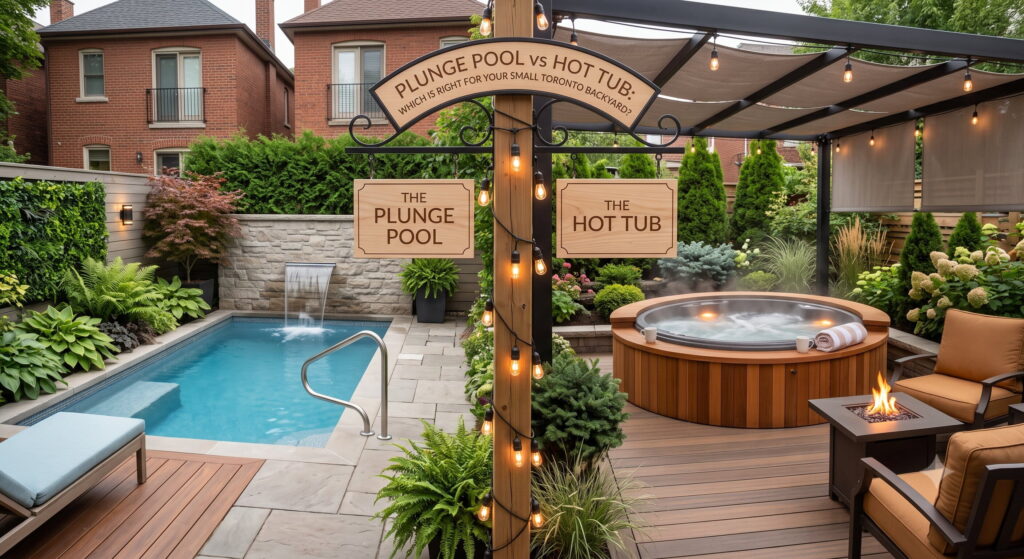
If you have a small Toronto backyard and want a water feature but can’t fit a full-size pool, you’re likely looking at two options: a plunge pool or a hot tub. They occupy similar square footage, they serve some overlapping purposes, and they’re in a similar price range. But they’re very different products, and the right choice depends almost entirely on what you actually want to do in the water.
This post covers the practical comparison — cost, space requirements, permits, year-round use, and use case — so you can make the decision that fits your specific situation.
What Each One Is, Briefly
A plunge pool is a compact, deep pool designed for soaking, cooling off, and hydrotherapy — not lap swimming. Typically 8–14 feet long and 4–6 feet deep, a plunge pool can be heated or left unheated, can include jets if specified, and is permanently installed as an inground or semi-inground structure. It provides a genuine pool experience at a fraction of a standard pool’s footprint.
A hot tub (also called a spa or whirlpool) is a freestanding or semi-inground unit with built-in heating and jets, designed for soaking in hot water at temperatures typically around 38–40°C. Most residential hot tubs hold 4–8 people and are designed for relaxation, muscle therapy, and socialising. They’re manufactured as complete units delivered to your property.
Both fit on small lots. Both can be used for relaxation. Beyond that, they serve quite different purposes.
Cost Comparison
Plunge pool: Plunge pools span two pricing tiers. A simpler fibreglass or vinyl-shell build runs $20,000–$45,000 installed. A full architectural-quality build in concrete, with premium finishes and integrated hardscape, runs $45,000–$95,000+. The wide range reflects how much design intent goes into the project — a plunge pool finished with full tile and integrated stone coping at the premium end is a substantively different investment than a compact fibreglass shell at the entry level.
Hot tub: A quality freestanding hot tub unit costs $5,000–$20,000 for the unit itself, plus $1,000–$3,000 for a concrete pad and dedicated electrical connection. Total all-in cost: typically $6,000–$23,000. A premium 7-person model with advanced jets and smart controls lands at the higher end of that range.
The cost reality: Hot tubs are significantly cheaper at equivalent quality levels. A $8,000 hot tub installation and a $35,000 plunge pool serve different purposes — but if soaking and relaxation are the primary goals, the cost difference is substantial.
Space Requirements
Plunge pool: A compact plunge pool at 8’×10′ requires roughly 80 square feet of water surface, plus deck surround and the 1.2-metre enclosure fence clearance required under Toronto’s bylaw. Realistically, a plunge pool installation needs 200–300 square feet of backyard space to feel comfortable — more if you want a meaningful surrounding patio.
Hot tub: A standard 7-person hot tub runs approximately 7’×7′, requiring only the pad it sits on plus service clearance (typically 1.2 metres on at least one side). A hot tub can realistically fit in 150–200 square feet of usable space and doesn’t require an enclosure fence if it has a permanently attached, lockable cover.
The space reality: Hot tubs win on footprint, particularly for the very smallest urban backyards. A plunge pool in a 10-foot-wide backyard is feasible; a hot tub is less constrained. If your available space is under 200 square feet, the hot tub is easier to accommodate without designing the entire yard around it.
Permits
Plunge pool: In Toronto, a plunge pool is regulated exactly like any other inground pool — it requires a Zoning Applicable Law Certificate followed by a Pool Fence Enclosure Permit. The enclosure must meet the full bylaw specification: minimum 1.2-metre height, self-closing and self-latching gate, four-sided isolation. See Pool Permits Toronto for the full process.
Hot tub: A hot tub with a permanently attached, lockable cover is exempt from the Pool Fence Enclosure Permit in Toronto — this is an explicit bylaw exemption for spas with locking covers. An ESA electrical permit is required for the dedicated circuit connection, regardless. A hot tub without a locking cover is subject to the same enclosure requirement as a pool.
The permit reality: If you want to avoid the pool enclosure permit process and its sequencing (Zoning Certificate first, then fence permit, then inspection before filling), a hot tub with a locking cover is meaningfully simpler to install from a regulatory standpoint. This isn’t a reason to choose one over the other, but it’s worth knowing if timeline is a priority.
Year-Round Use
This is where the products diverge most meaningfully, and it significantly affects the value calculation.
Hot tub: Designed for year-round use and built for it. A quality hot tub runs efficiently in Ontario winter conditions — well-insulated shells, covers designed for cold-climate performance, heating costs of roughly $15–$40 per month to maintain at temperature even in January. Soaking in a 40°C hot tub while it’s -10°C outside is a genuinely excellent experience and one of the most-cited reasons GTA homeowners buy one. The swim season is irrelevant — a hot tub is as useful on a February evening as a July afternoon.
Plunge pool: Year-round use depends on heating and how you’re using it. An unheated plunge pool is a warm-weather-only option — water temperatures below 15°C make it impractical for soaking. A heated plunge pool can extend into shoulder season (May, October) comfortably. True year-round plunge pool use as a cold plunge (intentionally cold water for contrast therapy or recovery) is increasingly popular and technically possible — but requires a chiller system ($2,000–$10,000) to actively cool the water rather than just allowing it to cool naturally.
The year-round reality: If you want something useful on cold winter evenings without special equipment, the hot tub wins without contest. A plunge pool used as intended (swimming, cooling off, recreational soaking) is seasonal in Ontario’s climate. A plunge pool used specifically for cold-contrast therapy is a different use case with different equipment requirements.
What Each One Is Actually Good For
Choose a plunge pool if:
- Cooling off and recreational water use during warm months is the primary goal
- You want the aesthetic of a water feature integrated into the yard — a plunge pool reads as part of the landscape in a way a hot tub box generally doesn’t
- You’re interested in the cold-plunge contrast therapy use case and will install the chiller to support it
- Your backyard has the space for 200+ square feet of pool area plus appropriate deck and fencing
- Budget is in the $25,000+ range and the investment in a designed landscape feature makes sense for your property
Choose a hot tub if:
- Year-round use, particularly in winter, is a priority
- Budget is the primary constraint — a quality hot tub installation at $8,000–$15,000 is significantly cheaper than any plunge pool
- Available space is tight — under 200 square feet of usable backyard area
- You want the regulatory simplicity of a locking-cover spa
- Muscle relaxation and jet therapy are the primary goals
Where it genuinely overlaps: Both products deliver a soaking experience. If you want to sit in warm water in July with a drink, either option works. The differentiation becomes clear at the extremes — deep cold-water plunge use (plunge pool wins), February winter evenings (hot tub wins by a lot), premium backyard landscape integration (plunge pool wins aesthetically), strict budget constraint (hot tub wins decisively).
The Third Option: Both
For homeowners who want the best of both, a pairing of a plunge pool and a hot tub — or a plunge pool with chiller capability for cold-contrast use — addresses both the seasonal swimming and year-round warmth use cases. This requires more space and more budget than either option alone, but on a property where both purposes are valued, it’s worth considering.
A simpler version of this: a plunge pool sized and configured for cold-contrast therapy (chilled to 10–15°C) paired with a portable hot tub for hot soaking, using the two together for contrast therapy. This is a growing wellness-oriented configuration in urban Toronto backyards with limited space for a traditional pool.
For more detail on plunge pool design and costs, see Plunge Pools and Cost to Install a Plunge Pool. For hot tub installation specifics, see Hot Tub and Spa Installation Toronto.