

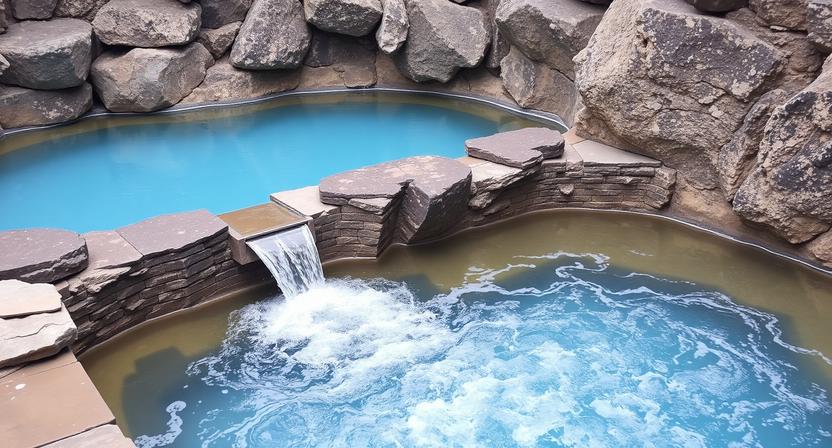
A plunge pool’s small footprint isn’t a limitation — it’s an invitation to treat it as a genuine design feature rather than just “a smaller pool.” Because the surface area is so much less than a standard pool, premium finishes, full tile surrounds, and integrated features become proportionally far more affordable than they would be at full pool scale. This guide covers cost, available sizes, and the design ideas that take full advantage of that.
Costs at a Glance
Plunge pools span two genuinely different price tiers: a budget/compact tier ($20,000–$45,000) using simpler fibreglass or vinyl construction, and a premium/architectural tier ($45,000–$95,000+) built to full inground construction quality, typically in concrete, with premium finishes and hardscape integration. Which tier you’re looking at matters more than almost anything else when comparing quotes. For the full breakdown, see Cost to Install a Plunge Pool.
Plunge Pool Sizes
| Size Category | Approx. Dimensions | Typical Depth |
| Compact | 8′ x 10′ | 4–5 ft |
| Standard | 10′ x 14′ | 5–6 ft |
| Large | 12′ x 16’+ | 5–7 ft |
Plunge pools are built deeper relative to their footprint than a standard pool, since the experience is centred on standing and soaking rather than swimming.
Design Ideas
Materials and Finishes
Because a plunge pool’s interior surface area is so much smaller than a full pool’s, finishes that would be cost-prohibitive at standard pool scale become genuinely achievable:
- Full tile surrounds — both inside the pool and wrapping the exterior edge — are one of the most popular plunge pool treatments, since the smaller area keeps material cost reasonable even with premium tile.
- Natural stone edging and coping give a more organic, garden-integrated look.
- Pebble or quartz finishes add texture and depth to the water’s appearance at a smaller incremental cost than they’d add to a full-size pool.
- Fibreglass shells in the budget tier offer a simpler, smooth finish at a lower cost than any of the above.
Integration Styles
- Courtyard or zen-garden setting: a plunge pool works well as the contemplative centrepiece of a small, intentionally minimal outdoor space — well suited to a pool this size, where a sprawling design would feel out of scale.
- Rooftop or elevated deck installation: because a plunge pool holds far less water than a full pool, it’s sometimes structurally feasible on a rooftop or elevated deck where a standard pool wouldn’t be — subject to a structural engineer confirming load capacity for your specific structure.
- Poolside lounge integration: the footprint a plunge pool frees up, compared to a standard pool, often goes toward a lounge area, outdoor shower, or fire feature positioned right alongside it.
- Narrow side-yard placement: a plunge pool can fit spaces a full pool simply can’t — turning an unused side yard into a genuine water feature you walk past rather than dead space.
Aesthetic Themes
- Modern minimalist: clean geometric edges, a dark plaster or tile finish, and integrated bench seating for a sleek, architectural look.
- Spa/wellness retreat: paired with an outdoor shower or sauna, sometimes with chiller-equipped contrast therapy capability — see our plunge pool cost guide for chiller pricing.
- Mediterranean/courtyard: light natural stone, potted greenery, and a small fountain or spillway feature for a softer, more traditional look.
- Rustic/natural: stone-edged and blended into garden plantings, sometimes finished to read more like a natural pond than a built structure.
Plunge-Pool-Specific Features
- Built-in bench seating: since plunge pools are built for soaking rather than swimming, a full-perimeter bench is far more common here than in a standard pool.
- Spillway or vanishing edge: a small overflow edge is proportionally far more attainable at plunge-pool scale than at full-pool scale, where the same feature requires a much larger catch basin and return system.
- Integrated perimeter lighting: the smaller perimeter makes full-loop lighting a more reasonable addition than it would be on a standard-size pool.
- Adjacent fire features: a fire bowl or small fire-and-water feature positioned beside the pool is a popular way to use the yard space a plunge pool frees up.
Is a Plunge Pool Right for You?
A plunge pool is the right call if you want a genuine water feature on a tight lot, or if soaking and cooling off matters more to you than swimming laps. If you want a bit more room to actually swim, see Cost to Install a Small Pool; if length matters most, see Cost to Install a Lap Pool. For the broader decision framework, see Best Pool Type to Install.
Frequently Asked Questions
What design styles work well for a plunge pool?
Modern minimalist, spa/wellness retreat, Mediterranean/courtyard, and rustic/natural are all popular approaches — the small footprint suits a more intentional, design-forward treatment than a standard-size pool often gets.
How much does a plunge pool cost?
Between $20,000 and $95,000+, depending heavily on whether you’re looking at a simpler compact build or a full architectural-quality installation. See our full cost guide for the two-tier breakdown.
What size is a typical plunge pool?
Most fall between 8’x10′ (compact) and 12’x16’+ (large), with depths of 4–7 feet — deeper relative to footprint than a standard pool.
Can a plunge pool go on a rooftop or deck?
Sometimes, since it holds far less water than a standard pool — but this always requires a structural engineer to confirm the specific structure can support the load.
What materials are best for a plunge pool?
Full tile surrounds and natural stone are popular premium choices, since the smaller surface area keeps material costs reasonable; fibreglass offers a simpler, lower-cost option in the budget tier.
Get a Design-Specific Quote
The right materials and features depend on your space and the look you’re going for.
Contact Easy Pools at (647) 449-9512 for a free, no-obligation quote on your plunge pool project.