

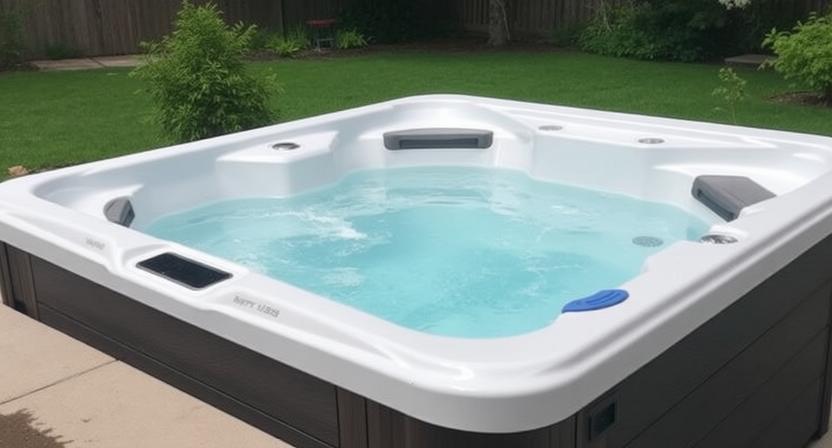
A hot tub or spa adds something a pool alone can’t provide: year-round use, therapeutic heat, and a distinct experience from regular swimming. In Toronto’s climate, a well-insulated hot tub is genuinely useful from October through April — the months when the pool is closed — making it one of the more practical outdoor investments for Ontario homeowners. This guide covers the types available, what installation actually involves, placement considerations, and how a spa integrates with an existing or new pool.
Types of Hot Tubs and Spas
Understanding the difference between installation types matters for both cost and how the spa fits with your property.
Portable (Freestanding) Hot Tubs
The most common type — a factory-manufactured acrylic shell with integrated jets, heater, and controls, delivered to your property and placed on a prepared base. “Portable” is a relative term; once a hot tub is filled with water (800–1,500+ litres) and occupied, it’s stationary, but it can be relocated or removed without demolition.
How they’re installed: a solid, level, load-bearing base is prepared (concrete pad or reinforced paver surface), the tub is craned or moved into position, and a dedicated electrical circuit is connected.
Costs: $5,000–$20,000 for the unit depending on size, brand, and feature level, plus $1,000–$3,000 for base preparation and electrical connection.
What they need: a structural base, a 240V/50A or 60A dedicated circuit (most 5+ person models), and ESA permit. Standard “plug-in” 120V models exist for small 2–3 person units but have significantly limited jet power and slow heating.
In-Ground or Semi-Inground Standalone Spas
A built-in-place spa — constructed like a small inground pool, independent of any main pool. Can be concrete, fibreglass shell, or vinyl. Less common as a standalone installation than as part of a pool project; typically chosen when homeowners want the built-in look without the scale of a full pool.
Costs: $10,000–$25,000 depending on material and finish.
Integrated Pool Spas (Spillover Spas)
A raised spa built as part of a pool project — connected to the main pool with a spillway, creating the visual composition of a pool with a spa overflowing into it. Almost always concrete. The spillway is typically open when both pool and spa are running; when only the spa is in use, the spillway can be closed and the spa operates independently.
Costs: $7,000–$25,000 added to a pool project, depending on spa size, material, and spillway design.
Swim Spas
Larger units (typically 4–6 metres long) combining a hot tub section with a current system for exercise swimming. Factory-manufactured, installed similarly to a portable hot tub. See Cost to Install a Small Pool for the full swim spa discussion.
Placement: What Determines Where a Spa Goes
Structural Requirements
A filled 6–7 person hot tub weighs 2,500–3,000+ kilograms — roughly equivalent to a small car sitting on a fixed point. The surface underneath must support this load continuously:
- Concrete pad: the standard and most reliable base. Typically 100–150mm (4–6 inches) thick, reinforced, on a prepared compacted gravel base.
- Paving stone or interlocking brick: works if installed on a properly prepared, compacted base with sufficient depth — not standard residential driveway installation.
- Wood decking: only if the deck is specifically engineered to support the hot tub’s weight at that location — standard residential decking is not adequate without reinforcement.
- Grass or soil: not suitable; the tub will sink and become unlevel.
Clearance and Access
A minimum of 1.2 metres of clearance around the tub is needed for maintenance access. The cover — typically a solid foam-core thermal cover — must have space to open, fold, and be set aside, which requires clearance on at least one side of the tub.
Wind, Privacy, and Orientation
Hot tubs lose heat faster in exposed locations. Positioning the spa near a fence, wall, or privacy screen reduces wind exposure and heating costs. Most homeowners also prefer some visual privacy when using a spa — both for personal comfort and to limit visibility from neighbouring windows.
Morning or evening sun exposure on a spa is pleasant; full afternoon sun in summer can be oppressive. Orienting a spa to receive morning sun (east-facing) is the most comfortable configuration for year-round use.
Distance From the House
Close proximity to the house is more convenient — a quick transition from house to spa in winter. But closer placement means more condensation and steam near windows in cold weather, and more noise from jets potentially entering living spaces. A covered, heated transition path (pergola, covered walkway) between the house and a spa positioned 5–10 metres away is a popular design solution.
Electrical and Permit Requirements in Ontario
ESA Permit Required
All hot tub and spa electrical connections in Ontario require an ESA (Electrical Safety Authority) permit and inspection. This applies to both portable hot tub wiring and any new electrical work for in-ground spas. Your electrician obtains this permit; confirm it’s included in their scope.
Dedicated Circuit
Most 5+ person portable hot tubs require a dedicated 240V, 50A or 60A circuit with GFCI protection at the panel. This is not an outlet you add to an existing circuit — it’s a new dedicated run from the electrical panel. If the panel is at capacity or located far from the spa location, this can add to electrical cost.
Pool Enclosure Permit
In Toronto, hot tubs with a water depth exceeding 600mm typically fall under the same pool enclosure rules as swimming pools — unless the tub has a cover permanently attached that can be locked to prevent access. A lockable cover exempts a hot tub from the Pool Fence Enclosure Permit requirement. See Pool Permits Toronto.
Bonding
If a portable hot tub is installed within 5 metres of an existing pool, both must be bonded together as part of the pool’s equipotential bonding system. An electrician must confirm this is done correctly — it’s a safety requirement, not optional.
Pool Integration Options
When a spa is being added alongside a pool — new or existing — three different integration approaches are possible:
Shared Water, Shared Equipment
The spa and pool are plumbed as a single connected system, sharing the same water volume and circulating through the same filtration and heating equipment. A valve system controls water flow between them. When the spillway is open, warm spa water overflows into the pool.
Implication: the pool and spa must maintain compatible chemistry, since they’re sharing water. Keeping the spa at 40°C while the pool is at 28°C requires that the heat transfer between them is managed — in practice, the spa is heated separately when in use.
Shared Water, Separate Equipment
The spa connects to the pool’s water supply but has its own dedicated heater and pump for jet operation. This allows the spa to be maintained at a different temperature without drawing on the pool’s equipment, and makes independent spa operation simpler.
Fully Independent Systems
Pool and spa have completely separate water, equipment, and chemistry. Most applicable when adding a portable hot tub to a property with an existing pool — they coexist physically but are operationally separate. The simplest configuration for retrofit situations.
Which is right for you: integrated systems produce the most visually unified result and are easier to operate when designed as a package from the start. Adding a portable freestanding hot tub is a significantly simpler and more affordable retrofit when a pool already exists.
Year-Round Use in Ontario
This is where a hot tub earns its keep in a way a pool cannot. Quality outdoor hot tubs and spas are specifically engineered for cold-climate use — well-insulated shells, efficient heaters, and covers designed to hold heat at -20°C. Using a hot tub in winter in Ontario is not an afterthought; it’s genuinely one of the better outdoor experiences available.
Heating cost in winter: a well-insulated hot tub costs approximately $15–$40/month to maintain at temperature in winter, depending on insulation quality, ambient temperature, and cover use.
Portable hot tubs don’t close seasonally — they run year-round, with water chemistry maintained on a different schedule than a pool. This is a meaningful advantage over an integrated pool spa, which is winterized with the pool in fall and reopened with it in spring.
Costs Summary
| Type | Unit/Build Cost | Installation/Base | Total Typical Range |
| Portable hot tub | $5,000 – $20,000 | $1,000 – $3,000 | $6,000 – $23,000 |
| In-ground standalone spa | $10,000 – $20,000 | Included | $10,000 – $25,000 |
| Integrated pool spa (added to pool project) | $7,000 – $25,000 | Included in pool project | $7,000 – $25,000 added |
Frequently Asked Questions
Do I need a permit for a hot tub in Toronto?
An ESA electrical permit is required for all hardwired hot tub installations. A Pool Fence Enclosure Permit is required for hot tubs with water depth over 600mm, unless the tub has a permanently attached, lockable cover — in which case it’s exempt.
What base does a hot tub need?
A solid, load-bearing surface capable of supporting 2,500–3,000+ kg — typically a dedicated concrete pad, properly installed paving, or structurally reinforced decking. Grass and standard soil are not suitable.
Can I add a hot tub to my existing pool?
Yes — a portable freestanding hot tub is the most straightforward retrofit option, operating independently of the pool. An integrated built-in spa can be added as a pool renovation, though it requires excavation and construction work.
What’s the difference between a spillover spa and a freestanding hot tub?
A spillover spa is built into the pool project — raised concrete or fibreglass, connected to the pool water, with a spillway that overflows into the pool. A freestanding hot tub is a separate factory-manufactured unit placed on a prepared pad, operating independently.
Is a hot tub worth it in Ontario’s climate?
Particularly yes — unlike a pool, a hot tub is usable year-round, providing a distinct value in the months when the pool is closed.
Get a Spa Quote Alongside Your Pool Design
Integrating a spa at the pool design stage is significantly more cost-effective than adding it later.
Contact Easy Pools at (647) 449-9512 for a free, no-obligation consultation on spa installation or pool integration.