

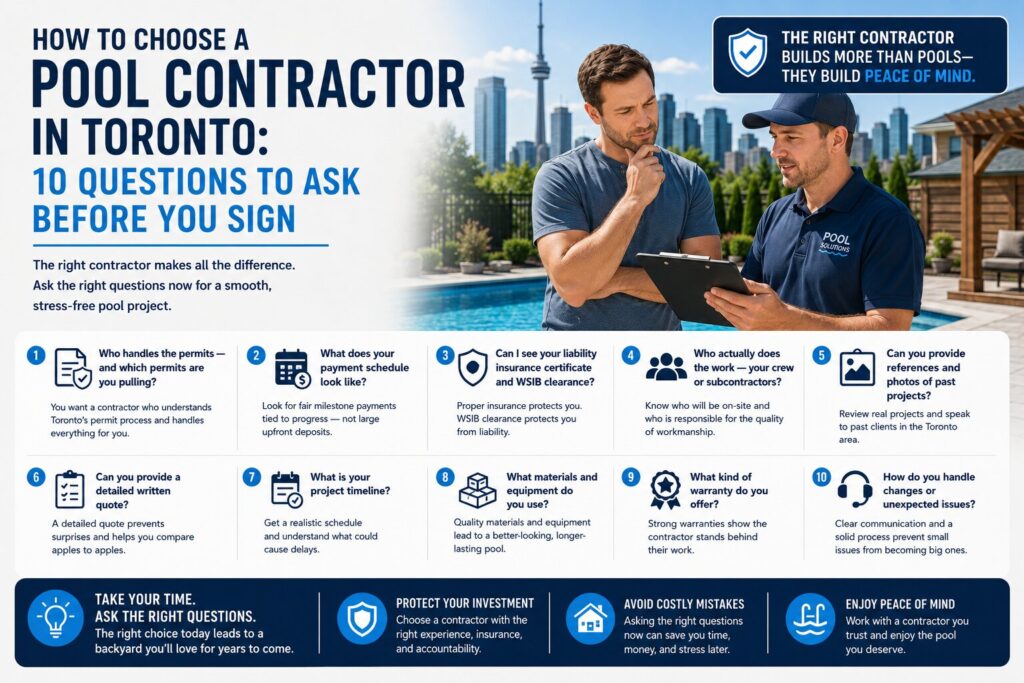
Choosing a pool contractor is the most consequential decision in the entire project. The design, the materials, the permits, the budget — every one of them gets filtered through the contractor you hire. Choose well and you get what you envisioned. Choose poorly and you’re managing disputes, delays, and potentially serious legal and structural problems on a project that has already consumed your backyard and a significant portion of your savings.
Toronto’s pool market makes this harder than it should be. The boom in pool demand over the past several years has pulled in contractors with varying levels of experience, licensing, and financial stability. Some of the quotes you’ll receive come from well-established local companies with deep permit knowledge and genuine accountability. Others come from operations that subcontract most of the work, handle permits loosely, and disappear when problems arise.
The questions below are designed to separate those two categories before you sign anything — not after your excavation is half-finished and leverage has shifted entirely to the contractor.
1. Who handles the permits — and which permits are you pulling?
This question alone reveals more about a contractor’s competence and professionalism than almost any other. In Toronto specifically, the permit process is one of the most commonly misunderstood parts of a pool build — even among contractors.
Here’s what the correct answer looks like: a Toronto pool project requires a Zoning Applicable Law Certificate (applied to Toronto Building) before any construction begins, followed by a Pool Fence Enclosure Permit (applied to Municipal Licensing and Standards) after zoning is cleared. These are sequential — the fence permit cannot be submitted until the zoning certificate is approved. Neither is a standard building permit; Toronto does not require a building permit for the pool structure itself, which surprises most contractors who work primarily outside the city.
Properties near ravines, watercourses, or Lake Ontario may also require Toronto and Region Conservation Authority (TRCA) approval, which runs alongside the City process but adds a separate application layer.
A contractor who confidently explains this process — naming the Zoning Certificate and the Pool Fence Enclosure Permit specifically, understanding the sequencing, and knowing whether your property triggers TRCA review — is one who has genuinely worked the Toronto permit system. A contractor who references a generic “building permit” or seems unclear on the two-step process is one who may not have done many builds within the City of Toronto proper.
The question of who submits the permits matters equally. Most established contractors handle permit applications as part of the project — it’s part of how they control scheduling. A contractor who passes permit responsibility entirely to you is offloading both work and knowledge.
→ Related reading: Pool Permits Toronto | Do You Need a Permit to Install a Pool?
2. What does your payment schedule look like?
Payment structure is one of the clearest signals of a contractor’s financial health and ethical practice.
A fair, industry-standard payment schedule for a pool build in Toronto looks something like this: a deposit at signing (10–15% of the project value is reasonable), milestone payments tied to specific construction phases — excavation complete, structure installed, plumbing and electrical in, finishing complete — and a holdback on the final payment until all work is done to your satisfaction and the City inspection has passed.
Warning signs to watch for:
- A request for more than 30% upfront before any work begins
- Cash-only payment requests (which create no paper trail and transfer risk entirely to you)
- No milestone structure — just a large deposit and a final payment with nothing tied to progress
- Pressure to pay ahead of schedule “to secure materials” or “hold a start date”
A contractor asking for a large upfront payment is sometimes a contractor managing cash flow problems from other projects. A contractor who structures payments around verifiable milestones is one who expects to earn each payment in turn.
3. Can I see your liability insurance certificate and WSIB clearance?
Two documents, two different things — both essential.
General liability insurance protects you if construction activity damages your property, a neighbouring property, or causes bodily injury. Ask for a current certificate naming you as an additional insured for the duration of the project. Minimum $2 million in commercial general liability coverage is a reasonable baseline; many established contractors carry $5 million.
WSIB clearance confirms the contractor is registered with Ontario’s Workplace Safety and Insurance Board and is current on their premium payments. In Ontario, any company that engages contractors or subcontractors on-site must verify that those contractors hold a valid WSIB clearance — and failure to do so transfers financial liability to the hiring organization if a worker is injured. This means if a worker is injured on your property and the contractor isn’t properly WSIB-registered, you may bear financial responsibility. WSIB clearances can be verified directly at clearances.wsib.ca at no cost.
Ask to receive both documents before signing. A reputable contractor will have these ready without hesitation.
4. Who actually does the work — your crew or subcontractors?
Pool construction involves multiple trades: excavation, plumbing, concrete or liner work, electrical, and sometimes gas connection. Almost every contractor uses some subcontractors at some point — the question is which parts and how much oversight the main contractor maintains.
A contractor who manages all coordination, maintains a consistent crew on site, and is directly accountable for every phase of the work is generally lower-risk than one who acts primarily as a broker between you and a series of separate trades. With the latter model, responsibility for problems gets diffused across multiple parties, and your point of contact may have limited direct control over quality on any given day.
Good answers include the contractor naming the specific trades they subcontract (electrician, gas tech), naming their primary installation crew, and explaining how they supervise subcontracted work. Red flag answers include vague descriptions of “our network of trusted partners” without specifics.
5. What’s included in the quote — and what isn’t?
This is where more project budgets go wrong than anywhere else. A pool quote that doesn’t explicitly separate what’s in and what’s out can grow by $20,000–$40,000 between signing and completion.
Standard pool quotes in Toronto typically cover the pool structure, basic excavation, plumbing rough-in, a pump and filter system, and one standard light. They typically do not include: the safety fence, finished decking, a heater, LED lighting upgrades, landscaping, permit fees, or electrical upgrades if your service panel doesn’t have sufficient capacity.
Ask the contractor to walk through the quote line by line and specifically identify anything that would be quoted separately or invoiced as a change order. Then ask for written quotes or estimates for the most likely add-ons — particularly fencing, decking, and heating — so you have a realistic all-in budget before you commit, not after excavation has begun.
→ Related reading: Pool Installation Cost Toronto | What to Know Before Installing a Pool
6. Do you do an on-site assessment before providing a final quote?
Any credible pool contractor should visit your property before issuing a final project quote. A phone or email quote based on a pool size and your verbal description of the yard is a starting-point estimate — it cannot account for soil conditions, access width for excavation equipment, overhead utility clearances, slope and drainage issues, protected trees, or proximity to the property line.
These site-specific variables can move a project cost by tens of thousands of dollars. A contractor who quotes without a site visit has essentially guaranteed that you’ll be discussing change orders once the project starts and reality contradicts the assumptions behind the initial price.
Some contractors charge a small fee for a detailed site assessment and site plan — this is reasonable and often indicates a contractor who takes the planning stage seriously.
7. What does your warranty cover and for how long?
Pool warranties have three distinct layers, and a thorough contractor will be clear about each:
- Structural warranty: covers the pool shell or liner structure, typically 10–25 years depending on pool type
- Equipment warranty: passes through the manufacturer’s warranty for pump, filter, heater, and automation — typically 1–5 years depending on component
- Workmanship warranty: covers defects in the contractor’s own installation work — 1–2 years is common; some contractors offer more
The questions worth asking: What happens if a fitting fails six months after completion — is that the equipment manufacturer’s problem or the contractor’s? What’s the process for a warranty claim — who do you call, what’s the response time, and will you be charged a service call? Is the warranty transferable if you sell the house before it expires?
A contractor who has a clear, written warranty policy and can answer these questions specifically is one who expects to be around and accountable after the job is done.
8. Can you provide references from recent Toronto builds?
References are the closest thing to a trial run available before signing. Ask for two or three references from projects completed in the past two years, preferably in Toronto or the GTA, and preferably with a pool type similar to what you’re considering.
When you follow up with those references, the most useful questions to ask are: did the project come in close to the quoted price? Were there surprises or change orders, and how were they handled? Did the contractor manage the permit process without pushing it onto you? Is the pool still performing as expected? Would you hire them again?
Online reviews (Google, HomeStars) are a reasonable secondary check — pay more attention to how the contractor responded to negative reviews than to the reviews themselves. A contractor who responds professionally to a complaint is more trustworthy than one with an unblemished online reputation and no verifiable references.
9. What’s a realistic timeline — and what causes delays?
In Toronto, the timeline from signing to swimming is longer than most homeowners expect. A realistic all-in timeline for most inground pools is 3–6 months for fibreglass and vinyl, and 4–8 months for concrete — the majority of which is permit processing and scheduling, not active construction. See our detailed pool installation timeline guide for the phase-by-phase breakdown.
A contractor who quotes you a 6-week build and has you swimming by July when you’re signing in May has either not accounted for Toronto’s permit timelines, or is telling you what you want to hear. Either is a problem.
Ask specifically: have you accounted for Toronto’s Zoning Certificate and Pool Fence Enclosure Permit sequencing? What’s the current backlog? What typically causes delays beyond permit timing — soil conditions, material supply, weather? What’s in the contract regarding delay communication and schedule updates?
10. What happens after I sign off at the end of the project?
The final inspection and pool sign-off isn’t the end of the relationship with a pool contractor — it’s the beginning of the warranty period, and potentially the beginning of ongoing maintenance or service work. Ask what post-completion support looks like:
- Who is your contact for warranty issues?
- Do they offer seasonal opening and closing services?
- If a fitting fails or equipment malfunctions in the first year, who comes out?
- What’s the response time for a warranty service call?
A contractor who has a clear answer to these questions — ideally a named contact and a documented process — is one who has thought through the service model as carefully as the construction model. One who deflects post-completion questions, or who “figures it out when we get there,” is one who hasn’t.
One More Thing Before You Sign
A signed contract should do more than name the parties and the price. It should include a complete description of the scope of work, the materials and equipment being used (by model and specification, not just description), the full payment schedule, the warranty terms, and a process for managing change orders. If any of these are missing from the contract presented to you, they should be added before signing — not promised verbally with the expectation of good faith.
The questions above aren’t designed to be adversarial — they’re designed to identify contractors who have nothing to hide and every reason to answer them clearly. The contractor you want to hire will have straightforward answers to all of them.
Ready to start comparing contractors? Our pool installation Toronto page covers what the full project involves from first consultation to first swim. Or jump directly to how to prepare your yard for pool installation if you’re getting close to a build decision.