

A pool is one of the largest single investments most Toronto homeowners make in their property. The contractor who builds it will control your backyard for 6–12 weeks, manage $60,000–$200,000+ of your money, and determine whether you spend the next decade enjoying the result or managing the fallout from a project that went wrong.
Most homeowners approach the contractor selection process too charitably. They compare prices, check that someone seems professional on the phone, and sign. The red flags covered below are ones that experienced contractors know to avoid — and that first-time buyers often miss until it’s too late.
Some of these signals will disqualify a contractor outright. Others are context-dependent — a single issue may be explainable, while the same issue alongside two or three others should end the conversation. Use this list as a filter, not a checklist of absolutes.
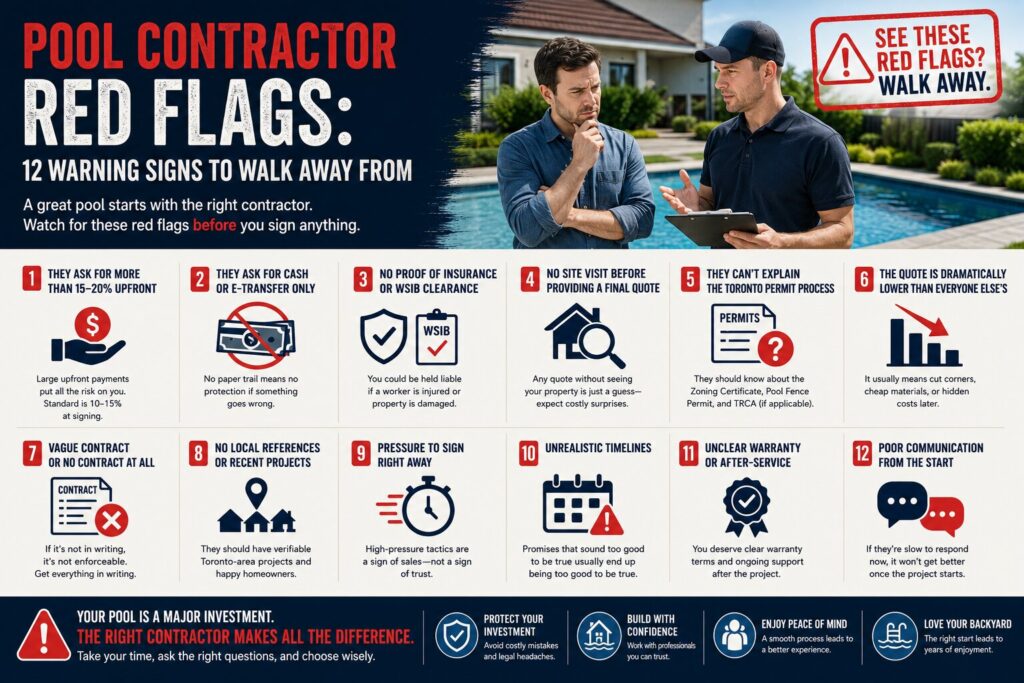
1. They Ask for More Than 15–20% Upfront
A deposit at signing is completely normal. A deposit that represents a third or more of the project value before any work has begun is not.
Industry-standard practice in Toronto is a deposit in the 10–15% range at contract signing, with subsequent payments tied to construction milestones — excavation complete, structure installed, finishing complete, and a final holdback released after the City inspection passes and you’re satisfied with the work.
A contractor pushing for 30–50% upfront may be managing cash flow from other projects, may have supplier credit problems, or may simply be transferring financial risk to you as quickly as possible. Once you’ve paid a large deposit, your leverage changes dramatically.
2. They Ask for Cash or E-Transfer Only
Cash-only payment requests should end the conversation. Beyond the obvious red flags around documentation and accountability, cash payments give you no paper trail if a dispute arises and no mechanism for recovery if the contractor disappears mid-project.
E-transfer requests without a formal invoice system are a softer version of the same concern. Legitimate contractors invoice formally, accept cheques or corporate transfers, and maintain records that would withstand an accounting review.
Payment method and paper trail aren’t administrative details — they’re your primary protection if the project encounters problems.
3. No Proof of Insurance or WSIB Clearance
This one isn’t negotiable. Ask for a current certificate of insurance showing minimum $2 million in commercial general liability coverage, and ask to be named as an additional insured for the project duration. Also request a WSIB clearance certificate, verifiable for free at clearances.wsib.ca.
In Ontario, if a contractor or their workers are injured on your property and the contractor isn’t properly WSIB-registered and current on premiums, financial liability can transfer to you as the property owner. This isn’t a technicality — it’s a real exposure that has caught Toronto homeowners off guard.
A reputable contractor produces both documents without hesitation. Hesitation, delay, or “I’ll get that to you” is a warning sign. A contractor who can’t produce these documents has no business starting work on your property.
→ See also: What to Know Before Installing a Pool
4. No Site Visit Before Providing a Final Quote
A phone or email quote based on your description of the yard is a placeholder estimate. It is not a basis for a contract.
Your property’s soil type, side-yard access width, slope, protected trees, utility locations, and proximity to the property line all affect project cost and feasibility — sometimes by tens of thousands of dollars. A contractor who quotes without seeing these things in person has essentially guaranteed that you’ll face change orders once the project starts and reality diverges from assumptions.
Any contractor serious about building your pool should insist on a site visit before finalising a quote. A contractor who skips this step is either inexperienced or is managing quote volume by issuing lowball estimates and recovering the margin through change orders later.
5. They Can’t Explain the Toronto Permit Process
In Toronto, pool projects don’t go through a standard building permit. The actual process is a Zoning Applicable Law Certificate (from Toronto Building) followed — sequentially — by a Pool Fence Enclosure Permit (from Municipal Licensing and Standards). Properties near ravines, watercourses, or Lake Ontario may also require TRCA approval. A building permit is not required for the pool structure itself in Toronto.
This surprises homeowners. It shouldn’t surprise a contractor who regularly builds pools in the city.
Ask directly: what permits does my project require, who files them, and in what order? A contractor who references a generic “building permit” without mentioning the Zoning Certificate or the Pool Fence Enclosure Permit, or who suggests the permits are “your responsibility to sort out,” hasn’t navigated Toronto’s specific system. That’s a problem on a project where permit sequencing directly affects your timeline and legal compliance.
→ Related reading: Pool Permits Toronto
6. The Quote Is Dramatically Lower Than Everyone Else’s
If three quotes cluster in a similar range and one comes in 30–40% lower, the question isn’t “did I find a deal?” — it’s “what is this quote not including?”
Low quotes in pool construction typically reflect one or more of: inferior materials (cheaper pump and filter package, thinner liner, lower-grade coping), work that will be subcontracted to the lowest-bidding trades rather than a retained crew, exclusions that will surface as change orders after signing, or a contractor who underprices to win contracts and recovers through extras.
Get itemised quotes — not lump-sum figures — so you can compare line by line rather than total to total. If the low quote excludes fencing, decking, permits, and the heater while the others include them, it’s not a low quote at all.
7. The Contract Is Vague or Verbal
A pool construction contract should specify: the exact scope of work, the materials being used (by model or specification, not just category), the full milestone payment schedule, the start and estimated completion dates, a change order process, and the warranty terms in writing.
If a contractor presents you with a brief letter of intent, a one-page summary, or worse, a verbal agreement accompanied by a payment request, that is a serious red flag. A vague contract protects only the contractor — because it gives them flexibility to interpret scope, materials, and timeline in their favour when disputes arise.
The more specific the contract, the more confidence you can have that the contractor knows what they’re committing to and intends to be accountable for it.
8. No Written Warranty
Every component of a pool project carries some form of warranty: the pool structure, the liner or plaster, the equipment, and the contractor’s own workmanship. A contractor who doesn’t put warranty terms in writing is a contractor who intends to interpret warranty obligations loosely — or avoid them entirely — when they’re invoked.
Ask specifically: what does the workmanship warranty cover and for how long? Is the equipment warranty the manufacturer’s, yours to register, or something the contractor manages? What’s the process for a warranty claim, and what is the response time? Is the warranty transferable if you sell?
Vague answers like “we stand behind our work” without specific terms written into the contract should be treated as no warranty at all.
9. They Push You to Sign Quickly
High-pressure closing tactics — “our schedule is filling up,” “this price is only good until Friday,” “we have another client interested in your slot” — are designed to compress your decision timeline so you don’t have time to compare alternatives, review the contract thoroughly, or verify insurance and references.
A legitimate contractor with a strong reputation doesn’t need to rush you. Their value proposition holds up under scrutiny. The contractors who need quick decisions are often the ones who don’t want you talking to their past clients, reading their contract carefully, or confirming their insurance is real.
Take the time you need. If a contractor won’t give it to you, that tells you something important.
10. They Have No Local References
References are the one thing no amount of polished sales presentation can substitute for. A contractor who has built dozens of pools in Toronto and the GTA should be able to connect you with past clients in your area, on similar projects, within the past two years.
Reluctance to provide references, references that are geographically vague (“we have a customer in the GTA you can talk to”), or references who only respond with written testimonials rather than taking a call are all soft red flags worth noting.
When you do speak to references, ask specifically: did the project come in close to the quoted price? How were change orders handled? Did the contractor manage permits without pushing them onto you? Would you hire them again?
11. They Dismiss Permit or Fence Compliance as Optional
You will sometimes encounter contractors who suggest that fence compliance “depends on the inspector” or that permit requirements are more flexible than they are. This is either ignorance or calculated risk-shifting — and either way, the risk ends up with you.
In Toronto, a pool that lacks the required pool enclosure permit, or whose fence doesn’t meet the bylaw’s specifications, is a compliance liability: it can affect your home insurance, create problems at property sale, and result in fines and orders to comply from Municipal Licensing and Standards. See What Happens If You Install a Pool Without a Permit for the full picture on exposure.
A contractor who treats compliance seriously is protecting you as much as themselves. One who treats it as optional is telling you how they operate generally.
12. Your Gut Says Something Is Off
This one doesn’t have a specific metric, but it belongs on the list.
Pool construction requires a significant degree of trust — you’re giving a contractor extended access to your property, your money, and your schedule for months at a time. If your instinct about a contractor is that something feels off — that they’re evasive about specific questions, that the enthusiasm in the sales call doesn’t match the detail in the contract, that they can’t quite account for where your deposit goes — those signals are worth taking seriously.
The contractors who build the best pools in Toronto tend to be the ones who are comfortable with direct questions, produce documentation without prompting, and have a clear enough track record that they welcome scrutiny. If a contractor can’t withstand a thorough evaluation, they’re not the right contractor for a project of this size.
What Good Looks Like
Every red flag on this list is the inverse of how a professional, established Toronto pool contractor operates: site visit before quoting, milestone-based payment with a reasonable deposit, insurance certificates and WSIB clearance available immediately, a detailed written contract, warranty terms in writing, specific answers to permit questions, and references from recent local projects.
If you’re still building your list of questions to ask potential contractors, How to Choose a Pool Contractor in Toronto: 10 Questions to Ask Before You Sign covers the specific questions that separate the two categories before you sign anything.
Planning to start contractor conversations? Our pool installation Toronto page covers the full project from first site visit to first swim, and What to Know Before Installing a Pool walks through the pre-signing checklist every homeowner should complete first.