

The most common source of frustration in Toronto pool projects isn’t the construction itself. It’s the gap between what a homeowner thought they were agreeing to and what the final invoice reflects.
This gap isn’t always the result of dishonest contractors — though sometimes it is. More often, it’s the result of a quote that was never fully explained, a homeowner who assumed that a quoted number was an all-in price, and a project that grew through the addition of things that were genuinely necessary but never clearly scoped in the original conversation.
This post explains what a pool quote in Toronto typically does and doesn’t include, how to read a quote properly, and how to build a realistic budget that won’t require revision once excavation has started.
The Number on the Quote Is Rarely the Final Number
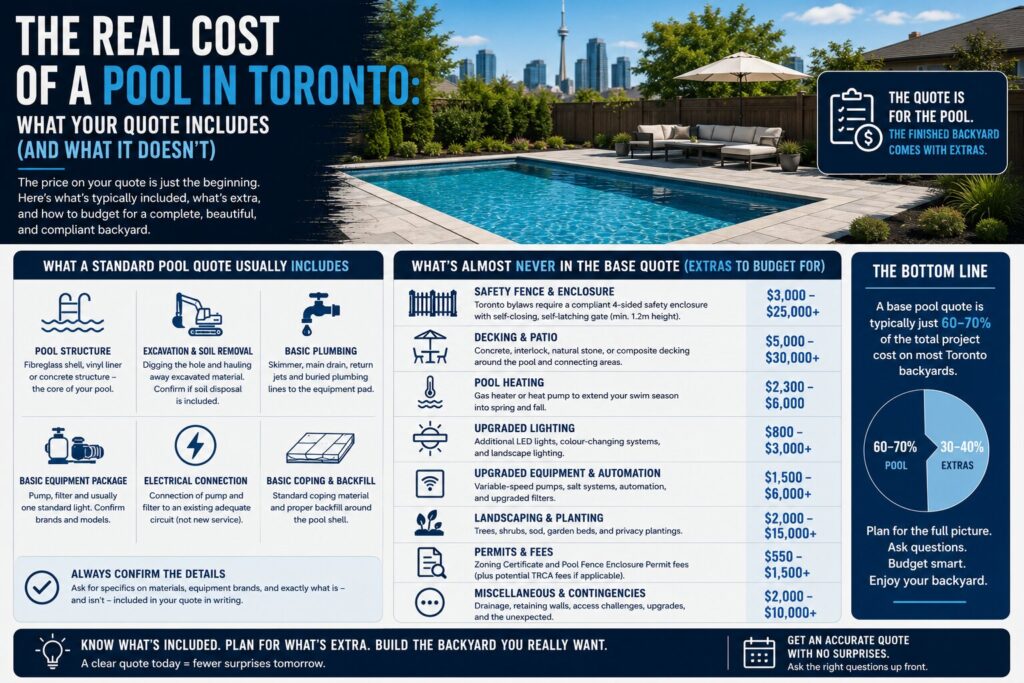
Let’s start with the most important fact: the price on most pool contractor quotes represents the cost of the pool — the structure, basic equipment, and core installation. It does not represent the cost of a complete, functional, compliant, finished backyard pool.
The gap between those two things can be anywhere from $10,000 on a simple project to $60,000+ on a larger or more design-forward build. The items that make up that gap are predictable. None of them should be surprises — they’re just often not discussed until they become line items on a change order or a separate invoice.
Here’s a systematic breakdown of what’s typically in a Toronto pool quote, what’s typically not, and where the most significant cost surprises tend to come from.
What a Standard Pool Quote Usually Includes
Most established Toronto pool contractors will include the following in a base quote:
The pool structure itself — whether that’s a fibreglass shell, vinyl wall panels and liner, or the rebar and gunite of a concrete build. This is the core of the quote and typically its largest single line item.
Excavation and soil removal — digging the hole and hauling away the excavated material. Some contractors include soil disposal in the base price; others quote it separately. Confirm explicitly which applies to your quote.
Basic plumbing — the skimmer, main drain, return jets, and the buried plumbing lines connecting them to the equipment pad.
Basic equipment package — a pump, a filter, and usually a single standard light. The grade of this equipment varies significantly between contractors; confirm what brands and models are included, not just that equipment is included.
Electrical connection to the equipment — connecting the pump and filter to a circuit. Note: this is typically connection to an existing adequate circuit, not the installation of new electrical service to the pool area if it doesn’t already exist.
Basic coping — the edge material that transitions between the pool wall and the surrounding surface. Most quotes include a standard coping option; premium materials (natural stone, cantilevered concrete) are typically extras.
Backfill — the material that goes back around the pool shell after installation, particularly relevant for fibreglass pools where the type of backfill material (gravel or stone, not soil) is specified by the manufacturer.
What’s Almost Never in the Base Quote
These are the items that generate the most mid-project surprises. None of them are hidden — they’re simply not included in most base quotes, and the question of whether a homeowner assumed they were is where the frustration originates.
Safety Fence and Enclosure
In Toronto, every pool requires a compliant safety enclosure — there’s no exemption for pool type, size, or how “low-risk” the yard seems. The fence must meet specific height requirements (1.2 metres minimum for single residential properties), have a self-closing, self-latching gate, and achieve four-sided isolation of the pool area. See Toronto Pool Fence Bylaws for the full specification.
This fence is almost never included in a pool quote. It’s a separate scope of work, often involving a different trade, and can run anywhere from $3,000 for basic chain-link on a smaller property to $25,000+ for glass panel fencing on a larger one.
Budget range: $3,000–$25,000+ depending on material, linear footage, and gate count.
Decking and Patio
The pool quote builds the pool. It does not build the surface you walk on to get to the pool. Decking — whether poured concrete, interlocking paving stone, natural stone, or composite — is almost universally quoted as a separate scope, often with a separate contractor.
On a typical GTA project, homeowners budget a minimum of $5,000 for basic concrete decking and routinely spend $15,000–$30,000 on natural stone or premium paving around a mid-size inground pool. The pool’s footprint is only part of the calculation; the surrounding patio, path connections, and any raised or multi-level elements all add to the scope.
Budget range: $5,000–$30,000+ depending on material, area, and design complexity.
Pool Heating
A pool heater is almost never included in a base quote. It’s one of the most common items homeowners assume is included and discover isn’t.
The type of heater matters significantly for both upfront and operating cost: gas heaters run $2,300–$5,500 installed; heat pumps run $2,500–$6,000 installed. If you want to extend your swim season meaningfully into May and October — which most Toronto homeowners do — you’ll need one. See Pool Heating Systems for the full comparison.
Budget range: $2,300–$6,000 installed, depending on type.
Permit Fees
Toronto’s pool permit process involves two sequential applications: the Zoning Applicable Law Certificate ($198.59) and the Pool Fence Enclosure Permit ($214.79). Total core permit cost is approximately $413. Additional costs may apply if your project requires TRCA review, tree protection, or a Minor Variance through the Committee of Adjustment.
Some contractors include permit fees in their quote; others pass them directly to the homeowner. More importantly, some contractors include the cost of preparing and managing the permit applications — which involves producing a site plan, coordinating with the City, and managing the inspection process — while others treat permits as something you handle yourself.
Clarify both: who pays the permit fees, and who manages the permit process?
Budget range: $413–$2,500+ in permit fees, depending on complexity.
→ Full permit detail: Pool Permits Toronto
Electrical Upgrades
Connecting pool equipment requires adequate electrical service. If your home’s current panel doesn’t have available capacity, or if the pool location requires a new circuit run that didn’t exist before, the electrical upgrade is a separate scope — typically involving a licensed electrician and an ESA permit.
Similarly, if you want LED lighting beyond the single standard fixture that comes with most equipment packages, each additional light is typically priced as an extra.
Budget range: $500–$3,000+ for panel or circuit upgrades; $400–$900 per additional LED light installed.
Gas Line Extension
If you’re installing a gas heater and the existing gas connection isn’t near the equipment pad, extending the gas line to the right location is a separate cost. This work must be done by a licensed gas technician and typically involves a permit. The cost varies significantly with distance and whether the line needs to be run through a slab or other obstacles.
Budget range: $500–$2,000+ depending on run length and complexity.
Landscaping
Excavation destroys whatever was in the ground-level path of the work — lawn, gardens, existing plantings, and sometimes irrigation. Restoring or replacing this landscaping after construction is never included in a pool quote. Depending on how much of your yard was disturbed and what you want to replace or add, this can range from minimal turf restoration to a significant landscape project.
Budget range: $1,000–$20,000+ depending on scope.
Premium Finishes and Upgrades
If the base quote includes a standard plaster interior finish and you want pebble or quartz, that’s typically an upgrade. If it includes aluminum coping and you want natural stone, that’s an upgrade. If it includes a basic pump and you want a variable-speed model, that’s an upgrade. These individual upgrades may not be large, but they accumulate — and each one was likely a decision made in the design process without an explicit cost being attached at the time.
Budget range: $500–$15,000+ depending on which upgrades and how many.
The 60–70% Rule
A useful planning heuristic: in most Toronto pool projects, the pool structure itself accounts for roughly 60–70% of the total all-in project cost. The remaining 30–40% is fencing, decking, heating, electrical, permits, landscaping, and upgrades.
This means a $90,000 pool quote has a realistic all-in project cost of $130,000–$150,000 once everything needed to make it a functioning, compliant, finished backyard pool is included. A $130,000 concrete pool quote might represent a $185,000–$210,000 total project.
This isn’t a critique of any contractor’s quoting practice — it reflects the genuine structure of pool projects, where multiple scopes of work are involved and quoting them all together requires a degree of design certainty that often doesn’t exist at the initial quoting stage. But it’s a reality every homeowner should understand before committing to a number.
How to Get a Realistic Budget Before You Sign
The most effective approach is to ask your contractor for an itemised quote — a breakdown that separates the pool structure, excavation and soil removal, equipment, permits, and any included extras. Then explicitly ask for separate estimates on the items most likely to be missing: fencing, decking, heating, and any electrical or gas work.
Some contractors will provide this proactively. Others will need to be asked specifically. Either way, a contractor who is willing to be transparent about what’s in and out of their quote, and who can give you reasonable estimates on the likely add-ons, is one who is setting you up for an honest project relationship rather than a series of uncomfortable mid-project conversations.
Questions worth asking at the quote stage:
- Is excavation and soil removal included? If so, does that include soil disposal off-site?
- What pump and filter brands and models are specified?
- Is a heater included? If not, what’s your estimate for adding one?
- Is fencing included? If not, what’s a typical fence cost for a pool like this?
- Is decking included? If not, what should I budget for a basic concrete surround?
- Who handles and pays for the permit applications?
- Are there any site conditions you’ve seen that might trigger cost increases — soil, access, utilities?
A contractor who can answer all of these clearly is giving you a real budget. A contractor who deflects or says “we’ll figure that out as we go” is one whose final invoice is unlikely to resemble their initial quote.
A Note on Change Orders
Even the most thorough quote will sometimes be followed by a change order — an unexpected soil condition, a utility that needed to be rerouted, or a design decision that evolved during construction. Change orders are a normal part of complex construction projects.
What distinguishes a professionally managed project from a problematic one isn’t the absence of change orders — it’s the process by which they’re handled. Every change order should be presented in writing, with a specific cost, before the relevant work is done. A change order presented verbally, or after the work is already complete, is not a change order — it’s an invoice you didn’t agree to.
Ask your contractor explicitly: what is your change order process, and will I receive written estimates before you proceed with any scope that wasn’t in the original contract? If the answer is yes and it’s backed up by language in the contract itself, that’s the right answer.
For a complete breakdown of pool costs by type, see Pool Installation Cost Toronto. For the pre-signing planning checklist, see What to Know Before Installing a Pool. For more on how to evaluate the contractors quoting you, see How to Choose a Pool Contractor in Toronto and Pool Contractor Red Flags.