

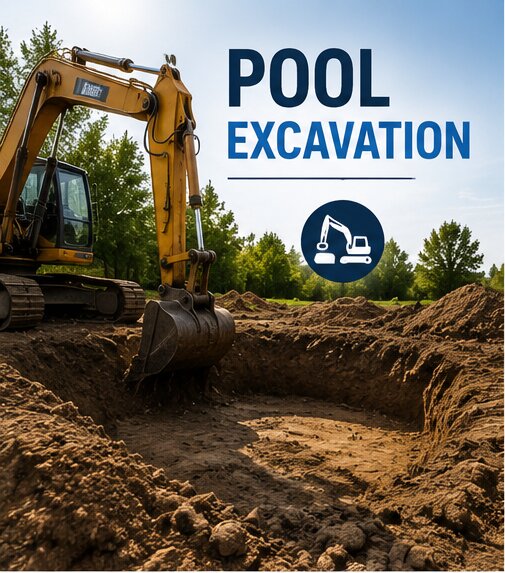
Pool excavation is where site conditions translate directly into cost and timeline. In Toronto specifically, two factors — the city’s prevalent clay soil and the narrow lot access common in established neighbourhoods — routinely push excavation from a straightforward phase to a problem-solving one. This guide covers both, along with dewatering, grading, and the site preparation work that happens alongside and after the dig.
Why Toronto Excavation Is Different
Most online pool guides are written for properties with wide, flat, sandy backyards — conditions that describe very few Toronto lots. Toronto’s established residential neighbourhoods present a specific combination of challenges:
- Clay soil dominates much of the city, particularly north of the lake shore — heavier to excavate, slower to work, and more sensitive to wet-weather conditions than the sandy loam common in newer suburban developments
- Narrow Victorian-era side yards in the old city’s inner neighbourhoods (The Annex, Leslieville, Roncesvalles, Riverdale, and others) regularly run 4–6 feet — barely enough for compact equipment
- Mature trees established over decades of urban infill create both root zone complications and overhead clearance challenges
- Urban fill from decades of prior construction activity means excavations in some older neighbourhoods occasionally hit inconsistent or debris-containing backfill rather than native soil
None of these is a project-stopper — experienced Toronto contractors work around all of them regularly — but each adds time and cost that a generic quote from an out-of-city contractor may not account for.
Access: The Urban Lot Challenge
The access width minimums for pool excavation equipment are fixed by the machinery, not by the contractor’s preference:
| Equipment | Minimum Clear Width | When Used |
| Compact/mini excavator | 5–6 ft | Tight urban lots; slower but fits narrower paths |
| Standard excavator | 8–10 ft+ | Standard suburban lots; faster excavation |
| Long-reach arm attachment | Varies | Can extend reach across a fence without full equipment entry |
| Hand excavation | Any width | Last resort; significantly adds labour cost and time |
Measuring accurately matters: the access width that matters is the narrowest point along the full path from the street to the pool location — not just the gate opening. An 8-foot gate with a 6-foot clearance between a fence and a garden shed creates a 6-foot effective access width.
Toronto-specific access options worth knowing:
- Rear lane access: many Toronto lots — particularly in the old city — back onto a public lane. Equipment that enters from the lane eliminates the side-yard access problem entirely. Check whether your property backs onto a lane before assuming side-yard access is the only option.
- Temporary fence removal: removing and reinstalling a fence section (your own or, with agreement, a shared fence) is often the most cost-effective way to widen access temporarily. Plan this in the contract, not as a day-of solution.
- Over-the-fence lifting: for smaller equipment or specific tasks, a crane or long-reach arm can sometimes reach over an obstacle rather than through a gate — worth discussing with your contractor if the access path is genuinely borderline.
- Street equipment staging: for fibreglass cranes or larger equipment, staging on the street requires a road occupancy permit from the City, typically arranged by the contractor. Confirm this is in scope for any fibreglass build.
Toronto’s Soil Types and What Each Means
Glacial Clay (Dominant Across Most of the City)
Toronto’s characteristic clay was deposited as glacial Lake Iroquois — the predecessor to Lake Ontario — receded thousands of years ago. It’s heavy (a cubic metre of wet clay can weigh over a tonne), expands when wet and contracts when dry, and takes longer per cubic metre to excavate than sandy soil.
What clay means for your pool:
- Excavation takes longer — clay is harder to break and load than sandy soil, especially after rain
- Dewatering may be needed — clay drains slowly and holds moisture; excavations in clay can fill with standing water during or after rain
- Fibreglass pool backfill is critical — excavated clay cannot be used to backfill around a fibreglass shell. Proper backfill (pea gravel or crushed stone) must be brought in and the excavated clay hauled away, adding both material and disposal cost
- Post-construction drainage needs particular attention — a pool shell surrounded by impermeable clay creates a drainage condition that needs to be managed, not ignored
Sandy Loam and Sandy Soil
More common in areas near the historic lake shore, in ravine-adjacent areas, and in some east-end neighbourhoods. Sandy soil excavates faster, drains better, and is less problematic for backfill — though it also shifts more easily, which is why the pool’s structural base must be on stable native soil rather than loose sandy fill.
Urban Fill
In older inner-city neighbourhoods with long construction histories, excavations sometimes encounter urban fill — inconsistent material deposited during previous construction, demolition, or grade-change projects. Fill can contain rubble, organic material, compressed construction debris, or voids. It’s less predictable than native soil and may require extra excavation time and attention to identify what’s actually there before building on it.
Shale
Encountered in some parts of Scarborough and pockets of North York. Shale requires different equipment than standard soil excavation — rock-breaking attachments rather than standard excavator buckets — and adds meaningfully to time and cost. A site visit and sometimes a soil test is the most reliable way to identify potential shale before committing to a fixed-price excavation quote.
Water Table and Dewatering
Properties near Lake Ontario — particularly south of the Gardiner Expressway, in areas like Mimico, the Beach, and parts of the Harbourfront — and properties adjacent to Toronto’s ravine system often have relatively high water tables. When excavation reaches groundwater level, dewatering becomes necessary: continuously pumping water out of the excavation while construction proceeds.
What dewatering involves:
- Submersible pumps operating continuously during excavation and structure installation
- Discharge of pumped water subject to the City’s Sewers By-law — groundwater discharge to the storm sewer requires a Sewer Discharge Permit, applied at least 8–12 weeks before the proposed start date (see Pool Drainage Requirements Toronto)
- Additional cost: typically $500–$3,000 depending on volume and duration, sometimes more for significantly wet sites
If your property is near the lake, a ravine, or a creek valley — or if your basement has historically had moisture issues — flag this to your contractor before excavation. It’s relevant to both equipment planning and permit timing.
Grading and Drainage
Excavation changes your lot’s grade. Removing a significant volume of soil below grade and then filling around the pool structure, adding coping, and laying decking all affect how surface water flows across your property. Two key principles:
Surface drainage must flow away from the pool structure and from your house. A pool installation that directs surface runoff toward the foundation creates a drainage problem that may only become apparent years later. Your contractor’s site plan should address how grade is restored and where water will flow.
Drainage cannot flow onto neighbouring properties. Any surface water that leaves your property without going to a proper drainage connection is a potential bylaw issue. On sloped lots, this requires active management — sometimes a perimeter drain or catch basin — not just grading around the pool.
The grading plan: on properties where grade changes are significant, a grading plan may be required as part of the permit process. This is more common on sloped or ravine-adjacent lots.
What Goes into the Excavated Space
Once excavation reaches the correct depth and profile, three things happen before the pool structure goes in:
- Bedding layer: a layer of compacted sand or crushed stone is installed at the floor of the excavation to provide a level, stable base for the pool shell or panels
- Plumbing rough-in: buried plumbing lines are laid before any structure is installed over them
- Structure installation: the pool shell, panels, or rebar begins
For fibreglass pools specifically, the space between the shell and the excavation wall must be filled with pea gravel or crushed stone — not the excavated clay or soil. This is a recurring quality issue on Toronto projects where contractors substitute local soil to save on material cost. See Fibreglass Pool Installation Process for why this matters structurally.
Soil Disposal
A mid-size inground pool excavation typically produces 60–200+ cubic metres of soil — too much to spread on a standard urban lot in most cases. Disposal options:
- Haul off-site: the most common option; confirm in your contract whether this is included or separately priced
- Spread on-site: only practical on larger lots with space and no drainage problems created; may require a grading plan
- Transfer to another project: some contractors have arrangements to deposit clean soil at other active sites; typically only viable for clay or sandy soil, not urban fill or mixed material
Soil hauling adds $500–$2,000+ to most Toronto projects depending on volume and disposal site distance.
Frequently Asked Questions
Why is pool excavation more expensive in Toronto than outside the city?
Primarily due to narrow lot access requiring smaller, slower equipment; Toronto’s heavy clay soil taking longer per cubic metre to excavate; and urban lot density that limits equipment staging and soil disposal options.
Can a pool be excavated on a very narrow lot?
Often yes, using a compact excavator, hand excavation for specific sections, or rear-lane access where available. The narrower the access, the longer the excavation phase takes and the higher the labour cost.
What is dewatering and when is it needed?
Dewatering is the continuous pumping of groundwater that seeps into the excavation. It’s needed when the excavation reaches the local water table — more common near the lake and ravine-adjacent properties. Discharge requires a City Sewer Discharge Permit applied 8–12 weeks in advance.
Can excavated clay be used as backfill around a fibreglass pool?
No. Fibreglass pool shells require pea gravel or crushed stone backfill specified by the manufacturer. Using excavated clay causes uneven settlement and potential shell distortion over time.
Does excavation affect my property’s drainage?
It can, significantly — particularly the grade restoration and hardscape installation that follows. Surface water must be directed away from the pool structure and the house, and cannot flow onto neighbouring properties. This should be part of your contractor’s site plan.
Get a Site-Specific Excavation Assessment
Toronto’s soil, access, and water table conditions vary significantly block by block. A site visit is the only reliable way to assess what excavation will actually involve on your property.
Contact Easy Pools at (647) 449-9512 for a free, no-obligation site assessment that includes an excavation and access review.