

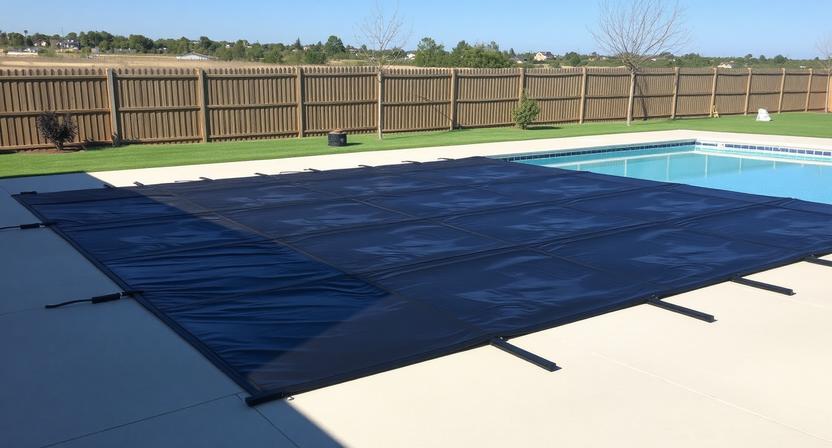
Not all pool covers are safety covers — and the distinction matters both for child safety and for how a cover behaves through a Toronto winter. This guide covers the three main types of pool safety covers, what each costs and requires, and how they perform differently under Ontario’s freeze-thaw conditions.
Safety Cover vs. Winter Cover: The Distinction That Matters
A standard winter cover (sometimes called a leaf cover or tarp cover) is designed to keep debris out of the pool. It’s typically held in place by water bags around the perimeter and provides no meaningful protection if a child or adult walks onto it — the cover can shift, the gap at the edge is significant, and the material may not support weight.
A safety cover is specifically engineered to support weight — ASTM F1346 (the North American safety cover standard) requires a cover to support at least 485 lbs of static load and to be secured in a way that prevents displacement. A safety cover that meets this standard can support a child or adult who falls or walks onto it without breaking through or pulling free.
This distinction matters practically: many Toronto pool owners believe their winter cover is a safety cover. If it’s not anchored to the deck and doesn’t carry an ASTM F1346 rating, it isn’t — and there’s a meaningful safety difference between the two.
Types of Pool Safety Covers
Mesh Safety Covers
The most common residential safety cover type in the GTA. A woven mesh cover is anchored to the deck with stainless steel or brass anchors drilled into the coping at approximately 3-foot intervals around the pool perimeter. The cover installs each fall on these anchors using a series of D-ring straps under tension, and is removed in spring.
How water is handled: mesh allows rain and snowmelt to drain through into the pool — no standing water accumulates on top of a mesh cover, and no pumping is required through the winter. This makes mesh significantly easier to manage than a solid cover.
What passes through: fine debris (dust, pollen, algae spores) and some silt can pass through mesh, leaving a thin layer at the pool bottom by spring. A more heavily textured “fine mesh” reduces this but doesn’t eliminate it.
Winter performance: mesh handles snow well — snow sits on top, melts and drains through without pooling. The anchoring system means the cover stays secure through wind events that blow winter covers off standard pools.
Typical cost: $1,500–$3,500 installed, including deck anchor installation. Initial installation requires drilling and setting anchors; after that, seasonal removal and reinstallation is straightforward.
Solid Safety Covers
A heavy-duty solid vinyl or PVC-coated cover that doesn’t allow water to drain through. Water and debris accumulate on top, requiring active management:
- Some solid safety covers have a central mesh drain panel that allows controlled water drainage while keeping debris out
- Others require a submersible pump to remove accumulated water periodically through the winter
Solid covers keep the pool considerably cleaner over winter — nothing passes through. They’re heavier than mesh and more labour-intensive to handle at installation and removal.
Not all solid covers meet ASTM F1346 — confirm the safety rating before purchasing if the cover is intended to serve a safety function rather than just debris control.
Typical cost: $1,000–$2,500 for the cover plus water-bag anchoring system; professional installation adds $300–$600.
Automatic Safety Covers
A motorized cover system that rolls or tracks across the pool surface at the touch of a button — or, with modern automation integration, via a smartphone or smart home system. The cover stores in a housing at one end of the pool (typically under the deck or in a recessed box at the pool’s edge) and extends across the pool on tracks mounted on the pool’s coping edge or on the deck surface.
ASTM F1346 compliance: automatic safety covers can meet the safety standard when properly installed — the tension on the track system, combined with the cover material, provides the required weight-bearing capacity.
Year-round use: unlike mesh and solid covers (which are installed seasonally), an automatic cover can be used throughout the swim season as a daily convenience cover — closing it to retain heat overnight, opening it for swimming. This makes an automatic cover one of the most cost-effective efficiency measures available (see Energy-Efficient Pool Systems) as well as a safety feature.
Winter use in Toronto: automatic covers need specific management in our climate:
- The cover mechanism should not be operated when the pool is frozen or when ice is forming at the pool edge — ice that contacts the track can damage both the track and the cover edge
- Many Toronto pool owners close the automatic cover for winter then add a standard mesh or solid cover on top as additional protection and debris control
- The cover’s motor, controls, and any above-water-line components should be weatherproofed or brought inside for winter
Typical cost: $8,000–$20,000 installed, depending on pool size, cover type (vinyl vs. mesh automatic), and track system. Lifespan is typically 8–15 years for the cover itself; the track and motor can last longer with proper maintenance.
Installation: Anchors and Tracking
Mesh and solid covers: deck anchors are typically set at 36-inch intervals around the pool’s full perimeter. Anchors are recessed into the deck with caps that sit flush with the surface when the cover is off — creating no tripping hazard in the swim season. Initial anchor installation (during pool construction or as a renovation) costs $200–$500 for a standard pool.
Automatic covers: require either a track system built into the pool’s coping edge (ideally specified at pool construction) or a surface-mounted track system on the deck (retrofittable). A recessed housing for the cover storage is either built into the pool end-wall or installed as a separate structure. Electrical connection for the motor is required; an ESA permit applies.
Safety Compliance: Does a Safety Cover Replace the Fence?
In Toronto, a pool safety cover does not replace the fence enclosure requirement. Toronto’s pool enclosure bylaw requires a physical fence barrier — even an ASTM F1346-rated automatic cover does not satisfy this requirement as the primary enclosure under the current bylaw.
A safety cover provides real, meaningful protection in addition to a fence — particularly an automatic cover that a child would need to operate equipment to open. But it’s supplemental to the required enclosure, not a substitute for it. See Toronto Pool Fence Bylaws for the full enclosure requirement.
One exception previously covered: a hot tub with a permanently attached, lockable cover is exempt from the Pool Fence Enclosure Permit. This applies to hot tubs specifically, not to swimming pool safety covers.
Costs Summary
| Cover Type | Typical Cost | Seasonal Management |
| Mesh safety cover | $1,500 – $3,500 installed | No pumping needed; debris residue at opening |
| Solid safety cover | $1,300 – $3,100 installed | Pump accumulated water periodically |
| Automatic safety cover | $8,000 – $20,000 installed | Active winter management needed; freezing risk to track |
Frequently Asked Questions
Does a safety cover replace the pool fence in Toronto?
No — Toronto’s pool enclosure bylaw requires a physical fence barrier; a safety cover is a supplemental safety measure, not a substitute for the required fence.
What’s the difference between a safety cover and a winter cover?
A safety cover meets ASTM F1346 — it’s anchored to the deck and engineered to support the weight of a child or adult who falls onto it. A standard winter cover (tarp cover) is held by water bags and provides no meaningful weight-bearing protection.
Does mesh or solid safety cover work better in Toronto’s winter?
Mesh is generally easier to manage through a Toronto winter — water drains through the mesh so there’s no accumulated standing water to deal with. Solid covers keep the pool cleaner but require active water removal throughout the season.
Can an automatic cover be left closed all winter?
Not recommended in Toronto’s climate without additional protection. Ice formation at the pool edge can damage the track and cover edge; most Toronto installers recommend adding a second cover layer over the closed automatic cover for winter.
How long do pool safety covers last? Mesh and solid covers: typically 10–15 years. Automatic covers: 8–15 years for the cover fabric; the track and motor generally last longer with proper maintenance.
Get a Safety Cover Quote
The right cover depends on your pool’s size and shape, your deck material and configuration, and how much management you want to do through the winter.
Contact Easy Pools at (647) 449-9512 for a free, no-obligation safety cover quote and installation assessment.