

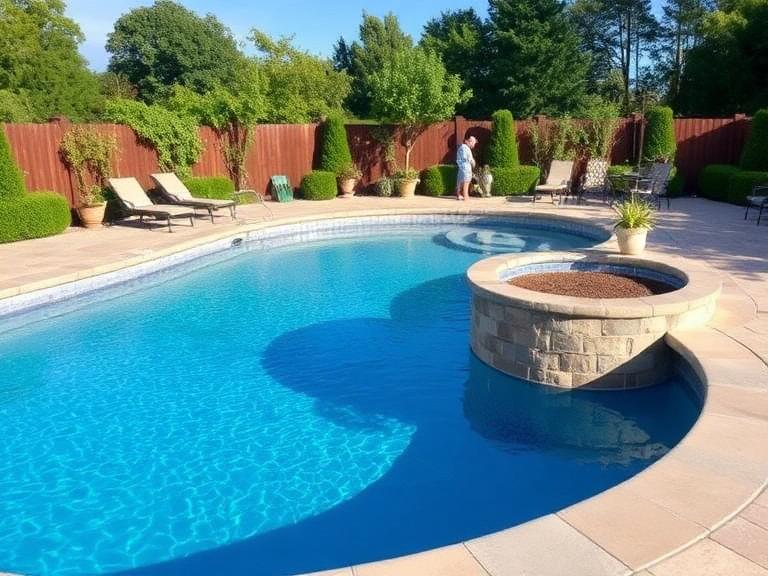
If you’re asking whether a pool is worth it purely as a financial investment, the honest answer is usually no — most pools don’t return their full cost at resale. But that’s a narrower question than “is it worth it,” and for most homeowners, it’s not actually the question that matters most. This guide looks at the fuller picture: real cost, the benefits that never show up on a resale appraisal, and a more useful way to think about long-term value than a single ROI percentage.
The Real Cost, Recapped
Installed cost for a Toronto pool typically runs $50,000 to $220,000+ depending on type and size, plus $1,500–$7,000 a year in ongoing maintenance, heating, and water care. For the full breakdown by type and size, see Pool Installation Cost Toronto and Pool Maintenance Toronto.
The Resale Side, Briefly
Canadian survey data puts the average resale value increase from a pool at around 6% — typically not enough to cover installation cost, let alone years of upkeep. If you want the full picture on appraisals, regional variation, and what actually moves resale value, see Does a Pool Increase Home Value in Toronto? That page covers the financial case in detail. This one is about everything else.
The Benefits That Don’t Show Up on a Resale Appraisal
A resale appraisal can’t measure what a pool is actually worth to live with — and for most homeowners who keep their pool for years, that’s the value that matters most:
- Daily-life enjoyment during Toronto’s hot summer stretch. A pool turns a backyard into somewhere you actually want to spend July and August evenings, rather than somewhere you tolerate the heat.
- Family time and entertaining. For many households, a pool becomes the default setting for birthdays, weekend hangouts, and simply getting kids (and adults) off screens.
- Reduced pressure to travel for the same experience. Some families find a backyard pool meaningfully cuts down on how often they feel they need a cottage weekend or a beach trip to get the same kind of relaxation.
- Low-impact exercise and unwinding. Lap swimming and casual pool time are genuinely useful for both fitness and simply decompressing after a long day — value that starts the moment the pool is finished, independent of what happens at resale.
These benefits don’t show up in a Royal LePage survey, but they’re the actual reason most people build a pool in the first place — and they’re worth naming explicitly rather than treating the decision as a pure financial calculation.
A More Useful Way to Frame the Cost: Cost Per Use
Instead of asking “will I get this $90,000 back,” it’s often more useful to ask “what does each day of use actually cost me.” Here’s an illustrative example:
- Installation: $90,000 (a mid-range inground pool)
- Ownership horizon: 12 years (a reasonable span before a major sale or renovation decision)
- Annual ownership cost: ~$2,500/year × 12 years = $30,000
- Total cost over 12 years: $120,000
- Estimated use: roughly 70 swim days a year (a realistic estimate across Ontario’s outdoor swim season) × 12 years = 840 total uses
That works out to roughly $143 per use before any resale credit. If you sell after 12 years and recover even a modest $15,000–$20,000 of the original cost (consistent with the kind of partial resale credit covered in our ROI guide), the effective cost drops to roughly $119–$125 per use.
Whether that feels reasonable is a personal call — but it’s a far more useful number than “$90,000,” because it actually reflects what you’re paying for: years of regular use, not a single transaction. Adjust the assumptions (more or fewer swim days, a longer or shorter ownership horizon, a different pool budget) to fit your own situation.
Who a Pool Makes the Most Sense For
- You have yard space to spare. A pool that leaves room for a lawn, dining area, and garden tends to get used more and regretted less than one that consumes the entire yard.
- You’ll genuinely use it most of the season. Households that swim regularly — not just a handful of times a summer — get the most value out of the cost-per-use math above.
- You’re planning to stay put for 7+ years. Longer ownership means more total use to spread the cost across, and it avoids the resale-timing problem covered in our ROI guide (installing a pool right before listing rarely pays off).
- You like to host. If summer entertaining is already part of your life, a pool tends to become the centrepiece of it.
- Pools are already common in your neighbourhood. This matters for resale (see our home value guide), but it also usually means your property already has the lot size and layout to support one comfortably.
Who Should Think Twice
- A small lot where the pool would dominate the yard, leaving little room for anything else.
- Plans to sell within the next 1–3 years. There’s not enough time to get meaningful personal use out of it, and the resale math is weakest on a short timeline.
- Resale value as the primary motivation. If that’s the main driver, the numbers in our ROI guide make a weak case on their own.
- Low tolerance for ongoing cost and upkeep. Beyond the installation, you’re committing to real annual maintenance — see Pool Maintenance Toronto for what that actually involves.
- A realistic chance you’ll travel most summers anyway. A pool you’re rarely home to use is the worst version of the cost-per-use math.
A Quick Decision Checklist
- Do I have enough yard space left over after the pool for the things I currently use my yard for?
- Will I — realistically, not optimistically — use it most weekends through the season?
- Am I planning to stay in this home for at least 5–7 more years?
- Have I budgeted for ongoing maintenance, not just installation?
- Am I building this primarily for how I’ll live, with resale value as a secondary bonus rather than the main goal?
If most of these check out, a pool is likely to be a good decision for you — even though, financially, it probably won’t pay for itself at resale.
The Honest Bottom Line
A pool is, for almost everyone, a lifestyle purchase with a partial financial offset — not an investment with a guaranteed return. Sold as a financial decision alone, the numbers don’t make a strong case. Evaluated as years of daily-life enjoyment for your household, the calculus often looks very different. The most useful question isn’t “will I get my money back,” it’s “is this how I want to spend my summers for the next decade” — and only you can answer that one.
Frequently Asked Questions
Is a pool worth it financially?
Usually not as a standalone investment — most pools don’t return their full cost at resale. It can still be worth it as a lifestyle purchase with a partial resale offset, depending on how much you’ll use it.
How many years of use justifies the cost?
There’s no fixed answer, but reframing cost as a per-use figure (rather than a lump sum) often makes the decision clearer. A pool used heavily for a decade-plus tends to feel like much better value than the same pool used only occasionally for a few years before a move.
What’s the real benefit of a pool if not resale value?
Daily-life enjoyment during the summer, family time, entertaining, and low-impact exercise — value that starts the day it’s finished and doesn’t depend on what happens if you eventually sell.
Is a pool worth it for a family with young kids?
Often, yes, if you have the yard space and will genuinely use it regularly — it tends to become the default setting for summer family time. Safety and fencing compliance matter more with young children in the home; see Toronto Pool Fence Bylaws.
Should I get a pool if I’m planning to sell in a few years?
Probably not primarily for that reason. There isn’t enough time to get much personal use out of it, and the resale math is weakest on a short timeline — see our home value guide for the details.
Talk Through Your Specific Situation
Whether a pool makes sense depends on your lot, your budget, and how you’ll actually use it — not a generic answer. For an itemized quote or to talk through what fits your property:
Contact Easy Pools at (647) 449-9512 for a free, no-obligation consultation.