

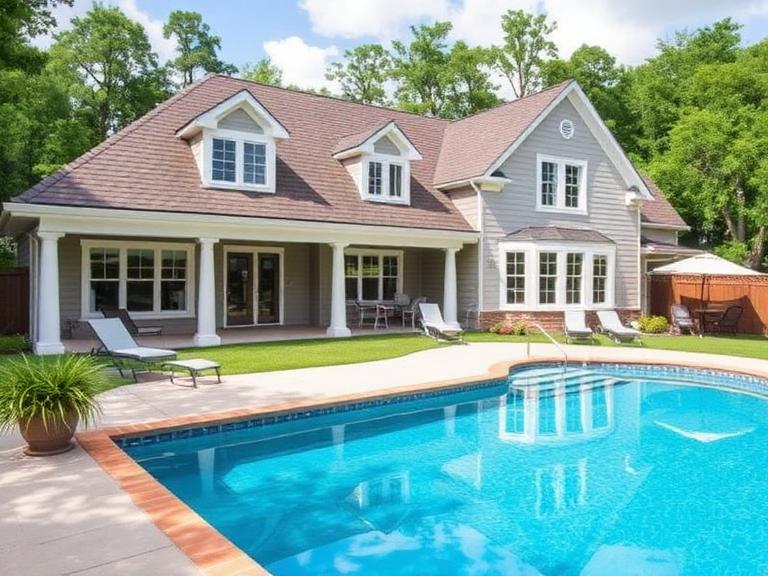
Most of the time, yes — a pool adds some value to a Toronto home. It rarely adds enough to cover its full cost. Canadian survey data puts the average value increase around 6%, behind kitchens (20%), bathrooms (16%), and even basic outdoor landscaping (10%). In a handful of GTA-adjacent markets, a well-maintained pool can add meaningfully more — but outside the right conditions, it can also make a home harder to sell.
How Much Value Does a Pool Really Add?
Royal LePage’s 2022 survey of Canadian real estate professionals found a pool added an average of 6% to home value — the lowest of any renovation surveyed. Its earlier 2018 advisor survey was even more pointed: 66.4% of advisors said a pool added less than 2.5% to selling price.
For context, on a $1,200,000 GTA detached home, a 6% increase works out to roughly $72,000 in added value — which sounds significant, but is still less than many homeowners spend building a mid-size concrete pool ($100,000–$150,000+). This is the core tension on this topic: the percentage sounds reasonable, but the dollar math rarely closes the gap with installation cost.
A frequently cited RE/MAX Canada example makes this concrete: a homeowner who spent roughly $100,000 on a pool saw only about $7,000 reflected in resale value in that particular case. That’s an illustrative example, not a universal outcome — but it shows how far actual resale credit can fall short of construction cost, even in a market where pools are generally well-regarded.
For broader context, U.S. industry data often cites pools recouping 40–60% of installation cost in markets where pools are in strong demand. Canadian survey data trends toward the lower end of that range, or below it — a meaningful difference worth knowing if you’ve seen the more optimistic U.S. figures elsewhere.
Where Pools Add the Most (and Least) Value
Regional appraisal data tells a more useful story than a single national average:
- Niagara, St. Catharines, Hamilton, and Burlington: in 2025 appraisal data, well-maintained pools in these markets have added $30,000–$80,000 in appraised value — well above the national 6% average — reflecting strong local demand for outdoor living and longer effective swim seasons.
- Northern and rural Ontario: a shorter swim season and buyer concerns about upkeep mean a pool can sometimes reduce a property’s appraised value rather than add to it.
- Toronto itself: demand for pools is strong, but smaller urban lots raise the stakes on how much yard space a pool actually takes — a factor that matters more here than in markets with larger suburban lots.
The takeaway: “does a pool add value” has a different answer depending on exactly where in the GTA-and-beyond region you’re asking. For the cost side of this equation across Ontario, see Cost to Install a Pool in Ontario.
What Actually Moves the Needle on Resale
- Pool type: inground pools (concrete and fibreglass especially) are treated as permanent property improvements and appraise more consistently. Above-ground pools are often treated closer to personal property — removable, and rarely credited at resale.
- Condition and documentation: service records, recent equipment, and a sound liner or finish reduce the repair risk buyers price into an offer. An older pool with no maintenance history works against you, even if it’s functioning fine.
- Lot fit: a pool that leaves room for lawn, a dining area, and garden space reads as a backyard asset. One that consumes the entire yard reads as a constraint — particularly relevant on tighter Toronto lots.
- Surrounding design: this is the most underrated point in the data. Royal LePage’s survey ranked outdoor entertaining space and landscaping at 10% average value increase — higher than the pool itself at 6%. The decking, lighting, and landscaping around your pool may matter more to resale than the pool. See Pool Landscaping Toronto.
- Permit compliance: an unpermitted pool is a red flag for buyers, lenders, and insurers alike, and can complicate closing. See Pool Permits Toronto.
The Ownership Costs That Eat Into ROI
Any honest ROI calculation has to net resale gain against what the pool actually cost to own, not just what it cost to build:
| Cost Category | Typical Range |
| Installation | $50,000 – $220,000+ (varies by type/size) |
| Annual maintenance | $1,500 – $7,000, depending on size, heating, and service level |
| Insurance increase | Roughly $30 – $75/month extra |
| Liner replacement (vinyl) | $4,000 – $7,000 every 7–12 years |
| Resurfacing (concrete) | $6,000 – $18,000 every 10–20 years |
A $90,000 pool with $3,000–$4,000 in annual ownership costs needs a substantial resale premium just to break even — which is exactly why national survey data shows most pools falling short of full payback. Full cost breakdown: Pool Installation Cost Toronto and Pool Maintenance Toronto.
Appraised Value vs. Buyer Appeal: A Useful Distinction
These are genuinely two different things, and conflating them is where a lot of pool-value confusion comes from:
- Buyer appeal is about how a listing looks, shows, and feels — pools tend to photograph well and can make a backyard feel like a finished retreat, especially in summer listings.
- Appraised/sale value is anchored to comparable sales evidence. A lender-ordered appraisal (the one that actually affects financing and final sale price) looks at what similar nearby homes — with and without pools — have actually sold for. It doesn’t add your construction invoice to the home’s value.
Note: this is distinct from an MPAC assessment, which is Ontario’s property tax valuation and isn’t the same process a buyer’s lender uses at the time of sale. If your neighbourhood’s comparable sales don’t show a consistent pool premium, no amount of personal investment will manufacture one at appraisal time — which is exactly why regional data (the Niagara/Hamilton example above) matters more than a single national figure.
So, Is It Worth Installing a Pool for Resale?
If resale value is your only goal, the numbers make a weak case: a 6% national average, an oft-cited example of $100,000 spent for $7,000 returned, and a pool ranking below kitchens, bathrooms, and even basic landscaping for resale impact. Compared dollar-for-dollar against other renovations, a pool is rarely the efficient choice.
If you’re planning to enjoy the pool for several years before selling, the calculus changes — you’re paying for a lifestyle upgrade with a partial, conditional resale credit as a bonus, not expecting full payback. That’s a different (and for most homeowners, more honest) way to frame the decision. For the fuller framework on weighing lifestyle value against financial payback, see Is a Pool Worth It in Toronto?
Smart Tips If Resale Matters to You
- Don’t outspend your neighbourhood. A pool well beyond what comparable homes on your street support rarely pays back proportionally.
- Protect usable yard space. A pool that swallows the whole lot can narrow your buyer pool, particularly on smaller Toronto properties.
- Budget for landscaping alongside the pool, not as an afterthought — it outranks the pool itself for resale impact in survey data.
- Keep permits and maintenance records. This protects whatever resale value the pool does have, and removes a common buyer objection.
- Get a local comparable-sales opinion, not just a national average, if resale timing is a real factor in your decision.
Frequently Asked Questions
Does a pool increase home value in Toronto?
Usually by a modest amount — Canadian survey data puts the average at around 6%, though well-maintained pools in some GTA-adjacent markets (Niagara, Hamilton, Burlington) have added substantially more in recent appraisal data.
How much value does a pool add on average?
Royal LePage’s 2022 survey found pools added an average of 6% to home value nationally — the lowest of any renovation category surveyed, behind kitchens, bathrooms, and landscaping.
Does an inground pool add more value than an above-ground pool?
Yes. Inground pools are treated as permanent property improvements and appraise more consistently; above-ground pools are often treated closer to removable personal property and rarely add resale value.
Can a pool decrease my home’s value?
In some cases, yes — particularly in markets with a shorter swim season, on lots where the pool removes most usable yard space, or where the pool is poorly maintained or unpermitted.
Is a pool a good investment?
As a pure financial investment, the data says it’s a weak one — most pools don’t return their full cost at resale. As a lifestyle investment with a partial, conditional resale credit, many homeowners still find it worthwhile.
Talk to a Local Expert Before You Build or List
Resale value is hyperlocal — what your specific street supports matters more than any national average. For an itemized installation quote, or to talk through what makes sense for your property:
Contact Easy Pools at (647) 449-9512 for a free, no-obligation consultation.