

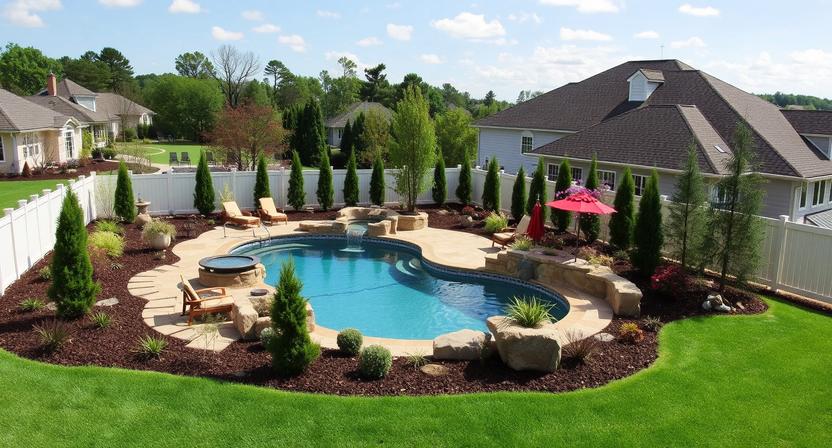
The finished pool backyard is the pool plus everything around it — hardscape, plants, lighting, and how it connects to the house. Done well, the landscaping is what makes a pool feel like a backyard retreat rather than a water feature surrounded by concrete. This guide covers the materials, plant selection, and design strategies that work in Toronto’s climate and lot sizes.
The Outdoor Rooms Concept
The most useful framework for pool landscaping is thinking about the backyard as a series of outdoor rooms, each with a purpose, rather than a single space organized around the pool. A well-designed Toronto backyard typically has:
- A transition zone between the house and the pool — a covered or partially covered patio close to the house where you eat, drink, and sit without necessarily being at the pool’s edge
- The pool deck — the hard surface immediately surrounding the pool; functional, wet, designed for safety and ease of access
- Activity or lounge areas on or adjacent to the pool deck — somewhere to recline and sit at pool level
- Planting zones that soften the boundary with the fence line, provide privacy screening, and create the sense of enclosure that makes a small outdoor space feel complete
Even on a tight lot, establishing these zones as distinct — even if they overlap — produces a more liveable result than treating the backyard as one undifferentiated pool-and-patio surface.
Hardscape: Patios, Decking and Material Choices
The hardscape surrounding the pool is typically the largest surface area in the finished backyard, and the material choice has both aesthetic and practical consequences.
Interlocking paving stone: the most common choice in Toronto’s established residential neighbourhoods. Durable, repairable (individual units can be replaced), and available in a wide range of colours and profiles. Permeable paving options satisfy Toronto’s soft landscaping requirement (see Pool Zoning Rules Toronto) while providing a usable hard surface. Paving stone also handles Toronto’s freeze-thaw cycle well when properly installed on a prepared base.
Natural stone (limestone, travertine, porcelain outdoor pavers): the premium option and the one that most significantly elevates a pool surround visually. Travertine’s warm tones work particularly well with warmer-toned pool interiors; limestone’s cooler grey suits contemporary and modern pools. Genuine travertine and limestone are highly durable in our climate when properly sealed; the textured surface provides natural slip resistance when wet.
Poured concrete: the most affordable and most customisable hard surface. Can be finished with aggregate, brushed, stained, or stamped. Requires sealing and eventual resurfacing, but can be done well initially at meaningful cost savings.
Composite and wood decking: used near above-ground pools, for raised platforms, or to create a warmer material contrast section alongside a predominantly stone or concrete surround. Real wood (cedar, IPE, teak) requires more maintenance than composite but has an unmatched natural quality; composite is more durable and lower maintenance.
Material continuity: the strongest pool landscapes typically use one primary hardscape material throughout — from the patio near the house to the coping and deck around the pool — rather than three different materials assembled together. Coping that matches or closely coordinates with the deck material reads as a designed decision; mismatched materials read as accumulated choices.
Plant Selection for Toronto Pool Environments
Choosing the right plants near a pool in Toronto involves two filters: what survives our climate (Zone 6b for most of the city), and what works practically in a pool environment. The plants that look beautiful year one and create problems year five are worth knowing about before they’re planted.
What Works Well Near Toronto Pools
Ornamental grasses: Karl Foerster grass, Blue Oat Grass, Miscanthus varieties — virtually no leaf litter in the pool, beautiful movement in the wind, and dramatic fall and winter structure when left up through the off-season. One of the best categories for pool environments.
Lavender: fragrant, low-water once established, no meaningful leaf drop, and visually beautiful against stone or paving.
Russian Sage (Perovskia): one of the toughest ornamental plants for Zone 6, with blue-purple summer interest and essentially zero maintenance. Handles drought well once established.
Boxwood and other evergreen hedging: provides structure year-round — important in Toronto where the pool area is visible from the house through winter and spring, not just summer. Columnar or globe forms add structure without spreading into the pool area.
Columnar trees (Sky Pencil Holly, columnar serviceberry, fastigiate conifers): vertical structure with limited horizontal spread — ideal for creating height and privacy screening without roots or canopy that extend aggressively over the pool.
Japanese Maples: slower-growing, dramatic, controllable size, and relatively tidy. One of the most-used specimen plants in Toronto pool gardens for good reason.
Native perennials (Echinacea/coneflower, Rudbeckia, Salvia): tough, Ontario-climate-adapted, good for pollinators and long flowering seasons with limited pool mess.
What to Avoid Near Pools
Silver Maple and Weeping Willow: aggressive root systems that can damage underground pool plumbing over time and enormous leaf drop into the pool.
Poplars and Cottonwoods: cottonwood fluff in early summer clogs pool skimmers; root systems are aggressive.
Norway Maple: common street tree in Toronto but produces heavy spring seed drop (helicopters) directly into pools.
Any tree with significant messy seed or fruit production positioned where the prevailing wind direction delivers debris into the pool: serviceberry, crabapple, and similar trees are beautiful but should be positioned upwind of the pool rather than directly adjacent.
Thorny plants along the pool edge: obvious safety concern for bare-footed pool areas.
Bamboo (without proper root control): running bamboo varieties spread aggressively; clumping bamboo is controllable but still vigorous.
Plants to Avoid Entirely Near Pools
Certain plants are toxic and belong away from pools where children swim: Foxglove, Oleander (not hardy in Toronto anyway), and Yew should not be planted where swimmers will have contact with plant material.
Privacy Planting
Toronto pool yards share fence lines with neighbours, and many inner-city properties have second-floor windows overlooking the pool area. Plants that provide meaningful privacy typically need height — beyond standard fence limits — or canopy coverage.
Effective privacy plantings:
- Cedar hedging (Thuja occidentalis): the standard Toronto privacy hedge, extremely durable, grows to significant height, holds form well with trimming. Eastern White Cedar performs better in shade than Western Red Cedar.
- Columnar Blue Spruce or similar fastigiate conifers: more formal, slower-growing, provide vertical screening without spreading.
- Pyrus calleryana ‘Chanticleer’ (ornamental pear): columnar form, spring flowers, fall colour, relatively tidy. Not a replacement for an evergreen hedge but useful as a canopy element.
- Vertical wood slat screens or metal trellis with climbing plants: structure that gets plants to fence height immediately while climbing plants establish.
For below-grade privacy along the fence line, a combination of hedge base and tall ornamental grass in front reads as a designed planting bed rather than just a screen.
Lighting: The Overview
Lighting does more than make the pool visible after dark — it defines how the entire backyard reads at night, which for most Toronto homeowners is when the outdoor space gets most enjoyed in summer. Three lighting zones matter:
- The pool itself: underwater LED lighting that colours the water and creates the central visual element after dark
- The deck and path lighting: low-level lighting for safety and navigation around the pool area
- The planting and perimeter: uplighting of specimen plants, fence-line lighting, or ambient lighting that extends the sense of the space beyond the pool’s immediate surround
For the full lighting specification — types, placement, electrical requirements, and what’s required for safety compliance — see Pool Light Installation Toronto.
Year-Round Interest in Toronto’s Climate
Toronto’s outdoor pool season runs roughly June through September, but the backyard is visible from inside the house all year. A pool landscape that reads well in December matters — and it’s achieved primarily through:
- Evergreen structure: hedging, columnar conifers, boxwood, and other plants that hold their form and colour through winter
- Ornamental grasses left standing: their winter silhouette and movement in wind is genuinely beautiful against snow
- Hardscape quality: a paving stone patio with good drainage looks its best in winter; a concrete pad that cracks and stains over the freeze-thaw cycle looks its worst
Pool covers, winterised equipment, and careful winterisation keep the pool area tidy; the plants and hardscape around it maintain the landscape through the off-season.
The Indoor-Outdoor Connection
A pool that’s visible from the main living areas of the house — through a kitchen window, glass doors, or a rear living room — needs to be designed for that viewing angle as much as for the experience of being in the yard. The most important consideration: what’s the sightline from inside the house, and is the pool backed by a planting composition or a fence? A specimen tree or a carefully designed planting bed as the visual terminus of the pool view significantly improves the year-round experience of living with the pool.
Frequently Asked Questions
What plants are best around a pool in Toronto?
Ornamental grasses, lavender, Russian Sage, boxwood hedging, columnar trees, and native perennials like coneflower. These combine low pool-side mess with good durability in Zone 6b conditions.
What trees should I avoid near a pool?
Silver Maple, Weeping Willow, Poplar, and Norway Maple — all known for aggressive root systems or significant messy leaf or seed drop into pool water.
What paving material is best for a pool patio in Toronto?
Interlocking paving stone handles our freeze-thaw cycle well and is the most common choice; natural stone (limestone, travertine) is the premium option. Material continuity between coping and deck creates the most cohesive result.
How do I add privacy to a pool area in a dense Toronto neighbourhood?
Cedar hedging, columnar conifers, and vertical screens with climbing plants are the most effective options. Standard fence heights don’t address second-floor sightlines — height or canopy coverage is needed for that.
Get a Landscaping Consultation Alongside Your Pool Quote
The best time to plan landscaping is before the pool is built — not after, when access is limited and the design is set.
Contact Easy Pools at (647) 449-9512 for a free, no-obligation consultation that includes the full backyard picture.