

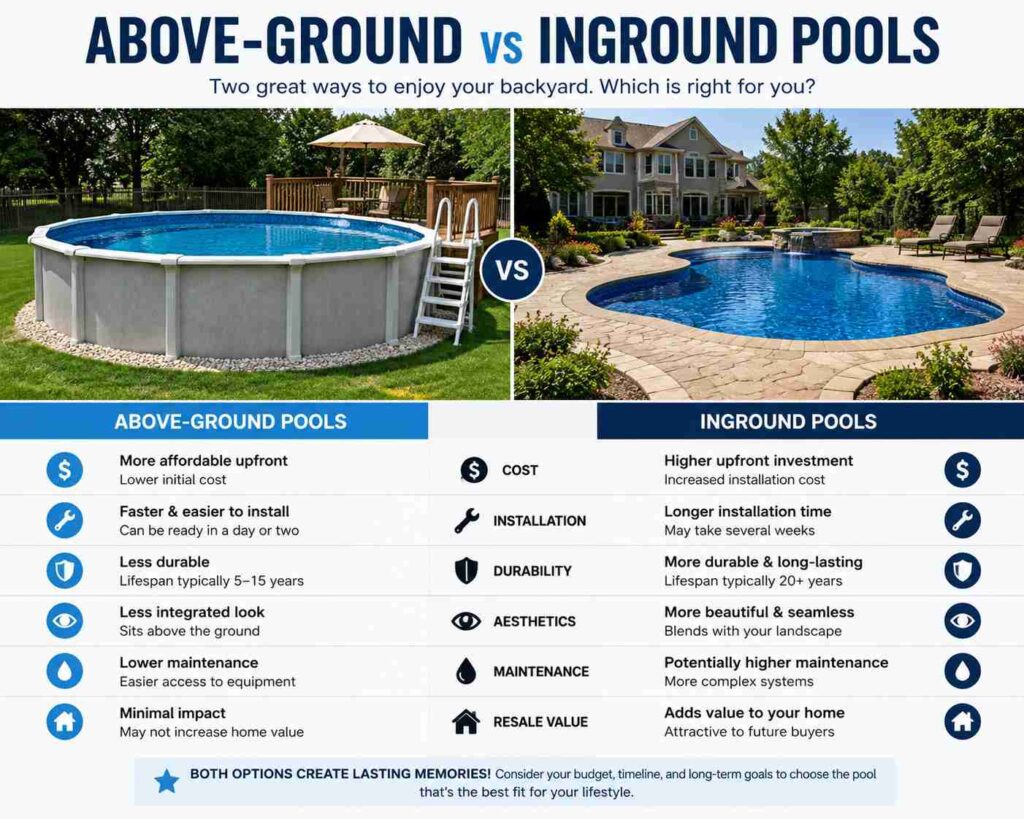
The gap between above-ground and inground pools isn’t just price — it’s a fundamentally different kind of purchase. An above-ground pool is a lower-cost, semi-permanent product with a shorter lifespan and little resale credit. An inground pool is a permanent property improvement with a much higher cost, a much longer lifespan, and a modest but real resale impact. Here’s the full comparison.
Quick Comparison at a Glance
| Above-Ground | Inground | |
| Typical installed cost | $2,500 – $15,000 | $50,000 – $220,000+ |
| Structural lifespan | 7–15 years | 25+ years (fibreglass) to 50+ years (concrete, with resurfacing) |
| Liner lifespan (if applicable) | 6–12 years | 7–12 years (vinyl) |
| Installation time | 1–3 days | 2–12 weeks, depending on material |
| Customization | Limited to manufactured shapes and sizes | Considerable to unlimited, depending on material |
| Permanence | Semi-permanent, removable | Permanent property improvement |
| Resale value impact | Minimal to none — often treated as removable personal property | Modest but real — averages around 6% home value increase |
| Permits | Lighter requirement, though enclosure rules can still apply | Building permit and pool enclosure permit required |
Cost Compared
Above-ground pools are dramatically cheaper because they skip excavation and permanent structural work entirely — see Cost to Install an Above-Ground Pool for the full size-by-size breakdown. Inground pools start at roughly $50,000 for vinyl and climb from there depending on material — see Cost to Install an Inground Pool. There’s effectively no overlap between the two ranges; this isn’t a case where a premium above-ground pool approaches inground pricing.
Lifespan Compared
This is where the comparison gets more nuanced than “inground lasts longer” suggests:
- Above-ground structures typically last 7–15 years, with the structure itself — frame, walls — being the limiting factor rather than the liner. Higher-end models (wood-sided construction in particular) can extend well beyond this, with some manufacturers citing 30+ years for premium builds, though this is the exception rather than the norm.
- Above-ground liners last 6–12 years, similar to inground vinyl liners, so you may replace a liner once or twice before the structure itself needs replacing.
- Inground vinyl structures (the wall panel system) can often last the life of the home, with the liner as the recurring wear item every 7–12 years.
- Inground fibreglass shells commonly last 25+ years, often the life of the home, with only a gelcoat refinish needed every 15–20 years.
- Inground concrete structures can last 50+ years with consistent resurfacing roughly every 10–15 years — the longest potential lifespan of any pool type, provided the maintenance schedule is kept up.
The practical upshot: an above-ground pool is realistically a 10–15 year purchase before a full replacement decision, while any inground pool is a multi-decade one — with periodic surface work along the way, but not a full structural rebuild.
Value Compared
Resale value is where the two diverge most sharply. Above-ground pools are frequently treated as removable personal property by buyers and appraisers alike, contributing little to nothing toward resale value — some sellers remove them entirely before listing. Inground pools are treated as permanent property improvements and show a real, if modest, average resale impact — commonly cited around 6% of home value in Canadian survey data. For the full picture, see Does a Pool Increase Home Value in Toronto?
Ownership value tells a related but distinct story. An above-ground pool costing $8,000 and lasting 10 years works out to roughly $800 a year before maintenance — genuinely inexpensive per year of use, even with no resale credit at the end. A $90,000 inground pool lasting 25+ years works out to roughly $3,600 a year before maintenance and surface work — a much higher annual figure, partially offset by the resale credit an inground pool retains if you sell partway through. Neither is objectively “better value” — it depends on how long you plan to stay, and whether resale credit or lowest annual cost matters more to you.
Which Should You Choose?
Above-ground makes sense if: budget is the primary constraint, you’re renting or expect to move within a decade, you want the pool up and swimmable within days rather than weeks, or you’re comfortable with a shorter lifespan and minimal resale credit in exchange for a much lower price.
Inground makes sense if: you want the pool to function as a permanent part of your backyard’s design, you’re planning to stay in the home long-term, resale credit (even modest) matters to your overall financial picture, or you want the widest possible range of size, shape, and feature customization.
For a fuller decision framework across every pool type — not just these two categories — see Best Pool Type to Install.
Frequently Asked Questions
Is an above-ground pool cheaper than inground long term?
Yes, on an annual cost basis it’s usually cheaper, even accounting for needing to replace it sooner — but it also returns essentially no resale credit, while an inground pool retains some resale value if you sell.
How much longer does an inground pool last than above-ground?
Considerably longer. Above-ground structures typically last 7–15 years, while inground pools commonly last 25–50+ years depending on material, with periodic surface maintenance along the way rather than a full structural replacement.
Does an above-ground pool add any home value?
Generally very little. Above-ground pools are often treated as removable personal property rather than a permanent improvement, so they rarely contribute meaningfully to resale value.
Can I convert an above-ground pool to inground later?
Not directly — they’re fundamentally different construction methods. If you start with above-ground and later want inground, it’s effectively a new pool project, not an upgrade of the existing one.
Which is better for resale, above-ground or inground?
Inground, by a clear margin. It’s treated as a permanent property improvement and shows a real (if modest) average resale impact, while above-ground pools typically don’t.
Get Quotes for Either Path
Whether above-ground or inground fits your situation better depends on your budget, timeline, and how long you plan to stay in your home.
Contact Easy Pools at (647) 449-9512 for a free, no-obligation quote on either option.