

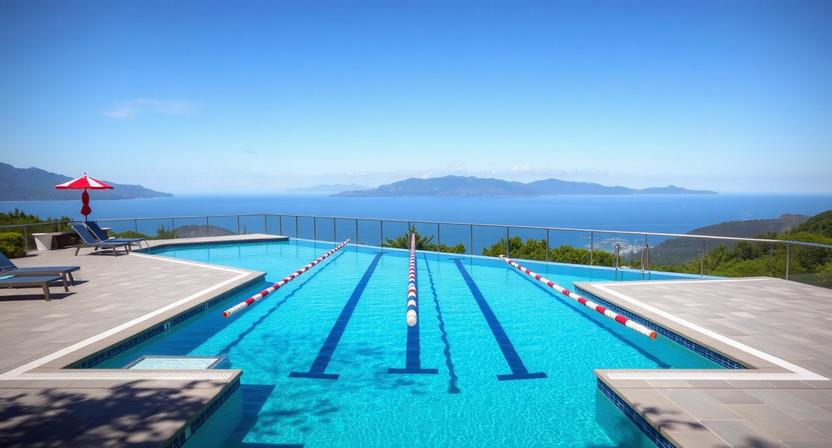
A lap pool is defined by length, but length is only one of three dimensions that determine whether it actually functions well for swimming. This guide covers cost, the full dimension picture — length, width, and depth — and the design choices, like turn walls and entry placement, that separate a genuinely useful lap pool from a long, narrow standard pool.
Costs at a Glance
Lap pool cost is driven primarily by length, ranging from $45,000 for a compact 30–40 ft recreational build to $400,000+ for a full 75–82 ft competitive-length pool, with most homeowners landing in the $70,000–$160,000 range for a comfortable 40–50 ft training length. For the full length-by-length breakdown, including why fibreglass has a hard length ceiling that concrete and vinyl don’t, see Cost to Install a Lap Pool.
Lap Pool Dimensions
Length
40–50 feet is the practical sweet spot for most homeowners — long enough for genuine training value without the cost and space demands of a competitive-length build. See our cost guide for the full length-tier breakdown up to 75–82 ft.
Width
Lap pools are typically 6–10 feet wide, and this choice matters more than people expect:
- 6–8 feet feels like a dedicated training lane — efficient to heat and build, but only really comfortable for one swimmer at a time.
- 8–10 feet allows two swimmers side by side, or a single swim lane plus a narrow lounging or sitting ledge along one edge — more versatile for household use beyond serious training.
Depth
Unlike a standard pool, lap pools are usually built to a consistent depth of 4–5 feet throughout, rather than sloping from shallow to deep. There’s no diving section, since the design priority is an even, predictable swimming surface from end to end.
Design Options
Lane Markings and Turn Walls
A painted or tiled lane line along the floor gives visual structure to the swim, and T-shaped markers near each end wall help swimmers judge distance to the wall without having to look up mid-stroke. End walls are typically built flat and vertical for hand-touch turns — the simplest and most common configuration for a residential lap pool.
Entry and Exit Placement
Entry points belong at the ends of a lap pool, not along the sides — a side entry interrupts the swim lane and reduces usable training width. Corner steps or a compact ladder at one end keep the full length and width clear for actual swimming.
Width and Use-Case Trade-Offs
Decide early whether the pool is primarily a training tool or a multi-use family pool that happens to be long and narrow. A narrower, training-focused lane is more efficient to build and heat; a wider design that accommodates two swimmers or a lounging ledge costs more but gets more general household use.
Combining Functions
Two popular ways to get more out of a lap pool’s footprint:
- Lap lane plus lounging shelf: the main rectangular swim lane runs alongside a separate, shallower shelf for kids or lounging — combining serious swimming with general family use in one structure.
- Pairing with a separate spa or plunge pool: many lap pool owners add a small spa or plunge pool at one end, either connected by a spillway or built as a fully separate feature, for post-swim relaxation.
Landscape Integration
Because of their long, linear shape, lap pools often double as a visual design element — running alongside a fence line or property edge, functioning almost like a reflecting pool as much as a swim lane. A dark plaster or tile finish leans into this effect, creating a striking mirror-like surface, especially with good lighting at night.
Lighting
In-floor or wall-mounted LED lighting spaced along the pool’s length serves a genuine functional purpose beyond ambiance — it helps swimmers judge distance and see the wall clearly during evening swims, in addition to the aesthetic benefit.
Is a Lap Pool Right for You?
A lap pool is the right call if genuine swimming distance matters to you more than lounging space, or if a narrow lot rules out a standard rectangular pool but still leaves room for length. If your priority is a compact soaking feature rather than swimming distance, see Cost to Install a Plunge Pool instead. For the broader decision framework, see Best Pool Type to Install.
Frequently Asked Questions
What’s the difference between a lap pool and a standard pool?
A lap pool is long, narrow, and built to a consistent depth specifically for swimming continuous lengths, while a standard pool is typically wider and shallower-to-deeper, designed more for general recreation than distance swimming.
How wide should a lap pool be?
6–8 feet for a dedicated single-lane training feel, or 8–10 feet if you want room for two swimmers or a narrow lounging ledge alongside the swim lane.
Can I add a spa to my lap pool?
Yes — a small spa or plunge pool at one end, either connected by a spillway or built separately, is a popular way to add relaxation space without compromising the swim lane itself.
What design features help with lap swimming specifically?
A consistent depth throughout, end-only entry points so the swim lane stays clear, flat end walls for hand-touch turns, and distance markers or lane lines for sighting during the swim.
How much does a lap pool cost?
Typically $70,000–$160,000 for a 40–50 ft training-length pool, ranging from $45,000 for a compact build to $400,000+ for a full competitive-length pool. See our full cost guide for the complete breakdown.
Get a Dimension-Specific Quote
The right length, width, and depth combination depends on how you’ll actually use the pool — serious training, family swimming, or both.
Contact Easy Pools at (647) 449-9512 for a free, no-obligation quote on your lap pool project.