Indoor pool installation in Toronto is the process of planning, designing, and building a year-round indoor swimming pool within a fully enclosed pool room or building structure. The work includes site review, structural design, excavation or interior construction, pool shell installation, plumbing, electrical work, dehumidification, ventilation, insulation, vapour control, interior finishing, and startup. The full scope covers the structural, mechanical, and environmental systems required to support safe indoor pool use in all seasons.
The right indoor pool depends on pool size, room design, HVAC system design, moisture control, energy use, and Toronto permit and bylaw requirements. A properly designed indoor pool room manages humidity, protects the building envelope, supports stable air quality, and reduces long-term moisture-related damage.
A complete Toronto indoor pool installation plan addresses cost, design, construction process, permit compliance, and long-term dehumidification performance from the start. Strong planning improves energy efficiency, protects interior finishes, and supports long-term pool operation.
What Is Indoor Pool Installation in Toronto?
Indoor pool installation in Toronto is the design and construction of an inground or enclosed swimming pool inside a conditioned building space, often called a natatorium or pool room. The work includes site review, structural planning, pool shell construction, plumbing, electrical work, ventilation, dehumidification, insulation, vapour control, interior finishes, and full integration with the building envelope. Toronto indoor-pool builders present humidity control, air quality, and condensation prevention as core engineering requirements, not optional upgrades.
What Is an Indoor Pool?
An indoor pool is a swimming pool located inside an enclosed room rather than in an open backyard. Toronto indoor-pool pages describe common residential formats such as lap pools, plunge pools, and spa-style indoor pools designed for year-round use, privacy, and wellness.
What Makes an Indoor Pool Different From an Outdoor Pool?
An indoor pool differs from an outdoor pool through its constant interaction with the building. Indoor pool design requires dedicated dehumidification, controlled ventilation, a sealed vapour retarder, and a pool-room envelope built to resist condensation and moisture migration. Toronto and natatorium-design sources state that uncontrolled humidity risks structural damage, corrosion, mould, and poor indoor air quality.
What Parts Form an Indoor Pool System?
An indoor pool system includes the pool shell, waterproofing, plumbing lines, main drains, skimmers, returns, filtration equipment, heater, lighting, electrical systems, the surrounding pool room, dedicated HVAC, dehumidification equipment, insulation, vapour barrier, drains, and finish materials that manage water and air movement around the pool. Toronto indoor-pool builders and natatorium sources treat the mechanical and enclosure systems as part of the pool system itself, since the room must control evaporation as well as hold water.
Why Do Toronto Homeowners Choose Indoor Pools?
Toronto homeowners choose indoor pools for year-round swimming, stronger privacy, protected use during winter, and a home wellness space that supports fitness and relaxation. Toronto indoor-pool pages repeatedly present indoor pools as private all-season environments, while local luxury-home and builder pages connect them with wellness-focused design and premium home features. Indoor pools also cost more than outdoor pools in Toronto because they require added ventilation, dehumidification, and building integration.
Why Choose an Indoor Pool in Toronto?
An indoor pool is chosen in Toronto for year-round swimming, stronger privacy, controlled indoor conditions, and direct integration with a home wellness or luxury design plan. Toronto indoor-pool pages and natatorium guidance treat indoor pools as a premium residential feature that depends on dedicated dehumidification, ventilation, and condensation control, not only on the pool shell itself.
Is an Indoor Pool Best for Year-Round Use?
Yes. An indoor pool is best for year-round use because the pool stays available through winter, rain, wind, and temperature swings. Toronto indoor-pool builders present all-season swimming as one of the main reasons homeowners choose an enclosed pool rather than an outdoor pool.
Is an Indoor Pool Best for Privacy and Controlled Use?
Yes. An indoor pool is best for privacy and controlled use because the pool sits inside a dedicated enclosed space rather than in an exposed backyard. That setting gives the homeowner more control over access, scheduling, comfort, and day-to-day use. Toronto indoor-pool pages repeatedly position privacy and controlled indoor conditions as core advantages of the indoor format.
Is an Indoor Pool Best for Wellness and Exercise?
Yes. An indoor pool is a strong fit for wellness and exercise because it supports regular swimming, lap use, recovery, and year-round fitness without seasonal interruption. Recent Toronto indoor-wellness pages connect indoor pools with saunas, steam rooms, plunge pools, and other home wellness features built into one controlled interior environment.
Is an Indoor Pool Best for Luxury Home Design?
Yes. An indoor pool is a strong fit for luxury home design because it combines custom architecture, premium interior finishes, controlled lighting, and a dedicated wellness space inside the home. Toronto indoor-pool design pages present indoor pools as a high-end residential feature used in custom homes where the pool room, glazing, finishes, and surrounding materials are designed as one integrated space.
Is an Indoor Pool Better for Weather Protection?
Yes. An indoor pool is better for weather protection because the pool is protected from snow, ice, rain, falling debris, and outdoor temperature swings. Toronto pages describe that protection as a major benefit in a climate with long winters. Natatorium design guidance adds that indoor performance depends on stable humidity control and a pool room designed to hold about 50% to 60% relative humidity year-round to prevent condensation and building damage.
How Much Does Indoor Pool Installation Cost in Toronto?
Indoor pool installation in Toronto sits at the premium end of the residential pool market because the budget covers both the pool system and the enclosed pool room. Current Toronto pages place a full-sized inground indoor pool with room construction and accessories near CAD 200,000, while recent Toronto market ranges list about CAD 20,000 to 95,000 for an indoor vinyl liner pool, CAD 60,000 to 120,000 for an indoor fibreglass pool, and up to CAD 250,000 for an indoor concrete pool. Toronto indoor-pool guides also state that indoor pools cost more than outdoor pools because they require added ventilation, dehumidification, insulation, and heating/cooling systems.

What Is the Average Indoor Pool Cost in Toronto?
Current Toronto guidance places a full-sized inground indoor pool near CAD 200,000 when the project includes the pool structure, the indoor room, and the required support systems. Type-based Toronto pricing shows a broad spread because an indoor vinyl, fibreglass, or concrete pool uses a different shell system and a different finish level. Higher-end custom builds move well beyond that level once the project adds structural upgrades, luxury finishes, or a full home wellness layout.
What Changes the Final Indoor Pool Price?
The final indoor pool price changes with the pool type, pool size, room size, structural engineering, dehumidification, HVAC, lighting, finish selection, and feature scope. Toronto quote pages state that an indoor-pool estimate must include HVAC and dehumidification to protect the home, while indoor-pool comparison pages identify ventilation, insulation, and heating/cooling as the main extra cost layers that separate indoor projects from outdoor projects. Natatorium engineering guidance also treats pool water heating, dehumidification, space heating, space cooling, and outdoor-air conditioning as the main operating and design loads in an indoor pool room.
How Much Do Structure and Room Construction Add?
Toronto indoor-pool guidance places the pool structure near CAD 100 per sq. ft. on one published cost breakdown. Full room construction adds a second major cost layer because the project needs an enclosed natatorium-style space with structural support, insulation, vapour control, moisture-resistant finishes, and mechanical-room space for the equipment. Toronto indoor-pool pages fold those room-related costs into the broader full-project figure of about CAD 200,000 for a full-sized inground installation.
How Much Do Dehumidification and HVAC Systems Add?
Toronto indoor-pool guidance places dehumidification systems at about CAD 20,000 to 30,000. Indoor-pool builders and natatorium engineers treat that system as essential because heated pool water releases constant moisture into the room, and uncontrolled humidity damages finishes, glazing, framing, and indoor air quality. Toronto quote pages also state that HVAC and dehumidification belong in the estimate from the start, not as late add-ons.
How Much Do Finishes, Lighting, and Features Add?
Toronto indoor-pool pricing guidance places miscellaneous pool parts at about CAD 40,000 to 60,000 in a full indoor build, and that category usually absorbs a large share of the cost for interior finishes, lighting, accessories, and feature upgrades. Recent Toronto indoor-wellness pages show the premium tier through integrated spas, cold plunges, custom lighting, high-end tile, non-slip luxury flooring, and acoustic treatments. Each added feature raises both construction scope and mechanical complexity.
What Does an Indoor Pool Cost to Operate?
An indoor pool carries a year-round operating budget because the room runs through all seasons. Toronto maintenance pages place routine pool maintenance near CAD 100 to 300 per month, while natatorium engineering guidance identifies pool water heating, dehumidification, space heating, space cooling, and outdoor-air treatment as the five main energy loads in an indoor pool room. Toronto indoor-pool comparison pages also state that indoor pools require a heater and added climate-control equipment, which makes operating cost higher than an outdoor pool of similar size.
What Indoor Pool Designs Can You Choose?
Indoor pool design in Toronto usually centres on three common formats: plunge pools for compact rooms, lap pools for exercise, and spa-style pools for relaxation. The final design depends on available floor area, ceiling height, intended use, and the mechanical demands of the enclosed pool room. Strong indoor designs also integrate lighting, glazing, ventilation, and dehumidification into the room plan from the start.
What Pool Shapes Work Best Indoors?
Rectangular lap pools, compact plunge pools, and refined spa-style layouts work best indoors because enclosed pool rooms usually favour clean lines and efficient circulation space. Recent Toronto indoor-pool design pages also show freeform layouts and zero-edge or infinity-edge details in high-end indoor wellness spaces where the room and structure are engineered for that level of complexity.
What Pool Sizes Fit an Indoor Space?
The right indoor pool size depends on available space, ceiling height, and how the pool will be used. Plunge pools fit compact rooms and space-saving wellness layouts, while lap pools need a longer footprint for continuous swimming. Toronto indoor-pool pages treat room dimensions and mechanical planning as the main sizing limits.
What Depth and Layout Options Can You Choose?
An indoor pool supports custom depth, shape, and layout planning when the project uses a fully customized shell, especially a concrete indoor pool. Toronto indoor-pool pricing and design pages state that homeowners select the size, depth, shape, tiles, and other finish details during the design stage, while the final layout follows the intended use, structural planning, and mechanical planning of the room.
Can You Add a Spa, Lap Lane, or Plunge Area?
Yes. Toronto indoor-wellness pages show long lap pools for fitness, integrated custom spas and hot tubs for relaxation, and dedicated cold plunge pools for contrast therapy. Those features often sit in one coordinated wellness wing with the main pool as the anchor element.
What Lighting, Glazing, and Ceiling Designs Can You Use?
Indoor pool rooms use LED lighting, large areas of glazing, and moisture-safe ceiling systems. Toronto design pages show advanced LED lighting systems, windows, skylights, and glass-fronted wellness spaces as common design features. Technical natatorium guidance adds that exterior windows and frames need thermal control to prevent condensation, and indoor pool ceilings need corrosion-resistant, moisture-resistant finishes built for high-humidity environments.
What Finishes Work Best in an Indoor Pool Room?
The strongest indoor pool room finishes resist moisture, support slip resistance, and tolerate chemical exposure. Recent Toronto indoor-pool pages highlight glass mosaic tile, large-format porcelain pavers, dark interior aggregate finishes, and textured wet-deck stone such as flamed granite and brushed limestone. Technical natatorium guidance adds moisture-resistant gypsum board, plaster, galvanized metal, and other water- and mildew-resistant finishes for enclosed pool-room ceilings and adjacent interior surfaces.
Why Do Dehumidification and Ventilation Matter?
Dehumidification and ventilation matter because an indoor pool room releases constant water vapour into the air. That moisture load raises the dew point, increases the risk of condensation, and damages the room when the building envelope and mechanical system do not control it. Indoor-pool engineering guides treat humidity control, air distribution, and vapour control as core parts of the room design, not optional upgrades.
What Does Pool Room Dehumidification Do?
Pool room dehumidification removes moisture from the air and keeps the room within a controlled relative humidity range. Natatorium design guides identify dehumidification as the main tool that limits evaporation impact, stabilizes the indoor dew point, and reduces the risk of moisture damage to finishes, glazing, and structure.
What Does Pool Room Ventilation Do?
Pool room ventilation moves outdoor air and conditioned supply air through the space to dilute and remove airborne disinfectant by-products such as chloramines, improve indoor air quality, and protect cold surfaces from condensation. Engineering guidance for indoor aquatic spaces states that proper air distribution prevents condensation, corrosion, and air stratification while pushing conditioned air across windows and other vulnerable surfaces.
What Humidity Level Is Best for an Indoor Pool?
The best humidity level for an indoor pool is usually 50% to 60% relative humidity. Current natatorium design guides repeat that target range because it balances comfort, energy use, and condensation control in a pool room.
Why Do Vapour Barriers and Insulation Matter?
Vapour barriers and insulation matter because indoor-pool air has a high dew point and drives moisture into walls and roofs when the building assembly is not protected. Natatorium design guidance states that moisture migration and cold interior surfaces increase condensation risk, which is why the room needs a sealed vapour retarder, thermal control, and insulation that keeps interior surfaces above the room dew point.
How Do Condensation and Corrosion Affect the Room?
Condensation and corrosion damage the pool room by wetting cold surfaces, supporting mould and mildew, and attacking metal components and nearby building materials. Indoor-pool engineering sources state that surfaces below the room dew point collect moisture, and HVAC guidance for pool spaces identifies chloramines plus humid air as a major source of corrosive condensate and indoor-air problems.
How Do HVAC and Air Quality Affect Comfort?
HVAC and air quality affect comfort through temperature control, humidity control, air movement, and contaminant removal. Natatorium guidance recommends holding pool-room air roughly 2°F to 4°F above water temperature and keeping relative humidity in the 50% to 60% range so occupants feel comfortable and the room stays stable. Strong air distribution into the breathing zone also improves perceived air quality by removing airborne pool by-products more effectively.
How Does Indoor Pool Installation Work?
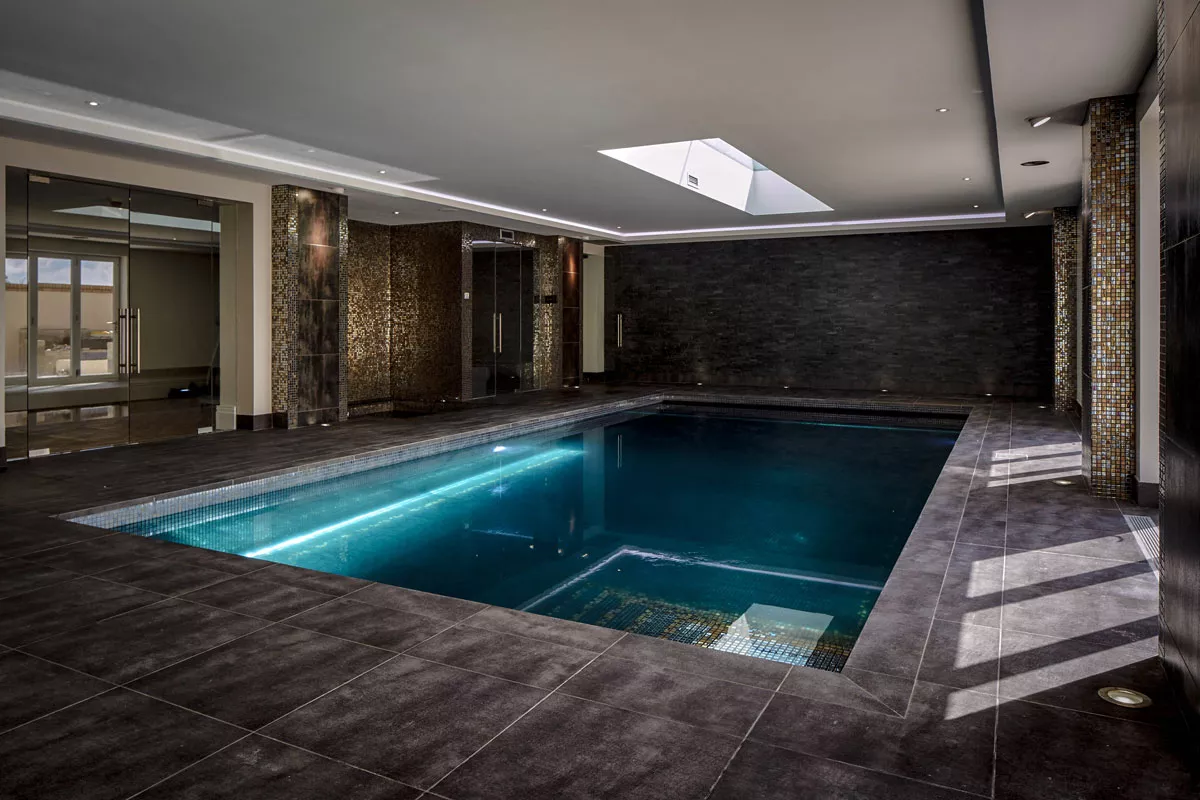
Indoor pool installation in Toronto follows a building-led sequence: consultation, site review, structural and mechanical design, room planning, shell construction or shell installation, plumbing, electrical work, HVAC, dehumidification, interior finishing, and startup. Toronto indoor-pool builders present the process as a combined pool project and building-envelope project because the room must control moisture, air quality, temperature, and condensation as well as hold water.
What Happens During Consultation and Site Review?
The consultation sets the pool type, size, use case, budget, and the role of the pool within the home. The site review checks the available room or building footprint, structural limits, glazing, drainage, utility routes, and the space needed for HVAC, dehumidification, and service access before design moves forward.
What Happens During Structural and Mechanical Design?
The structural and mechanical design stage turns the concept into a buildable indoor-pool system. Toronto indoor-pool pages state that this stage uses structural engineers, HVAC specialists, and inspectors to plan the pool structure, room loads, ventilation strategy, humidity control, and safe year-round operation.
What Happens During Room Planning and Engineering?
Room planning sets the pool-room layout, circulation space, glazing, finishes, insulation, and the position of the mechanical room and air-distribution paths. Natatorium guidance states that the room must be engineered around vapour control, surface temperature, and the impact of moist corrosive air on the building envelope and nearby components.
What Happens During Excavation or Interior Build Work?
A new-build indoor pool usually starts with excavation, ground preparation, and structural work for the shell and room. A retrofit project shifts more work into interior demolition, slab changes, structural reinforcement, and preparation for the enclosed pool room and its mechanical systems. Toronto estimate pages treat excavation, site work, and shell and structure as core cost and schedule stages in the project.
What Happens During Pool Shell Installation?
Pool shell installation sets the chosen indoor pool structure. Toronto indoor-pool builders state that residential indoor pools use vinyl liner, fibreglass, or concrete systems, each with its own installation method and long-term performance profile.
What Happens During Plumbing, Electrical, and HVAC Setup?
This stage installs the plumbing lines, filtration equipment, heater, lighting, control wiring, and the core HVAC connections that support the room. Indoor-pool engineering guidance treats space heating, space cooling, water heating, humidity removal, and ventilation as the main mechanical loads that must be coordinated during installation.
What Happens During Dehumidifier and Ventilation Installation?
This stage installs the dedicated dehumidification and ventilation system for the pool room. Natatorium guidance states that indoor-pool dehumidifiers remove moisture from the air, recover heat, and deliver controlled air back to the space, while proper air distribution protects windows, walls, and other cold surfaces from condensation and moisture damage.
What Happens During Finishing and Startup?
The finishing stage completes the interior surfaces, room materials, trim, and surrounding pool area. Startup covers equipment checks, controller setup, airflow balancing, water preparation, and final testing before handover; Toronto indoor-pool builders describe the last step as the point where the ventilation strategy and full pool system are tested for real use.
Do You Need Permits for Indoor Pool Installation in Toronto?
Yes. Indoor pool installation in Toronto usually needs a building permit because the project normally involves a new building, an addition, or a material alteration to an existing building, plus new or altered mechanical, plumbing, and often electrical systems. Toronto’s permit process reviews zoning, building code, and, where applicable, mechanical plans and fire prevention issues before permit issuance.
When Is a Building Permit Required?
A building permit is required when the indoor-pool project creates a new enclosed pool room, adds space to the house, alters the structure, changes room use, or installs or modifies heating, plumbing, or other regulated building systems. Toronto states that permits are required for a new building, an addition, structural or material alterations, and work that installs or modifies heating and plumbing systems. Toronto’s homeowner guide also states that most construction projects need a permit, including work that affects structural design, mechanical, electrical, or plumbing services.
What Pool Enclosure Rules Apply?
Toronto’s published Pool Fence Enclosure Permit process applies to outdoor swimming pools, hot tubs, ponds, and similar outdoor structures more than 600 mm deep. A fully enclosed indoor pool does not follow that outdoor fence-permit path in the same way. Toronto’s fence pages frame that permit around outdoor pools and outdoor pool areas, while an indoor project moves through the building-permit route for the building work itself.
What Structural and Mechanical Approvals Apply?
Structural approval applies when the project changes the building structure or adds a new pool room, because Toronto reviews permit drawings for structural sufficiency under the Ontario Building Code. Mechanical approval applies where the project adds or alters HVAC, ventilation, and related systems. Toronto’s mechanical permit guide requires a mechanical system layout, equipment information, heat-loss and heat-gain calculations, duct design calculations, and mechanical ventilation calculations and design. Toronto also requires a Commitment to General Reviews by Architect and Engineer where professional design and field review are required by the Code.
What Electrical and HVAC Approvals Apply?
Electrical work needs a separate ESA Notification of Work before the work starts. ESA states that the Ontario Electrical Safety Code requires almost all electrical work to be reported by filing a notification, and ESA inspections must occur before concealed or buried electrical work is covered. On the Toronto side, HVAC work forms part of the building permit review, and HVAC drawings must be submitted as separate PDF documents for each mechanical permit application.
What Drawings and Site Information Are Required?
Toronto requires permit drawings to be on standardized sheet sizes, drawn to scale, fully dimensioned, signed, dated, and submitted in PDF format. For indoor-pool work, the required submission commonly includes the Application to Construct or Demolish, Schedule 1: Designer Information, architectural drawings for the alteration, mechanical system layouts, ventilation calculations, and plumbing plans or a site/key plan where plumbing work is included. Toronto’s electronic-submission rules also state that HVAC and plumbing plans must be submitted as separate PDF documents, while electrical information goes in the main building-permit set.
How Do Permits Affect the Build Timeline?
Permits affect the project at the front end and often set the earliest possible construction start date. Toronto reviews complete applications in 10 business days in the House Stream, 15 business days in the Small Building Stream, 20 business days for large buildings, and 30 business days for complex buildings. Toronto also states that an application is not considered complete without the required forms, plans, fees, and an issued Zoning Applicable Law Certificate, and incomplete applications have no review timeframe. The City’s review process then moves through zoning review, building code review, and, if applicable, mechanical plans examination and fire prevention examination.
How Long Does Indoor Pool Installation Take in Toronto?
Indoor pool installation in Toronto usually runs from several weeks to several months. The schedule is longer than an outdoor pool schedule because the project includes design, engineering, building permits, structural work, pool installation, HVAC, dehumidification, and final commissioning inside a conditioned room. Toronto indoor-pool pages state that structural modifications, ventilation installation, finishing details, site conditions, and permit approvals all extend the timeline.
How Long Does Design and Engineering Take?
Design and engineering usually take about 2 to 6 weeks in project planning. That stage covers the pool layout, room layout, structural design, mechanical design, and the drawing package needed for pricing and permit submission. Residential pool timeline references place planning and design near 1 to 4 weeks, while indoor-pool projects add room-engineering and moisture-control work on top of standard pool planning.
How Long Does Permit Approval Take?
Permit approval in Toronto depends on the review stream. The City of Toronto reviews complete House Stream applications within 10 business days and complete Small Building Stream applications within 15 business days. Larger or more complex files move into 20-business-day or 30-business-day review streams. Incomplete submissions have no review timeframe.
How Long Does Structural Construction Take?
Structural construction usually takes about 2 to 6 weeks in project planning. That window covers excavation or interior structural alteration, site preparation, the pool shell, and related building work around the room. Residential pool-build references place excavation and site preparation near 1 to 3 days, then place the structural shell and related rough construction across the next phase of the build. Toronto indoor-pool builders state that indoor projects take longer when the work includes larger structural modifications.
How Long Does Mechanical Installation Take?
Mechanical installation usually takes about 1 to 3 weeks once the room and shell are ready for services. That stage includes plumbing, electrical work, HVAC, dehumidification equipment, ductwork, and controls. A Toronto pool-dehumidifier contractor places on-site dehumidifier replacement work at 1 to 3 weeks after equipment arrival, and a new indoor-pool installation usually carries more coordination than a straight replacement because it adds full room integration and startup testing.
How Long Does Finishing and Commissioning Take?
Finishing and commissioning usually take about 1 to 3 weeks. That stage covers interior finishes, final trim, pool fill, water preparation, system balancing, and operational testing of the dehumidification and ventilation system. General pool-construction timelines place tile, coping, and decking near 1 to 2 weeks, then place interior finish and pool fill near 1 to 3 days and startup and final inspection near 3 to 10 days.
What Delays an Indoor Pool Project?
The main delays are incomplete permit submissions, added structural modifications, complex ventilation and dehumidification coordination, difficult site conditions, and long equipment lead times. Toronto indoor-pool pages identify structural modifications, ventilation installation, finishing details, site conditions, and permit approvals as the main schedule drivers. A Toronto HVAC source states that pool dehumidifier equipment lead times currently run about 8 to 14 weeks, which shows how mechanical procurement alone can shift the project calendar.
What Does an Indoor Pool Cost to Run?
An indoor pool costs more to run than an outdoor pool because the owner pays for pool heating, dehumidification, ventilation, air handling, water treatment, and routine maintenance through all 12 months of the year. Toronto indoor-pool pages state that heating thousands of gallons of water and running a dehumidifier continuously raise energy use, while natatorium guidance identifies pool water heating, dehumidification, space heating, space cooling, and outdoor-air treatment as the main operating loads in an indoor pool room.
How Much Does Pool Heating Cost?
Pool heating is usually the largest operating cost in an indoor pool. Natatorium engineering guidance states that about 90% of an indoor pool’s annual water-heating cost comes from evaporation losses, not from simple temperature maintenance alone. Toronto indoor-pool pages also state that an indoor pool needs a heater because it does not receive the same solar warming as an outdoor pool. Toronto and Ontario pool-cost pages do not publish one fixed monthly heating bill for every residential indoor pool, because the real cost changes with water temperature, pool size, cover use, and equipment efficiency.
How Much Does Dehumidification Cost?
Dehumidification is a major year-round electrical cost because the system usually runs whenever the pool room needs humidity control. Toronto indoor-pool pages state that the dehumidifier is essential for controlling indoor moisture, and current indoor-pool design pages state that running a dehumidifier continuously adds to home energy bills. Published Toronto pages usually discuss dehumidification as part of the overall indoor-pool operating budget rather than as a standalone monthly utility number.
How Much Does Ventilation and Air Handling Cost?
Ventilation and air handling add another permanent operating load because the room needs conditioned air movement to control air quality, chloramines, and condensation. Natatorium guidance treats outdoor-air heating and cooling as one of the main annual loads in an indoor pool room, and Toronto indoor-pool pages state that ventilation, insulation, and heating/cooling are some of the main reasons indoor pools cost more to own than outdoor pools. A separate flat Toronto homeowner rate is not commonly published for this load, because it is usually embedded inside the wider HVAC and dehumidification energy bill.
How Much Does Water Treatment Cost?
Water treatment costs include chlorine or sanitizer, pH control, balancing chemicals, filter media, and periodic testing supplies. Toronto maintenance pages place routine pool maintenance near CAD 100 to 300 per month for an average-sized pool, while MoneySense places seasonal maintenance near up to CAD 1,800 for fibreglass, up to CAD 2,000 for vinyl, and up to CAD 2,500 for concrete, including chemical costs of CAD 325, CAD 475, and CAD 695 respectively. Indoor pools often avoid debris-related cleaning costs, but they still need steady chemical control because they operate all year.
How Much Does Maintenance and Service Cost?
Routine maintenance and service usually starts with the same Toronto baseline of about CAD 100 to 300 per month for an average-sized pool, but an indoor pool often needs added service for the dehumidifier, HVAC, and controls. Toronto indoor-pool pages state that proper ventilation, humidity control, and heating systems are part of long-term maintenance, not only part of the original build. That makes the total service budget broader than the budget for a standard outdoor pool.
How Do Energy-Efficient Systems Reduce Operating Cost?
Energy-efficient systems reduce operating cost by cutting evaporation, lowering heater runtime, and recovering waste heat. Toronto indoor-pool pages state that an automatic pool cover reduces evaporation and lowers the energy cost of running the dehumidifier. Natatorium guidance states that keeping room air about 2°F to 4°F above pool water temperature reduces evaporation, and that a dehumidifier with pool-water heat recovery can return captured energy to the pool and greatly reduce annual heating cost. PoolPak states that this heat-recovery approach has a coefficient of performance of 8 and that the pool-water-heating option often pays for itself in less than one year. Energy Star also states that variable-speed pool pumps help cut energy costs.
What Maintenance Does an Indoor Pool Need?
An indoor pool needs two parallel maintenance systems: pool-water care and pool-room moisture control. The water needs regular testing, cleaning, and chemical balancing. The room needs steady dehumidification, controlled ventilation, and ongoing checks for condensation, corrosion, and hidden moisture damage.
How Do You Maintain Water Quality?
Maintain water quality through frequent testing and prompt correction of imbalance. Health Canada states that pool water should be tested daily for sanitizer level, pH, total alkalinity, and calcium hardness. Toronto pool-maintenance guidance adds the routine cleaning side of that work: daily or as-needed skimming, plus weekly brushing and vacuuming to keep the water clear and reduce buildup on the pool surfaces.
How Do You Maintain Dehumidification Equipment?
Maintain dehumidification equipment through preventive service, filter and component inspection, and regular performance checks. Indoor-pool dehumidification manuals state that periodic preventive maintenance is required for reliability, safety, and operating efficiency. A City of Mississauga natatorium maintenance presentation states that pool dehumidification units are serviced and inspected four times a year, with added monthly service during summer peak months in that municipal example.
How Do You Maintain Ventilation and Air Distribution?
Maintain ventilation and air distribution by keeping the system running properly and correcting weak or uneven airflow fast. Toronto indoor-pool guidance says proper ventilation needs a consistent schedule. Indoor aquatic ventilation guidance adds that good air mixing prevents stratification and dead spots that raise the risk of corrosion, while proper return and exhaust paths help remove chloramines from the pool space.
How Do You Prevent Condensation and Mould?
Prevent condensation and mould by holding the room at the right humidity level, keeping warm air moving across vulnerable surfaces, and fixing any moisture leaks early. Toronto indoor-pool guidance states that indoor-pool humidity is optimal at 50% to 60% and recommends a dehumidification system to control it. Indoor-pool engineering sources add that uncontrolled condensation damages finishes and structure, and promotes mould and mildew growth over time.
What Repairs Are Common in Indoor Pool Rooms?
Common indoor pool room repairs include dehumidifier repairs, condensate drain repairs, correction of fogged glazing and window condensation, treatment of rust or corrosion, repainting where moisture has caused bubbling paint, and repair of water-damaged finishes around the room. Toronto-area dehumidifier guidance lists condensation on windows, walls, or ceilings, musty odours, visible corrosion, and humidity readings above 60% as warning signs that the room or equipment needs attention.
What Maintenance Schedule Fits an Indoor Pool?
A practical indoor pool maintenance schedule uses short daily routines and fixed seasonal service. The strongest pattern from current guidance is daily water testing, daily or as-needed skimming, weekly brushing and vacuuming, ongoing monitoring of humidity and ventilation, and professional dehumidifier service at least quarterly. That schedule fits the two main risk areas in an indoor pool: unstable water chemistry and uncontrolled room moisture.
Is an Indoor Pool Better Than an Outdoor Pool?
An indoor pool is better for year-round use, privacy, and controlled indoor conditions. An outdoor pool is better for lower build cost and lower operating cost in most Toronto projects. Toronto indoor-pool pages state that indoor pools cost more because they add ventilation, dehumidification, insulation, and extra heating/cooling, while outdoor pools avoid those enclosed-room mechanical loads.
Is an Indoor Pool Better for Year-Round Use?
Yes. An indoor pool is better for year-round use because the pool stays available through winter, rain, wind, and seasonal temperature swings. Toronto indoor-pool builders present all-season swimming as one of the main reasons homeowners choose an enclosed pool.
Is an Outdoor Pool Better for Lower Build Cost?
Yes. An outdoor pool is better for lower build cost. Toronto comparison pages state that indoor pools are generally more expensive than outdoor pools because indoor projects need added ventilation, dehumidification, insulation, and heating/cooling. Toronto indoor-pool pricing pages also place a full-sized inground indoor pool near CAD 200,000, while Ontario 2026 pricing guides place many outdoor inground pools at lower starting ranges, such as CAD 50,000 to 80,000 for vinyl, CAD 50,000 to 100,000 for fibreglass, and CAD 130,000 to 180,000+ for concrete.
Is an Indoor Pool Better for Privacy and Controlled Conditions?
Yes. An indoor pool is better for privacy and controlled conditions because the pool sits inside a dedicated enclosed space rather than in an exposed backyard. Toronto indoor-pool pages present indoor pools as private, climate-controlled spaces with managed humidity, air quality, and temperature.
Is an Outdoor Pool Better for Lower Operating Cost?
Yes. An outdoor pool is usually better for lower operating cost because an indoor pool runs extra dehumidification, ventilation, and air-handling equipment throughout the year. Toronto indoor-pool pages state that indoor pools require added climate-control systems, and natatorium guidance identifies pool water heating, dehumidification, space heating, space cooling, and outdoor-air treatment as the main indoor operating loads.
Which Pool Type Fits the Property and Budget Better?
The best pool type depends on the property goal. An indoor pool fits a home that prioritizes year-round swimming, privacy, wellness use, and a premium enclosed design. An outdoor pool fits a property that prioritizes lower build cost, lower mechanical complexity, and a simpler ownership model. Toronto comparison pages present that choice as a trade-off between convenience and control on one side and cost and simplicity on the other.
How Do You Choose a Toronto Indoor Pool Installer?
Choose a Toronto indoor pool installer who proves regular indoor pool work, explains the full structural and mechanical scope, handles permits and code requirements, coordinates HVAC and dehumidification design, shows real past projects and public reviews, and states warranty and workmanship coverage in writing. Local indoor-pool and permit pages repeat those same proof points across the Toronto market.
Does the Installer Build Indoor Pools Regularly?
Yes. A strong installer shows repeated indoor pool work, not only general pool installation work. Toronto indoor-pool builder pages present dedicated indoor-pool services, indoor-specific design language, and project types such as residential indoor pools, spas, lap pools, and enclosed pool rooms. That record is a stronger qualification signal than a general backyard-pool claim.
Does the Installer Explain the Structural and Mechanical Scope Clearly?
Yes. A strong installer explains the full indoor pool scope before the contract is signed. Toronto indoor-pool pages describe the work through layout planning, 3D modelling, structural planning, ventilation, humidity control, and coordination between the pool shell and the pool room. Indoor-pool design pages also state that standard outdoor-pool knowledge is not enough for enclosed projects because the room itself becomes part of the engineered system.
Does the Installer Handle Permits and Code Requirements?
Yes. A strong installer handles the building permit path and the related code requirements early. Toronto states that a building permit is required for most new construction, additions, structural alterations, and work that installs or modifies heating or plumbing systems. Toronto also requires mechanical permit documents for related HVAC work, and the ESA requires an electrical Notification of Work before almost all electrical work starts. An installer who understands that approval sequence reduces preventable delay.
Does the Installer Coordinate HVAC and Dehumidification Design?
Yes. A strong indoor-pool installer coordinates HVAC and dehumidification design as part of the main project, not as an afterthought. Toronto indoor-pool builder pages state that ventilation and humidity control are core parts of indoor-pool planning, and Toronto-area dehumidification specialists focus on indoor-pool humidity control, system integration, maintenance, and repair. That coordination matters because indoor-pool performance depends on the room’s moisture control as much as on the pool itself.
Does the Installer Show Past Indoor Pool Projects and Reviews?
Yes. A strong installer shows real indoor pool projects, not stock imagery alone, and pairs that work with visible public review signals. Toronto indoor-pool pages promote recent projects, design showcases, and image galleries, while review platforms such as HomeStars help homeowners compare Toronto pool companies through public feedback. Those proof points help confirm that the installer has completed real projects in the local market.
Does the Installer Offer Warranty and Workmanship Coverage?
Yes. A strong installer states warranty and workmanship coverage in writing. Current Toronto-area pool pages show different coverage models, including limited labour warranties, longer parts-and-labour coverage, and separate manufacturer-backed warranties. Written terms matter more than verbal promises because the owner needs clear coverage for the pool installation, related systems, and any indoor-specific work.
Frequently Asked Questions About Indoor Pool Installation in Toronto
How Much Does an Indoor Pool Cost in Toronto?
A full-sized indoor pool in Toronto costs about CAD 200,000 when the project includes the pool structure, the enclosed pool room, and core support systems. Toronto pages also place indoor concrete pools around CAD 100,000 to 250,000, while they state that indoor projects cost more than outdoor pools due to added ventilation, dehumidification, insulation, and heating/cooling.
Do You Need a Permit for an Indoor Pool in Toronto?
Yes. Indoor pool projects in Toronto usually need a building permit when the work adds a new room, alters the structure, or installs or modifies heating or plumbing systems. Toronto reviews complete permit applications within 10 business days in the House Stream and 15 business days in the Small Building Stream.
Why Does an Indoor Pool Need a Dehumidifier?
An indoor pool needs a dehumidifier because heated pool water releases constant moisture into the room air. Natatorium guidance treats dehumidification as the core system that removes that moisture, lowers dew point risk, and protects finishes, glazing, and structure from damage.
What Humidity Level Should an Indoor Pool Room Have?
An indoor pool room should stay around 50% to 60% relative humidity. Natatorium guidance uses that range to balance comfort, energy use, and condensation control.
How Long Does Indoor Pool Installation Take?
Indoor pool installation takes several weeks to several months from design to startup. Toronto indoor-pool pages identify structural modifications, ventilation installation, finishing details, site conditions, and permit approvals as the main schedule drivers.
Is an Indoor Pool Better Than an Outdoor Pool?
An indoor pool is better for year-round use, privacy, and controlled indoor conditions. An outdoor pool is better for lower build cost and lower operating cost in most Toronto projects because it avoids the extra enclosed-room systems tied to dehumidification, ventilation, and year-round climate control.
What Does an Indoor Pool Cost to Operate?
An indoor pool costs more to operate than an outdoor pool because the owner pays for pool heating, dehumidification, ventilation, air handling, water treatment, and routine maintenance through all 12 months of the year. Toronto maintenance pages place routine pool care near CAD 100 to 300 per month, while natatorium guidance identifies water heating, dehumidification, space heating, space cooling, and outdoor-air treatment as the main indoor operating loads.
What Maintenance Does an Indoor Pool Need?
An indoor pool needs daily water testing, regular cleaning, stable humidity control, and routine service for the dehumidification and ventilation system. Health Canada states that pool water should be tested daily for sanitizer, pH, total alkalinity, and calcium hardness, while Toronto indoor-pool pages add ongoing checks for room damage, heating equipment, and humidity-related issues.
What Is Included in Indoor Pool Installation?
Indoor pool installation includes site review, structural planning, pool shell construction or installation, plumbing, electrical work, HVAC, dehumidification, insulation, vapour control, interior finishes, and startup. Toronto indoor-pool builders treat the pool room and the mechanical systems as part of the project itself because the room must control moisture as well as hold water.
How Do You Prevent Condensation in an Indoor Pool Room?
Condensation prevention depends on proper dehumidification, proper ventilation, a sealed vapour retarder, and insulation that keeps room surfaces above the indoor dew point. Natatorium guidance states that cold surfaces below the room dew point collect moisture, while Toronto indoor-pool guidance identifies uncontrolled humidity as a direct cause of damage, warping, and mould.
How Do You Get a Quote for Indoor Pool Installation in Toronto?
Getting a quote for indoor pool installation in Toronto usually starts with an on-site visit, then moves to design review, a written cost estimate, and a draft permit and build timeline. Toronto indoor-pool and estimate pages present the quote stage as a planning step that checks the property, defines the pool room scope, and prices the work around structure, ventilation, dehumidification, and other building-related systems.
How Do You Book a Site Visit?
You book a site visit by contacting a Toronto indoor pool installer and requesting an on-site pool assessment or free quote. Toronto pool-estimate pages state that many builders offer a free pool estimate to start the process and use the on-site assessment to match the project to a realistic plan before the formal quote is issued.
How Do You Get a Design and Mechanical Estimate?
You get a design and mechanical estimate after the installer turns the site information into a proposed pool layout, room scope, and system plan. Toronto estimate guidance states that a proper estimate should break down labour, materials, equipment, permits, and site work, while indoor-pool pages show that indoor projects need pricing for ventilation systems, insulation, and structural requirements from the start. Toronto estimate guidance also notes that full construction drawings and engineering often require a design retainer, which many builders credit back when the project moves ahead.
How Do You Plan the Permit and Build Timeline?
You plan the permit and build timeline by separating approvals from physical construction. Toronto states that a building permit is required for a new building, an addition, structural or material alterations, and work that installs or modifies heating or plumbing systems. The City’s current permit guide states that, effective February 16, 2026, applicants must use the updated Application for a Permit to Construct or Demolish form. Toronto’s current review-stream page states that complete House Stream applications are reviewed within 10 business days and complete Small Building Stream applications within 15 business days. Incomplete applications have no review timeframe. A strong indoor-pool quote should therefore show both an approval window and a construction window, not one single start date.