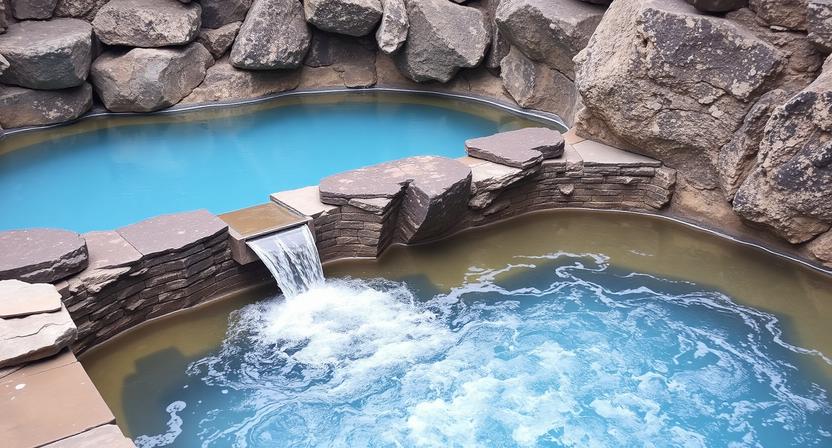
Plunge pools are compact swimming pools designed for cooling, soaking, relaxation, small-yard swimming, and outdoor living areas. Many plunge pool designs fit patios, courtyards, narrow yards, and urban lots because they use less space than standard pools. Common compact pool guidance lists small pool formats around 10–16 ft long and 6–8 ft wide, while broader plunge pool ranges often sit around 200–400 sq. ft. with depths near 3–7 ft.
Plunge pools suit small backyards, patios, courtyards, and outdoor lounge zones because they keep more yard space open for seating, planting, decking, outdoor kitchens, and walkways. Their lower water volume reduces water use, heating demand, cleaning time, and chemical demand compared with larger pools.
The right plunge pool depends on size, depth, material, seating, steps, heating, jets, pool covers, yard access, fencing, permits, and long-term maintenance. Health Canada states that pool water needs daily testing for sanitizer, pH, total alkalinity, and calcium hardness, so water care remains part of plunge pool ownership.
Quick Answer
What are plunge pools?
Plunge pools are small pools designed for cooling, sitting, soaking, and compact backyard use. Common plunge pool models measure about 8 ft or 12 ft wide and 12 ft to 24 ft long.
Are plunge pools good for small backyards?
Plunge pools are good for small backyards because they use less yard space than standard pools while still supporting cooling, seating, relaxation, and light exercise. Compact models also suit tighter patios, courtyards, and urban lots.
Are plunge pools cheaper than regular pools?
Plunge pools cost less than larger pools when the design uses less material, less water, less excavation, and less deck space. Final plunge pool cost depends on material, excavation, access, heating, decking, fencing, permits, and added features.
Quick Overview
| Decision Factor | Plunge Pool Detail |
|---|---|
| Best for | Small backyards, courtyards, patios, cooling, soaking, relaxation |
| Not best for | Full lap swimming, diving, large pool games, large groups |
| Main size value | Compact footprint and lower water volume |
| Main design value | Seating, steps, jets, heating, covers, patio integration |
| Main cost driver | Material, access, excavation, heating, decking, fencing, permits |
| Main limitation | Limited swimming length and fewer users at one time |
| Long-term focus | Water care, cover use, heating cost, equipment care, winter care |
What Are Plunge Pools?
Plunge pools are compact swimming pools built for cooling, soaking, sitting, relaxation, and small-backyard use. They use a smaller footprint than standard pools and often include bench seating, steps, jets, heating, and pool covers.
How are plunge pools different?
Plunge pools are different because they focus on compact use rather than full swimming length. Standard pools support longer swimming, larger groups, and pool games. Plunge pools support cooling, soaking, seated use, light movement, and outdoor living integration.
Their smaller footprint leaves more space for patios, decking, landscaping, outdoor kitchens, and lounge areas.
What are plunge pools used for?
Plunge pools are used for cooling, soaking, relaxation, light exercise, family use, and small-yard swimming. Heated models also support spa-style use when paired with jets, bench seating, and a thermal cover.
A plunge pool works well beside a patio, courtyard, deck, or garden seating area because the pool becomes part of the outdoor living space.
What makes them compact?
A small footprint makes plunge pools compact. Many models use shorter lengths, narrower widths, lower water volume, and simple layouts.
Compact designs often include built-in steps, benches, corner seating, or ledges to increase use without increasing the pool size. Lower water volume also reduces heating load, chemical demand, and cleaning time compared with larger pools.
What materials are used?
Plunge pools use fibreglass, concrete, vinyl, and prefabricated pool systems. Each material changes the build method, design range, surface finish, cost, and installation timeline.
Fibreglass plunge pools use pre-moulded shells with fixed shapes and smooth surfaces. Concrete plunge pools support custom size, shape, depth, seating, and finishes. Vinyl plunge pools use a wall system and fitted liner for lower-cost inground customization.
Raised plunge pools, semi-inground plunge pools, and inground plunge pools fit different site conditions. Raised models reduce excavation. Semi-inground models suit sloped yards and deck integration. Inground models create a finished pool look at patio or landscape level.
What limits plunge pools?
Plunge pools are limited by short swimming length, compact width, seating layout, depth, and user capacity. They do not suit full lap swimming, diving, large pool games, or large groups.
Site limits also affect the final design. Tight access, setback rules, utility lines, drainage, fencing, permits, excavation conditions, and equipment space shape the pool size, placement, and installation method.
What Benefits Do Plunge Pools Offer?
Plunge pools offer small-space swimming, cooling, soaking, relaxation, faster heating, lower water volume, easier maintenance, and better patio integration than larger pools. Their compact size supports small backyards, courtyards, urban lots, and outdoor lounge areas.
Why do they suit small backyards?
Plunge pools suit small backyards because they use a compact footprint while still adding water, seating, and outdoor living value. Some compact pool formats measure about 10–16 ft long and 6–8 ft wide, which suits tight yard layouts better than many standard pools.
A smaller plunge pool leaves more space for landscaping, pavers, decking, outdoor kitchens, walkways, and lounge zones. This matters in urban lots where yard space is limited.
Why is water volume lower?
Water volume is lower because plunge pools are shorter, narrower, and smaller than standard pools. Lower volume reduces fill water, chemical dosing, filtration demand, and heating load.
A lower-volume compact pool also supports faster water turnover through the pump and filter. This helps keep water care simpler when the pool has correct circulation and testing.
Why is heating faster?
Heating is faster because a plunge pool has less water to warm than a larger pool. Smaller water volume needs less heat energy to reach a set temperature.
A thermal pool cover improves heating performance by reducing evaporation and heat loss. The U.S. Department of Energy states that pool covers reduce evaporation and are the most effective way to reduce pool heating cost, with possible savings of 50% to 70%.
Why is maintenance easier?
Maintenance is easier because plunge pools have less surface area, less water, and less debris load than larger pools. A compact pool needs regular testing, skimming, brushing, filtration, and cover care, but each task takes less time.
Smaller compact pool formats use less water, fewer chemicals, and lower heating input than many traditional pools. A fitted pool cover also reduces debris, evaporation, heat loss, and chemical loss.
Why does patio space matter?
Patio space matters because plunge pools work best as part of a full outdoor living layout. The pool, seating, deck, steps, fencing, planting, and walkways need to fit together.
A well-planned plunge pool keeps enough room for chairs, shade, dining, outdoor cooking, storage, and safe movement around the water. This makes the pool useful without letting it dominate the whole backyard.
What Types of Plunge Pools Are Available?
Plunge pools are available as fibreglass, concrete, vinyl liner, above-ground, semi-inground, and spa-style pools. The right plunge pool type depends on yard access, budget, depth, finish, seating, heating, jets, deck layout, and long-term maintenance.
| Plunge Pool Type | Main Feature | Best Use |
|---|---|---|
| Fibreglass plunge pool | Pre-moulded shell | Faster installation where access allows |
| Concrete plunge pool | Custom-built structure | Custom size, shape, depth, and finish |
| Vinyl plunge pool | Liner-based system | Lower-cost inground customization |
| Above-ground plunge pool | Raised compact pool | Lower excavation and simple access planning |
| Semi-inground plunge pool | Partly buried compact pool | Sloped yards and deck integration |
| Spa-style plunge pool | Heated compact pool with jets | Soaking, relaxation, and wellness use |
What are fibreglass plunge pools?
Fibreglass plunge pools are pre-moulded compact pool shells installed as one piece. They suit faster installation when the yard has enough access for shell delivery, lifting, and placement.
A fibreglass plunge pool usually includes a smooth gelcoat surface, fixed shape, built-in steps, seating ledges, and a set depth. The main limits are shell size, access width, crane space, and fewer custom design changes.
What are concrete plunge pools?
Concrete plunge pools are custom-built compact pools formed on site. They suit homeowners who need a specific size, shape, depth, seating layout, or finish.
A concrete plunge pool supports custom benches, steps, ledges, tile, plaster, pebble, and spa-style features. The main limits are longer construction time, higher labour needs, waterproofing detail, and finish maintenance.
What are vinyl plunge pools?
Vinyl plunge pools use a wall system with a fitted vinyl liner. They suit lower-cost inground customization compared with many concrete builds.
A vinyl plunge pool gives a smooth surface, liner pattern choices, and flexible shape options. The main limits are liner wear, puncture risk, liner replacement, and careful water balance.
What are above-ground plunge pools?
Above-ground plunge pools are raised compact pools installed above the finished grade. They suit yards that need lower excavation, simpler access planning, or deck integration around a raised pool wall.
An above-ground plunge pool reduces excavation work and soil removal. The design still needs a level base, safe access, filtration, drainage, fencing, steps, and equipment space.
What are semi-inground plunge pools?
Semi-inground plunge pools are partly buried compact pools. They suit sloped yards, raised decks, uneven ground, and sites where a fully inground layout needs more excavation.
A semi-inground plunge pool helps connect the pool with patios, steps, retaining walls, and deck zones. The main limits are drainage, wall support, access, setbacks, and enclosure rules.
What are spa-style plunge pools?
Spa-style plunge pools are heated compact pools with seating, jets, and warm-water use. They suit soaking, relaxation, wellness use, and small outdoor living areas.
A spa-style plunge pool needs a heater, jets, pump, controls, cover, and strong water care. Warm water raises heating demand, so a fitted thermal cover helps reduce heat loss and evaporation.
What Sizes Are Common for Plunge Pools?
Plunge pool sizes usually range from tiny courtyard pools to medium compact pools for cooling, soaking, sitting, and light exercise. Many plunge pools measure about 8 ft or 12 ft wide and 12 ft to 24 ft long, while common depth ranges often sit between 4 ft and 8 ft.
| Size Group | Common Examples | Best Fit |
|---|---|---|
| Tiny plunge pool | Around 5–10 ft long where available | Courtyards and compact patios |
| Small plunge pool | Around 8–12 ft wide and 12–16 ft long | Small backyards and sitting use |
| Medium plunge pool | Around 8–12 ft wide and 16–24 ft long | More movement and light exercise |
| Shallow plunge pool | Around 3–4.5 ft deep | Sitting, cooling, and family use |
| Deeper plunge pool | Around 5–6 ft deep | Immersive soaking and standing depth |
What small sizes are common?
Small plunge pool sizes commonly start around 8 ft wide and 12 ft long. Smaller courtyard models also exist where site access, product range, and local code allow them.
A small plunge pool suits sitting, cooling, soaking, and compact patio use. It leaves more room for decking, pavers, planting, furniture, fencing, and safe access around the pool.
What medium sizes are common?
Medium plunge pool sizes often measure around 8–12 ft wide and 16–24 ft long. This size range gives more space for light movement, water exercise, bench seating, steps, and social use.
A 12 ft by 24 ft compact pool sits near the upper end of many plunge or small-pool formats. This size needs more yard space, excavation, water, heating, decking, and equipment capacity.
What depths are common?
Plunge pool depths commonly range from about 4 ft to 8 ft, with many homeowner designs sitting near 4 ft to 6 ft for cooling, standing, and soaking.
A shallow plunge pool around 3–4.5 ft suits sitting, cooling, and family use. A deeper plunge pool near 5–6 ft supports more immersive soaking and standing depth.
What size suits a small yard?
A small yard suits a plunge pool that keeps enough room for access, drainage, fencing, furniture, planting, and maintenance. Compact models around 8–12 ft wide and 12–16 ft long often fit small backyards better than larger pools.
The best size depends on setback rules, side-yard access, utility lines, patio layout, equipment space, and required pool enclosure. A smaller pool footprint reduces yard disruption and leaves more usable outdoor space.
What size suits soaking?
A soaking plunge pool suits a compact size with comfortable depth, bench seating, steps, and optional heating. Depth near 4–6 ft works for many soaking layouts because it supports seated use, standing depth, and full-body cooling.
A spa-style plunge pool benefits from heating, jets, a fitted cover, and seating ledges. Larger lengths are less important than depth, seating layout, water temperature, and easy entry.
What Design Options Are Available for Plunge Pools?
Plunge pools offer design options for shape, seating, entry, water features, heating, covers, lighting, and surrounding materials. The right plunge pool design depends on yard size, access, depth, patio layout, privacy, heating needs, and maintenance plan.
| Design Option | Plunge Pool Examples |
|---|---|
| Shape | Rectangle, square, round, freeform, courtyard, spa-style |
| Seating | Bench seats, corner seats, full-width ledges |
| Entry | Wide steps, corner steps, ladder, deck-level entry |
| Water features | Jets, bubblers, small waterfalls, spillover edge |
| Heating | Gas heater, electric heat pump, solar where suitable |
| Cover | Safety cover, automatic cover, thermal cover |
| Lighting | LED pool lights and landscape lighting |
| Surround | Pavers, concrete, stone, timber, composite deck |
What shapes are common?
Plunge pool shapes commonly include rectangle, square, round, freeform, courtyard, and spa-style designs. Rectangle and square pools suit small backyards because they use space well and fit patios, fences, and deck edges.
Round and freeform plunge pools suit garden-style layouts. Courtyard pools suit enclosed outdoor spaces. Spa-style shapes suit seating, jets, and warm-water relaxation.
What seating is available?
Plunge pool seating includes bench seats, corner seats, ledges, and full-width benches. Seating increases comfort without needing a large pool footprint.
Bench seats support soaking, cooling, social use, and supervised family use. Corner seats save space. Full-width ledges create a wider sitting zone and work well in rectangle plunge pools.
What steps are available?
Plunge pool steps include wide steps, corner steps, ladders, and deck-level entry. Entry design affects safety, comfort, and usable water space.
Wide steps support easier entry and seated use. Corner steps save space. Ladders suit compact or above-ground models. Deck-level entry connects the pool with patios, pavers, or raised decks.
What jets are available?
Plunge pool jets include circulation jets, massage-style jets, bubblers, and swim-current systems where the pool design supports them. Jets add water movement, comfort, and spa-style use.
Jet placement matters because compact pools have limited space. Poor placement reduces comfort, affects seating use, and adds pump, plumbing, controls, and maintenance needs.
What covers are useful?
Plunge pool covers include safety covers, automatic covers, and thermal covers. A cover reduces debris, evaporation, heat loss, and heating demand.
The U.S. Department of Energy states that pool covers are the most effective way to reduce pool heating costs and reduce heat loss from evaporation. A fitted thermal cover is especially useful for heated plunge pools and spa-style designs.
What Small Backyard Layouts Work for Plunge Pools?
Plunge pools work in small backyards, courtyards, patio yards, narrow yards, side yards, townhome yards, and large yards where the pool needs a compact footprint. The best layout keeps space for access, drainage, fencing, seating, planting, and maintenance.
| Backyard Type | Plunge Pool Fit |
|---|---|
| Small backyard | Strong fit with compact shell or custom layout |
| Courtyard | Strong fit for square or rectangular plunge pool |
| Patio yard | Strong fit with deck-level or paver surround |
| Narrow yard | Strong fit with rectangular plunge pool |
| Side yard | Site-dependent; access and setback rules matter |
| Townhome yard | Site-dependent; access, drainage, and permit rules matter |
| Large yard | Strong fit where the pool does not dominate the space |
Do courtyards suit plunge pools?
Courtyards suit plunge pools because square and rectangular pool shapes fit enclosed outdoor spaces. A compact pool works well with pavers, raised planters, privacy screens, wall lighting, and built-in seating.
A courtyard layout needs clear drainage, safe walking space, equipment access, and fence compliance. A thermal cover also helps reduce debris, evaporation, and heat loss.
Do patios suit plunge pools?
Patios suit plunge pools when the pool sits level with pavers, concrete, stone, timber, or composite decking. A patio layout connects the pool with seating, dining, shade, and outdoor lounge zones.
A strong patio plunge pool layout keeps a clear edge around the water. It also includes slip-resistant surfaces, drainage slope, cover space, and easy access to steps or benches.
Do narrow yards suit plunge pools?
Narrow yards suit plunge pools when the design uses a long rectangular shape. A narrow plunge pool gives cooling, soaking, and light movement without using the full yard width.
This layout needs careful checks for setbacks, side access, fence placement, drainage, and equipment location. Built-in bench seating or corner steps help save usable water space.
Do side yards suit plunge pools?
Side yards suit plunge pools only when access, setbacks, drainage, and service space work. Tight side-yard conditions affect shell delivery, excavation, plumbing, electrical work, and equipment placement.
A side-yard plunge pool often works best as a slim rectangular pool with a simple deck edge. The layout needs enough clearance for maintenance, fencing, and safe movement beside the water.
Do townhome yards suit plunge pools?
Townhome yards suit plunge pools when access, drainage, noise, privacy, and permit rules allow the project. Compact pool shells, above-ground formats, and patio-integrated designs often fit tighter lots.
A townhome plunge pool needs strong layout control. Key checks include utility lines, fence rules, equipment location, water drainage, neighbour setbacks, and final inspection needs.
What Affects Plunge Pool Cost?
Plunge pool cost depends on pool size, material, yard access, excavation, heating, jets, decking, fencing, and permits. 2026 cost guidance lists size, shape, material, excavation, tree removal, yard regrading, permits, fencing, and maintenance as major plunge pool budget factors.
| Cost Factor | Why It Affects Price |
|---|---|
| Pool size | Larger plunge pools need more excavation, material, water, and equipment |
| Material | Fibreglass, vinyl, and concrete have different cost structures |
| Access | Tight side yards raise labour, crane, or equipment costs |
| Excavation | Rock, clay, groundwater, and soil disposal raise cost |
| Heating | Heater type and cover use affect installation and operating cost |
| Jets | Pumps, plumbing, and controls add cost |
| Decking | Pavers, concrete, stone, or deck structures affect the final price |
| Fencing and permits | Local enclosure rules add required compliance cost |
Does size affect cost?
Size affects plunge pool cost because larger pools need more excavation, more material, more water, larger equipment, and more finishing work. Longer and wider pools also need more decking, coping, fencing area, heating capacity, and filtration time.
A compact plunge pool reduces cost by limiting water volume and yard disruption. A larger plunge pool increases cost when the design adds depth, seating, wider steps, jets, or a larger patio surround.
Does material affect cost?
Material affects plunge pool cost because fibreglass, vinyl, and concrete use different build methods. Fibreglass plunge pools use pre-moulded shells. Vinyl plunge pools use a wall system and liner. Concrete plunge pools use custom structure work, reinforcement, waterproofing, and finishing.
2026 pool-cost guidance identifies construction type and finishes as key price drivers. Custom finishes, curved shapes, added features, and complex structural work increase final cost.
Does access affect cost?
Access affects plunge pool cost because tight yards need more labour, smaller machines, crane planning, hand digging, or extra material handling. Narrow side yards, overhead wires, fences, trees, sheds, and steep grades increase installation time.
Access also affects soil removal, shell delivery, plumbing routes, electrical routes, and equipment placement. A clear access route lowers handling work and reduces delay risk.
Does heating affect cost?
Heating affects plunge pool cost through heater type, energy source, water volume, cover use, and operating schedule. Gas heaters, electric heat pumps, and solar-assisted systems have different installation and running costs.
A pool cover reduces heat loss and evaporation. The U.S. Department of Energy states that pool covers are the most effective way to reduce pool heating costs, with possible heating-cost savings of 50% to 70%.
Does decking affect cost?
Decking affects plunge pool cost because the pool surround needs safe access, drainage, slip control, and durable materials. Pavers, concrete, stone, timber, and composite decking have different material, base preparation, labour, and maintenance costs.
Decking cost rises when the project includes raised structures, retaining walls, drainage channels, lighting, stairs, seating, fencing, or patio integration. A larger deck also increases excavation, base preparation, and finishing work.
How Are Plunge Pools Installed?
Plunge pools are installed through site review, design, utility locates, permits, excavation, base preparation, pool placement, plumbing, electrical bonding, equipment setup, decking, fencing, inspection, filling, and water balancing. The exact process depends on pool material, yard access, soil condition, setbacks, heating needs, and local permit rules.
What happens during site review?
Plunge pool site review checks yard size, pool location, access width, slope, soil condition, drainage, utilities, overhead clearance, fencing layout, equipment space, and setback rules. Site measurement confirms whether the yard suits an inground, semi-inground, above-ground, or patio-integrated plunge pool.
Utility locates come before excavation. Ontario One Call states that homeowners or their contractors must submit a locate request before digging on public or private property. It also states that private locates are needed for privately owned underground infrastructure where present.
What happens during design?
Plunge pool design sets the pool size, depth, material, seating, steps, jets, heating, cover, coping, decking, fencing, drainage, and equipment layout. The design also includes a site plan showing the pool location, enclosure, gates, setbacks, and access routes.
Permit planning starts at this stage. Toronto requires an approved Zoning Certificate before a Pool Fence Enclosure Permit application. The city also requires site drawings that show the location, height, and materials of the proposed fence.
What happens during excavation?
Plunge pool excavation removes soil for the pool shell, base, plumbing, drainage, and equipment connections. The excavation stage also includes grading, soil disposal, rock or clay handling, groundwater control, and base preparation.
A compact plunge pool usually needs less excavation than a larger pool, but tight access increases labour. Narrow side yards, trees, fences, sheds, and overhead wires affect machine access, crane access, and soil removal.
What happens during placement?
Plunge pool placement depends on the pool type. A fibreglass plunge pool uses shell placement on a prepared base. A concrete plunge pool uses structure work, reinforcement, waterproofing, and finishing. A vinyl plunge pool uses wall panels, base preparation, and liner fitting.
Placement also includes plumbing lines, skimmers, returns, drains, coping, electrical bonding, equipment setup, heater connection, filtration, sanitizer setup, and jet plumbing where fitted. Decking, pavers, concrete, stone, or composite surrounds are installed after the pool position and levels are set.
What happens before startup?
Plunge pool startup happens after fencing, inspections, equipment checks, filling, circulation testing, leak checks, and water balancing. Toronto states that a pool cannot be constructed and filled with water without a fence installed under City of Toronto Municipal Code Chapter 447 – Fences.
Startup checks include the pump, filter, heater, sanitizer, jets, cover, drainage, bonding, and controls. Water balancing sets sanitizer, pH, total alkalinity, and calcium hardness before regular use.
What Maintenance Is Needed for Plunge Pools?
Plunge pool maintenance needs regular water testing, cleaning, filtration care, cover care, heating checks, jet checks, and winterization. A plunge pool has lower water volume than many standard pools, but it still needs correct sanitizer, circulation, equipment care, and seasonal protection.
| Maintenance Area | Plunge Pool Requirement |
|---|---|
| Water testing | Sanitizer, pH, alkalinity, and calcium hardness |
| Cleaning | Skimming, brushing, vacuuming, and debris removal |
| Filtration | Pump, filter, baskets, returns, and circulation |
| Cover care | Reduces debris, evaporation, and heat loss |
| Heating care | Heater inspection, thermostat checks, and energy control |
| Jet care | Pump, plumbing, and nozzle checks where fitted |
| Winterization | Protects plumbing, equipment, waterline, and cover |
What water testing is needed?
Water testing needs daily checks for sanitizer levels, pH, total alkalinity, and calcium hardness. Health Canada states that pool and spa water needs daily water-balance testing for these four measures. This applies to plunge pools and other residential pool systems.
Health Canada also states that clear pool water still contains microorganisms, including bacteria and viruses, when sanitizer levels are not maintained. Proper sanitization reduces microorganisms to safer levels.
What filter care is needed?
Filter care needs checks for the pump, filter, baskets, returns, and water circulation. A clean filtration system moves treated water through the pool and helps remove fine debris.
Small plunge pools still need steady circulation because low water volume changes faster when swimmers, heat, leaves, sunscreen, rain, or low sanitizer affect the water.
What cover care is needed?
Cover care keeps the pool cover clean, fitted, and ready for daily use. A working cover reduces debris, evaporation, heat loss, and chemical loss.
A thermal cover helps heated plunge pools hold water temperature. A safety cover helps restrict access when the pool is not in use. Cover tracks, straps, anchors, and fabric need regular checks.
What heating care is needed?
Heating care includes heater inspection, thermostat checks, flow checks, and energy-control checks. A heated plunge pool needs stable water temperature without wasting energy.
A fitted pool cover supports heating care because it reduces heat loss when the pool is closed. Heater care also includes checking vents, connections, controls, and manufacturer service needs.
What winter care is needed?
Winter care protects the plunge pool, plumbing, equipment, waterline, and cover during freezing conditions. The closing process usually includes water balancing, cleaning, lowering water where needed, draining lines, adding winter plugs, protecting equipment, and fitting a winter cover.
A heated or covered plunge pool still needs winter planning in cold Canadian climates. Poor winterization damages pipes, pumps, heaters, fittings, liners, covers, and pool surfaces.
How Do Plunge Pools Use Less Water?
Plunge pools use less water because they have a smaller water volume than standard swimming pools. Lower water volume reduces fill water, chemical dosing, heating load, pump demand, and filtration time when the pool has correct circulation and cover use.
Does smaller size reduce water use?
Smaller size reduces water use because a plunge pool has less length, width, and surface area than a standard pool. A compact shell needs less fill water and leaves less exposed water surface for evaporation.
A smaller pool also needs less water for refilling after splash-out, backwashing, cleaning, and seasonal water loss. Site design still matters. Wind exposure, sun exposure, leaks, and uncovered water increase water loss.
Does lower volume reduce chemical use?
Lower volume reduces chemical use because chemical dosing depends on litres or gallons of pool water. A lower-volume plunge pool needs smaller sanitizer and pH adjustment doses than a larger pool with the same water condition.
Water testing still matters. Health Canada states that pool water needs daily testing for sanitizer levels, pH, total alkalinity, and calcium hardness. Clear water still needs proper sanitization because microorganisms remain present without correct treatment.
Does a cover reduce evaporation?
A pool cover reduces evaporation by limiting direct contact between pool water and moving air. Less evaporation reduces water loss, chemical loss, heat loss, and heater demand.
The U.S. Department of Energy states that pool covers reduce evaporation and are the most effective way to reduce pool heating costs, with possible savings of 50% to 70%. A thermal cover is especially useful for heated plunge pools.
Does heating work faster?
Heating works faster in plunge pools because lower water volume needs less heat energy to raise the temperature. Smaller pools reach target temperature faster than larger pools when heater size, weather exposure, and cover use are suitable.
A thermal cover improves heating speed by reducing heat loss from evaporation. Lower heat loss keeps more energy in the water and reduces repeated heater cycling.
Does less water mean less maintenance?
Less water means less maintenance work, but it does not remove maintenance needs. A plunge pool usually needs less skimming, brushing, vacuuming, chemical volume, pump runtime, and filtration time than a larger pool.
Lower water volume also changes faster. Heavy use, rain, heat, leaves, sunscreen, and low sanitizer affect small pools quickly. Regular water testing, correct chemical dosing, steady filtration, and cover use keep a plunge pool easier to manage.
What Heating Options Work for Plunge Pools?
Plunge pool heating options include gas heaters, electric heat pumps, solar heating, thermal covers, jets, and automation. The right heating setup depends on water volume, climate, gas service, electrical capacity, sun exposure, cover use, and planned season length.
| Heating Feature | Use |
|---|---|
| Gas heater | Faster heating where gas service fits |
| Electric heat pump | Efficient seasonal heating in suitable conditions |
| Solar heating | Supplemental heating where site exposure works |
| Thermal cover | Reduces heat loss and evaporation |
| Jets | Adds movement, massage-style use, and circulation |
| Automation | Controls heater, pump, lights, and cover where specified |
Can plunge pools be heated?
Plunge pools can be heated with a gas heater, electric heat pump, or solar heating system. Smaller water volume helps a plunge pool reach a set temperature faster than a larger pool with the same heater output.
Natural Resources Canada lists pool heat loss routes as evaporation, convection, long-wave radiation, and conduction. A heated plunge pool needs a heater, cover, pump, and controls that match the pool size and use pattern.
Can plunge pools use jets?
Plunge pools can use jets for water movement, massage-style use, and added circulation. Jets need a pump, plumbing, controls, and careful placement near seating areas.
Jet placement affects comfort. Poor jet layout wastes energy, creates uneven water movement, and reduces usable seating space in a compact pool.
Can plunge pools work like spas?
Plunge pools can work like spas when the design includes heating, bench seating, jets, strong circulation, and a fitted thermal cover. A spa-style plunge pool suits soaking, cooling, relaxation, and light hydrotherapy-style use.
A plunge pool is not the same as a hot tub. Plunge pools usually have more swim-style water space, while hot tubs focus on hotter water, built-in seats, and dense jet layouts.
Can covers reduce heating cost?
Pool covers reduce heating cost by cutting evaporation and heat loss when the pool is not in use. The U.S. Department of Energy states that pool covers are the most effective way to reduce pool heating costs, with possible savings of 50% to 70%.
A thermal cover is especially useful for heated plunge pools because lower heat loss reduces heater runtime, evaporation, water loss, and chemical loss.
Can plunge pools extend the season?
Plunge pools can extend the season when heating, cover use, wind protection, and automation work together. Gas heaters support faster heat-up. Electric heat pumps suit efficient seasonal heating in suitable outdoor conditions. Solar heating adds supplemental heat where sun exposure is strong.
Automation helps control the heater, pump, lights, and cover where specified. ENERGY STAR states that certified pool pumps can run at different speeds and match pump speed to pool operation, which supports better energy control.
What Problems Happen With Plunge Pools?
Plunge pool problems usually come from choosing the wrong size, adding too many features, underplanning access, ignoring permit rules, skipping a cover, weak drainage, poor water balance, or expecting lap-pool use from a compact pool. These issues raise cost, delay installation, reduce comfort, and increase maintenance.
Can plunge pools feel too small?
Plunge pools feel too small when the size does not match the planned use. A compact plunge pool suits cooling, soaking, sitting, light movement, and patio use. It does not suit full lap swimming, diving, large pool games, or large groups.
Correct sizing matters. Bench seating, steps, jets, and ledges reduce open water space, so the layout needs enough room for movement and comfort.
Can heating cost rise?
Heating cost rises when a plunge pool has warm water, no thermal cover, wind exposure, poor equipment sizing, or frequent heat-up cycles. Warm water loses heat through evaporation, especially when the pool stays uncovered.
A fitted pool cover reduces heat loss, evaporation, water loss, and chemical loss. Cover use matters most for heated plunge pools and spa-style designs.
Can access be difficult?
Access becomes difficult when side yards are narrow, gates are too small, overhead wires block crane work, or landscaping limits machine movement. Tight access increases labour, shell handling, excavation time, soil removal cost, and equipment setup work.
Access planning needs side-yard width, crane reach, machine route, overhead clearance, fence removal, and equipment-room location. Poor planning leads to delays and change orders.
Can permits delay installation?
Permits delay plunge pool installation when zoning, setbacks, pool enclosure, fencing, gate hardware, electrical inspection, utility locates, or final inspection details are missing. Permit review also affects pool placement, fence layout, drainage, and equipment location.
A complete permit package reduces delay risk. It needs a site plan, pool location, setbacks, fence details, gate details, equipment location, drainage plan, and utility information.
Can features raise the price?
Plunge pool features raise the price when the design adds jets, heating, automation, lighting, waterfalls, spillover edges, premium decking, safety covers, or custom seating. Each feature adds material, plumbing, electrical work, controls, labour, and maintenance.
Feature control keeps the project focused. A simple plunge pool with seating, steps, a cover, safe decking, and correct equipment often gives better long-term value than an overloaded compact design.
What Yards Suit Plunge Pools?
Plunge pools suit small yards, narrow yards, courtyards, patio zones, large yards, and some indoor spaces. Sloped yards and tight-access sites need more planning because excavation, drainage, equipment access, retaining walls, and permit rules affect the final layout.
| Yard or Site Condition | Plunge Pool Fit |
|---|---|
| Small yard | Strong fit |
| Narrow yard | Strong fit with rectangular layout |
| Courtyard | Strong fit |
| Patio zone | Strong fit with pavers or deck integration |
| Sloped yard | Site-dependent; semi-inground or retaining design may help |
| Large yard | Strong fit where open space matters |
| Indoor room | Strong fit with dehumidification and ventilation planning |
| Tight access | Site-dependent; shell size and equipment access matter |
Do small yards suit them?
Small yards suit plunge pools because compact pool sizes use less ground area than standard swimming pools. A smaller footprint leaves space for seating, planting, decking, walkways, fencing, and equipment access.
A small-yard plunge pool works best with simple shapes, built-in seating, wide steps, a fitted cover, and clear drainage.
Do narrow yards suit them?
Narrow yards suit plunge pools when the design uses a rectangular layout. A long, slim plunge pool fits beside fences, patios, garden beds, or side walls while keeping a clear walkway.
Narrow-yard plunge pools need setback checks, service access, drainage routes, and fence planning before excavation starts.
Do sloped yards suit them?
Sloped yards suit plunge pools when the design includes semi-inground construction, retaining walls, raised decking, or stepped patio levels. The slope affects excavation, drainage, pool wall support, and access.
A sloped-site design needs grading, soil review, drainage planning, and safe deck transitions. Poor slope planning increases water runoff, soil movement, and installation cost.
Do large yards suit them?
Large yards suit plunge pools when homeowners want a pool that does not dominate the outdoor space. A compact pool keeps more room for lawn, planting, dining, outdoor kitchens, fire features, and lounge zones.
A large-yard plunge pool also works well as a secondary pool, spa-style pool, or private soaking area near a patio or garden room.
Do indoor spaces suit them?
Indoor spaces suit plunge pools when the room has proper dehumidification, ventilation, drainage, heating, vapour control, and moisture-resistant finishes. A compact indoor plunge pool uses less space and less water than a full indoor swimming pool.
An indoor layout needs a protected building envelope, a separate HVAC system, negative air pressure, safe access, and daily water care. Poor moisture control increases condensation, mould risk, corrosion, and building damage.
What Safety Rules Matter for Plunge Pools?
Plunge pool safety rules focus on pool enclosure, restricted access, self-closing gates, self-latching gates, slip control, safe steps, handrails, pool covers, and supervision. Small pool size does not remove safety duties because a compact pool still holds enough water to create drowning, slip, and access risks.
Do plunge pools need fencing?
Plunge pools need fencing when local pool enclosure rules apply. Toronto defines a swimming pool as anything on private property used for swimming, wading, or bathing with a water depth of 60 cm or more at any point. The city states that a pool cannot be constructed and filled with water without a fence installed under its fence bylaw.
A plunge pool enclosure separates the water from the rest of the yard. It helps stop unsupervised access by children, visitors, and pets.
Do small pools need gates?
Small pools need gates when the pool enclosure has an access point. Health Canada recommends a pool fence at least 1.2 m high, a self-closing gate, a self-latching gate, a latch placed beyond a child’s reach, and a locked gate when the pool is not in use.
Toronto requires a Zoning Certificate before a Pool Fence Enclosure Permit application. The city also requires pool enclosure drawings that show fence location, height, and materials.
Do covers improve safety?
Pool covers improve safety when they are rated for safety use, fitted correctly, and kept closed when the plunge pool is not in use. Covers help restrict access and reduce open-water exposure.
A pool cover does not replace fencing, gates, supervision, or local permit rules. A cover also supports water care by reducing debris, evaporation, heat loss, and chemical loss.
Do steps need slip control?
Plunge pool steps need slip control because wet surfaces increase fall risk. Safer layouts use anti-slip decking, textured steps, handrails, clear lighting, and stable entry points.
Steps also need enough contrast and clear edges. Bench seating, ledges, ladders, and deck-level entries need the same slip-control planning because compact pools have less movement space.
Do children need restricted access?
Children need restricted access around plunge pools at all times. Restricted access means a compliant enclosure, locked gates, controlled doors, secure covers, clear sightlines, and active adult supervision.
Health Canada says to keep toys, garden furniture, and tools away from the pool fence because children use them to climb over barriers. It also advises checking local rules before building a pool fence.
What Permits Apply to Plunge Pools?
Plunge pool permits include pool enclosure permits, zoning certificates, setback review, site-plan review, electrical inspections, utility locates, and final inspections. Local rules set the exact permit path, but most regulated plunge pools need approval before construction, excavation, filling, or use.
Are pool permits needed?
Pool permits are needed when a plunge pool meets the local definition of a regulated swimming pool. Toronto defines a swimming pool as anything on private property used for swimming, wading, or bathing with a depth of 60 cm or more at any point.
Toronto requires an approved Zoning Certificate before a Pool Fence Enclosure Permit application. This applies to pool enclosure approval before the pool is built and filled.
Are pool fences needed?
Pool fences are needed when local enclosure rules apply. Toronto states that a pool cannot be constructed and filled with water without a fence installed under Toronto Municipal Code Chapter 447 – Fences.
A plunge pool fence needs compliant height, location, materials, gate hardware, and restricted access. A self-closing gate and self-latching gate help control access to the pool area.
Are setbacks checked?
Setbacks are checked during zoning review and site-plan review. A plunge pool site plan needs to show the pool location, property lines, existing structures, proposed fence, gate location, equipment area, and drainage direction.
The City of Toronto Pool Fence Enclosure Permit form lists the Zoning Certificate and zoning-approved site plan or drawings as part of the pool fence enclosure permit package.
Are inspections needed?
Inspections are needed before a plunge pool is filled and used. Toronto states that water cannot be filled or left in a swimming pool until the City has inspected and confirmed a permanent swimming pool enclosure that complies with the bylaw.
Electrical inspections also matter. Electrical Safety Authority guidance states that electrical equipment within 3 m of the inside walls of a pool requires GFCI protection unless suitably separated.
Are utility locates needed?
Utility locates are needed before excavation for a plunge pool, fence posts, decking, drainage, gas lines, or electrical routes. Ontario One Call states that homeowners or contractors must submit a locate request before excavating on public or private property.
A complete plunge pool permit plan includes utility locates, pool enclosure approval, setbacks, fence height, gate hardware, electrical inspection, final inspection, and approved startup before the pool is filled.
How Do Plunge Pools Compare?
Plunge pools compare by size, use, water volume, heating demand, exercise value, and comfort features. Plunge pools suit compact leisure use, while standard pools, lap pools, hot tubs, swim spas, and cocktail pools serve different needs.
| Comparison | Plunge Pool Difference |
|---|---|
| Plunge vs standard pool | Plunge pools use less space and water, but provide less swimming room |
| Plunge vs lap pool | Plunge pools suit soaking and cooling; lap pools suit fitness swimming |
| Plunge vs hot tub | Plunge pools hold more swim-style water space; hot tubs focus on hot-water soaking |
| Plunge vs swim spa | Swim spas use current systems for exercise; plunge pools focus on compact pool use |
| Plunge vs cocktail pool | The terms often overlap; both describe compact leisure pools |
How do they compare with standard pools?
Plunge pools use less yard space and less water than standard pools. They suit cooling, soaking, sitting, patio use, and small-backyard layouts.
Standard pools provide more swimming length, more open water, and more space for games or larger groups. They also need more excavation, more water, larger equipment, more decking, and higher maintenance time.
How do they compare with lap pools?
Plunge pools suit soaking, cooling, seating, and compact outdoor living. Lap pools suit straight-line swimming and fitness use.
A lap pool needs more length and a clear swim lane. A plunge pool needs less space and works better for patios, courtyards, and smaller backyards.
How do they compare with hot tubs?
Plunge pools provide more swim-style water space than hot tubs. They suit cooling, soaking, light movement, and outdoor lounge areas.
Hot tubs focus on hot-water soaking, built-in seating, and dense jet layouts. A heated spa-style plunge pool sits between a pool and a spa because it adds warm water, seating, and jets while keeping a larger water area than many hot tubs.
How do they compare with swim spas?
Plunge pools focus on compact pool use, cooling, soaking, and relaxation. Swim spas use current systems that support stationary swimming and exercise.
A swim spa needs pumps, current controls, and a spa-style shell. A plunge pool works better when the goal is a simple compact pool with seating, steps, heating, and patio integration.
How do they compare with cocktail pools?
Plunge pools and cocktail pools often overlap. Both describe compact leisure pools used for cooling, soaking, seating, and small-yard design.
Cocktail pools often emphasize social use, shallow lounging, seating ledges, and patio-style entertaining. Plunge pools often emphasize cooling, soaking, compact water volume, and relaxation.
Who Are Plunge Pools Best For?
Plunge pools are best for homeowners who want a small backyard pool, cooling, soaking, patio integration, lower water volume, and faster heating. They are not best for lap swimming, diving, large pool games, or large pool parties.
| Homeowner Need | Fit |
|---|---|
| Small backyard pool | Strong fit |
| Cooling and soaking | Strong fit |
| Patio integration | Strong fit |
| Lower water volume | Strong fit |
| Faster heating | Strong fit |
| Lap swimming | Weak fit |
| Diving | Weak fit |
| Large pool parties | Weak fit |
Are they best for small yards?
Plunge pools are best for small yards because they use a compact footprint and leave more space for seating, planting, decking, walkways, and outdoor living areas. Rectangular and square models suit tight layouts well.
Are they best for cooling?
Plunge pools are best for cooling because the pool gives enough water depth for sitting, standing, and full-body refreshment without taking the space of a standard pool. This makes them useful for patios, courtyards, and urban lots.
Are they best for relaxation?
Plunge pools are best for relaxation when the design includes bench seating, steps, heating, jets, lighting, and a fitted cover. These features support soaking, quiet use, and spa-style comfort in a smaller pool area.
Are they best for fitness?
Plunge pools are not best for full fitness swimming because they have limited length. They support light movement, water walking, stretching, and gentle exercise, but a lap pool or swim spa suits stronger swim training.
Are they best for large families?
Plunge pools are not best for large families that need open water space for several users, games, and long swim sessions. They suit smaller households, couples, compact yards, and homeowners who value cooling, soaking, and patio use over large-group swimming.
What Mistakes Increase Plunge Pool Cost?
Plunge pool mistakes increase cost when homeowners compare only the shell price and ignore excavation, access, heating, jets, decking, fencing, permits, drainage, covers, equipment, water care, and winterization. The lowest shell price does not show the full installed plunge pool cost.
Is choosing the wrong size a mistake?
Choosing the wrong size is a costly plunge pool mistake because size affects excavation, water volume, heating load, equipment size, decking, fencing, and maintenance. A pool that is too small feels limited. A pool that is too large raises cost and uses more yard space.
The right size matches the yard, user count, seating plan, access route, setback rules, and intended use. Cooling, soaking, and sitting need a different layout than light exercise or family use.
Is adding too many features a mistake?
Adding too many features is a plunge pool cost mistake when the design includes jets, waterfalls, automation, premium lighting, custom seating, raised edges, heating, and complex decking without a clear use need. Each feature adds labour, plumbing, electrical work, controls, maintenance, and repair points.
Feature selection works best when it supports daily use. Bench seating, safe steps, a heater, a fitted cover, and good lighting often add more practical value than a long list of decorative upgrades.
Is ignoring access a mistake?
Ignoring access is a costly mistake because tight side yards, narrow gates, fences, trees, sheds, slopes, and overhead wires affect excavation, shell delivery, crane use, soil removal, and equipment setup. Poor access planning increases labour time and change orders.
Access review needs side-yard width, machine route, crane clearance, material storage, soil haulage route, and equipment location. A compact pool still needs enough space for workers, plumbing, electrical bonding, and finishing.
Is skipping a cover a mistake?
Skipping a cover is a mistake because an uncovered plunge pool loses heat, water, and chemicals through evaporation. A cover also reduces debris and helps protect water quality between uses.
The U.S. Department of Energy states that pool covers are the most effective way to reduce pool heating costs, with possible savings of 50% to 70%. A thermal cover is especially useful for heated plunge pools and spa-style designs.
Is ignoring permits a mistake?
Ignoring permits is a costly mistake because permit issues delay installation, filling, inspection, and final use. Required checks often include zoning, setbacks, pool enclosure, fence height, gate hardware, electrical inspection, utility locates, and final inspection.
Toronto requires an approved Zoning Certificate before a Pool Fence Enclosure Permit application. The city also states that a pool cannot be constructed and filled with water without the required fence installed under its pool fence rules.
How Do You Compare Plunge Pool Quotes?
Plunge pool quotes need comparison across pool size, pool material, installation type, excavation, access, heating, jets, decking, fencing, permits, water care, winter care, and warranty coverage. A complete quote shows the full installed cost, not only the pool shell price.
| Quote Item | What to Check |
|---|---|
| Pool size | Length, width, depth, water volume, and seating layout |
| Pool material | Fibreglass, concrete, vinyl, steel, or prefabricated system |
| Installation type | Inground, semi-inground, above-ground, indoor, or patio-integrated |
| Excavation | Soil, rock, access, grading, haulage, and disposal |
| Access | Side-yard width, crane access, machine access, and overhead clearance |
| Heating | Heater type, cover use, energy demand, and controls |
| Jets | Jet count, pump size, plumbing, and controls |
| Decking | Pavers, concrete, stone, wood, composite, and drainage |
| Fencing and permits | Enclosure, gate, zoning, setbacks, and inspections |
| Water care | Pump, filter, sanitizer, startup chemicals, and testing |
| Winter care | Cover, plugs, closing process, and equipment protection |
| Warranty | Structure, shell, surface, equipment, installation, and exclusions |
What pool details matter?
Pool details matter because size, depth, material, and seating layout set the base cost. Compare the proposed length, width, depth, water volume, steps, benches, ledges, shell thickness, surface finish, and pool-cover type.
A fibreglass plunge pool, concrete plunge pool, vinyl plunge pool, steel pool, and prefabricated system each has a different cost structure. The quote needs clear wording for the pool shell, surface, coping, plumbing fittings, drains, returns, skimmers, and startup equipment.
What site details matter?
Site details matter because yard access, soil, slope, excavation, utility lines, grading, and drainage affect labour and delay risk. Compare side-yard width, machine access, crane access, overhead clearance, tree removal, rock, clay, groundwater, haulage, and soil disposal.
Ontario One Call states that homeowners need to submit a locate request at least 5 business days before digging, and utility companies then mark buried lines on the property. This locate step needs inclusion in the installation schedule.
What feature details matter?
Feature details matter because heating, jets, covers, lighting, water features, and automation add equipment, plumbing, electrical work, controls, service needs, and energy use. Compare heater type, thermal cover, jet count, pump size, plumbing layout, lighting type, and automation controls.
A heated plunge pool needs the quote to show heater capacity, fuel or electrical needs, cover type, thermostat controls, and winter protection. A jet package needs pump size, nozzle placement, service access, and control details.
What equipment details matter?
Equipment details matter because the pump, filter, heater, sanitizer, valves, automation, cover, and winter parts affect water care and operating cost. Compare equipment brands, model numbers, capacity, installation location, service clearance, drains, and warranty coverage.
Electrical details also need clear wording. Electrical Safety Authority guidance states that electrical equipment within 3 m of the inside walls of a pool needs GFCI protection unless suitably separated.
What warranty details matter?
Warranty details matter because plunge pools include structure, surface, equipment, installation, decking, waterproofing, and winter-care risks. Compare coverage for the shell, liner, concrete finish, pump, filter, heater, jets, controls, cover, workmanship, exclusions, transfer terms, and service response.
Permit responsibility needs written detail. Toronto states that swimming pool enclosures need an approved Zoning Certificate and a Pool Fence Enclosure Permit. The city also states that a pool cannot be constructed and filled with water without a fence installed under Toronto Municipal Code Chapter 447 – Fences.
How Do Plunge Pools Affect Comfort?
Plunge pools affect comfort through depth, seating, heating, and jet placement. A comfortable plunge pool supports easy entry, stable sitting space, suitable water temperature, and water movement that matches the pool’s size.
Does depth affect comfort?
Depth affects comfort because it controls how the body sits, stands, and cools in the water. Shallow plunge pools around 3–4.5 ft suit sitting, cooling, and family use. Deeper plunge pools near 5–6 ft suit more immersive soaking and standing depth.
Depth also affects safety, entry design, heating load, and user confidence. A deeper pool holds more water and needs more heating, filtration, and care.
Does seating affect use?
Seating affects use because bench seats, corner seats, and full-width ledges turn a compact pool into a soaking and relaxation space. Good seating gives users a stable place to sit, rest, cool down, and use jets.
Seating layout matters in a small pool. Large benches reduce open water space. Corner seats and narrow ledges keep more room for movement.
Does heating affect use?
Heating affects use because warm water extends comfort during cool evenings, spring, autumn, and cloudy weather. A heated plunge pool supports soaking, relaxation, and spa-style use.
Heating also increases energy demand. A fitted thermal cover reduces heat loss, evaporation, and heater runtime when the pool is not in use.
Does jet placement affect comfort?
Jet placement affects comfort because jets control water movement around the body. Good jet placement supports back, leg, or seating-area comfort without making the water feel crowded or turbulent.
Poor jet placement reduces usable seating space, creates uneven pressure, and adds equipment needs. A compact plunge pool works best when jets align with benches, steps, and the main sitting area.
How Do Plunge Pools Affect Energy Use?
Plunge pools affect energy use through water volume, heating demand, pool cover use, pump size, filtration time, wind exposure, and sun exposure. A smaller plunge pool usually needs less energy than a larger pool because it holds less water and has a smaller surface area.
Does smaller volume reduce heating?
Smaller volume reduces heating because a plunge pool has less water to warm. Lower water volume means the heater needs less total energy to raise the pool temperature.
Pool heat loss comes from evaporation, convection, long-wave radiation, and conduction through the pool structure. Natural Resources Canada lists these as key pool heat-loss routes.
Does a cover reduce heat loss?
A pool cover reduces heat loss by limiting evaporation from the water surface. Less evaporation means less heat loss, less water loss, and lower heating demand.
The U.S. Department of Energy states that pool covers are the most effective way to reduce pool heating costs, with possible savings of 50% to 70%. A fitted thermal cover is especially useful for heated plunge pools.
Does pump size affect power use?
Pump size affects power use because larger pumps use more electricity when they run longer than needed. A plunge pool often needs a smaller pump than a standard pool because it has lower water volume.
ENERGY STAR states that certified inground pool pumps use 20% less energy than standard pumps, while certified above-ground pool pumps use 11% less energy than standard pumps. Variable-speed pumps also match speed to filtration, cleaning, and circulation needs.
Does wind exposure affect temperature?
Wind exposure affects temperature because moving air increases evaporation and heat loss from the pool surface. A windy plunge pool cools faster than a protected pool with the same heater and cover.
Wind control reduces energy waste. Fences, privacy screens, planting, walls, and a fitted thermal cover help protect water temperature, reduce evaporation, and lower heater runtime.
How Do Plunge Pools Affect Resale?
Plunge pools affect resale through pool condition, yard design, small-yard fit, and permit compliance. A clean, compliant, well-placed plunge pool supports buyer appeal when it improves outdoor living without taking too much yard space.
Does pool condition matter?
Pool condition matters because buyers check the shell, liner, surface, coping, decking, cover, heater, pump, filter, jets, and water quality. A well-kept plunge pool signals lower repair risk and easier ownership.
CREA notes that pool maintenance time varies by pool size, condition, and features, with regular tasks such as skimming, basket cleaning, brushing, vacuuming, and water testing. This makes clear service records useful during resale.
Does yard design matter?
Yard design matters because a plunge pool adds value only when it fits the outdoor space. A good layout keeps room for seating, planting, dining, walkways, fencing, drainage, and maintenance access.
A poor layout reduces usable yard space. A strong layout connects the plunge pool with patios, pavers, decking, lighting, privacy screens, and lounge zones.
Does small-yard fit matter?
Small-yard fit matters because plunge pools suit buyers who want a compact pool without losing the full backyard. A small pool footprint leaves more usable space than many standard pools.
Real estate research shows that pool value depends on market, climate, home size, and buyer demand. Realtor.com reported that homes with pools held a 21.2% higher price per square foot in April 2025 than homes without pools, but it also noted that pool homes often sit in higher-priced areas and are larger overall.
Does permit compliance matter?
Permit compliance matters because buyers, inspectors, insurers, and lenders review pool safety and legal status. Missing permits or failed inspections create resale delays, correction costs, and buyer concern.
Toronto states that swimming pool enclosures need an approved Zoning Certificate and a Pool Fence Enclosure Permit. Toronto also states that a swimming pool means any private-property structure used for swimming, wading, or bathing with water depth of 60 cm or more at any point.
Toronto also states that a pool cannot be constructed and filled with water without a compliant fence installed under Municipal Code Chapter 447 – Fences. The city requires inspection before water is filled or left in the pool.
How Do Plunge Pools Affect Winter Care?
Plunge pools affect winter care through plumbing protection, equipment shutdown, heater care, waterline control, cover support, and freeze protection. Cold Canadian winters make proper winterization important for pipes, pumps, heaters, fittings, covers, and pool surfaces.
Do plunge pools need winter closing?
Plunge pools need winter closing in freezing climates. Winter closing protects the pool shell, plumbing lines, pump, filter, heater, jets, waterline, and cover from freeze damage.
A proper closing process includes water testing, cleaning, water-level adjustment, line protection, equipment draining, winter plugs, and secure cover fitting.
What happens to plumbing?
Plunge pool plumbing needs protection before freezing weather. Water left inside pipes, jets, returns, skimmers, pumps, and filters expands when frozen and damages fittings or lines.
Winter care includes draining lines, clearing water from pipes, adding winter plugs where needed, and protecting exposed equipment. Jet systems need extra care because small lines and nozzles hold water.
What happens to the cover?
Plunge pool covers protect the water, shell, and surrounding area during winter. A winter cover reduces debris, limits sunlight, protects the waterline, and helps keep the pool safer when closed.
Cover care includes checking straps, anchors, fabric, track systems, and edge tension. Heavy snow, ice, and standing water need safe removal to reduce stress on the cover and pool edge.
What happens to the heater?
Plunge pool heaters need shutdown and protection before freezing weather. Gas heaters, heat pumps, and connected plumbing need draining, power control, and service checks based on the manufacturer’s instructions.
Heater winter care protects internal parts from freezing, corrosion, scale, and blocked flow. Heated plunge pools that stay open longer still need a winter plan for power loss, freezing nights, cover use, and equipment protection.
FAQs About Plunge Pools
Are plunge pools worth it?
Plunge pools are worth it for homeowners who want cooling, soaking, relaxation, patio integration, and a small backyard pool. They offer less value for lap swimming, diving, large pool games, or large-group use.
Are plunge pools cheaper than regular pools?
Plunge pools often cost less than regular pools because they use less space, less water, less material, and less excavation. Final plunge pool cost still depends on material, access, excavation, heating, decking, fencing, permits, and features.
What size is a plunge pool?
A plunge pool is a compact pool. Many models measure about 8 ft or 12 ft wide and 12 ft to 24 ft long. Smaller courtyard pools and larger compact pools exist where the site, access, and permit rules allow them.
What depth is best for a plunge pool?
The best plunge pool depth depends on use. Shallow depths around 3–4.5 ft suit sitting, cooling, and family use. Deeper designs near 5–6 ft suit immersive soaking and standing depth.
Are plunge pools good for small backyards?
Plunge pools are good for small backyards because they use a compact footprint and leave more space for patios, pavers, planting, seating, outdoor kitchens, and walkways.
Can plunge pools be heated?
Yes. Plunge pools use gas heaters, electric heat pumps, or solar heating where the site and equipment allow it. Smaller water volume helps the pool heat faster than many larger pools.
Can plunge pools have jets?
Yes. Plunge pools use jets for water movement, massage-style comfort, and added circulation. Jet placement works best near benches, ledges, or main seating areas.
Can plunge pools be used in winter?
Yes, heated plunge pools support longer seasonal use when heating, cover use, wind protection, and winter planning are in place. Freezing climates still need proper winterization to protect plumbing, equipment, fittings, and covers.
Can plunge pools be used for exercise?
Yes. Plunge pools support light exercise, water walking, stretching, and gentle movement. They do not replace lap pools for full swim training because compact length limits continuous swimming.
Are plunge pools easy to maintain?
Plunge pools are easier to maintain than many larger pools because they hold less water and collect less debris. They still need regular cleaning, filtration, cover care, and water testing. Health Canada states that pool and spa water needs daily testing for sanitizer levels, pH, total alkalinity, and calcium hardness.
Do plunge pools need permits?
Plunge pools need permits when local rules classify them as regulated pools. Toronto requires an approved Zoning Certificate before a Pool Fence Enclosure Permit application. The City also states that a pool cannot be constructed and filled with water without a fence installed under Toronto Municipal Code Chapter 447 – Fences.
Do plunge pools need fencing?
Plunge pools need fencing when local pool enclosure rules apply. Toronto states that a swimming pool enclosure must completely surround the pool area, with no openings except a gate.
Are fibreglass plunge pools better?
Fibreglass plunge pools suit faster installation where yard access allows one-piece shell delivery and placement. They work best when a fixed shell size, smooth surface, built-in steps, and lower surface maintenance match the project.
Are concrete plunge pools better?
Concrete plunge pools suit custom size, custom depth, custom seating, custom shape, and premium finishes. They work best when design flexibility matters more than shorter installation time.
What is the difference between a plunge pool and a lap pool?
A plunge pool is a compact pool for cooling, soaking, sitting, and small-yard use. A lap pool is a long, narrow pool for fitness swimming and straight-line exercise.