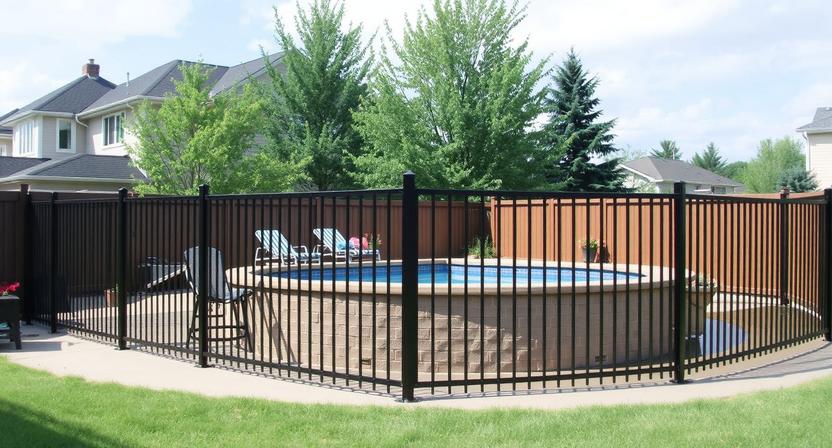
Toronto pool fence bylaws control pool enclosure height, gate construction, distance from the water’s edge, climbability, site placement, and the permit path for outdoor pools. The bylaw context sits under Toronto Municipal Code Chapter 447 – Fences, which sets the enclosure standards for private swimming pools and related pool access rules.
Toronto pool enclosures must meet clear height rules. A pool enclosure on a single residential property must be at least 1.2 metres high. A pool enclosure on a multiple residential property or non-residential property must be at least 1.8 metres high. These minimum heights support access control and inspection before the pool is used.
Toronto pool fence location rules require the enclosure, including gates, to completely surround the pool area. The fence must have no opening except a compliant gate. The enclosure must sit at least 1.2 metres from the pool edge and at least 1 metre from easily climbable objects, such as a tree. Toronto also restricts climbable features between 10 cm and 1.2 metres above the ground.
Toronto pool fence permits follow a two-step approval path. Applicants must obtain a Zoning Certificate before applying for a Pool Fence Enclosure Permit. The City states that a pool must not be constructed and filled with water without a fence installed under Chapter 447 – Fences.
Toronto pool gate rules focus on controlled access. A compliant pool gate must support the enclosure, restrict entry, and meet the bylaw’s gate standards. Fence material, gate hardware, latch placement, openings, climbable surfaces, and building-wall access all affect compliance. A correct permit plan should confirm fence height, gate function, pool-edge distance, climbability, site plan details, and inspection timing before pool construction, filling, or use.
What Are Toronto Pool Fence Bylaws?
Toronto pool fence bylaws are local rules that control how a swimming pool enclosure must be built, permitted, inspected, and maintained. These bylaws set standards for fence height, gate access, latch placement, pool-edge distance, climbability, building-wall access, and permit approval. Toronto requires a pool enclosure to completely surround the pool area, with no openings except a compliant gate.
What Is a Toronto Pool Fence Enclosure?
A Toronto pool fence enclosure is a fence, wall, gate, or other barrier that surrounds a swimming pool area and restricts access to the water. The enclosure must fully separate the pool area from uncontrolled entry points. Toronto states that a property with a swimming pool must have a swimming pool enclosure around the pool area, with no openings except a gate.
What Is Chapter 447 – Fences?
Chapter 447 – Fences is the section of the Toronto Municipal Code that sets fence and pool enclosure rules in the city. It defines pool enclosure standards, gate requirements, height rules, climbability limits, enforcement powers, and permit duties for swimming pool enclosures. Toronto pool fence bylaws use this chapter as the main legal framework for pool enclosure compliance.
Why Does Toronto Regulate Pool Enclosures Separately?
Toronto regulates pool enclosures separately because swimming pools create a direct access-control and safety issue. A general yard fence does not always meet pool safety rules. Pool enclosures need stricter standards for height, self-closing gates, self-latching hardware, lockable access, non-climbable surfaces, and distance from the pool edge. Toronto also requires an approved Zoning Certificate before a Pool Fence Enclosure Permit for applications submitted after March 31, 2021.
What Is the Short Answer on Toronto Pool Fence Rules?
Toronto pool fence rules require a compliant enclosure before pool construction, filling, and use. The enclosure must fully surround the pool area, include only compliant gate openings, meet the required height standard, sit at least 1.2 metres from the pool edge, and stay at least 1 metre from easily climbable objects. A pool enclosure also needs an approved Zoning Certificate and Pool Fence Enclosure Permit before installation.
Do You Need a Pool Fence Permit in Toronto?
Yes. Toronto requires a Pool Fence Enclosure Permit for outdoor swimming pools, hot tubs, whirlpools, and other outdoor structures capable of swimming use, unless a specific exemption applies. Toronto also requires an approved Zoning Certificate before the Pool Fence Enclosure Permit application. The permit path exists because the pool enclosure must meet Toronto Municipal Code Chapter 447 – Fences before construction, filling, and use.
When Is a Pool Fence Enclosure Permit Required?
A Pool Fence Enclosure Permit is required when a property owner builds or maintains fences and gates around an outdoor swimming pool, hot tub, whirlpool, or similar structure capable of swimming use. Toronto states that a Pool Fence Enclosure Permit is not required for a hot tub, whirlpool, or spa with a permanently attached cover that locks to prevent access when the unit is not in use.
What Is a Zoning Applicable Law Certificate?
A Zoning Applicable Law Certificate is the zoning approval required before applying for a Pool Fence Enclosure Permit through Municipal Licensing and Standards. Toronto uses this certificate to review the proposed pool location, site plan, fence layout, and zoning compliance before the enclosure permit stage. The City requires drawings to be drawn to scale, fully dimensioned, signed, and dated.
Why Does Toronto Use a Two-Step Permit Process?
Toronto uses a two-step permit process to separate zoning review from pool enclosure approval. Step 1 is the Zoning Certificate through Toronto Building. Step 2 is the Pool Fence Enclosure Permit through Municipal Licensing and Standards. Toronto states that applications submitted after March 31, 2021 must obtain a Zoning Certificate before applying for the enclosure permit.
When Can the Pool Be Filled and Used?
A Toronto pool can be filled and used only after the pool enclosure rules are met. Toronto states that a pool cannot be constructed and filled with water without a fence installed according to Chapter 447 – Fences. Chapter 447 also states that a pool must not be filled or hold water until an officer confirms completion of a compliant permanent enclosure. Limited filling is allowed with compliant temporary fencing, but pool use must wait until the permanent enclosure is installed, inspected, and confirmed complete.
What Pool Types Must Follow Toronto Pool Fence Bylaws?
Toronto pool fence bylaws apply to outdoor structures on private property that are used or capable of being used for swimming, wading, or bathing when the water depth reaches the bylaw threshold. The rules cover inground pools, above-ground pools, many hot tubs, spas, whirlpools, and similar outdoor water structures unless a stated exemption applies. Toronto requires a compliant swimming pool enclosure that fully surrounds the pool area, with no openings except a gate.
Do Inground Pools Follow the Same Rules?
Inground pools follow Toronto pool fence bylaws when they are outdoor private-property pools used for swimming, wading, or bathing. The pool enclosure must meet Chapter 447 – Fences, including height, gate, distance, and climbability rules. Toronto also requires an approved Zoning Certificate before the Pool Fence Enclosure Permit application.
Do Above-Ground Pools Follow the Same Rules?
Above-ground pools follow Toronto pool fence bylaws when they meet the swimming pool definition and depth threshold. The pool wall does not automatically replace a compliant enclosure. The permit review still checks access points, ladders, supports, decks, gates, wall height, climbable objects, and enclosure layout.
Toronto states that a swimming pool enclosure must completely surround the pool area and have no openings except a gate. That rule applies to the enclosure system around the pool, not only to the pool structure itself.
Do Hot Tubs and Spas Follow the Same Rules?
Hot tubs and spas follow Toronto pool enclosure rules when they are outdoor structures capable of swimming, wading, or bathing use and no specific exemption applies. Toronto states that a pool enclosure fence permit is required on private property. The City also states that a pool enclosure fence is not required for a hot tub, whirlpool, or spa if it has a permanently attached cover that locks to prevent access when not in use.
Do Ponds and Similar Water Features Follow the Same Rules?
Ponds and similar water features follow Toronto pool fence bylaws when they meet the bylaw’s swimming pool definition. The rule depends on use and depth. A decorative pond below the threshold may fall outside the pool enclosure rule, but a deeper water feature used or capable of being used for swimming, wading, or bathing needs local review.
Toronto pool enclosure rules focus on access control around outdoor water structures that create swimming, wading, or bathing risk. The enclosure must restrict access through a compliant fence, wall, gate, or other approved barrier.
What Depth Triggers the Enclosure Rules?
A 600 mm water depth triggers Toronto pool enclosure rules when the outdoor structure is used or capable of being used for swimming, wading, or bathing. 600 mm equals 60 cm, or about 24 inches. Toronto’s public pool-fence guidance connects enclosure rules to outdoor water structures capable of swimming use, and municipal bylaw summaries identify 600 mm as the depth threshold for swimming pool enclosure requirements.
What Fence Height Rules Apply?
Toronto pool fence height rules set different minimum heights by property type. A pool enclosure on a single residential property must be at least 1.2 metres high. A pool enclosure on a multiple residential property or non-residential property must be at least 1.8 metres high. These height rules work with gate, latch, climbability, and pool-edge distance rules under Toronto Municipal Code Chapter 447 – Fences.
What Fence Height Applies on a Single Residential Property?
A Toronto pool fence on a single residential property must be at least 1.2 metres high. This minimum height applies to the swimming pool enclosure, including fence sections and gates that restrict access to the pool area. The fence must also fully surround the pool area, with no opening except a gate that complies with the Fence Bylaw.
What Fence Height Applies on a Multiple Residential Property?
A Toronto pool fence on a multiple residential property must be at least 1.8 metres high. This higher minimum applies because multiple residential sites usually have more shared access points, more users, and higher exposure to uncontrolled pool entry. The enclosure still needs compliant gate hardware, non-climbable construction, and proper separation from the pool edge and climbable objects.
What Fence Height Applies on a Non-Residential Property?
A Toronto pool fence on a non-residential property must be at least 1.8 metres high. This applies to commercial, institutional, or other non-residential settings where public or semi-public access risk is higher than on a single residential lot. The enclosure must still meet the same core pool safety rules for complete enclosure, controlled gate access, and climbability limits.
What Maximum Fence Height Rule Applies?
Toronto’s general fence bylaw sets maximum fence-height rules by location and fence type, but pool enclosures must first meet the minimum pool safety height. The City states that fences on an attached unroofed deck may reach 2 metres above the deck surface. Pool enclosure plans that exceed ordinary fence-height limits or conflict with the bylaw may need an exemption review before approval.
When Does a Fence Height Exemption Matter?
A fence height exemption matters when the proposed pool fence does not comply with Toronto’s height or fence bylaw limits. The owner needs approval before relying on a non-standard fence height, location, or design. This matters most when the pool enclosure sits on a deck, near grade changes, beside shared property lines, or near climbable objects where the proposed design needs added height or a layout change to meet safety rules.
What Location Rules Apply to a Pool Fence?
Toronto pool fence location rules require the pool enclosure and any gate to fully surround the pool area, sit at least 1.2 metres from the pool edge, and stay at least 1 metre from easily climbable objects. These rules help prevent direct access into the water and reduce climbing risk before construction, filling, and use.
How Far Must the Fence Be From the Pool Edge?
A Toronto pool fence must be at least 1.2 metres from the pool edge. The City states that a pool fence, including its gates, must be no closer than 1.2 m to the edge of the pool. This distance applies to the enclosure layout and should appear on the pool fence permit site plan before approval.
How Far Must the Fence Be From Climbable Objects?
A Toronto pool fence must be at least 1 metre from easily climbable objects. The City gives a tree as an example of an object that creates climbable access. The rule also matters near decks, retaining walls, sheds, furniture, equipment, planters, and other fixed or movable objects that help someone climb the enclosure.
What Site Placement Rules Matter Most?
The most important site placement rules are pool-edge distance, climbable-object distance, complete enclosure, gate access, and building-wall access. Toronto states that a pool fence must completely surround the pool, with no opening except a compliant gate. If a building wall forms part of the enclosure, that wall cannot have doors or windows opening into the pool area.
What Lot Conditions Change the Fence Layout?
Lot conditions change the fence layout when property lines, grade changes, decks, trees, retaining walls, buildings, narrow side yards, or equipment locations affect enclosure access. A fence that meets height rules may still fail if a nearby object creates a climbable route or if the layout places the gate too close to the water’s edge. Toronto also restricts climbable features between 10 cm and 1.2 metres above the ground on the outside of the enclosure.
Why Do Location Rules Matter Before Construction?
Location rules matter before construction because the fence layout controls permit approval, inspection, pool filling, and legal use. A pool enclosure placed too close to the pool edge or near climbable objects may need redesign before approval. Toronto requires an approved Zoning Certificate before the Pool Fence Enclosure Permit, so location errors can delay the permit before the fence or pool work starts.
What Gate Rules Apply to a Pool Fence?
Toronto pool gate rules require every gate in a swimming pool enclosure to use substantial hinges, controlled closing, secure latching, and locking. Toronto Municipal Code Chapter 447 – Fences treats gates as part of the pool enclosure, so the gate must meet the same access-control purpose as the fence.
Must a Pool Gate Be Self-Closing?
A Toronto pool gate must be self-closing. Chapter 447 states that a single gate in a swimming pool enclosure must be self-closing and supported on substantial hinges. A double gate must have one gate that is self-closing and equipped with the required locking latch.
Must a Pool Gate Be Self-Latching?
A Toronto pool gate must be self-latching. A single pool gate must have a lockable, self-latching device. A double gate must have one self-closing gate with a lockable, self-latching device, plus a second gate with a lockable drop bolt.
Must a Pool Gate Be Lockable?
A Toronto pool gate must be lockable. Chapter 447 requires a single gate to stay locked at all times except when the enclosed pool area is in use. A double gate must also stay locked, including the lockable drop bolt, except when the enclosed area is in use.
Where Must the Latch Be Placed?
A Toronto pool gate latch must be placed inside near the top of the gate or outside at least 1.5 metres above grade. This rule applies to the lockable, self-latching device on a single gate and the main active leaf of a double gate.
What Clearance Rules Apply Under a Gate?
Toronto pool gate clearance must follow the same construction standards as the pool enclosure. Chapter 447 treats gates as part of the swimming pool enclosure, so openings, gaps, and bottom clearance must not create access under or through the enclosure. Double gates also need a lockable drop bolt that extends at least 25 millimetres into concrete, asphalt, or paving stones.
What Climbability Rules Apply?
Toronto climbability rules require a pool fence to block easy climbing from outside the enclosure. The fence must stay at least 1 metre from easily climbable objects and must not have climbable features between 10 cm and 1.2 metres above the ground. These rules matter because a tall fence still fails when objects, openings, rails, supports, or gaps create a climbable route into the pool area.
What Objects Make a Pool Fence Easy to Climb?
Objects that make a pool fence easy to climb include trees, decks, retaining walls, sheds, benches, chairs, planters, equipment pads, pool pumps, storage boxes, ladders, and decorative fence parts. City of Toronto states that a pool fence must stay at least 1 metre from any easily climbable object, such as a tree.
What Openings and Gaps Matter Most?
Openings and gaps matter most when they allow a foothold, handhold, or passage through the enclosure. Chapter 447 defines non-climbable chain-link construction as mesh no greater than 38 mm square for at least 1.2 metres vertically. For other enclosures, the bylaw links non-climbability to the absence of horizontal openings or steps greater than 38 mm in width for 1.2 metres vertically, unless horizontal components sit at least 1.2 metres apart.
What Does Toronto Ban Between 10 cm and 1.2 m Above Grade?
Toronto bans climbable features between 10 cm and 1.2 m above grade on the outside of a pool enclosure. The City states that a pool fence must have nothing climbable between 10 cm and 1.2 m above the ground that may help someone climb the outside of the enclosure.
Why Do Climbability Rules Matter More Than Fence Height Alone?
Climbability rules matter more than fence height alone because a fence that meets the minimum height still fails when nearby objects or fence details create a climbing path. A compliant Toronto pool enclosure needs the correct height, pool-edge distance, object clearance, non-climbable face, gate hardware, and gap control. The City requires the enclosure to completely surround the pool, with no opening except a compliant gate.
Can the House Form Part of the Pool Enclosure?
A house forms part of a Toronto pool enclosure only when the building wall does not create access into the enclosed pool area. Toronto pool fence bylaws allow a building wall to function as part of the enclosure only when it protects access in the same way as the fence. Doors and windows that open into the pool area create a direct access point and do not meet the enclosure purpose.
Can a Building Wall Form Part of the Fence?
Yes, a building wall forms part of the fence only when it has no doors or windows opening into the pool area. The wall must help complete the swimming pool enclosure and restrict access to the water. A wall that gives direct entry from the home into the pool area fails the access-control purpose of Chapter 447 – Fences.
Can Doors Open Into the Enclosed Pool Area?
No, doors must not open into the enclosed pool area when the building wall forms part of the enclosure. A door creates uncontrolled access from the house into the pool zone. Toronto requires the enclosure to fully control pool access, with openings limited to compliant gates.
Can Windows Open Into the Enclosed Pool Area?
No, windows must not open into the enclosed pool area when the building wall forms part of the pool enclosure. An opening window creates access and weakens the enclosure. Toronto’s pool enclosure rules also refer to pool visibility from windows or doors in the main living area, which makes building-wall placement important during design review.
Why Does Toronto Restrict Access Through the Building Wall?
Toronto restricts access through the building wall because the pool enclosure must block unsupervised entry to the water. A compliant enclosure uses controlled gates, proper latches, required height, non-climbable construction, and safe placement. Direct access through a house wall bypasses those controls and creates inspection risk before the pool is filled or used.
Can an Above-Ground Pool Wall Count as the Fence?
An above-ground pool wall counts as the fence only in limited Toronto bylaw conditions. Toronto Municipal Code Chapter 447 – Fences lists a specific exception for an above-ground pool erected before July 6, 2000 when the pool meets height, guard, climbability, setback, and gated-access standards. Newer above-ground pools generally need a compliant swimming pool enclosure unless the City approves the enclosure design through the permit process.
When Can the Pool Wall Count as the Enclosure?
The pool wall can count as the enclosure when the above-ground pool qualifies under the Chapter 447 exception. The pool must be at least 1.2 metres above grade. Any deck or platform must have a guard at least 1 metre high. The combined height of the pool structure and guard must not exceed 2.6 metres. The access point into the pool must also have a gated enclosure that meets Toronto’s pool enclosure rules.
What Makes a Pool Wall Non-Compliant?
A pool wall becomes non-compliant when it fails height, access, climbability, or setback rules. Chapter 447 requires the outside of the pool structure and any guard to be free of any element or attachment that may support climbing. No part of the pool structure may sit closer than 1.2 metres to any lot line under the above-ground pool exception.
A wall also fails when ladders, decks, stairs, platforms, braces, storage items, furniture, trees, or other nearby objects create uncontrolled access to the pool. Toronto’s general pool fence rules require the enclosure to fully surround the pool area and have no opening except a compliant gate.
Do Supports and Struts Affect Compliance?
Supports and struts affect compliance when they help someone climb the outside of the pool wall. Toronto’s above-ground pool exception requires the outside of the pool structure and any guard to remain free of any climbable element or attachment. Braces, struts, frame supports, ladder brackets, deck framing, and nearby equipment may create a climbable path and weaken the enclosure.
Toronto climbability rules also require a pool fence to stay at least 1 metre from easily climbable objects. The enclosure must have nothing climbable between 10 cm and 1.2 metres above the ground on the outside face.
When Is a Separate Fence Still Required?
A separate fence is still required when the above-ground pool wall does not meet Toronto’s enclosure rules or does not qualify under the Chapter 447 exception. A separate enclosure is also required when the pool has an uncontrolled ladder, deck access, climbable supports, poor gate control, a non-compliant wall height, or a location too close to a lot line.
Toronto pool fence bylaws focus on access control, not only pool height. A compliant enclosure must fully surround the pool area, use approved gate access, sit at least 1.2 metres from the pool edge, and stay clear of climbable objects.
What Materials and Construction Rules Apply?
Toronto pool fence materials and construction rules require a pool enclosure to use normal fence materials, avoid electrified materials, follow non-climbable construction standards, and stay in good repair. Toronto Municipal Code Chapter 447 – Fences sets detailed standards for wood, chain-link, mesh, gate hardware, openings, and workmanship.
What Materials Are Allowed for a Pool Fence?
Toronto pool fences must use materials normally used for fence construction. The City states that fences cannot be constructed of materials not usually used for fence construction. Common compliant materials include wood, metal, chain-link, masonry, and other durable fence systems when they meet height, gate, gap, and climbability rules.
Can a Pool Fence Use Electrified Materials?
No. A Toronto pool fence cannot use electrified materials. The City states that fences cannot be a conductor of electricity. This rule matters for pool enclosures because the fence sits near water, gates, users, and outdoor equipment.
What Chain-Link Rules Apply?
Toronto chain-link pool fences must control mesh size and climbability. Chapter 447 defines non-climbable chain-link fencing as mesh no greater than 38 mm square for at least 1.2 metres vertically. This standard helps prevent handholds and footholds on the outside of the enclosure.
What Construction Standards Matter Most?
The most important construction standards are height, non-climbability, gate function, gap control, and durable workmanship. A wood pool fence must be built in a good, workmanlike manner. Vertical boards must be not less than 19 mm by 89 mm nominal dimensions and spaced not more than 38 mm apart. Horizontal members must sit on the inside of the enclosure or follow the non-climbable spacing rules.
What Workmanship Problems Trigger Enforcement?
Workmanship problems trigger enforcement when the fence no longer restricts access or fails the bylaw standard. Common issues include loose boards, broken mesh, weak posts, missing gate hardware, non-working self-closing hinges, faulty latches, climbable cross rails, gaps larger than allowed, and fence materials that deteriorate or shift out of alignment.
Toronto requires pool enclosures to completely surround the pool area, use compliant gates, and block climbable access. A poorly built or poorly maintained fence creates inspection failure, correction work, and possible enforcement under Chapter 447 – Fences.
What Site Plan Rules Apply to a Pool Fence Permit?
Toronto pool fence permit site plans must show the pool location, property boundaries, required distances, fence layout, gate details, pool equipment, and hard-versus-soft landscaping information. Toronto requires drawings for a Zoning Applicable Law Certificate to be drawn to scale, fully dimensioned, signed, and dated. The approved zoning drawings then support the Pool Fence Enclosure Permit review.
What Distances to Lot Lines Must the Site Plan Show?
The site plan must show distances from the pool and pool equipment to the lot lines. Toronto requires the pool zoning site plan to reference a legal survey, show property lines, list pool and property dimensions, and show distances from the pool to the lot lines. These measurements help reviewers confirm site placement before the fence permit stage.
What Distances to the House Must the Site Plan Show?
The site plan must show distances from the pool to the house. Toronto requires the pool zoning site plan to show distances from the pool to the house, plus the location and dimensions of doors and windows beside the pool area. These details help reviewers assess access points, enclosure placement, and building-wall conditions.
What Fence and Gate Details Must the Site Plan Show?
The site plan must show fence location, fence height, fence materials, and gate placement. Toronto requires the Pool Fence Enclosure Permit package to include zoning-approved site plans or drawings that show the fence location, height, and materials. Fence details should also confirm gate access, latch placement, self-closing hardware, and the required 1.2-metre separation from the pool edge.
What Pool Equipment Details Must the Site Plan Show?
The site plan must show pool equipment locations and distances from equipment to lot lines. Required equipment details include the heater, pump, filter, and other pool equipment. These details help reviewers check placement, service access, equipment clearance, and any zoning issue tied to the equipment location.
What Hard and Soft Landscaping Details Must the Plan Show?
The site plan must show hard landscaping and soft landscaping percentages. Toronto requires the pool zoning site plan to include hard-versus-soft landscaping details, and the City states that soft landscaping may include the water surface area of outdoor swimming pools and similar water-holding structures, including fountains and artificial ponds. These figures help reviewers confirm how the pool and surrounding surfaces fit the property.
How Long Does Toronto Pool Fence Permit Approval Take?
Toronto pool fence permit approval usually takes about 15 business days across the two main review stages when the submission is complete: about 10 business days for the Zoning Certificate review and about five business days for the Pool Fence Enclosure Permit review. Missing drawings, unclear measurements, incomplete fence details, or extra City information requests extend the timeline.
How Long Does Zoning Review Take?
Zoning review takes about 10 business days after the Zoning Applicable Law Certificate application is accepted and the fee is paid. This review happens before the Pool Fence Enclosure Permit stage. Toronto uses the zoning review to check the pool location, property dimensions, lot line distances, house distances, equipment locations, fence details, and hard-versus-soft landscaping information.
How Long Does Pool Fence Permit Review Take?
Pool fence permit review takes about five business days when the application is complete. Toronto states that a complete Pool Fence Enclosure Permit application takes approximately five business days to review, and the review takes longer when information is missing or more information is requested.
What Missing Information Delays Approval?
Missing information delays approval when the application lacks the approved Zoning Certificate, the completed Pool Fence Enclosure Permit application form, or zoning-approved drawings showing fence location, height, and materials. Zoning delays also occur when the site plan omits property lines, pool dimensions, house distances, lot line distances, doors and windows near the pool area, pool equipment details, or hard-versus-soft landscaping percentages.
What Inspection Steps Apply Before Use?
Inspection steps before use confirm that the permanent swimming pool enclosure is installed and compliant before the pool is filled or used. Toronto Municipal Code Chapter 447 states that a pool must not be filled with water, or have water remain in it, until an officer has inspected and confirmed a compliant permanent enclosure. Limited filling is allowed with compliant temporary fencing, but pool use must wait until the permanent enclosure is installed, inspected, and confirmed complete.
What Happens If a Pool Fence Does Not Meet the Bylaw?
A Toronto pool fence that does not meet the bylaw can lead to permit refusal, permit revocation, a notice of violation, an order to correct, fines, and restrictions on filling or using the pool. Toronto Municipal Code Chapter 447 – Fences requires the pool enclosure to fully comply before the pool holds water, except for limited filling with compliant temporary fencing.
Can Toronto Refuse or Revoke the Permit?
Toronto can refuse or revoke a pool fence permit when the proposed or installed enclosure does not comply with Chapter 447, another applicable law, submitted information is false or mistaken, or the required fee is unpaid. Permit refusal or revocation means the fence design, site plan, gate details, or enclosure layout needs correction before approval continues.
Can Toronto Issue a Notice of Violation?
Toronto can issue a notice of violation when a pool fence, gate, temporary fence, or enclosure does not follow Chapter 447. A violation can involve missing gate controls, wrong fence height, climbable objects, poor latch placement, openings in the enclosure, or pool use before permanent enclosure approval.
Can Toronto Order Corrections?
Toronto can order corrections when the pool enclosure fails the bylaw. Corrections may include raising the fence height, changing gate hardware, adding a self-closing latch, removing climbable objects, moving the fence, closing gaps, changing materials, or revising access through a building wall. Chapter 447 allows the City to require work that corrects a contravention.
Can Toronto Fine the Owner?
Toronto can fine the owner for a Chapter 447 pool fence contravention. The bylaw sets a maximum fine of $100,000 for a person convicted of contravening the article, a notice of violation, a direction, or an order. A continuing offence carries a maximum daily fine of $10,000 for each day or part of a day that the offence continues.
Can the Pool Stay Empty Until Compliance?
Yes. The pool can stay empty until compliance is confirmed. Toronto states that a swimming pool cannot be filled with water, or have water remain in it, until the City inspects and confirms a compliant permanent swimming pool enclosure. Limited filling with compliant temporary fencing is allowed, but the pool area cannot be used until permanent fencing is installed, inspected, and confirmed complete.
Can You Get an Exemption to Toronto Pool Fence Bylaws?
Yes. A Toronto fence exemption may be requested when a proposed fence does not comply with the standards in Toronto’s Fence Bylaw. The exemption process applies through the local Community Council, but approval is not automatic. A pool fence still needs to protect access to the pool area, and the owner remains responsible for Chapter 447 – Fences compliance unless an exemption is approved.
What Is a Fence Exemption?
A fence exemption is a request for permission to install or keep a fence that does not comply with Toronto’s Fence Bylaw. The City states that property owners may request an exemption from their local Community Council when they want to install a fence that does not meet the bylaw standards.
When Does a Fence Exemption Application Matter?
A fence exemption application matters when the proposed pool fence has a non-standard height, location, material, or design. Examples include a fence that exceeds a general height limit, needs a different layout because of grade changes, or conflicts with a site condition. A pool enclosure still needs to meet safety goals for controlled access, gate security, climbability, and pool-edge separation unless the City approves a specific exemption.
Who Approves a Fence Exemption?
The local Community Council approves a Toronto fence exemption. Toronto states that an exemption to Municipal Code Chapter 447 – Fences must be approved by the respective Community Council. The completed application and applicable fee must be submitted to the local Municipal Licensing and Standards Office where the fence is located.
What Happens If the Exemption Is Refused?
If the exemption is refused, the fence must comply with Toronto’s Fence Bylaw before approval, filling, or use. The owner may need to revise the fence height, gate details, material, location, or enclosure layout. A non-compliant pool fence may lead to permit refusal, correction orders, inspection failure, or restrictions on pool use until the enclosure meets Chapter 447 – Fences.
FAQs About Toronto Pool Fence Bylaws
What Height Must a Toronto Pool Fence Be?
A Toronto pool fence must be at least 1.2 metres high on a single residential property. A pool fence must be at least 1.8 metres high on a multiple residential property or non-residential property. These heights apply to the swimming pool enclosure under Toronto Municipal Code Chapter 447 – Fences.
How Far Must a Pool Fence Be From the Pool?
A Toronto pool fence must sit at least 1.2 metres from the pool edge. The enclosure also must stay at least 1 metre from easily climbable objects, such as trees, decks, retaining walls, equipment, furniture, or other climbable items near the fence.
Does a Pool Gate Need to Be Self-Closing?
Yes. A Toronto pool gate must be self-closing, supported by substantial hinges, and built as part of the approved swimming pool enclosure. A gate that fails to close by itself creates an access-control issue and may fail inspection.
Can the House Form Part of the Pool Enclosure?
A house wall forms part of a Toronto pool enclosure only when it does not create access into the pool area. Doors or windows opening into the enclosed pool area weaken the enclosure because they bypass the controlled gate system required under Chapter 447.
Can an Above-Ground Pool Wall Count as the Fence?
An above-ground pool wall counts as the fence only under limited Toronto bylaw conditions. The wall or structure must meet height, access-control, non-climbability, and gate rules. Ladders, decks, supports, struts, furniture, or nearby objects that create climbable access make a separate compliant enclosure necessary.
Do You Need a Permit for a Pool Fence in Toronto?
Yes. Toronto requires a Pool Fence Enclosure Permit for outdoor swimming pools and similar structures unless a stated exemption applies. Applications submitted after March 31, 2021 also require a Zoning Certificate before the Pool Fence Enclosure Permit application.
How Long Does Pool Fence Permit Approval Take?
A complete Toronto Pool Fence Enclosure Permit application takes about five business days to review. Review takes longer when information is missing or the City requests added details. The zoning step happens before this permit review.
What Happens If the Fence Does Not Meet Code?
A Toronto pool fence that does not meet code may lead to permit refusal, inspection failure, correction orders, fines, and restrictions on pool filling or use. Toronto states that a pool must not be constructed and filled with water without a fence installed under Chapter 447 – Fences.
How Do You Start a Pool Fence Permit Application in Toronto?
Start a Toronto pool fence permit application by preparing the Zoning Applicable Law Certificate submission first, then preparing the Pool Fence Enclosure Permit package after zoning approval. Toronto requires applicants to obtain a Zoning Certificate before applying for a Pool Fence Enclosure Permit for applications submitted after March 31, 2021. The pool must not be constructed and filled with water without a fence installed under Toronto Municipal Code Chapter 447 – Fences.
How Do You Prepare the Zoning Submission?
Prepare the zoning submission with scaled, fully dimensioned, signed, and dated drawings for the Zoning Applicable Law Certificate. City of Toronto states that this certificate is required before the Pool Fence Enclosure Permit application through Municipal Licensing and Standards.
The zoning site plan should show the proposed pool location, property lines, lot line distances, house distance, pool equipment location, fence location, fence height, fence material, and other site details needed for zoning review. The zoning step confirms the pool and enclosure layout before the permit office reviews the fence application.
How Do You Prepare the Pool Fence Site Plan?
Prepare the pool fence site plan with the approved zoning drawings and clear fence, gate, and pool enclosure details. Toronto Municipal Code Chapter 447 requires pool enclosure permit plans to show the pool location in relation to lot lines and adjacent buildings, plus complete details of the swimming pool enclosure.
The site plan should identify the fence route, gate location, gate swing, fence height, fence material, latch location, pool-edge distance, and nearby climbable objects. A complete Pool Fence Enclosure Permit submission also uses the approved Zoning Certificate and zoning-approved drawings.
How Do You Check Gate and Height Compliance Early?
Check gate and height compliance early by comparing the design against Chapter 447 – Fences before submission. A single residential property needs a pool enclosure at least 1.2 metres high. A multiple residential property or non-residential property needs a pool enclosure at least 1.8 metres high.
Gate details should confirm self-closing hinges, self-latching hardware, lockable access, latch placement, and proper clearance. The enclosure should sit at least 1.2 metres from the pool edge and at least 1 metre from easily climbable objects. Early checks reduce redesign, permit delays, and failed inspection risk.
How Do You Align Fence Approval With Pool Construction Timing?
Align fence approval with pool construction timing by completing zoning review, fence permit review, fence installation, and inspection before pool filling or use. Toronto states that a complete Pool Fence Enclosure Permit application takes about five business days to review when all information is present. Missing information or extra City requests extend the timeline.
Pool filling and use depend on enclosure compliance. Chapter 447 restricts filling until an officer inspects and confirms a compliant permanent swimming pool enclosure. Toronto allows filling with compliant temporary fencing in limited cases, but the pool area must not be used until permanent fencing has been installed, inspected, and confirmed complete.