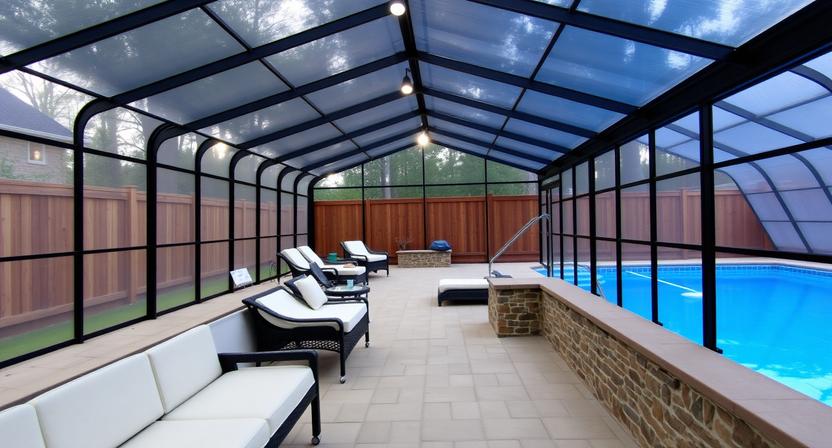
Ontario pool enclosure rules for private residential pools are set mainly through municipal bylaws, not one identical Ontario-wide backyard pool fence rule. Toronto, Hamilton, Vaughan, Mississauga, and Ottawa each require pool owners to follow local permit, fence, gate, site plan, and inspection rules before pool use. Toronto requires a Zoning Certificate before a Pool Fence Enclosure Permit and states that a pool cannot be built and filled without a compliant fence.
Pool enclosure requirements usually cover inground pools, above-ground pools, hot tubs, spas, and deeper temporary pools. Common rule areas include minimum fence height, self-closing gates, self-latching gates, lockable access, non-climbable fence design, gap limits, lot line setbacks, equipment location, and final inspection. Hamilton states that all swimming pools need a pool enclosure and that the enclosure fence needs a building permit.
Municipal differences matter before design starts. Vaughan lists a 1.22 m minimum pool enclosure height, while Hamilton’s bylaw document lists a 1.5 m minimum height. Mississauga requires a legal survey and scaled site plan for swimming pool, hot tub, or swim spa installation. Ottawa treats some locked hot tub safety covers as the enclosure, yet still requires a pool enclosure permit and inspection.
Ontario Regulation 565 applies to public pools under provincial law, while most backyard pool enclosure rules come from the local municipality. Homeowners need to confirm the correct city bylaw, pool depth trigger, permit type, fence design, gate hardware, site plan details, and inspection timing before pool installation begins.
What Are Ontario Pool Enclosure Rules?
Ontario pool enclosure rules are local safety rules that control how a residential swimming pool, hot tub, or spa must be enclosed before use. These rules usually cover the pool fence, gate, latch, lock, site plan, permit, and final inspection. The supplied page outline places this section before permit types, fence height, gate rules, construction rules, above-ground pools, hot tubs, inspections, and city differences.
Ontario municipalities set most backyard pool enclosure rules through local bylaws. Toronto requires a Zoning Certificate before a Pool Fence Enclosure Permit, and states that a pool cannot be constructed and filled without a fence that meets Toronto Municipal Code Chapter 447 – Fences. Hamilton states that all swimming pools require a pool enclosure, and that the pool enclosure fence needs a building permit.
Is There One Ontario-Wide Pool Enclosure Rule for Residential Pools?
There is no single identical Ontario-wide pool enclosure rule for private residential pools. Residential pool enclosure rules come mainly from the local municipality where the property sits.
Ontario Regulation 565 applies to public pools under provincial law. That regulation covers public pool operation, maintenance, equipment, and health protection. It does not create one standard backyard pool fence rule for every private home in Ontario.
Why Do Pool Enclosure Rules Change by Municipality?
Pool enclosure rules change by municipality because each city writes and enforces its own local bylaw for private residential pools. Local bylaws reflect different lot patterns, zoning rules, fence standards, inspection processes, and permit systems.
Vaughan requires a swimming pool enclosure permit before pool installation or ground excavation and lists a 1.22 m minimum enclosure height. Hamilton states that pool enclosures are required for all swimming pools and that the enclosure fence needs a building permit. These examples show the same safety goal with different local rules and process details.
What Is the Short Answer on Ontario Pool Enclosure Rules?
Ontario pool enclosure rules require homeowners to follow the local municipal bylaw before installing, filling, or using a private pool. The rule check starts with the correct municipality, then moves to the permit, fence height, gate hardware, site plan, and inspection.
Toronto uses a zoning-first process before the pool fence enclosure permit. Vaughan applies its pool permit rule to any body of water 30 inches or more in depth, including in-ground, above-ground, temporary, seasonal, hot tub, and spa installations.
What Safety Goals Do Pool Enclosure Rules Serve?
Pool enclosure rules reduce unsafe access to water by children, visitors, neighbours, and the public. The enclosure creates a controlled barrier around a pool, hot tub, or spa before the water area becomes usable.
The main safety goals include restricted entry, delayed unsupervised access, secure gate closure, reduced climb risk, and clear inspection control. Toronto states that the pool fence enclosure process exists to protect public safety, and Vaughan requires a temporary fence before excavation once the permit is granted.
Who Controls Pool Enclosure Rules in Ontario?
Municipalities control most residential pool enclosure rules in Ontario. Local bylaws set the main rules for private backyard pools, including pool fence permits, fence height, gate hardware, site plans, and final inspections. This section separates municipal residential pool rules from Ontario public pool rules, as required by the supplied outline.
Ontario Regulation 565 controls public pools, not one standard residential backyard pool fence rule for every private home. The regulation applies to public pools, related buildings, pool equipment, and public pool operation.
Do Municipalities Control Residential Pool Enclosures?
Municipalities control residential pool enclosures in Ontario through local pool fence, zoning, building, and property bylaws. The city or town where the property sits sets the permit process and inspection standard.
Toronto requires a Zoning Certificate before a Pool Fence Enclosure Permit. The city states that a pool cannot be built and filled with water without a fence that meets Toronto Municipal Code Chapter 447 – Fences.
Hamilton states that a building permit is not needed to install a swimming pool, but a Building Permit is needed to construct the pool enclosure fence. Hamilton also states that pool enclosures are required for all swimming pools.
What Ontario Rules Apply to Public Pools Instead?
Ontario Regulation 565 applies to public pools and the buildings, equipment, and appurtenances used in public pool operation. The regulation sits under provincial health law and deals with public pool health and safety controls.
Public pool rules cover facilities such as public swimming pools, public spas, and regulated aquatic settings. These rules differ from a backyard pool fence permit because they focus on operation, water safety, supervision, equipment, and public health duties.
Why Do Private and Public Pool Rules Need Separate Explanations?
Private and public pool rules need separate explanations because they serve different legal purposes. Private residential pool enclosure rules control barriers around backyard pools through municipal bylaws. Public pool rules control regulated pool operation under provincial law.
Residential pool owners deal mainly with the local city or town. The review process focuses on the pool enclosure permit, zoning, fence design, gate safety, and final approval. Public pool operators deal with provincial public health rules under Ontario Regulation 565.
What Official City Examples Show the Local Rule Pattern?
Official city examples show that Ontario uses a local rule pattern for residential pool enclosures. The same safety theme appears across cities, but the permit names, height rules, depth triggers, and review steps differ.
Toronto uses a zoning-first process before the Pool Fence Enclosure Permit. Hamilton requires a permit for the pool enclosure fence and blocks pool filling until the enclosure is in place and final city approval is received. Vaughan requires a Swimming Pool Enclosure Permit before pool installation or excavation, sets a 1.22 m minimum enclosure height, and applies the permit rule to water structures that hold 30 inches of water or more.
When Is a Pool Enclosure Required in Ontario?
A pool enclosure is required in Ontario when the local municipality classifies the water feature as a regulated swimming pool, hot tub, spa, swim spa, pond, or similar artificial water body. The trigger depends on the municipal bylaw, the water depth, the pool type, and the access control method. This section follows the outline focus on inground pools, above-ground pools, hot tubs, ponds, and common depth triggers.
Toronto defines a swimming pool as an outdoor structure or thing on private property used for swimming, wading, or bathing where the water depth at any point exceeds 600 mm. Toronto requires a swimming pool enclosure around the pool area, with no opening except a compliant gate.
Do Inground Pools Need an Enclosure?
Inground pools need an enclosure when the municipality’s pool bylaw applies. Toronto requires every owner of a regulated swimming pool to erect and maintain a swimming pool enclosure that completely encloses the pool area. Toronto also requires a permit before excavation or pool erection.
Hamilton states that pool enclosures are required for all swimming pools. Hamilton does not require a building permit to install the pool itself, but it requires a Building Permit to construct the pool enclosure fence.
Do Above-Ground Pools Need an Enclosure?
Above-ground pools need an enclosure when the local bylaw classifies the pool by depth, access, or structure. Mississauga requires city approval documents and fees before installing an above-ground pool, in-ground pool, hot tub, or swim spa in a backyard.
Toronto provides a limited exception for some older above-ground pools built before July 6, 2000, but the pool structure still needs minimum height, non-climbable conditions, lot line separation, and a protected gated access point. New above-ground pool projects need local review before installation.
Do Hot Tubs and Spas Need an Enclosure?
Hot tubs and spas need an enclosure unless the municipality accepts another compliant safety barrier, such as a lockable safety cover. Ottawa states that a hot tub needs a pool enclosure unless it has a lockable safety cover that meets the bylaw. Ottawa still requires a pool enclosure permit and inspection.
Hamilton requires a rigid hot tub cover capable of supporting a 90 kg load or meeting the current ASTM hot tub standard. Hamilton requires the cover to stay securely fastened and locked when the hot tub is not in use. A hot tub without that compliant cover needs an enclosure that meets the bylaw.
Do Ponds and Similar Water Features Need an Enclosure?
Ponds and similar water features need an enclosure when the municipal bylaw includes artificial water bodies that meet the local depth trigger. Ottawa groups pool, hot tub, and pond under its pool enclosure guidance, which means homeowners need to check the bylaw before adding a backyard pond with regulated depth or access risk.
Markham defines a swimming pool as an outdoor artificial body of water where depth at any point exceeds 0.6 m. The definition includes spas, hot tubs, landscaped ponds, wading pools, inflatable pools, above-ground pools, and in-ground pools.
What Depth Trigger Appears Most Often in Ontario Cities?
The most common depth trigger in reviewed Ontario city sources is about 0.6 m, stated as 600 mm, 0.6 m, or 24 inches / 61 cm. Toronto uses a water-depth threshold above 600 mm. Mississauga refers to pool types capable of holding water exceeding 24 inches / 61 cm. Markham uses depth that exceeds 0.6 m.
Depth triggers are not identical across Ontario. London uses a permit and fence trigger for pools with more than 75 cm depth at any point and more than 1 m² surface area. This difference confirms why homeowners need the local municipal bylaw before buying the pool, ordering fencing, or preparing the site plan.
What Permit Types Apply to a Pool Enclosure?
Pool enclosure projects in Ontario often involve five approval types: pool enclosure permit, zoning review, building permit for the pool fence, ESA electrical notification/permit, and building permit for a related deck. The exact permit package depends on the municipality, pool type, fence design, electrical equipment, and deck design. The supplied outline places these permit types before fence height, gate rules, site plan rules, and inspection steps.
Toronto requires a Zoning Certificate before a Pool Fence Enclosure Permit. Hamilton does not require a building permit for the pool itself, but it requires a Building Permit for the pool enclosure fence. ESA states that almost all electrical work in Ontario requires an electrical notification of work, often called a permit.
What Is a Pool Enclosure Permit?
A pool enclosure permit is the local approval for the barrier system around a private swimming pool, hot tub, spa, or similar regulated water feature. The permit usually reviews the fence line, gate location, latch, lock, access points, pool location, and site plan.
Toronto states that a pool cannot be constructed and filled with water without a fence installed under Toronto Municipal Code Chapter 447 – Fences. Toronto also states that applicants need a Zoning Certificate before the Pool Fence Enclosure Permit.
What Is a Zoning Review for a Pool Enclosure?
A zoning review for a pool enclosure checks whether the proposed pool and enclosure meet local zoning rules before the enclosure permit stage. The review checks property layout, lot lines, setbacks, structure locations, and drawing details.
Toronto uses a Zoning Applicable Law Certificate for pool fence enclosure applications. Toronto requires drawings on standard sheet sizes, drawn to scale, fully dimensioned, signed, and dated.
What Is a Building Permit for a Pool Fence?
A building permit for a pool fence is a municipal approval for the construction of the pool enclosure where the municipality treats the enclosure as permit-controlled work. This permit focuses on the fence, not always the pool shell.
Hamilton states that homeowners do not need a building permit to install a swimming pool, but they need a Building Permit to construct the pool enclosure fence. Ontario describes a building permit as a document issued by the body responsible for enforcing Ontario’s Building Code in the local area.
What Is an Electrical Permit for Pool Equipment?
An electrical permit for pool equipment is an ESA notification of work for electrical work connected to pool systems. Pool equipment often includes pumps, heaters, lighting, automation controls, hot tub wiring, bonding, and grounding.
ESA states that almost all electrical work in Ontario must be reported by filing a notification of work, or “permit,” before the work starts. ESA also notes that pool equipment and nearby metal objects, such as pool ladders, need proper grounding and bonding.
What Permit Applies to a Deck Beside the Pool?
A deck beside the pool needs a municipal building permit when the deck meets local permit thresholds. Permit rules depend on whether the deck is attached to the house, covered, raised above grade, or used with an above-ground or on-ground pool.
Hamilton states that an attached deck, any deck used with an on-ground or above-ground swimming pool, a detached uncovered deck over 10 m² and more than 200 mm above grade, and a detached covered deck over 10 m² require a building permit. Toronto also lists decks and porches under its residential building permit application guide.
What Fence Height Rules Apply?
Fence height rules for Ontario pool enclosures depend on the local municipal bylaw, the property type, and the measured grade outside the enclosure. Toronto, Hamilton, and Vaughan show different minimum height rules, so homeowners need the local city standard before fence design, permit drawings, or pool installation starts. This section follows the supplied outline’s focus on Toronto, Hamilton, Vaughan, municipal differences, and design-stage height checks.
What Minimum Fence Height Does Toronto Use?
Toronto uses a 1.2 m minimum pool enclosure height for a pool on a single residential property. Toronto uses 1.8 m for a pool on a multiple residential property or non-residential property. The height is measured above the highest outside grade within 1 m of the enclosure.
Toronto pool fence design also needs a non-climbable outside face. The fence must keep climbable elements away from the outside of the enclosure between 100 mm and 1.2 m above grade.
What Minimum Fence Height Does Hamilton Use?
Hamilton uses a 1.5 m minimum pool enclosure height measured from the effective ground level on the outside of the enclosure. Hamilton’s bylaw also requires no opening that lets a spherical object larger than 100 mm pass through when gates are closed.
Hamilton pool enclosures must sit at least 1.0 m from the nearest inside pool wall. The bylaw also bars objects near the enclosure that help climbing or weaken the enclosure.
What Minimum Fence Height Does Vaughan Use?
Vaughan uses a 1.22 m minimum swimming pool enclosure height. Vaughan also requires no exterior fence projections that help climbing, such as railings or other structures.
Vaughan pool enclosure rules require a Swimming Pool Enclosure Permit before a pool is installed or excavation begins. Vaughan also requires a temporary fence before excavation once the permit is granted.
Why Do Fence Height Rules Change by Municipality?
Fence height rules change by municipality because each Ontario city sets its own private residential pool enclosure bylaw. Local bylaws define the permit process, minimum fence height, measurement method, climbability rules, and inspection standard.
Toronto sets 1.2 m for single residential pool enclosures. Hamilton sets 1.5 m for pool enclosures. Vaughan sets 1.22 m for swimming pool enclosures. These city examples show the same safety goal with different legal numbers.
What Height Rule Matters Most Before Design Starts?
The local municipal minimum height rule matters most before design starts. The homeowner needs the city bylaw height, the measurement point, the gate height, the grade condition, and the non-climbable zone before ordering materials or submitting drawings.
Pool fence design that meets one city’s rule does not automatically meet another city’s rule. A 1.22 m enclosure may match Vaughan’s minimum, but it does not meet Hamilton’s 1.5 m minimum. A design check before the permit stage reduces rejected drawings, fence changes, gate changes, and final inspection delays.
What Gate Rules Apply to Pool Enclosures?
Pool enclosure gates need to control entry as strictly as the pool fence controls the perimeter. Municipal bylaws commonly require self-closing gates, self-latching devices, locks, secure hinges, and latch placement that limits access by children. The supplied outline places gate rules directly after fence height rules, which keeps the section focused on access control before fence construction details.
Toronto, Hamilton, and Vaughan all require gate hardware that closes, latches, and locks. Toronto and Vaughan require a lockable, self-latching device on the inside near the top of the gate or on the outside at least 1.5 m above grade. Hamilton requires a self-closing device, a self-latching device on the inside at least 1.35 m above the bottom of the enclosure, and a lock on the inside of the enclosure.
Must a Pool Gate Be Self-Closing?
A pool gate must be self-closing where the local pool enclosure bylaw requires it. A self-closing gate returns to the closed position without manual pushing. This rule reduces the risk created when a person enters or leaves the pool area and forgets to shut the gate.
Toronto requires every single pool enclosure gate to be self-closing. Vaughan sets the same rule for single gates in a Swimming Pool Enclosure. Hamilton requires every owner to construct and maintain any enclosure gate with a self-closing device.
Must a Pool Gate Be Self-Latching?
A pool gate must be self-latching where the municipal bylaw requires self-latching gate hardware. A self-latching device secures the gate after it closes, which stops the gate from resting closed but unlatched.
Toronto requires a lockable, self-latching device on a single pool gate. Vaughan uses the same requirement. Hamilton requires a self-latching device on the inside of the enclosure.
Must a Pool Gate Be Lockable?
A pool gate must be lockable in the reviewed municipal examples. Locking rules matter because a closed and latched gate still permits access if the latch remains reachable or unsecured.
Toronto states that single pool enclosure gates must have a lockable, self-latching device and must stay locked except when the enclosed area is in use. Hamilton requires a lock on the inside of the enclosure and requires gates to stay closed and locked except during pool entry, exit, or use. Vaughan requires single gates to be lockable and locked except when the enclosed area is in use.
Where Must the Latch Be Placed?
The latch must be placed where the local bylaw requires it, often high or inside the enclosure. This placement reduces easy reach from outside the pool enclosure.
Toronto requires the lockable, self-latching device to sit on the inside near the top of the gate or on the outside at least 1.5 m above grade. Vaughan uses the same placement rule. Hamilton requires the self-latching device on the inside of the enclosure at least 1.35 m above the bottom of the enclosure.
Why Do Gate Rules Matter as Much as Fence Height?
Gate rules matter as much as fence height because the gate is the active entry point in the pool enclosure. A tall fence loses safety value when the gate stays open, fails to latch, lacks a lock, or places the latch within easy reach.
Pool gate compliance needs a full hardware check before final inspection. The key items include self-closing hinges, self-latching hardware, lockable access, correct latch height, secure gate framing, and closed-and-locked use when the pool area is not active. Toronto’s public guidance states that a pool fence must completely surround the pool with no opening except a gate that complies with the fence bylaw.
What Fence Construction Rules Apply?
Fence construction rules for an Ontario pool enclosure control the barrier’s openings, gaps, climbable features, materials, chain-link mesh, open fence visibility, and any building wall used as part of the enclosure. These rules sit after fence height and gate rules because height alone does not prove compliance. The supplied outline places this section before above-ground pool wall rules, which keeps the page flow focused on the physical enclosure before pool-type exceptions.
Toronto, Hamilton, and Mississauga show the same core safety pattern: the enclosure must block easy entry, resist climbing, maintain clear sightlines where required, and use approved fence materials. Toronto lists construction standards for chain-link fencing, wood fencing, metal picket fencing, glass panel fencing, and masonry walls.
What Opening and Gap Limits Apply?
Opening and gap limits set the maximum space allowed through or below a pool enclosure fence. Hamilton requires no opening, when gates are closed, that allows a spherical object larger than 100 mm to pass through. Mississauga sets the same 10 cm maximum for vertical spacing and bottom spacing, while chain-link mesh must not exceed 38 mm.
Toronto applies detailed gap limits by fence type. A chain-link pool fence uses a 38 mm maximum mesh size. Toronto also applies spacing rules for metal picket and glass panel fences, including 38 mm and 100 mm limits based on horizontal element spacing.
What Climbability Rules Apply?
Climbability rules stop the outside face of the pool enclosure from acting like a ladder. Toronto requires no climbable element or attachment between 100 mm and 1.2 m above grade. Toronto also requires non-climbable facing material on the outside of the enclosure from no more than 50 mm above grade to the required minimum height.
Hamilton requires the enclosure to have nothing that helps climbing or reduces structural integrity. Mississauga states that decorative items, accessible latches on wrought iron fencing, and exposed diagonal braces on wood gates are not acceptable as part of the enclosure.
What Materials Are Restricted or Prohibited?
Restricted or prohibited materials include items that fail to create a safe, stable, non-climbable pool enclosure. Hamilton prohibits an enclosure made in whole or in part from an overhead garage door, hedge, vegetation, barbed wire, chicken wire, other sharp material, or any material that conducts electricity.
Toronto permits specific enclosure types under its construction standards, including chain-link, wood, metal picket, glass panel, and masonry wall systems. Property owners need the exact municipal standard before choosing panels, posts, rails, mesh, boards, or glass.
What Rules Apply to Chain-Link and Open Fences?
Chain-link pool enclosure rules often control mesh size, wire gauge, posts, rails, and bottom support. Toronto requires 38 mm maximum mesh for chain-link pool fences. Hamilton requires chain-link mesh openings of not more than 38 mm, plus galvanized steel wire, support posts, a top rail, and a bottom rail. Mississauga requires chain-link fencing at least 1.2 m high, with 38 mm maximum mesh, a continuous solid top rail, and a bottom tension wire.
Open fence construction matters when the fence separates the pool from the home. Toronto requires open mesh chain-link or equivalent open fence construction where the enclosure separates the pool from a residential building and the fence must not block the line of sight from main living area doors or windows. Hamilton uses a similar open mesh or open face rule for visibility from the dwelling’s access level.
What Building-Wall Rules Apply If the House Forms Part of the Enclosure?
Building-wall rules depend on the municipality and the wall’s access points. Toronto states that a pool enclosure must fully surround the pool with no opening except a compliant gate. Toronto also states that where a building wall forms part of the fence, the wall must not have doors or windows opening into the pool area.
Hamilton allows a building or structure wall to form all or part of an enclosure only when openings that give direct access to the pool area are protected by a door, window, or other covering and kept closed and locked when the pool is not under competent supervision. This difference shows why the local bylaw must guide the final enclosure design.
Can an Above-Ground Pool Wall Count as the Enclosure?
An above-ground pool wall counts as part of the pool enclosure only when the local municipal bylaw allows it and the pool wall meets height, access, and non-climbable rules. Hamilton requires the combined height of the above-ground pool wall and enclosure guard to be at least 1.5 m, with access areas enclosed under the bylaw. Toronto gives a limited exception for above-ground pools erected before July 6, 2000, when the pool structure meets strict height, guard, access, and climbability rules.
When Can the Pool Wall Count as the Fence?
The pool wall counts as the fence when the municipality accepts the above-ground pool structure as an effective barrier. The wall or combined wall-and-guard system needs enough height, no easy climbing points, and a controlled access point with a compliant gate or enclosure. Hamilton requires the above-ground pool wall and enclosure guard to reach at least 1.5 m and not help climbing.
Toronto applies a narrow older-pool exception where the above-ground pool must sit at least 1.2 m above grade, any platform or deck needs a guard at least 1 m high, the outside must stay free of climbable attachments, and the access point must have a compliant gated enclosure.
What Makes an Above-Ground Pool Wall Non-Compliant?
An above-ground pool wall becomes non-compliant when it fails the local height, access, climbability, or location rule. Low walls, reachable ladders, open decks, climbable braces, unsafe platforms, and unprotected access points create common compliance problems.
Toronto requires the outside of the above-ground pool structure and guard to stay free of elements or attachments that help climbing. The access point also needs a gated enclosure that meets the city’s swimming pool enclosure standards.
Do Supports and Struts Affect Compliance?
Supports and struts affect compliance when they make the outside of the above-ground pool easier to climb. A pool wall that reaches the required height still fails when braces, rails, decks, steps, ladders, or support frames create footholds or handholds.
Hamilton requires the above-ground pool wall and guard to avoid climbability. Toronto requires the outside of the pool structure and any guard to stay free of climbable elements or attachments.
When Is a Separate Fence Still Required?
A separate fence is still required when the above-ground pool wall does not meet the municipal enclosure rule. Hamilton states that where an above-ground pool is not built and maintained under the above-ground pool rule, the owner must build and maintain an enclosure that otherwise complies with the bylaw.
Vaughan requires swimming pool grading permits and fence enclosures before installation for in-ground pools, above-ground pools, hot tubs, spas, and temporary or seasonal pools. Vaughan also states that any body of water 30 inches or more in depth requires a pool permit.
Do Hot Tubs and Spas Follow Different Rules?
Hot tubs and spas follow different pool enclosure rules in some Ontario municipalities because a locking safety cover sometimes replaces a full fence. The local bylaw still controls the permit, cover standard, enclosure need, and inspection process. This section follows the outline focus on locking safety covers, full enclosures, separate hot tub treatment, and official city examples.
Ottawa states that a hot tub needs a pool enclosure unless it has a lockable safety cover that meets the bylaw. Toronto states that a pool enclosure fence is not required for a hot tub, whirlpool, or spa when it has a permanently attached cover that locks to prevent access when not in use.
Can a Locking Safety Cover Replace a Fence?
A locking safety cover replaces a fence only when the local municipality allows it and the cover meets the stated standard. The cover needs to stay locked when the hot tub or spa is not in use.
Hamilton requires a rigid cover for a hot tub that supports a 90 kg load or meets the current American Society for Testing and Materials hot tub standard. Hamilton also requires the cover to remain securely fastened and locked when the hot tub is not in use.
When Does a Hot Tub Still Need a Full Enclosure?
A hot tub still needs a full enclosure when it lacks a compliant locking cover or fails the local cover rule. A weak, loose, unlocked, damaged, removable, or non-compliant cover does not replace the required barrier.
Hamilton states that where a hot tub is not built and maintained with the required rigid cover, the owner must construct and maintain an enclosure that complies with the bylaw. Ottawa uses the same safety pattern by requiring an enclosure unless a lockable safety cover meets the bylaw.
Why Do Municipal Rules Treat Hot Tubs Separately?
Municipal rules treat hot tubs separately because a hot tub has a smaller footprint than a swimming pool and often has an engineered safety cover designed to block access. The safety question shifts from fence-only control to locked-cover control.
Hot tub rules still target the same access risk as pool fence rules. The barrier must stop unsupervised entry when the water is not in use. Toronto’s rule focuses on a permanently attached lockable cover. Hamilton’s rule focuses on rigid cover strength, ASTM alignment, secure fastening, and locking.
What Official City Examples Show the Difference?
Official city examples show that Ontario municipalities use different rules for hot tubs and spas. The safety goal stays consistent, but the accepted barrier differs by city.
Toronto accepts a permanently attached lockable cover instead of a pool enclosure fence for a hot tub, whirlpool, or spa. Ottawa accepts a lockable safety cover that meets the bylaw. Hamilton accepts a rigid cover that supports 90 kg or meets the current ASTM standard, with secure fastening and locking when not in use. Mississauga includes hot tubs and swim spas in its residential swimming pool installation process, which means property owners still need local approval before installation.
What Site Plan and Location Rules Apply?
Site plan and location rules show where the pool enclosure, pool shell, gate, house, lot lines, deck, and pool equipment sit on the property. Municipal reviewers use these drawings to check zoning, setbacks, drainage, fence location, and inspection access before pool work starts. The supplied outline places this section before inspection and approval steps, which keeps the content flow tied to permit review before construction.
Toronto requires a detailed, fully dimensioned site plan for a Pool Fence Enclosure zoning review. The plan must show a legal survey reference, pool and property dimensions, distances to the house and lot lines, nearby doors and windows, pool equipment locations and distances to lot lines, proposed fence height and material, and hard versus soft landscaping.
Do You Need a Survey or Site Plan?
A survey or site plan is required for many Ontario pool enclosure applications. The city uses the drawing to confirm the pool location, fence line, property boundaries, grading, and nearby structures.
Mississauga requires one 11″ × 17″ Swimming Pool Site Plan with lot grading, current grade elevations, drainage, and proposed changes. Mississauga also requires one 11″ × 17″ legal survey showing existing fencing, structures, easements, and property boundaries.
What Lot Line Measurements Must the Plan Show?
The plan must show lot line measurements that prove the pool, fence, and equipment sit in the correct location. These measurements help the municipality check setbacks, zoning limits, easements, and neighbouring property impacts.
Toronto requires distances from the pool to the house and lot lines. The plan must also show pool and property dimensions. Mississauga states that pools must comply with the Swimming Pool Enclosure By-law and be set back from all property lines.
What Pool and Fence Distances Must the Plan Show?
The plan must show pool and fence distances from the house, lot lines, and other relevant structures. These distances confirm that the pool enclosure surrounds the water area and matches the proposed permit design.
Toronto requires the location, height, and material of the proposed fence on the site plan. Mississauga requires the pool location to be marked with spray paint or stakes before the pre-construction meeting, including where the pool enclosure walls and pool equipment sit.
What Equipment Locations Must the Plan Show?
The plan must show pool equipment locations, including the heater, pump, and filter. Equipment placement matters because municipalities check lot line distances, drainage, noise impacts, zoning limits, and safe access.
Toronto requires the site plan to show pool equipment locations and distances to lot lines. Mississauga requires the proposed pool location, enclosure walls, and pool equipment locations to be marked before inspectors arrive for the pre-construction meeting.
Why Do Site Plan Errors Delay Approval?
Site plan errors delay approval because municipal staff need accurate drawings before they accept the pool location, fence route, drainage pattern, and inspection setup. Missing dimensions, unclear lot lines, wrong equipment locations, changed grades, and unmarked enclosure walls create review problems.
Mississauga states that hand sketches are not accepted. Mississauga also states that changes made after the submitted site plan require a revised site plan before pool installation. The city requires no changes to the approved site plan during pool and enclosure installation.
What Inspection and Approval Steps Apply?
Inspection and approval steps for an Ontario pool enclosure confirm that the permit, site plan, fence, gate, latch, lock, temporary barrier, and final enclosure meet the local municipal bylaw before pool use. The supplied outline places this section after site plan and location rules, which matches the approval path from drawing review to construction checks and final inspection.
Toronto states that a pool cannot be filled with water or retain water until the City has inspected the site and confirmed a completed permanent swimming pool enclosure that complies with the bylaw. Mississauga schedules a pre-construction meeting after site plan approval, and the proposed pool, pool enclosure walls, and pool equipment need marking before inspectors arrive.
What Happens Before Construction Starts?
Before construction starts, the municipality reviews the pool enclosure permit package and approved site plan. The application stage checks the pool location, fence line, gate access, lot lines, pool equipment, and any related zoning or building requirements.
Mississauga contacts the applicant to schedule a pre-construction meeting after site plan approval. The proposed pool location needs spray paint or stakes, including the location of pool enclosure walls and pool equipment. Vaughan requires a Swimming Pool Enclosure Permit before pool installation or excavation, and a temporary fence before any ground excavation once the permit is granted.
What Happens During Enclosure Construction?
During enclosure construction, the approved pool enclosure layout must match the permit drawings and local bylaw. Fence height, gate swing, latch placement, openings, climbable features, pool access, and equipment locations need to match the approved design.
Hamilton requires pool enclosures for all swimming pools and requires a Building Permit for the pool enclosure fence. Existing fencing still needs to meet Hamilton By-law 16-184, and changes remain necessary when the existing fence fails the bylaw standard.
What Final Inspection Happens Before Pool Use?
Final inspection confirms that the permanent pool enclosure meets the municipal bylaw before pool use. Inspectors review the completed fence, gate, self-closing device, self-latching device, lock, opening limits, height, and approved enclosure route.
Toronto requires City inspection before a swimming pool is filled or allowed to hold water. The City confirms completion of a permanent swimming pool enclosure that fully complies with the bylaw. Pool use before this inspection creates a fine risk.
Why Must the Pool Stay Unfilled Until Approval in Some Cities?
The pool must stay unfilled until approval in some cities because the enclosure is the required safety barrier before water access begins. Water creates the hazard that the fence, gate, latch, and lock are designed to control.
Toronto states that a swimming pool cannot be filled with water, or keep water in it, until the City inspection confirms a completed permanent enclosure that complies with the bylaw. Toronto’s pool fence enclosure guide also states that a pool cannot be constructed and filled without a fence installed under Municipal Code Chapter 447 – Fences.
What Missing Items Delay Final Approval Most?
Missing items delay final approval when they stop the inspector from confirming a complete and compliant pool enclosure. Common delay items include missing gate hardware, wrong latch height, non-locking access, gaps under or through the fence, climbable objects near the enclosure, unapproved site plan changes, unmarked equipment locations, and incomplete fence sections.
Mississauga requires the proposed pool, pool enclosure walls, and pool equipment to be marked before the pre-construction meeting. Vaughan requires temporary fencing before excavation after permit approval. Toronto requires final inspection confirmation before the pool holds water. These steps show why missing markings, missing temporary fencing, and incomplete permanent enclosure work delay approval.
What City Differences Matter Most Across Ontario?
City differences matter most across Ontario because each municipality sets its own residential pool enclosure process. The key differences involve the permit name, depth trigger, fence height, site plan documents, temporary fencing, hot tub rules, and final inspection timing. This section follows the outline’s city-by-city comparison focus for Toronto, Ottawa, Hamilton, Mississauga, and Vaughan.
What Does Toronto Require?
Toronto requires a Zoning Certificate before a Pool Fence Enclosure Permit. The city states that a pool cannot be constructed and filled with water without a fence installed under Toronto Municipal Code Chapter 447 – Fences.
Toronto pool enclosure rules require the enclosure to surround the pool area. The enclosure needs a compliant gate and no other opening. The process starts before construction, not after the pool is built.
What Does Ottawa Require?
Ottawa requires pool enclosures for pools, hot tubs, spas, and ponds that hold more than 60 cm of water. Ottawa requires a pool enclosure permit for a new enclosure, a replacement enclosure, or a new pool where fencing already exists. Ottawa also states that pools cannot be filled until the city completes the final inspection.
Ottawa hot tub rules allow a different path when the hot tub has a compliant lockable safety cover. A hot tub needs a pool enclosure unless the cover meets the bylaw requirements.
What Does Hamilton Require?
Hamilton requires a Building Permit for the pool enclosure fence. Hamilton states that a building permit is not needed to install the swimming pool itself, but a permit is needed to construct the pool enclosure and any deck built beside or in addition to the pool.
Hamilton pool enclosure rules apply to all swimming pools. The city states that owners must not excavate or build the pool enclosure until the Building Permit is issued, and must not put water in the pool until the enclosure is in place and the city gives final approval.
What Does Mississauga Require?
Mississauga requires a Swimming Pool Enclosure Inspection Request for pools capable of holding water over 24 inches, or 61 cm, in depth. The city’s 2026 guide applies to residential swimming pools, hot tubs, and swim spas.
Mississauga site plan rules require one 11″ × 17″ legal survey and one 11″ × 17″ scaled swimming pool site plan. The site plan must show the proposed pool, pool equipment, accessory structures, landscaping features, and relevant grade elevations. Free-hand sketches are not accepted.
What Does Vaughan Show About Depth Triggers and Temporary Pools?
Vaughan shows that depth triggers and temporary pools are part of municipal pool enclosure control. Vaughan states that in-ground pools, above-ground pools, hot tubs, spas, and temporary or seasonal pools need swimming pool grading permits and fence enclosures before installation.
Vaughan uses a 30-inch depth trigger. Any body of water 30 inches or more in depth requires a pool permit. Vaughan also lists separate permit categories for inground pools, permanent above-ground pools, and temporary or seasonal pools, which shows why temporary backyard pools need the same early rule check as permanent pools.
What Mistakes Cause Pool Enclosure Problems?
Pool enclosure problems usually come from mismatched drawings, wrong fence height, faulty gate hardware, unsafe above-ground pool access, and misunderstood hot tub cover exemptions. These mistakes delay permits, inspections, final approval, and pool use. The supplied outline places this section after city differences, which makes it a practical compliance check before enforcement and FAQ sections.
Do Incomplete Site Plans Delay Approval?
Incomplete site plans delay approval because municipal staff need clear property, pool, fence, grading, and equipment details before review. Missing lot lines, unclear setbacks, unmarked pool equipment, wrong drawing scale, and free-hand sketches create application problems.
Mississauga requires one 11″ × 17″ legal survey and one 11″ × 17″ scaled swimming pool site plan. The site plan must show the proposed pool, pool equipment, accessory structures, landscaping features, grade elevations, setbacks, and pool dimensions. The city states that hand sketches are not accepted.
Do Fence Height Errors Delay Approval?
Fence height errors delay approval when the installed enclosure does not meet the local minimum height or measurement rule. A fence that meets one city’s rule does not automatically meet another city’s rule.
Toronto requires a 1.2 m minimum pool enclosure height for a pool on a single residential property. Hamilton requires a 1.5 m minimum enclosure height. Vaughan lists a 1.22 m minimum swimming pool enclosure height. These differences make city-specific height checks necessary before ordering fence materials.
Do Gate and Latch Errors Delay Approval?
Gate and latch errors delay approval because the gate controls daily access to the pool area. A compliant fence fails when the gate does not close, latch, lock, or place the latch at the required height.
Toronto requires a gate to be self-closing and self-latching, with a lockable device placed on the inside near the top of the gate or on the outside at least 1.5 m above grade. Hamilton requires a self-closing device, a self-latching device on the inside at least 1.35 m above the bottom of the enclosure, and a lock on the inside of the enclosure.
Do Above-Ground Pool Access Details Cause Problems?
Above-ground pool access details cause problems when ladders, steps, decks, platforms, supports, or struts create easy entry over the pool wall. The wall height alone does not prove compliance when access points remain open or climbable.
Hamilton states that an above-ground pool that is not built and maintained under the above-ground pool wall rule needs an enclosure that complies with the bylaw. Vaughan requires pool grading permits and fence enclosures before installation for above-ground pools, hot tubs, spas, and temporary or seasonal pools. Vaughan also states that any body of water 30 inches or more in depth requires a pool permit.
Do Owners Misread Hot Tub Cover Exemptions?
Owners misread hot tub cover exemptions when they treat any cover as a legal replacement for a fence. A hot tub cover only replaces an enclosure where the local bylaw accepts the cover and the cover meets the required locking, attachment, or strength standard.
Toronto states that a Pool Fence Enclosure Permit is not required for a hot tub, whirlpool, or spa when a permanently attached cover locks to prevent access when not in use. Hamilton requires a rigid hot tub cover that supports a 90 kg load or meets the current ASTM hot tub standard, and the cover must stay securely fastened and locked when the hot tub is not in use.
What Happens If a Pool Enclosure Does Not Meet the Rules?
A non-compliant pool enclosure delays approval, blocks pool filling or pool use, triggers correction orders, and creates fine risk. Municipal staff review the permit, site plan, fence height, gate hardware, latch, lock, openings, and inspection status before final approval. This section follows the supplied outline’s enforcement focus after permit, design, city-difference, and mistake sections.
Can the City Refuse or Delay Approval?
The city refuses or delays approval when the pool enclosure permit package is incomplete or the proposed work fails the local bylaw. Hamilton states that no permit is issued unless the application is complete, required inspections are complete, and the proposed pool and enclosure comply with the bylaw, zoning, site alteration rules, approved grading plans, the Ontario Building Code, and other applicable laws.
Toronto requires a Zoning Certificate before a Pool Fence Enclosure Permit. The city states that a pool cannot be constructed and filled without a fence installed under Toronto Municipal Code Chapter 447 – Fences.
Can the City Order Corrections?
The city orders corrections when an officer finds a bylaw contravention. Hamilton’s Pool Enclosure By-law allows an officer to order a person, owner, or occupier to stop the contravening activity or complete work that corrects the contravention.
Correction orders identify the problem, the property, the required work, and the compliance deadline. Hamilton also states that non-compliance with an order lets the city complete the required work at the owner’s expense.
Can the City Stop Pool Use Until Compliance?
The city stops pool use until compliance by withholding final approval or preventing water from being placed in the pool. Hamilton states that water must not be placed in a pool unless the enclosure has been inspected, approved by an officer, and built in compliance with the bylaw.
Hamilton also tells homeowners not to put water in the pool until the swimming pool enclosure is in place and the city gives final approval. Toronto states that a pool cannot be constructed and filled without a fence that meets Chapter 447 – Fences.
Can Fines or Penalties Apply?
Fines and penalties apply when a person contravenes the local pool enclosure bylaw and receives a conviction. Hamilton lists a maximum fine of $10,000 for a first conviction and $25,000 for a later conviction. A corporation faces maximum fines of $50,000 for a first conviction and $100,000 for a later conviction.
Court orders also apply after conviction. Hamilton states that a court may prohibit the continuation or repetition of the offence in addition to any penalty imposed under the bylaw.
Why Does Non-Compliance Usually Cost More Than Early Compliance?
Non-compliance costs more than early compliance because the owner pays through delays, redesign, rework, missed inspections, delayed pool filling, correction work, city recovery costs, and fine risk. Early compliance starts with the local bylaw, a complete site plan, correct fence height, compliant gate hardware, and inspection timing before construction.
Hamilton permits the city to recover correction-work costs by action or by adding the cost to the tax roll, with 15% interest from the date the city incurs the cost until payment. Vaughan also requires a Swimming Pool Enclosure Permit before pool installation or excavation and a temporary fence before excavation after permit approval, which shows why compliance needs to start before site work begins.
FAQs About Ontario Pool Enclosure Rules
Do You Need a Pool Enclosure in Ontario?
You need a pool enclosure in Ontario when your municipality requires one for a residential pool, hot tub, spa, pond, or similar water feature. Toronto defines a swimming pool as a private outdoor structure used for swimming, wading, or bathing with water 60 cm / 600 mm deep or more. Toronto states that a pool cannot be constructed and filled without a fence that meets the city’s fence bylaw.
Is There One Ontario Pool Fence Rule?
There is no single Ontario pool fence rule for all private residential pools. Ontario municipalities set local pool enclosure bylaws for backyard pools. Vaughan uses a 30-inch depth trigger for pool permits, while Toronto uses a 60 cm / 600 mm depth definition for swimming pools.
How High Must a Pool Fence Be in Ontario?
A pool fence in Ontario must meet the local municipal height rule. Toronto commonly uses 1.2 m for single residential pool enclosures, while Hamilton uses 1.5 m under its pool enclosure bylaw. Vaughan requires a swimming pool enclosure permit and lists fence enclosure requirements before installation.
Do Above-Ground Pools Need a Fence in Ontario?
Above-ground pools need a fence or approved enclosure when the local bylaw applies. Vaughan states that above-ground pools, hot tubs, spas, and temporary or seasonal pools need swimming pool grading permits and fence enclosures before installation. Hamilton states that an above-ground pool that does not meet the above-ground wall rule needs an enclosure that complies with the bylaw.
Do Hot Tubs Need a Fence in Ontario?
Hot tubs need a fence or a compliant locking safety cover where the local bylaw requires one. Ottawa states that a pool enclosure permit is needed even when the hot tub lid locks. Hamilton accepts a rigid hot tub cover that supports 90 kg or meets the current ASTM hot tub standard, with the cover fastened and locked when not in use.
What Permit Do You Need for a Pool Enclosure?
The permit needed for a pool enclosure depends on the municipality. Toronto requires a Zoning Certificate before a Pool Fence Enclosure Permit. Hamilton requires a Building Permit for the pool enclosure fence. Vaughan requires a pool permit for any body of water 30 inches or more in depth.
Can a Pool Wall Count as the Fence?
A pool wall counts as the fence only when the municipal bylaw accepts the wall as part of the pool enclosure. Hamilton allows the above-ground pool wall rule only when the pool is built and maintained under the bylaw. A separate enclosure is required when the above-ground pool fails that rule.
What Happens If the Enclosure Does Not Meet Code?
A pool enclosure that does not meet the local bylaw delays approval, blocks legal pool use, and creates correction or penalty risk. Toronto states that a pool cannot be constructed and filled without a compliant fence. Hamilton lists fines up to $10,000 for a first individual conviction and $25,000 for a later individual conviction under its pool enclosure bylaw.
How Do You Start a Pool Enclosure Check in Ontario?
A pool enclosure check in Ontario starts with the correct municipality, local depth trigger, required permit path, approved site plan, and construction timing. Ontario does not use one identical residential pool fence rule for every backyard pool, so the local city bylaw controls the first compliance step. This section follows the supplied outline’s final action sequence for municipal lookup, depth review, fence and gate confirmation, and approval timing.
How Do You Identify the Correct Municipality First?
You identify the correct municipality first by using the property address, not the contractor’s address or nearest large city. The municipality controls the local pool enclosure bylaw, permit form, inspection process, and final approval.
Toronto requires a Zoning Certificate before a Pool Fence Enclosure Permit. Hamilton requires a Building Permit for the pool enclosure fence, not for the swimming pool itself. Vaughan requires a Swimming Pool Enclosure Permit before pool installation or excavation. These examples show why the property’s city decides the rule path.
How Do You Check the Local Depth Trigger?
You check the local depth trigger by reading the municipality’s pool enclosure definition before buying a pool, hot tub, swim spa, or temporary pool. The trigger usually depends on water depth, pool type, and whether the structure holds water for swimming, wading, or bathing.
Mississauga requires a Swimming Pool Enclosure Inspection Request for pools that hold water deeper than 24 inches / 61 cm at any point. Vaughan requires a pool permit before installation or excavation and applies its swimming pool enclosure process through local permit categories and fence rules.
How Do You Confirm Fence, Gate, and Site Plan Rules?
You confirm fence, gate, and site plan rules by checking the local bylaw, permit guide, and drawing requirements together. The check needs the minimum fence height, self-closing gate, self-latching device, lock, latch height, pool location, equipment location, lot line setbacks, and grading details.
Vaughan lists a 1.22 m minimum pool enclosure height and requires gates to be self-closing with a self-latching device at least 1.22 m above the bottom of the door. Mississauga requires an 11″ × 17″ legal survey and an 11″ × 17″ scaled swimming pool site plan showing the proposed pool, equipment, accessory structures, landscaping, grade elevations, setbacks, and gate locations.
How Do You Align Enclosure Approval With Pool Construction Timing?
You align enclosure approval with pool construction timing by securing the permit, installing any required temporary barrier, building the permanent enclosure, and passing final inspection before filling or using the pool. The enclosure timeline needs to lead the pool timeline, not follow it.
Toronto states that a pool cannot be constructed and filled with water without a fence installed under Toronto Municipal Code Chapter 447 – Fences. Hamilton states that owners must not excavate or build a pool enclosure until the building permit is issued, and must not put water in the pool until the enclosure is in place and final city approval is received. Vaughan requires a temporary fence before ground excavation when the pool enclosure permit is granted.