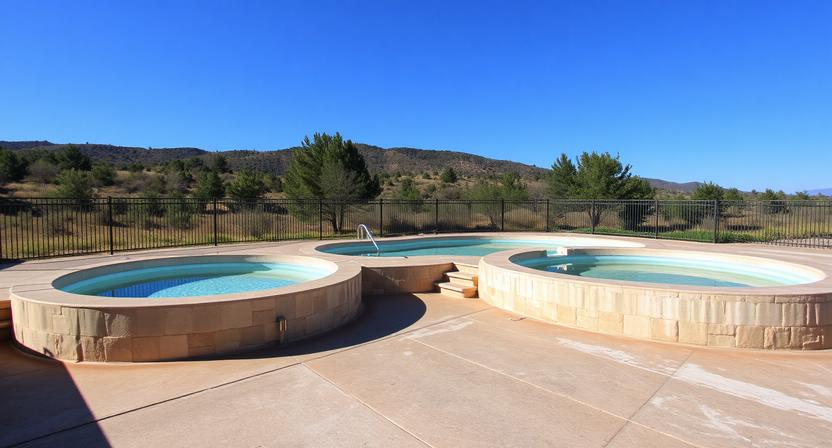
Concrete pools are custom-built inground pools formed on site with reinforced concrete, gunite, or shotcrete. The pool structure is built to match the planned shape, depth, features, and backyard layout.
Concrete pools are commonly chosen for custom shapes, custom depths, premium finishes, integrated spas, tanning ledges, water features, and long-term backyard design. The site-built structure supports complex layouts that standard pre-moulded shells do not offer.
The right concrete pool depends on budget, yard conditions, design goals, engineering needs, finish choice, maintenance planning, and local pool enclosure rules. A complete plan should include excavation, structure, waterproofing, finish selection, decking, fencing, drainage, equipment, inspections, and future pool resurfacing.
Quick Answer
What are concrete pools?
Concrete pools are inground pools built on site with a reinforced concrete structure and an interior pool finish. Common finish options include plaster, tile, pebble finish, aggregate finish, and exposed surface materials.
The structure uses steel reinforcement and concrete placed through gunite, shotcrete, or formed concrete methods. The interior finish creates the visible pool surface and affects comfort, cleaning, appearance, and future pool resurfacing needs.
Why choose concrete pools?
Concrete pools suit homeowners who need custom shapes, custom depths, premium finishes, deep ends, integrated spas, and complex backyard layouts. The site-built structure supports design details that pre-moulded pool shells do not provide.
Concrete pools also suit sloped yards, view lots, raised walls, tanning ledges, beach entries, vanishing edges, and landscape-integrated pool areas. Canadian concrete pool sources repeatedly connect concrete pools with design freedom and long-term structural durability.
What is the main limit?
Concrete pools usually cost more and need more surface maintenance than fibreglass pools or vinyl liner pools. The higher cost comes from excavation, steel reinforcement, concrete placement, curing, waterproofing, finish work, labour, and longer construction time.
Ontario cost guidance places concrete pools in the premium category and lists replastering as a future ownership cost. Long-term care includes water balance, brushing, stain control, crack checks, finish repair, and planned pool resurfacing.
Quick Overview
| Decision Factor | Concrete Pool Detail |
|---|---|
| Best For | Custom design, premium finish, complex yards, deep ends |
| Not Best For | Lowest budget, fastest installation, low-maintenance ownership |
| Main Structure | Reinforced concrete, gunite, or shotcrete |
| Main Surface | Plaster, tile, pebble finish, aggregate finish, or custom finish |
| Design Range | Highest among common inground pool materials |
| Key Limit | Higher cost, longer build time, resurfacing, surface care |
| Long-Term Focus | Water balance, brushing, crack checks, finish care, pool resurfacing |
What Are Concrete Pools?
Concrete pools are custom inground pools built on site with a reinforced concrete shell, steel reinforcement, plumbing, electrical bonding, waterproofing, and an interior finish. The structure supports custom shapes, custom depths, steps, benches, spas, ledges, and water features.
How are concrete pools built?
Builders create concrete pools through excavation, steel placement, plumbing rough-in, concrete application, curing, waterproofing, finishing, coping, decking, equipment setup, inspection, and startup.
The process starts with a design plan and layout markings. Crews excavate the pool area, install reinforced steel, place plumbing lines, add electrical bonding, and form the pool shell. The concrete is then applied with gunite, shotcrete, or formed concrete methods.
What is gunite?
Gunite is a dry-mix concrete method used to build concrete pool shells. The dry cement and sand mix travels through a hose, then water is added at the nozzle during application.
Gunite forms a strong pool structure around steel reinforcement. It suits custom shapes, curves, deep ends, steps, benches, and integrated spas.
What is shotcrete?
Shotcrete is a wet-mix concrete method used to build concrete pools. The concrete is mixed with water before it reaches the hose, then sprayed into place under pressure.
Shotcrete creates a reinforced shell when applied over steel. It supports custom layouts, smooth shaping, and strong structural coverage when placed and cured correctly.
What structure supports the pool?
The concrete pool structure is supported by reinforced steel, a concrete shell, plumbing, waterproofing, and stable ground conditions. Steel bars form the structural cage. Concrete surrounds the steel and creates the pool shell.
The structure also depends on soil strength, drainage, excavation quality, shell thickness, and engineering where the yard has slope, groundwater, retaining walls, or complex loads.
What finish covers the concrete?
An interior pool finish covers the concrete shell and creates the visible swimming surface. Common concrete pool finishes include plaster, tile, pebble finish, aggregate finish, exposed materials, and custom surfaces.
The finish affects colour, texture, swimmer comfort, cleaning needs, and future pool resurfacing. Coping finishes the pool edge. Decking surrounds the pool area. The equipment pad holds the pump, filter, heater, sanitizer system, valves, and controls.
What Benefits Do Concrete Pools Offer?
Concrete pools offer custom shapes, custom sizes, custom depths, premium pool finishes, built-in features, landscape integration, and long-term structural durability. The site-built structure makes concrete pools suitable for complex yards, sloped properties, view lots, and detailed backyard designs.
Why does custom shape matter?
Custom shape matters because concrete pools are formed on site. The pool can match the yard layout, patio shape, house style, slope, and landscape plan.
Common options include rectangular pools, freeform pools, L-shape pools, geometric pools, beach-entry designs, and vanishing-edge layouts. This flexibility helps the pool fit the property instead of forcing the yard to fit a pre-set shell.
Why does custom depth matter?
Custom depth matters because concrete pools support shallow play areas, sport profiles, deeper swim zones, and deep ends where local rules allow them. Depth can match family use, fitness use, lounging, and entertainment goals.
A custom depth profile also supports Baja shelves, tanning ledges, benches, steps, and integrated spas. These features need accurate structural design and water-depth planning.
Why do premium finishes matter?
Premium finishes matter because they control surface feel, colour, texture, water appearance, and long-term maintenance. Concrete pools can use plaster, tile, pebble finish, aggregate finish, exposed materials, and custom finish systems.
Finish choice affects comfort, brushing needs, stain control, scale risk, and future pool resurfacing. Higher-end finishes often add more visual detail but also raise material and labour cost.
Why do built-in features matter?
Built-in features matter because concrete pools can include features formed directly into the structure. Common options include integrated spas, tanning ledges, beach entries, benches, raised walls, waterfalls, deck jets, swim-outs, and vanishing edges.
These features improve access, comfort, views, and outdoor living use. They also need clear planning for plumbing, waterproofing, electrical bonding, finish work, and equipment sizing.
Why does long-term structure matter?
Long-term structure matters because concrete pools are built as reinforced pool shells. A well-built concrete shell can support decades of use when the pool has proper engineering, drainage, water balance, winter care, crack repair, and surface renewal.
Long-term ownership still needs planned maintenance. Concrete pools require brushing, surface checks, water testing, stain control, crack inspection, and pool resurfacing when the interior finish wears.
What Custom Designs Are Possible for Concrete Pools?
Concrete pools support the widest custom pool design range among common inground pool materials. The site-built structure allows custom shapes, depths, steps, benches, spas, ledges, raised walls, and view-focused edge systems.
| Custom Design Option | Concrete Pool Use |
|---|---|
| Rectangle | Clean layout and lap-friendly use |
| Freeform | Natural yard layouts |
| L-Shape | Zone separation and corner yards |
| Deep End | Diving-style layouts where allowed |
| Baja Shelf | Shallow lounging area |
| Integrated Spa | Warm-water add-on |
| Tanning Ledge | Shallow sitting and lounge space |
| Vanishing Edge | View-focused properties |
| Beach Entry | Gradual entry design |
| Raised Wall | Feature wall and grade change control |
What shapes are possible?
Concrete pools allow rectangular, freeform, L-shape, geometric, Roman-end, courtyard, lap-style, plunge-style, and vanishing-edge shapes. The shape is formed on site with steel reinforcement and concrete, so the layout can match the yard, patio, slope, and landscape plan.
What depths are possible?
Concrete pool depths include shallow play zones, sport profiles, gradual slopes, deep ends, and custom depth transitions. Depth depends on pool use, excavation limits, safety rules, soil conditions, and local design requirements.
A deep end suits diving-style layouts only where depth, length, slope, and local rules allow it.
What steps are possible?
Concrete pool steps can be placed where the design needs them. Common options include wide entry steps, corner steps, side steps, full-width steps, beach-style entries, and steps linked to benches or tanning ledges.
Step design affects access, swim space, finish work, and safety.
What benches are possible?
Concrete pool benches can be built along walls, corners, shallow zones, spa areas, or view-facing sides. Benches support sitting, resting, social use, and shallow-water comfort.
Bench size, height, and placement should match water depth, entry design, and pool use.
What spas are possible?
Concrete pools can include integrated spas, raised spas, spillover spas, and separate spa zones. Spa design needs plumbing, heating, jets, waterproofing, electrical bonding, and finish planning.
An integrated spa adds warm-water use and visual connection to the main pool, but it also increases structure, equipment, energy use, and maintenance scope.
What Finishes Are Available for Concrete Pools?
Concrete pools use plaster, tile, pebble finish, aggregate finish, exposed finishes, paint, or coating systems. The pool finish creates the visible surface, affects swimmer comfort, changes water appearance, and sets future pool resurfacing needs.
| Finish Type | Main Feature | Long-Term Note |
|---|---|---|
| Plaster | Smooth classic finish | Needs surface care and later renewal |
| Tile | Premium colour and detail | Higher material and labour cost |
| Pebble | Textured natural appearance | More durable than basic plaster in many projects |
| Aggregate | Mixed stone finish | Texture and colour depend on material |
| Exposed Finish | Strong visual texture | Requires careful surface selection |
| Paint or Coating | Lower-cost surface option | Usually shorter service life than plaster or tile |
What is plaster?
Plaster is a smooth cement-based concrete pool finish applied over the concrete shell. It creates a classic interior surface and gives the water a clean, bright appearance.
Pool plaster needs regular brushing, balanced water, stain control, and later renewal. Roughness, stains, flaking, and surface wear often signal that pool resurfacing needs assessment.
What is tile?
Tile is a premium concrete pool finish used for colour, detail, waterline design, steps, spas, or full pool interiors. Pool tile gives strong design control and works well for detailed edges, mosaics, raised walls, and luxury finishes.
Tile usually costs more because it needs more material, layout work, labour, grout care, and skilled installation.
What is pebble finish?
Pebble finish is a textured surface made with small stones set into the pool finish. It gives concrete pools a natural look and often lasts longer than basic plaster in many projects.
Pebble finishes have more texture than plaster. Texture choice affects foot feel, brushing needs, stain visibility, and long-term comfort.
What is aggregate finish?
Aggregate finish uses mixed stone, quartz, glass, or similar materials in the surface layer. It gives concrete pools more colour depth, texture, and visual detail than plain plaster.
Aggregate finishes vary by material, stone size, colour blend, and exposure level. Surface selection affects grip, comfort, cleaning, and future resurfacing cost.
What is exposed finish?
Exposed finish is a textured pool finish where selected materials show at the surface. It creates strong visual texture and a custom water appearance.
Exposed finishes need careful selection because roughness, slip resistance, cleaning demand, and swimmer comfort vary by material. Finish quality also affects stain control and surface life.
Resurfacing cost changes with finish type, pool size, surface condition, and location. A larger concrete pool, premium finish, rough surface, deep staining, cracks, or difficult access increases resurfacing scope.
What Affects Concrete Pools Cost?
Concrete pools cost depends on pool size, shape, finish, site access, soil, slope, features, decking, permits, and engineering. Concrete pools sit in the premium pool category because they need excavation, steel reinforcement, concrete placement, curing, waterproofing, interior finishing, and skilled labour.
| Cost Factor | Why It Affects Price |
|---|---|
| Pool Size | Larger pools need more excavation, steel, concrete, finish, and equipment |
| Shape | Curves, corners, ledges, and deep ends increase forming work |
| Finish | Tile, pebble, and aggregate change material and labour cost |
| Site Access | Tight access increases labour, equipment limits, and haulage |
| Soil | Rock, clay, groundwater, and poor drainage add site work |
| Slope | Retaining walls, grading, and drainage increase scope |
| Features | Spas, waterfalls, shelves, lights, and automation add cost |
| Decking | Coping, patio, stairs, and hardscape affect final budget |
| Permits | Pool enclosure, setbacks, plans, and inspections add required cost |
Does size affect cost?
Pool size affects concrete pools cost because larger pools need more excavation, steel, concrete, waterproofing, finish material, water, and equipment. Larger pools also increase decking, coping, heating, filtration, and long-term maintenance needs.
A bigger concrete pool usually raises both construction cost and ownership cost.
Does shape affect cost?
Pool shape affects concrete pools cost because curves, corners, ledges, deep ends, beach entries, and vanishing edges need more forming work. Complex shapes also increase steel placement, concrete application, waterproofing, finish labour, and inspection detail.
A simple rectangle usually costs less than a freeform or feature-heavy layout.
Does finish affect cost?
Pool finish affects concrete pools cost because plaster, tile, pebble finish, aggregate finish, and exposed finishes use different materials and labour. Tile and premium aggregate finishes usually cost more than basic plaster.
Finish choice also affects future pool resurfacing cost. A larger pool or higher-end finish raises renewal cost later.
Does site access affect cost?
Site access affects concrete pools cost because excavation equipment, concrete delivery, steel, plumbing, soil removal, and finish materials need safe access. Tight side yards, narrow gates, overhead wires, trees, fences, and limited staging space increase labour.
Poor access also raises haulage time and equipment needs.
Does engineering affect cost?
Engineering affects concrete pools cost when the site has slope, poor soil, high groundwater, retaining walls, nearby structures, or complex edge systems. Structural design may need thicker shell sections, more steel reinforcement, drainage planning, waterproofing detail, and retaining support.
Ontario cost guidance places concrete pools in the premium category. Many custom projects reach six figures, and resort-style builds exceed $200,000 in some cases.
How Are Concrete Pools Installed?
Concrete pools are installed through design planning, permits, utility locates, excavation, steel reinforcement, plumbing rough-in, concrete placement, curing, waterproofing, interior finish installation, coping, decking, equipment setup, inspection, and startup. The pool is built on site, so each stage affects structure, finish quality, timeline, and long-term maintenance.
What happens during design?
Concrete pool design sets the pool shape, size, depth, entry points, features, finish, equipment location, drainage, and deck layout. The design plan also confirms setbacks, access, slope, soil concerns, utility locations, and local pool enclosure rules.
A complete design includes the pool shell, plumbing, electrical bonding, coping, decking, equipment pad, fence location, and inspection steps.
What happens during excavation?
Concrete pool excavation creates the pool cavity based on the approved layout. The crew marks the pool shape, removes soil, shapes the depth profile, and prepares space for plumbing, drainage, and structural work.
Soil type, rock, clay, groundwater, tree roots, slope, and tight access affect excavation. Utility locates must be completed before digging.
What happens during steel work?
Steel work creates the reinforced cage that supports the concrete shell. Crews place steel bars across the floor, walls, steps, benches, ledges, and spa areas.
The steel layout follows the design and engineering requirements. Plumbing rough-in happens around this stage, including skimmers, returns, drains, spa lines, and water-feature lines. Electrical bonding connects metal components for safety.
What happens during concrete placement?
Concrete placement forms the structural shell. Builders use gunite or shotcrete to apply concrete around the steel reinforcement. The shell is shaped by hand and tool work during application.
The concrete then needs curing time. Proper curing supports strength, reduces surface defects, and prepares the shell for waterproofing and finish work.
What happens during finishing?
Concrete pool finishing includes waterproofing, interior finish installation, coping, decking, equipment setup, inspection, water filling, and startup. Common finishes include plaster, tile, pebble finish, aggregate finish, and exposed finishes.
Final work includes pump, filter, heater, sanitizer, lights, automation, fencing, water balancing, and system testing. The pool is ready for use after inspections, safe access, correct water balance, and equipment startup are complete.
How Long Does Concrete Pools Installation Take?
Concrete pools installation usually takes longer than fibreglass pool or vinyl liner pool installation because the pool is formed on site. The process needs excavation, steel reinforcement, concrete placement, curing, waterproofing, finish installation, decking, equipment setup, inspections, and startup.
Why does concrete take longer?
Concrete pools take longer because the structure is built in stages. Crews must excavate the pool, build the steel cage, install plumbing rough-ins, apply gunite or shotcrete, shape the shell, allow curing, add waterproofing, and install the interior finish.
The pool surface also needs skilled finish work. Plaster, tile, pebble finish, and aggregate finish each add different labour and timing needs.
What delays construction?
Concrete pool construction is delayed by permit timing, utility locates, weather, soil problems, rock, clay, groundwater, tight access, slope, retaining work, design changes, material delays, and inspection schedules.
Complex features also add time. Integrated spas, tanning ledges, beach entries, raised walls, waterfalls, deep ends, and vanishing edges need more forming, plumbing, waterproofing, and finish detail.
What work follows concrete placement?
Work after concrete placement includes curing, shell cleaning, waterproofing, interior finish installation, coping, decking, equipment setup, fencing, inspection, water filling, water balancing, and startup.
The pool cannot move straight from concrete placement to regular use. The shell must be stable, finished, inspected, filled, and balanced before swimming starts.
What inspections affect timing?
Inspections affect timing when the municipality or electrical authority checks pool enclosure rules, setbacks, electrical bonding, plumbing, structural details, fence gates, and approved site plans.
Permit-related inspections may pause work until approval is complete. Fence or enclosure inspection often matters before the pool is filled or used.
What weather affects timing?
Weather affects concrete pools installation because rain, freezing temperatures, high heat, wind, and wet soil change excavation, concrete placement, curing, waterproofing, finish work, decking, and startup.
Cold weather slows curing and finish work. Heavy rain affects excavation, drainage, soil stability, and access. High heat affects concrete curing and plaster timing.
What Maintenance Is Needed for Concrete Pools?
Concrete pools need water testing, brushing, vacuuming, filter care, surface inspection, crack repair, winterization, and planned pool resurfacing. The textured surface on many concrete pool finishes makes cleaning and water balance more important than in smoother pool systems.
| Maintenance Area | Concrete Pool Requirement |
|---|---|
| Water Testing | Sanitizer, pH, alkalinity, and calcium hardness |
| Brushing | More important because many concrete finishes have texture |
| Vacuuming | Removes grit, debris, and sediment |
| Filter Care | Keeps circulation and water clarity stable |
| Surface Inspection | Finds stains, cracks, rough areas, and scale |
| Crack Repair | Reduces water loss and structural risk |
| Winterization | Protects plumbing, finish, and equipment in cold climates |
| Resurfacing | Restores worn, rough, stained, or damaged surfaces |
What water testing is needed?
Concrete pool water testing needs checks for sanitizer, pH, total alkalinity, and calcium hardness. Health Canada says pool water needs daily testing for these items. This applies to concrete pools and other residential pool systems.
Balanced water protects swimmers, pool plaster, tile, pebble finish, aggregate finish, plumbing, heaters, pumps, filters, and fittings.
Why does brushing matter?
Brushing matters because many concrete pool finishes have texture. Texture gives dirt, algae, scale, and minerals more places to attach.
Regular brushing keeps the surface cleaner and supports better sanitizer contact. Concrete pools with plaster, pebble, aggregate, or exposed finishes need steady brushing around walls, steps, benches, corners, and waterline areas.
Why does surface care matter?
Surface care matters because the finish controls swimmer comfort, water appearance, cleaning demand, and future pool resurfacing needs. Rough areas, stains, scale, cracks, and flaking signal surface wear.
Good surface care includes brushing, stain checks, scale control, balanced water, and early repair. Delayed care raises resurfacing scope and long-term ownership cost.
Why does pH matter?
pH matters because it affects sanitizer performance, swimmer comfort, scale formation, corrosion risk, and finish condition. High pH reduces sanitizer strength and increases scale risk. Low pH increases corrosion risk and surface wear.
Stable pH, alkalinity, and calcium hardness help protect concrete pool finishes from roughness, staining, etching, and scale.
Why do cracks need repair?
Concrete pool cracks need repair because cracks increase water loss, surface damage, staining, and structural risk. Small surface cracks need assessment before they spread or affect waterproofing.
Crack repair protects the concrete shell, interior finish, surrounding soil, decking, plumbing, and long-term pool structure. Professional inspection is important when cracks appear with water loss, movement, staining, or loose finish.
When Do Concrete Pools Need Resurfacing?
Concrete pools need resurfacing when the interior finish becomes rough, stained, cracked, flaking, worn, or linked to water loss. Pool resurfacing restores the swimming surface, improves comfort, protects the concrete shell, and reduces long-term repair risk.
| Resurfacing Sign | What It May Show |
|---|---|
| Rough Surface | Finish wear or plaster breakdown |
| Stains | Mineral, algae, metal, or surface ageing |
| Cracks | Surface movement or structural stress |
| Flaking | Finish failure or poor surface bond |
| Water Loss | Crack, fitting, plumbing, or shell issue |
| Higher Chemical Use | Water balance or surface deterioration issue |
What signs show surface wear?
Surface wear shows through rough areas, dull finish, thin plaster, exposed aggregate, faded colour, scale, and patchy texture. These signs mean the concrete pool finish is losing its smooth protective layer.
Surface wear often appears first on steps, benches, shallow areas, corners, and high-use zones.
What signs show rough plaster?
Rough plaster shows through abrasive texture, chalky areas, pitting, etching, and uneven surface feel. Rough pool plaster affects swimmer comfort and gives dirt, algae, and scale more places to attach.
Rough plaster often means the surface needs professional assessment for pool resurfacing.
What signs show cracks?
Cracks show as visible lines in the finish, shell, steps, benches, or corners. Small surface cracks may affect only the finish. Wider cracks, spreading cracks, or cracks linked with water loss may show structural movement or waterproofing failure.
Crack repair protects the concrete shell, finish, plumbing, decking, and surrounding soil.
What signs show stains?
Stains show as brown, green, blue, black, grey, or rust-coloured marks on the concrete pool surface. Common causes include metals, minerals, algae, leaves, organic debris, scale, and surface ageing.
Stains that return after cleaning may show deeper finish wear or water-balance issues.
What signs show water loss?
Water loss shows through a dropping water level, wet soil near the pool, air in the pump, repeated refill needs, or visible leaks near fittings. The cause may be a crack, fitting issue, plumbing leak, shell problem, or finish failure.
Resurfacing cost changes with surface material, pool size, finish type, surface condition, access, and location. Larger concrete pools, premium finishes, deep staining, cracks, and difficult access increase the repair scope.
How Long Do Concrete Pools Last?
Concrete pools last for decades when the structural shell, steel reinforcement, drainage, water balance, winter care, and surface renewal are managed correctly. The concrete structure has long service life, while the interior pool finish needs repair or resurfacing during ownership.
What affects structural life?
Structural life depends on the concrete shell, steel reinforcement, engineering, soil support, groundwater control, and drainage. A strong shell needs correct concrete placement, proper curing, stable backfill, and reduced pressure from surrounding water and soil.
Freeze-thaw exposure affects structural life in Canadian climates. Winter closing, water-level control, drainage, and equipment protection help reduce seasonal stress.
What affects finish life?
Finish life depends on finish type, surface texture, water chemistry, brushing, stain control, and sun exposure. Plaster, tile, pebble finish, and aggregate finish each age differently.
Balanced pH, sanitizer, total alkalinity, and calcium hardness protect the finish from etching, scale, stains, roughness, and colour loss.
What affects repair needs?
Repair needs increase when concrete pools have cracks, stains, rough plaster, flaking, hollow spots, water loss, poor drainage, or weak water balance. Cracks need early inspection because they may affect the surface finish, waterproofing, or shell.
Repairs often include crack repair, stain treatment, tile repair, plaster patching, leak repair, and surface correction.
What affects resurfacing timing?
Resurfacing timing depends on finish wear, roughness, staining, cracks, flaking, water loss, and chemical demand. High-use pools, poor water chemistry, freeze-thaw stress, and delayed brushing often need earlier pool resurfacing.
The resurfacing cycle also changes by finish type. Basic plaster usually needs renewal sooner than many premium pebble, tile, or aggregate systems.
What care extends lifespan?
Concrete pool care extends lifespan through balanced water, regular brushing, surface checks, drainage control, winter closing, crack repair, and planned resurfacing. Good care protects the structural shell, steel reinforcement, pool finish, plumbing, equipment, coping, decking, and long-term backyard value.
What Problems Happen With Concrete Pools?
Concrete pool problems usually come from poor water balance, weak drainage, ground movement, surface wear, freeze-thaw stress, poor installation, poor brushing, or delayed resurfacing.
Common concrete pool problems include:
- Cracks in the finish, shell, steps, benches, or corners.
- Stains from metals, minerals, algae, leaves, scale, or ageing finish.
- Rough surfaces from plaster wear, etching, pitting, or exposed aggregate.
- Algae growth on textured surfaces, corners, steps, and low-circulation areas.
- Water loss from cracks, fittings, plumbing, or shell movement.
- Flaking from poor surface bond, finish failure, or water-balance issues.
- Higher chemical demand from rough, worn, or deteriorated surfaces.
Do concrete pools crack?
Concrete pools crack when ground movement, freeze-thaw stress, weak drainage, poor installation, shell movement, or structural pressure affects the pool. Small surface cracks may affect only the pool finish. Wider cracks or cracks linked with water loss need professional inspection.
Early crack repair protects the concrete shell, waterproofing, finish, plumbing, decking, and surrounding soil.
Do concrete pools stain?
Concrete pools stain when metals, minerals, algae, leaves, organic debris, scale, or poor water balance affect the surface. Stains often appear on plaster, tile grout, steps, benches, corners, and textured finish areas.
Balanced pH, sanitizer, total alkalinity, and calcium hardness help reduce staining risk.
Do concrete pools feel rough?
Concrete pools feel rough when plaster, pebble finish, aggregate finish, or exposed surfaces wear down. Etching, scale, pitting, flaking, and surface ageing also create a rough feel.
Rough surfaces affect swimmer comfort. They also collect dirt, algae, and scale more easily than smoother surfaces.
Do concrete pools grow algae?
Concrete pools grow algae when sanitizer levels drop, circulation is weak, brushing is skipped, or textured surfaces collect buildup. Algae often settles on steps, corners, benches, walls, and rough finish areas.
Regular brushing, filtration, vacuuming, and correct water balance reduce algae growth on concrete pool surfaces.
Do concrete pools need resurfacing?
Concrete pools need resurfacing when the finish becomes rough, stained, cracked, flaking, worn, or hard to clean. Pool resurfacing restores the interior surface and protects the concrete shell.
Resurfacing timing depends on finish type, water chemistry, brushing, freeze-thaw exposure, cracks, stains, surface texture, and maintenance history.
What Yards Suit Concrete Pools?
Concrete pools suit yards that need custom forming, structural design, drainage planning, retaining support, or premium landscape integration. They fit sloped yards, narrow spaces, complex layouts, view lots, and large entertainment-focused backyards when engineering and access are planned early.
| Yard Condition | Concrete Pool Fit |
|---|---|
| Sloped Yard | Strong fit with engineering and retaining design |
| Narrow Yard | Strong fit where custom forming solves layout limits |
| Complex Yard | Strong fit for non-standard shapes |
| View Lot | Strong fit for vanishing edge designs |
| Large Yard | Strong fit for custom entertaining layouts |
| Tight Access | Site-dependent; concrete may reduce shell delivery limits |
| High Groundwater | Requires drainage and engineering review |
Do sloped yards suit concrete pools?
Sloped yards suit concrete pools when the project includes engineering, retaining design, grading, and drainage. The site-built concrete shell supports raised walls, terraced layouts, vanishing edges, and pool levels that match changing grade.
Do narrow yards suit concrete pools?
Narrow yards suit concrete pools because the structure is formed on site. Custom forming supports long rectangles, slim plunge layouts, lap-style pools, and compact pool shapes that fit restricted yard width.
Access still matters. Excavation equipment, concrete delivery, plumbing, steel, decking, and fencing need a clear work route.
Do complex yards suit concrete pools?
Complex yards suit concrete pools because the structure supports non-standard shapes, custom depths, retaining walls, steps, benches, spas, and landscape transitions.
Complex layouts often need engineering for soil, slope, groundwater, wall pressure, drainage, and nearby structures.
Do luxury yards suit concrete pools?
Luxury yards suit concrete pools because the material supports premium design features. Common options include tile finishes, pebble finishes, aggregate finishes, integrated spas, beach entries, tanning ledges, raised walls, waterfalls, and vanishing edges.
A luxury yard also needs coordinated coping, decking, lighting, equipment placement, drainage, fencing, and long-term pool maintenance.
Do tight-access yards suit concrete pools?
Tight-access yards suit concrete pools when crews can manage excavation, concrete placement, steel delivery, plumbing, and material movement safely. Concrete construction avoids delivery limits linked to large one-piece shells.
Tight access still raises labour, haulage, equipment, and staging needs. Narrow side yards, overhead wires, fences, trees, garages, and nearby structures affect the final construction plan.
What Permits and Safety Rules Apply to Concrete Pools?
Concrete pool permits and safety rules depend on the municipality, zoning rules, setbacks, pool enclosure bylaw, inspections, electrical work, and utility locates. Concrete pools need early permit planning because excavation, structural work, fencing, decking, equipment, and inspections affect the final layout.
Toronto requires a Zoning Certificate before a Pool Fence Enclosure Permit application. The City states that a pool cannot be constructed and filled with water without a fence installed under Toronto Municipal Code Chapter 447 – Fences.
Are pool permits needed?
Pool permits are needed when the municipality requires approval for the pool enclosure, site layout, excavation, structural work, or related construction. A concrete pool project often needs more review than a simple pool kit because it may include structural drawings, retaining walls, raised walls, drainage work, electrical bonding, and custom features.
Toronto uses a two-step process for outdoor pools and hot tubs. Applicants apply for a Zoning Certificate first, then submit a Pool Fence Enclosure Permit application after zoning approval.
Are pool fences needed?
Pool fences are needed for private pools in many Canadian municipalities. A compliant pool enclosure restricts access and forms part of the approval process.
Toronto requires a swimming pool enclosure that completely surrounds the pool area, with no openings except a gate. This applies to concrete pools and other private swimming pools.
Are setbacks checked?
Setbacks are checked during zoning review because the concrete pool, fence, equipment pad, decking, retaining walls, and related structures must meet approved distances from lot lines, buildings, easements, and regulated areas.
Setback review should happen before excavation. Moving a concrete pool after layout or digging creates high redesign, excavation, and compliance costs.
Are inspections needed?
Inspections are needed when the municipality or electrical authority checks the pool enclosure, gates, setbacks, electrical bonding, equipment placement, and approved plans. Inspection timing depends on the municipality and project scope.
A concrete pool may also need inspections linked to structural work, electrical work, deck work, retaining walls, grading, or final enclosure compliance.
Are utility locates needed?
Utility locates are needed before excavation, fence-post digging, trenching, drainage work, deck footings, retaining work, or equipment-pad work. Ontario One Call says homeowners need to submit a locate request at least 5 business days before digging.
Utility locates reduce the risk of damaging gas lines, electrical cables, water lines, telecom lines, sewer lines, and other buried services. This step matters for concrete pool excavation, plumbing trenches, electrical routes, drainage systems, fencing, decking, and landscaping.
How Do Concrete Pools Compare?
Concrete pools compare by structure, surface type, design freedom, installation method, maintenance needs, and long-term repair cycle. Concrete describes the pool material and shell system. Terms such as plunge pools and saltwater pools describe pool size, use, or sanitation system.
| Comparison | Concrete Pool Difference |
|---|---|
| Concrete vs Fibreglass | Concrete is built on site; fibreglass uses a pre-moulded shell |
| Concrete vs Vinyl | Concrete uses a hard finished shell; vinyl uses a replaceable liner |
| Concrete vs ICF | ICF uses insulated concrete forms; standard concrete pools use formed or sprayed concrete systems |
| Concrete vs Plunge | Concrete describes material; plunge describes size and use |
| Concrete vs Saltwater | Concrete describes structure; saltwater describes sanitation system |
How do concrete pools compare with fibreglass?
Concrete pools are built on site with reinforced concrete, gunite, or shotcrete. Fibreglass pools use a factory-made pre-moulded shell placed into an excavated area.
Concrete pools provide more custom shape, depth, finish, and feature options. Fibreglass pools usually install faster and need less surface maintenance.
How do concrete pools compare with vinyl?
Concrete pools use a hard structural shell with an interior finish such as plaster, tile, pebble, or aggregate. Vinyl liner pools use wall panels and a replaceable vinyl liner.
Concrete pools suit custom depths, raised walls, beach entries, and premium finishes. Vinyl liner pools usually suit lower upfront cost, smooth surface feel, and future liner refresh.
How do concrete pools compare with ICF pools?
Concrete pools use formed, sprayed, or poured concrete systems. ICF pools use insulated concrete forms that stay in place around the reinforced concrete.
Concrete pools focus on structural flexibility and finish choice. ICF pools add continuous insulation, which supports heat retention and energy efficiency for heated pools.
How do concrete pools compare with plunge pools?
Concrete describes the pool material. Plunge pool describes a compact pool size and use.
A concrete plunge pool uses a site-built concrete structure in a smaller footprint. It suits small yards, patios, courtyards, soaking, cooling, and custom design.
How do concrete pools compare with saltwater pools?
Concrete describes the pool structure. Saltwater describes the sanitation system.
A concrete pool may use a saltwater system when the finish, equipment, metal components, and manufacturer guidance support salt chlorine generation. Saltwater pools still need chlorine testing, pH control, alkalinity checks, calcium hardness checks, scale prevention, and corrosion control.
Who Are Concrete Pools Best For?
Concrete pools are best for homeowners who want custom shape, custom depth, premium finishes, integrated spas, and complex yard design. They are a weak fit for homeowners who want the lowest upfront cost, the fastest installation, or low-maintenance ownership.
| Homeowner Need | Fit |
|---|---|
| Custom Shape | Strong Fit |
| Custom Depth | Strong Fit |
| Premium Finish | Strong Fit |
| Integrated Spa | Strong Fit |
| Sloped Yard Design | Strong Fit with Engineering |
| Fast Installation | Weak Fit |
| Lower Upfront Cost | Weak Fit |
| Low-Maintenance Ownership | Weak Fit |
Are they best for custom design?
Concrete pools are a strong fit for custom design because the pool is formed on site. The structure supports custom shapes, custom depths, raised walls, beach entries, tanning ledges, integrated spas, and vanishing edges.
Are they best for deep ends?
Concrete pools are a strong fit for deep ends when yard size, excavation depth, safety rules, and local approvals allow the design. A deep-end layout needs proper slope, length, water depth, and structural planning.
Are they best for premium finishes?
Concrete pools are a strong fit for premium finishes because they support plaster, tile, pebble finish, aggregate finish, exposed finishes, glass tile, and custom surface systems. Finish choice affects colour, texture, comfort, cleaning, and resurfacing cost.
Are they best for complex yards?
Concrete pools are a strong fit for complex yards because the site-built structure can match slopes, narrow layouts, view lots, raised patios, retaining walls, and non-standard backyard shapes. Complex yards often need engineering, drainage planning, and structural review.
Are they best for low maintenance?
Concrete pools are a weak fit for low-maintenance ownership because many concrete finishes need more brushing, surface checks, stain control, crack repair, and planned pool resurfacing than smoother pool systems.
Fibreglass pools often suit low-maintenance ownership better because they use a smooth gelcoat shell and do not need liner replacement or plaster resurfacing.
What Mistakes Increase Concrete Pools Cost?
Concrete pool mistakes usually happen when homeowners compare only the build price and ignore excavation, engineering, finish type, water care, resurfacing, decking, fencing, permits, drainage, and winter care.
Common cost mistakes include:
- Choosing a concrete pool only by shape.
- Ignoring the cost difference between plaster, tile, pebble finish, and aggregate finish.
- Leaving future pool resurfacing out of the long-term budget.
- Skipping drainage review on sloped, wet, clay, or high-groundwater sites.
- Comparing quotes without checking excavation, steel, concrete, waterproofing, finish, equipment, decking, fencing, permits, and warranty scope.
- Adding spas, tanning ledges, waterfalls, raised walls, or automation without checking plumbing, electrical, and equipment cost.
- Ignoring winter closing needs in Canadian freeze-thaw conditions.
Is choosing only by shape a mistake?
Choosing only by shape is a mistake because shape is only one part of concrete pool cost. A curved, freeform, or vanishing-edge design also changes excavation, steel work, concrete placement, waterproofing, finish labour, coping, decking, and drainage.
A simple shape with poor access, weak soil, or premium finishes may cost more than a larger basic shape on an easier site.
Is ignoring finish cost a mistake?
Ignoring finish cost is a mistake because the pool finish affects the first build price and future renewal cost. Plaster usually costs less than many tile, pebble, or aggregate finishes.
Finish choice also affects brushing, stain control, surface feel, water appearance, and future pool resurfacing.
Is ignoring resurfacing a mistake?
Ignoring resurfacing is a mistake because concrete pools need surface renewal during ownership. Rough plaster, stains, cracks, flaking, and water loss often lead to resurfacing assessment.
A realistic budget includes the original finish, routine surface care, repairs, and future pool resurfacing based on finish type, pool size, surface condition, and location.
Is ignoring drainage a mistake?
Ignoring drainage is a mistake because water pressure around the concrete shell increases the risk of movement, cracks, leaks, and deck settlement. Sloped yards, clay soil, groundwater, poor grading, and retaining walls need drainage planning.
Good drainage protects the shell, waterproofing, backfill, coping, decking, equipment pad, and nearby landscaping.
Is comparing quotes poorly a mistake?
Comparing quotes poorly is a mistake because concrete pool quotes often include different scopes. A lower quote may exclude engineering, utility locates, soil disposal, drainage, waterproofing, premium finish, coping, decking, electrical work, fencing, permits, or startup.
A proper comparison checks the full project cost, long-term surface care, warranty terms, and exclusions.
How Do You Compare Concrete Pools Quotes?
Concrete pool quotes compare best when each quote lists the same design, structure, finish, excavation, plumbing, equipment, features, decking, permits, warranty, and future resurfacing details. A clear quote separates the first build price from long-term ownership costs.
| Quote Item | What to Check |
|---|---|
| Pool Size | Length, width, depth, shape, and water volume |
| Structural Method | Gunite, shotcrete, formed concrete, or ICF |
| Reinforcement | Steel, spacing, shell thickness, and engineering notes |
| Finish | Plaster, tile, pebble, aggregate, or other surface |
| Excavation | Soil, rock, haulage, grading, drainage, and disposal |
| Plumbing | Skimmers, returns, drains, fittings, and lines |
| Equipment | Pump, filter, heater, lights, automation, and sanitizer |
| Features | Spa, ledge, bench, waterfall, edge system, and stairs |
| Decking | Coping, patio, stairs, drains, and retaining work |
| Resurfacing | Expected future surface renewal and exclusions |
| Permits | Pool fence, setbacks, drawings, and inspections |
| Warranty | Structure, finish, equipment, workmanship, and exclusions |
What design details matter?
Design details matter because concrete pools are built to the approved shape, depth, edge, and feature plan. The quote should list pool length, width, depth, water volume, steps, benches, ledges, spa, raised walls, and water features.
A quote should also confirm whether the design includes a rectangle, freeform shape, deep end, beach entry, vanishing edge, or custom profile.
What structure details matter?
Structure details matter because the concrete shell controls strength, durability, and repair risk. The quote should state the structural method, such as gunite, shotcrete, formed concrete, or ICF.
The quote should also list steel reinforcement, spacing, shell thickness, engineering notes, soil assumptions, drainage requirements, waterproofing method, and inspection scope.
What finish details matter?
Finish details matter because the pool finish affects cost, surface feel, cleaning, appearance, and future pool resurfacing. The quote should name the finish type, colour, texture, brand or product line, installation scope, and care requirements.
Common finish options include plaster, tile, pebble finish, aggregate finish, exposed finish, and coating systems.
What equipment details matter?
Equipment details matter because pump, filter, heater, sanitizer, lights, automation, plumbing, and valves affect performance and operating cost. The quote should name equipment models, capacities, warranties, controls, electrical requirements, and installation scope.
A complete quote also states skimmers, returns, drains, fittings, lines, heater type, automation controls, and startup water balancing.
What warranty details matter?
Warranty details matter because concrete pools have separate warranty areas. The quote should separate warranty coverage for the concrete structure, finish, equipment, plumbing, waterproofing, workmanship, and labour.
The warranty section should also list exclusions for cracks, staining, scale, freeze damage, poor water balance, delayed maintenance, resurfacing, and third-party equipment.
How Do Concrete Pools Affect Comfort?
Concrete pools affect comfort through pool finish, depth, shape, water temperature, entry design, and swimming space. The right design supports sitting, swimming, lounging, fitness, and family use without wasting yard space.
Does the finish affect surface feel?
Pool finish affects surface feel because each concrete pool finish has a different texture. Plaster usually feels smoother. Pebble, aggregate, and exposed finishes feel more textured. Tile feels smooth but depends on grout lines and slip resistance.
Surface texture affects swimmer comfort, foot feel, brushing needs, algae attachment, and long-term surface wear.
Does depth affect use?
Pool depth affects use because shallow areas support sitting, standing, play, steps, benches, and tanning ledges. Deeper areas support stronger swimming use and deep-end layouts where local rules allow them.
A concrete pool can use a custom depth profile. This helps match the pool to family use, fitness, lounging, and entertainment needs.
Does shape affect swimming space?
Pool shape affects swimming space because rectangles, L-shapes, freeform layouts, plunge-style shapes, and lap-style layouts create different movement areas. A rectangular concrete pool supports straight swimming. A freeform concrete pool supports landscape integration and social use.
Shape also affects step placement, benches, spa zones, water features, and usable open water.
Does colour affect water appearance?
Finish colour affects water appearance because the surface changes how light reflects through the water. Light pool finishes create brighter water. Darker finishes create deeper water colour. Grey, blue, pebble, tile, and aggregate tones each create a different visual effect.
Sunlight, shade, pool depth, water clarity, decking, and landscaping also change the final water appearance.
How Do Concrete Pools Affect Energy Use?
Concrete pools affect energy use through pool size, water volume, heating demand, pump type, cover use, wind exposure, and finish colour. The concrete shell is not the main energy driver. Heating, circulation, evaporation, and water volume create most ongoing energy demand.
Does pool size affect heating?
Pool size affects heating because larger concrete pools hold more water. More water needs more energy to heat and more time to reach the target temperature.
Deeper profiles, large surface areas, attached spas, and long swim lanes increase heating demand. Smaller concrete pools, plunge-style designs, and compact layouts reduce water volume and heating load.
Does a cover reduce heat loss?
A pool cover reduces heat loss by limiting evaporation from the water surface. Evaporation is a major source of heat loss in outdoor pools.
A fitted thermal cover, safety cover, or automatic cover also reduces debris, water loss, chemical loss, and overnight cooling. Cover fit matters because gaps allow heat and moisture to escape.
Does pump type affect power use?
Pump type affects power use because circulation equipment runs for regular filtration, heating, cleaning, and water treatment. A variable-speed pump uses lower speeds for routine circulation and higher speeds only when needed.
Correct pump sizing, clean filters, clear baskets, efficient plumbing, and balanced run time reduce wasted electricity. Oversized pumps and long run times increase operating cost.
Does finish colour affect heat gain?
Finish colour affects heat gain slightly because darker concrete pool finishes absorb more sunlight than lighter finishes. Darker plaster, pebble, tile, or aggregate surfaces also create a deeper water appearance.
Pool size, cover use, wind exposure, heater type, pump efficiency, sunlight, and shade affect energy use more than finish colour. Finish colour should match water appearance, comfort, stain visibility, and maintenance needs.
How Do Concrete Pools Affect Resale?
Concrete pools affect resale through pool condition, finish quality, yard design, permit compliance, maintenance history, and buyer demand. A well-kept concrete pool supports stronger buyer confidence because the structure, surface, equipment, fencing, and deck appear ready for long-term use.
Does pool condition matter?
Pool condition matters because buyers assess the concrete shell, surface finish, water clarity, equipment, coping, decking, and safety features. Clean water, stable equipment, smooth finishes, and clear maintenance records reduce buyer concern.
Poor condition lowers appeal. Cracks, rough plaster, stains, leaks, worn decking, weak fencing, or old equipment signal future repair cost.
Does finish quality matter?
Finish quality matters because the pool finish controls appearance, comfort, cleaning needs, and future pool resurfacing cost. Tile, pebble finish, aggregate finish, and well-maintained plaster show stronger care than stained, rough, flaking, or patched surfaces.
A newer finish with warranty details, product records, and care history gives buyers clearer ownership information.
Does yard design matter?
Yard design matters because buyers judge the full outdoor space, not only the pool. A strong layout connects the concrete pool with decking, seating, lighting, fencing, landscaping, drainage, and access.
Good yard design gives the pool a clear purpose. It supports family swimming, entertaining, lounging, fitness, and long-term backyard use.
Does permit compliance matter?
Permit compliance matters because buyers, inspectors, insurers, and municipalities check safety and legal use. A compliant concrete pool needs approved permits where required, proper fencing, safe gates, electrical inspection records, setbacks, and final inspection documents.
Missing permits, unsafe fences, poor gate hardware, or unclear records create resale delays and buyer risk. Clear documents support a smoother sale process.
How Do Concrete Pools Affect Water Care?
Concrete pools affect water care through surface texture, pH, calcium hardness, sanitizer demand, brushing, circulation, and filtration. Many concrete pool finishes have more texture than smooth shell or liner systems, so dirt, scale, and algae need closer control.
Does surface texture affect algae?
Surface texture affects algae because rougher concrete pool finishes give algae more places to attach. Plaster, pebble finish, aggregate finish, and exposed finishes need regular brushing around steps, benches, corners, walls, and waterline areas.
Balanced sanitizer and steady circulation reduce algae growth. Brushing removes buildup before it becomes harder to treat.
Does calcium hardness matter?
Calcium hardness matters because it affects scale risk, surface protection, and water balance. High calcium hardness increases scale on pool surfaces, heaters, fittings, and waterline areas. Low calcium hardness creates more aggressive water that may damage plaster and equipment.
Stable calcium hardness helps protect concrete pool finishes, plumbing, pumps, filters, heaters, and fittings.
Does pH affect plaster?
pH affects pool plaster because low pH can etch the surface, and high pH can cause scale. Poor pH balance also affects sanitizer performance and swimmer comfort.
Stable pH, total alkalinity, calcium hardness, and sanitizer levels help protect plaster, tile grout, pebble, aggregate, and exposed finishes.
Does brushing reduce buildup?
Brushing reduces buildup by removing algae, dirt, minerals, and scale before they settle into textured areas. Concrete pools need brushing more often than many smoother pool systems because the finish has more grip and surface detail.
Regular brushing supports better sanitizer contact, clearer water, lower stain risk, and longer finish life.
FAQs About Concrete Pools
Are concrete pools worth it?
Concrete pools are worth it for homeowners who need custom shape, custom depth, premium finishes, integrated spas, and long-term backyard design. Value depends on budget, site conditions, maintenance planning, drainage, and future pool resurfacing.
Are concrete pools expensive?
Concrete pools are expensive compared with many fibreglass pools and vinyl liner pools. Higher cost comes from excavation, steel reinforcement, concrete placement, curing, waterproofing, finish work, decking, fencing, equipment, permits, and skilled labour.
Are concrete pools better than fibreglass pools?
Concrete pools are better than fibreglass pools for custom shapes, custom depths, deep ends, raised walls, beach entries, vanishing edges, and premium finishes. Fibreglass pools are better for faster installation and lower surface maintenance.
Are concrete pools better than vinyl liner pools?
Concrete pools are better than vinyl liner pools for fully custom structure, premium finishes, complex yards, and long-term design flexibility. Vinyl liner pools are better for lower upfront cost, smooth surface feel, and future liner replacement.
Are concrete pools hard to maintain?
Concrete pools need more maintenance than many smoother pool systems. Maintenance includes water testing, brushing, vacuuming, filter care, stain control, crack checks, winterization, and planned pool resurfacing.
Do concrete pools crack?
Concrete pools crack when ground movement, freeze-thaw stress, poor drainage, weak installation, or structural pressure affects the pool. Small surface cracks need inspection before they spread or affect waterproofing.
Do concrete pools need resurfacing?
Concrete pools need resurfacing when the finish becomes rough, stained, cracked, flaking, worn, or hard to clean. Resurfacing restores the swimming surface and protects the concrete shell.
How often do concrete pools need resurfacing?
Concrete pools need resurfacing based on finish type, water balance, surface wear, brushing, stain control, freeze-thaw exposure, and maintenance history. Basic plaster usually needs renewal sooner than many tile, pebble, or aggregate finishes.
What finishes are used for concrete pools?
Concrete pools use plaster, tile, pebble finish, aggregate finish, exposed finishes, paint, or coating systems. The finish affects water colour, surface feel, brushing needs, stain control, and future resurfacing cost.
What is the difference between gunite and shotcrete?
Gunite is a dry-mix concrete method where water is added at the nozzle. Shotcrete is a wet-mix concrete method where the concrete is mixed before spraying. Both methods build reinforced concrete pool shells.
Are concrete pools good for Canadian winters?
Concrete pools are good for Canadian winters when they have proper engineering, drainage, winter closing, water-level control, equipment protection, and crack repair. Freeze-thaw exposure increases the need for correct drainage and seasonal care.
Are concrete pools good for sloped yards?
Concrete pools are good for sloped yards because the site-built structure supports retaining walls, raised walls, terraced layouts, vanishing edges, and custom levels. Sloped yards need engineering, drainage, grading, and structural review.
Are concrete pools fully custom?
Concrete pools are fully custom in shape, depth, entry design, finish, steps, benches, ledges, spas, and water features. Site conditions, safety rules, permits, engineering, and budget set the final design limits.
Do concrete pools need more chemicals?
Concrete pools often need closer chemical control because textured finishes collect algae, scale, minerals, and debris more easily than smoother surfaces. Regular testing for sanitizer, pH, alkalinity, and calcium hardness protects the surface and equipment.
How long do concrete pools last?
Concrete pools last for decades with a strong concrete shell, proper steel reinforcement, stable drainage, balanced water, winter care, crack repair, and planned pool resurfacing. The structure lasts longer than the interior finish, which needs renewal during ownership.