Above-ground pool installation in Toronto is the process of planning and installing a raised residential swimming pool through site review, yard levelling, base preparation, pool wall installation, liner installation, plumbing, electrical work, equipment setup, decking, fencing, and startup. The full scope covers the structural, mechanical, and finishing work required to create a safe, functional, and durable pool that fits the property and the intended use.
The right above-ground pool depends on budget, pool size, yard layout, site access, ground conditions, and Toronto permit and enclosure requirements. An above-ground pool is often selected for its lower upfront cost, faster installation, easier yard placement, and simpler project scope than many inground pool builds.
A complete Toronto above-ground pool installation plan addresses cost, pool size, installation process, permit compliance, and ongoing maintenance requirements from the start. Strong planning improves site fit, controls project cost, and supports long-term pool performance and seasonal upkeep.
What Is Above-Ground Pool Installation in Toronto?
Above-ground pool installation in Toronto is the process of placing a swimming pool on top of the ground, assembling the structure, connecting the circulation equipment, and meeting the City’s enclosure rules before the pool is filled and used. In Toronto, a swimming pool is any outdoor structure on private property that is capable of being used for swimming, wading, or bathing and has water depth of 600 millimetres or more at any point. The City requires an approved Zoning Certificate and a Pool Fence Enclosure Permit, and the pool cannot be constructed, filled, or used until the required enclosure is in place and inspected.
What Is an Above-Ground Pool?
An above-ground pool is a pool that sits on top of the ground rather than being built into an excavated hole. Industry guidance defines it as a pool designed to rest above grade, while the City of Toronto treats it as a swimming pool once it reaches the 600 mm depth threshold. That means an above-ground pool is different in structure from an inground pool, but it still falls under Toronto’s pool-enclosure rules when it is deep enough for the bylaw to apply.
What Makes an Above-Ground Pool Different From an Inground Pool?
An above-ground pool differs from an inground pool because the pool structure sits above grade and supports the water with its own wall and frame system, while an inground pool is built into the ground and is designed to resist both water pressure and soil pressure. Planning guidance also identifies a practical difference: above-ground pools usually cost less and install faster because they do not require the same level of excavation and heavy construction as inground pools.
What Parts Form an Above-Ground Pool System?
An above-ground pool system usually includes the pool wall or frame, the liner, the skimmer, the return port, and the pump-and-filter system. Pool-equipment guidance states that the skimmer pulls surface water and debris toward the pump, the filter cleans the water, and the return sends treated water back into the pool. The full installation also commonly includes a prepared base, entry system, and the required pool enclosure under Toronto rules.
Why Do Toronto Homeowners Choose Above-Ground Pools?
Toronto homeowners choose above-ground pools mainly for lower upfront cost, faster installation, and less construction disruption than an inground pool. Current pool-planning guidance and recent housing coverage both describe above-ground pools as the lower-cost and quicker-to-install option, while Toronto’s own rules still let homeowners add a backyard pool as long as the required enclosure and permit path are followed. That makes an above-ground pool a practical choice for households that want a simpler backyard pool project.
Why Is an Above-Ground Pool a Good Fit for Toronto?
An above-ground pool is a good fit for Toronto when the goal is lower cost, faster setup, less excavation, and a simpler seasonal backyard pool project. Toronto still applies the same core enclosure and permit rules once the pool reaches 600 millimetres of water depth, so the pool stays easier to build than an inground pool, but it does not avoid local safety requirements.
Is an Above-Ground Pool Better for Lower Budgets?
Yes. An above-ground pool is better for lower budgets because it usually costs less to buy and install than an inground pool. Current consumer guidance describes above-ground pools as the more affordable option, and one recent pricing source places typical installation around $3,000 on average, though final cost rises with add-ons such as decking.
Is an Above-Ground Pool Better for Faster Installation?
Yes. An above-ground pool is better for faster installation because it avoids the long excavation and structural build sequence of an inground pool. Current guidance states that many above-ground pools install in one to two days, while inground pools often take months.
Is an Above-Ground Pool Better for Simpler Yard Work?
Yes. An above-ground pool is better for simpler yard work because the project usually needs ground preparation and levelling rather than full excavation and permanent shell construction. That reduces site disruption compared with an inground pool, even though the yard still needs a stable base and compliant enclosure in Toronto.
Is an Above-Ground Pool Better for Temporary or Flexible Use?
Yes. An above-ground pool is better for temporary or flexible use because many models are removable and easier to replace or relocate than an inground pool. Current guidance lists removability and portability as core differences between above-ground and inground pool types.
Is an Above-Ground Pool Better for Family Recreation?
Yes. An above-ground pool is better for family recreation when the goal is casual summer swimming, backyard relaxation, and lower-cost home use. Current guidance describes above-ground pools as a cost-effective way to get similar backyard fun and enjoyment with faster installation and less expense than an inground pool.
How Much Does Above-Ground Pool Installation Cost in Toronto?
Above-ground pool installation in Toronto usually has two cost layers: the pool kit and installation, then the Toronto safety and backyard add-ons such as the required pool enclosure, electrical, and any decking or landscaping. Toronto requires an approved Zoning Applicable Law Certificate before a Pool Fence Enclosure Permit application, and the pool cannot be built, filled, or used without a compliant enclosure.
What Is the Average Above-Ground Pool Cost in Toronto?
The average above-ground pool cost in Toronto is best read as $4,000 to $12,500+ for the pool kit plus professional installation, then higher once the yard needs a new compliant fence, electrical work, or a heater. That range comes from combining a Canada-wide above-ground pool price range of $1,500 to $7,000+ with a recent Toronto/GTA installation range of $2,500 to $5,500+. That total is an evidence-based estimate rather than a posted City fee schedule.
What Changes the Final Above-Ground Pool Price?
The final above-ground pool price changes with pool size, yard levelling, access, the need for a new pool enclosure, electrical work, decking, landscaping, and any heating upgrade. A recent Canada-wide installation guide states that base installation pricing excludes the pool kit, electrical work, fencing or permits, and decking or landscaping, which is why the real project total often rises well above the base labour quote.
How Much Do Size and Shape Affect Cost?
Size affects cost directly. Recent Canada-wide installation ranges place 10′–12′ pools at $1,500 to $3,000 for installation, 15′–18′ pools at $2,500 to $5,000, 21′–24′ pools at $3,000 to $6,500, 27′–30′ pools at $4,000 to $7,500, and 33′ pools at $5,000 to $8,500+. Shape affects cost through material count and labour complexity, so larger and more complex layouts usually sit higher in the range. That second point is an inference from the installation-size data.
How Much Do Plumbing, Electrical, and Heating Add?
Electrical and heating usually add more than basic hose-style pool connections. A recent installation guide states that electrical work sits outside the base installation quote. Recent heater-installation data places pool heater installation at about $1,830 to $4,249, while current Canadian heat-pump pricing commonly spans about $1,999 to $4,999+ before extra electrical labour.
How Much Do Decking, Landscaping, and Fencing Add?
Fencing is the first major add-on because Toronto requires a compliant pool enclosure. Recent pricing guides place fencing around $20 to $60 per linear foot in one Canada-wide guide and around $40 to $95 per linear foot in a current Ontario guide. Decking in Ontario currently sits around $50 to $100 per square foot installed in one recent guide, while broader landscaping work commonly ranges from $15 to $60 per square foot, with full installations often reaching $10,000 to $40,000+.
What Ongoing Ownership Costs Should You Expect?
Basic annual above-ground pool ownership often starts around $1,300 to $2,700 before heavy heating. Recent Canadian cost guidance places chemicals at $500 to $800 per year, electricity and water at $300 to $800 per year, and basic equipment upkeep at $300 to $600 per year. Recent 2026 closing-cost data places professional pool closing at $200 to $500. Regular electric heating pushes costs much higher because recent Canadian guidance places monthly electric heating around $100 to $600. Pool ownership also needs an insurance review with the home insurer. The annual total is an inference from those cost components.
What Sizes and Shapes Can an Above-Ground Pool Use?
Above-ground pools mainly use round and oval shapes. Current size charts and product ranges show a standard market pattern built around a set of common diameters, oval footprints, and wall heights. In Toronto, the right fit depends on the available yard area plus the required enclosure space because the pool fence enclosure must sit at least 1.2 metres from the water’s edge, and the site plan must show the proposed pool dimensions, location, and setbacks from property lines.
What Round Pool Sizes Can You Choose?
Round above-ground pools commonly use 12 ft, 15 ft, 18 ft, 21 ft, 24 ft, 27 ft, 30 ft, and 33 ft diameters. Those sizes appear repeatedly across current size charts and product listings.
What Oval Pool Sizes Can You Choose?
Oval above-ground pools commonly use 12 x 24 ft, 13 x 20 ft, 15 x 26 ft, 15 x 30 ft, 16 x 26 ft, 16 x 32 ft, and 18 x 33 ft footprints. Some current charts and listings extend the oval range to 18 x 38 ft and 18 x 40 ft.
What Pool Depth Options Can You Choose?
Above-ground pool wall heights commonly use 48 inches, 52 inches, and 54 inches. Current pool guidance states that 48-inch walls hold about 3.5 feet of water, 52-inch walls hold about 3 feet 10 inches, and 54-inch walls hold about 4 feet. Recent product pages also show current market availability in 48-inch, 52-inch, and 54-inch formats.
What Pool Size Fits a Toronto Backyard?
The pool size that fits a Toronto backyard is the size that leaves enough room for the pool, the required enclosure, circulation space, and the rest of the yard. Toronto requires the site plan to show the proposed pool dimensions and location, the setbacks from property lines measured to the water’s edge, and the enclosure setbacks from the water’s edge. The enclosure itself must sit at least 1.2 metres from the water’s edge. A compact yard often aligns with 12 ft or 15 ft round pools or a 12 x 24 ft oval. A medium yard often aligns with 18 ft or 21 ft round pools or 15 x 26 ft and 15 x 30 ft oval pools. A larger yard often aligns with 24 ft, 27 ft, 30 ft, or 33 ft round pools or an 18 x 33 ft oval. That sizing breakdown is an inference from current size charts plus Toronto enclosure rules.
What Pool Shape Fits the Yard Best?
Round pools fit best where the yard has balanced width and depth and where the goal is the most swim area inside one simple footprint. Oval pools fit best where the yard is longer than it is wide or where the layout needs a more linear shape beside a fence line, deck, or patio. That shape guidance follows the geometry of the listed size ranges: round pools expand by diameter, while oval pools provide more length without using the same full-width circle.
What Design Features Can an Above-Ground Pool Use?
An above-ground pool uses finish, access, comfort, and landscape features that improve appearance and daily use without changing the core pool type. The most common design layers are the liner, entry system, decking, heating, lighting, cover, and the surrounding landscaping. In Toronto, the design also has to respect the local enclosure rules. For an above-ground pool, the access point must be protected by a gated enclosure, the outside of the pool structure must be free of climbable attachments, and no part of the pool structure may be closer than 1.2 metres to any lot line.
What Liner Patterns and Colours Can You Choose?
Above-ground pool liners usually come in a range of patterns and colours rather than one standard blue finish. Current liner guidance states that modern liners are available in darker colours and decorative patterns. Darker liners also absorb more heat, which gives them a small solar benefit. That makes liner choice both a visual decision and a minor water-temperature decision.
What Steps, Ladders, and Entry Systems Can You Add?
An above-ground pool usually uses either a ladder, a wider step system, or a gated entry system. Standard above-ground ladders attach to the pool wall and usually provide steps on both the inside and outside of the pool. Wider step-entry systems add handrails, non-slip treads, and, in some models, a self-closing, self-latching gate. Current entry-system guidance shows common compatibility with 48-inch to 54-inch pool walls.
What Decking Works Best Around an Above-Ground Pool?
Decking works best when it improves access, creates a dry standing area, and keeps the pool visually tied to the yard. Current design guidance shows three common layouts: a partial deck, a wraparound deck, and a deck tied into existing backyard seating or stairs. Current deck-idea guidance identifies wood, composite, and other weather-resistant deck materials as practical options around an above-ground pool. In Toronto, any deck layout around an above-ground pool still has to protect the access point with a gated enclosure that complies with the fence rules.
What Heating, Lighting, and Covers Can You Add?
An above-ground pool can add a heater, LED lighting, and a pool cover. Current heater guidance lists gas heaters for colder conditions, electric heaters for temperate and cool areas, solar heaters for sunny conditions, and heat pumps where heating or cooling flexibility matters. Current lighting guidance points to LED pool lights as the standard upgrade because they are brighter and use less energy than older incandescent lights. Current cover guidance states that solar covers reduce evaporation and help retain heat.
What Landscaping Works Best Around an Above-Ground Pool?
Landscaping works best when it softens the pool edges, improves the transition into the yard, and stays easy to maintain. Current above-ground pool landscaping guidance highlights pea gravel, pavers, planters with varied heights, and fast-growing herbs and shrubs such as lavender and rosemary. The same guidance shows that taller greenery, layered planting, and simple low-mess borders help the pool feel integrated with the yard instead of isolated in it.
How Does Above-Ground Pool Installation Work?
Above-ground pool installation in Toronto follows a fixed sequence: consultation, site review, yard levelling, base preparation, pool wall and frame assembly, liner installation, partial fill, plumbing and electrical setup, equipment installation, and final decking, fencing, and startup. In Toronto, the permit path sits inside that sequence because the City requires a Zoning Certificate before the Pool Fence Enclosure Permit, requires a pre-construction inspection after permit issuance, and states that a pool cannot be constructed and filled with water without a fence installed in accordance with Chapter 447 – Fences.
What Happens During Consultation and Site Review?
Consultation and site review establish the legal layout and the physical fit of the above-ground pool. In Toronto, the detailed site plan must show the legal survey reference, lot lines, lot dimensions, proposed pool dimensions and location, setbacks from property lines to the water’s edge, enclosure setbacks, adjacent doors and windows, pool equipment location, fence material and height, and gate type. The same City guidance states that missing information delays the review and issuance process.
What Happens During Yard Levelling and Base Preparation?
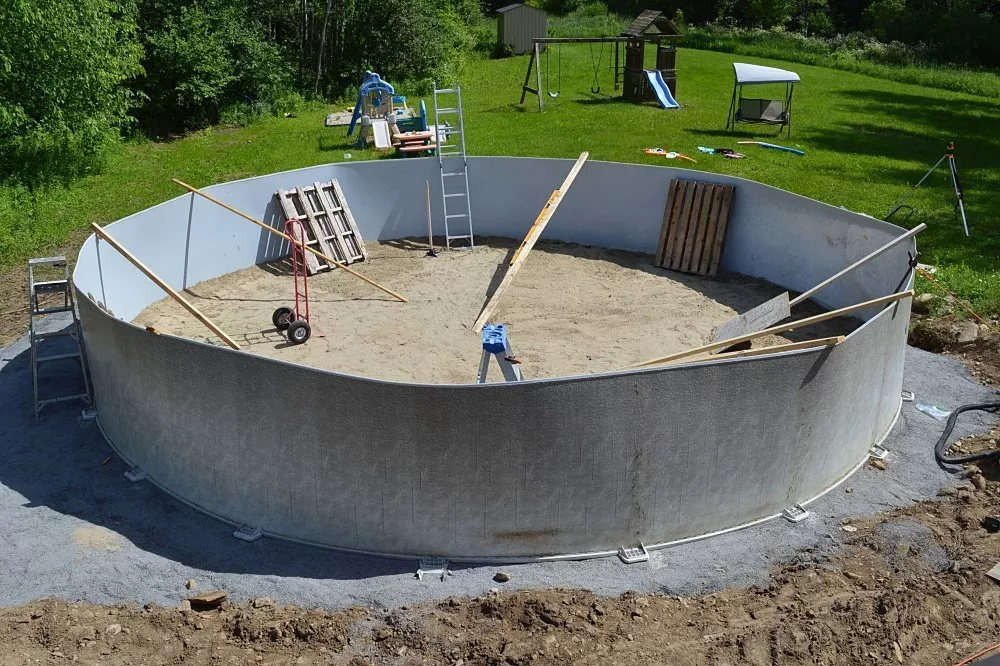
Yard levelling and base preparation create a stable surface for the pool wall, liner, and water load. The installation sequence removes vegetation and sharp objects, cuts down high spots, fills low spots, checks level, and then builds the liner bed. Current installation guidance uses a level base plus a 2- to 4-inch sand layer under the liner, while an above-ground pool manual describes a protective base across the pool area before structure assembly.
What Happens During Pool Wall and Frame Installation?
Pool wall and frame installation assemble the structural shell of the above-ground pool. The wall roll is set into the bottom track, the wall supports are installed, and the installer checks that the pool holds its intended shape before moving to the liner stage. Current installation guidance also states that the support points must sit correctly on the prepared blocks or base and that the pool dimensions should be rechecked before the liner goes in.
What Happens During Liner Installation and Pool Fill?
Liner installation and pool fill lock the water-holding layer into the pool body and seat it against the wall and floor. The liner is unfolded, hooked or secured into place, wrinkles are worked out, and the pool is filled slowly at first so the liner settles properly. Current manuals state that the skimmer and return are installed once the water has risen enough for the liner to press firmly against the wall, after which filling continues.
What Happens During Plumbing and Electrical Setup?
Plumbing and electrical setup connect the pool to safe water circulation and power. A basic above-ground pool plumbing layout runs skimmer → pump → filter → return, with added treatment devices such as a chlorinator or UV system placed between the filter outflow and the return line. In Ontario, the ESA states that electrical equipment within 3 metres of the inside walls of the pool requires GFCI protection unless it is suitably separated by a fence, wall, or other permanent barrier, and receptacles are not permitted closer than 1.5 metres to the pool.
What Happens During Equipment Installation?
Equipment installation places and connects the pump, filter, skimmer, and return fittings so the water can circulate and be cleaned. Current installation guidance sets the equipment area near the pool cutouts, installs the skimmer and return after the liner tightens, then connects the hoses from the skimmer to the pump, from the pump to the filter, and from the filter back to the return. That sequence completes the working circulation loop.
What Happens During Decking, Fencing, and Startup?
Decking, fencing, and startup complete the usable backyard setup and prepare the above-ground pool for operation. In Toronto, the access point to an above-ground pool must be protected by a gated enclosure, and the City’s fence bylaw requires self-closing, self-latching gates and a compliant enclosure height and placement. The City also states that decks or sheds shown on the site plan are subject to separate building permit applications and approvals and that the permit holder must contact the bylaw officer for a pre-construction inspection before work under the pool permit begins. After the enclosure and equipment are in place, the installer finishes the fill, checks for leaks, starts the system, and balances the water.
Do You Need Permits for Above-Ground Pool Installation in Toronto?
Yes. Above-ground pool installation in Toronto needs approvals when the structure meets the City’s definition of a swimming pool. Toronto defines a swimming pool as any outdoor structure on private property where water depth at any point can exceed 600 millimetres. For applications submitted after March 31, 2021, the City requires an approved Zoning Applicable Law Certificate before the Pool Fence Enclosure Permit application. The City also states that a pool cannot be constructed and filled with water without a fence installed in accordance with Chapter 447 – Fences.
When Is a Permit Required?
A permit is required when the above-ground pool is deep enough to qualify as a swimming pool under Toronto’s bylaw, which means water depth can exceed 600 millimetres at any point. The permit requirement is tied to the pool enclosure, not only to the pool shell itself. The permit application must include plans showing the pool location, the enclosure details, and any other information needed to confirm compliance.
What Pool Fence and Enclosure Rules Apply?
The main pool enclosure rules are fixed in Chapter 447. On single residential property, the minimum enclosure height is 1.2 metres. The enclosure must sit at least 1.2 metres horizontally from the water’s edge. Every gate must be self-closing and have a lockable, self-latching device. The bylaw also requires owners to control every access point to the pool area.
What Zoning and Site Plan Rules Apply?
Toronto requires a detailed site plan as part of the Zoning Applicable Law Certificate application. The plan must be drawn to scale, fully dimensioned, signed, and dated. It must show the legal survey reference, pool and property dimensions, distances to the house and lot lines, nearby doors and windows, equipment location, proposed fence location, fence height and material, and the percentage of hard versus soft landscaping. The listed 2026 zoning certificate fee is $214.79.
Do Pool Walls Ever Count as the Enclosure?
Generally, no for new above-ground pool installations. Chapter 447 contains a narrow exception only for an above-ground pool erected before July 6, 2000 if it meets specific conditions, including being at least 1.2 metres above grade, being free of climbable attachments on the outside, staying at least 1.2 metres from any lot line, and protecting the access point with a gated enclosure that meets the bylaw. That means a new above-ground pool should not be treated as automatically exempt from the standard enclosure rules.
How Do Permits Affect the Build Timeline?
Permits add a defined review stage before installation. The City’s FAQ states that, after the zoning certificate application is accepted and fees are paid, the expected review time is 10 business days. After the zoning certificate is issued, the pool permit review takes about five business days if the submission is complete. Missing information extends both review periods. The bylaw also states that the pool cannot be used until an officer confirms completion of a compliant permanent enclosure.
How Long Does Above-Ground Pool Installation Take in Toronto?
Above-ground pool installation in Toronto usually breaks into two timelines: the City of Toronto approval timeline and the physical installation timeline. The zoning certificate review takes about 10 business days after the application is accepted and fees are paid. The pool permit review then takes about 5 business days if the submission is complete. On-site above-ground pool assembly is much faster. General installation sources place the physical build at one day on a prepared site, or a few days to a week when yard work, electrical, or finishing work are included.
How Long Does Design and Planning Take?
Design and planning for an above-ground pool is shorter than for an inground pool because the pool usually uses standard sizes, standard wall heights, and a simpler installation sequence. In Toronto, the main planning work is the site plan, which must show the proposed pool dimensions, location, setbacks, equipment location, fence details, and hard-versus-soft landscaping. The physical design choice is simple. The document and layout preparation still takes time because missing information extends the review.
How Long Does Permit Approval Take?
Permit approval in Toronto takes about 10 business days for the zoning certificate review after acceptance and fee payment, then about 5 business days for the pool permit review when the application is complete. The City states that both stages take longer if information is missing or additional information is requested.
How Long Does Yard Preparation Take?
Yard preparation usually takes part of a day to a few days, depending on how much levelling the site needs. The work includes removing vegetation, cutting high spots, filling low spots, checking level, placing support blocks, and building the sand or base layer for the liner. Sources that outline the installation sequence treat ground preparation as the first labour-heavy stage and note that larger pools or sites with extra grading take longer.
How Long Does Pool Installation Take?
Actual pool installation is the fastest stage. Current installation sources state that most above-ground pools go in within one day once the site is properly prepared, and broader pool-timeline guidance places the full above-ground build at a few days to a week, with the shortest projects finishing in one to two days when the site is already level.
How Long Do Decking and Finishing Take?
Decking and finishing often take longer than the pool assembly itself. Current installation guidance states that projects involving extra grading, electrical work, or decking take longer than a one-day pool install. One detailed deck-building guide estimates 19 to 24 days for a specific above-ground deck plan built by a two-person team, which shows how quickly the schedule expands once the project moves beyond the pool itself.
What Delays an Above-Ground Pool Project?
The main delays are incomplete Toronto permit submissions, extra yard levelling, poor weather, added electrical work, and extra decking or landscaping scope. The City states that missing information slows both permit stages. Installation sources state that larger pools and projects with additional grading, electrical, or decking also take longer than a standard prepared-site install.
How Do You Choose Pool Size and Location?
Above-ground pool size and location depend on the yard footprint, ground level, drainage, access, and Toronto enclosure rules. The City of Toronto requires the site plan to show the proposed pool dimensions and location, the setbacks from property lines to the water’s edge, the enclosure setbacks from the pool, the dimensions from buildings, access doors to the proposed pool, adjacent doors and windows, and the location of pool equipment. The enclosure itself must sit at least 1.2 metres from the water’s edge.
Where Should an Above-Ground Pool Go in the Yard?
An above-ground pool should go on the flattest, most usable part of the yard with enough room for the pool, the enclosure, equipment, and safe circulation around it. The City of Toronto requires the site plan to show the pool location, equipment location, fence location, and distances from lot lines and buildings, so pool placement is a measured site-planning decision rather than a rough backyard estimate. Installation guidance also states that the selected area should have a level and firm base.
How Do Slope and Access Affect Installation?
Slope affects labour, base preparation, and final stability. Access affects how easily materials, equipment, and installers reach the site. Installation guidance states that sudden slopes near the pool area should be avoided and that the site should be level before assembly. Where the yard slopes, extra grading or retaining work increases the preparation stage before the pool goes in.
How Does Ground Stability Affect Installation?
Ground stability affects structural safety directly. Installation manuals state that the site should be stable, level, and well drained, and that the ground should be compacted to achieve a firm base. Levelling guidance also states that the higher ground should be cut down to the lowest point rather than raising low areas with loose fill, because settlement under the water load damages the pool.
How Close Can an Above-Ground Pool Be to a Fence or House?
The distance to a fence and the house is controlled through the Toronto zoning and site-plan review rather than one simple rule for every yard. The City requires the application drawings to show the dimensions from buildings and the proposed pool setbacks from property lines measured to the water’s edge. The enclosure must be at least 1.2 metres from the water’s edge. A narrow exception for older above-ground pools states that no part of the pool structure may be closer than 1.2 metres to any lot line, but that exception applies only to pools erected before July 6, 2000.
What Pool Options Fit a Small Backyard?
A small backyard usually fits a smaller round pool or a compact oval pool best. Common smaller options include 12-foot round, 15-foot round, and 12 x 24-foot oval layouts. An oval pool often fits a narrow or longer yard better because it uses length more efficiently, while a round pool fits better where the yard has more balanced width and depth. The final choice still has to leave room for the required enclosure and setbacks shown on the Toronto site plan.
Is an Above-Ground Pool Better Than an Inground Pool?
An above-ground pool is better when the priority is lower cost, faster installation, and a simpler backyard project. An inground pool is better when the priority is custom design, permanent landscape integration, and a higher-spec finished look. In Toronto, both pool types still fall under the City’s pool-enclosure rules once the structure reaches 600 millimetres of water depth.
Is an Above-Ground Pool Better for Lower Cost?
Yes. An above-ground pool is better for lower cost. Recent cost guidance places large above-ground pools around $6,000 to $8,000, while inground pools often start much higher, with one current cost guide placing them around $37,000 to $67,000. That cost gap is the clearest reason many homeowners choose an above-ground pool first.
Is an Above-Ground Pool Better for Faster Installation?
Yes. An above-ground pool is better for faster installation. Current installation guidance states that many above-ground pools go in within one to two days, while an inground pool often takes two to three months from construction start to completion.
Is an Inground Pool Better for Design Flexibility?
Yes. An inground pool is better for design flexibility. An inground pool supports more custom work in shape, depth, materials, and surrounding finish design because the structure is built into the ground rather than assembled from a fixed above-grade wall system. Current comparison guidance describes above-ground pools as more limited in shape and long-term design expression.
Is an Inground Pool Better for Long-Term Integration?
Yes. An inground pool is better for long-term integration. An inground pool sits as a permanent part of the yard and usually connects more cleanly with patios, landscaping, and the overall property layout. Current cost and planning guidance also associates inground pools more strongly with long-term property improvement than above-ground pools.
Which Pool Type Fits the Property Best?
The best pool type fits the budget, the intended length of ownership, the yard layout, and the level of design ambition. An above-ground pool fits properties where lower cost, faster setup, and simpler yard work matter most. An inground pool fits properties where permanent integration, stronger visual finish, and custom design matter most. In Toronto, the final decision still has to respect the City’s enclosure and permit path for any qualifying swimming pool.
What Maintenance Does an Above-Ground Pool Need?
An above-ground pool needs regular cleaning, stable water balance, protection of the liner and wall system, prompt repair of leaks and rust, and seasonal opening and closing. CDC identifies disinfectant and pH as the first defense against germs, and pool-maintenance guidance ties long pool life to routine cleaning, filtration, and winter protection.
How Do You Clean an Above-Ground Pool?
Above-ground pool cleaning starts with removing surface debris, brushing the walls, vacuuming the floor, and emptying baskets so the pump and filter keep water moving properly. Spring-opening guidance uses that same sequence: skim, vacuum, clean the walls and floor, clear debris from baskets, reconnect equipment, and run the filtration system.
How Do You Protect the Liner and Wall System?
The liner and wall system stay protected through early leak detection, rust control, and careful inspection around the skimmer and wall openings. Rust on an above-ground pool wall is common, and one repair guide states that untreated rust can puncture the liner or weaken the wall to the point of collapse. Leak guidance for a thru-wall skimmer identifies cracked plastic parts and misaligned or kinked gaskets as common leak sources.
What Water Balance Matters Most?
The most important water-balance readings are free chlorine or bromine and pH. CDC states that the typical chlorine range is 1 to 4 ppm, the typical bromine range is 3 to 8 ppm, and pH should stay at 7.0 to 7.8. CDC and PHTA Healthy Pools both state that disinfectant and pH should be checked at least twice per day, and CDC notes that poor pH control reduces disinfectant effectiveness and damages pool equipment.
What Repairs Are Common With Above-Ground Pools?
Common above-ground pool repairs are liner tears, skimmer leaks, gasket problems, and rust on the wall system. Repair guidance identifies cracked skimmer components and poorly seated gaskets as common leak points, while wall-repair guidance identifies rust as a common defect that spreads if it is not repaired early.
How Do You Open and Close an Above-Ground Pool?
Opening an above-ground pool involves removing and cleaning the cover, reconnecting the pump, filter, hoses, and accessories, priming and testing the pump, running filtration, and then testing and balancing the water. Closing starts once water temperature stays below about 65°F, then moves through full cleaning, water balancing, shock treatment, draining and protecting equipment, and securing the winter cover.
How Do You Winterize an Above-Ground Pool in Toronto?
Winterizing an above-ground pool in Toronto means closing the pool after the water cools, cleaning and balancing the water, lowering the water level to the correct point, draining and protecting the plumbing and equipment, and securing a proper winter cover. That sequence reduces algae growth, limits freeze damage, and makes spring opening easier.
When Should You Close an Above-Ground Pool?
Close the above-ground pool when the water temperature stays around 12 to 15°C or 60 to 65°F, and before repeated freeze conditions arrive. Closing too early increases the risk of algae and bacteria growth during the off-season.
What Winterizing Steps Matter Most?
The main winterizing steps are: clean the pool, balance the water, add the closing chemicals, lower the water level, drain and protect the pump, filter, and lines, then install and secure the winter cover. That order appears consistently across current closing guides because it protects both the water and the mechanical system.
What Cover Options Work Best?
A solid winter cover works best when the priority is debris control and spring cleanup. A mesh cover works when the pool is drained enough to handle added rain and melting snow. Many above-ground winterizing guides also pair the cover with an air pillow to help manage ice pressure under the cover.
How Do You Protect Plumbing and Equipment in Winter?
Protect the plumbing and equipment by disconnecting or draining the lines, opening the drain plugs, draining the pump, filter, chlorinator, and heater if present, and blowing out or removing trapped water before freezing weather. Water left inside the system expands when it freezes and cracks pipes, pumps, filters, and other components.
What Problems Does Poor Winterizing Cause?
Poor winterizing causes algae growth, dirty spring water, cracked plumbing, broken equipment, liner damage, and stress on the pool walls and cover system. Current winter-closing guidance ties bad closures directly to harder spring openings and higher repair costs.
How Do You Choose a Toronto Above-Ground Pool Installer?
Choose a Toronto above-ground pool installer based on six checks: regular above-ground pool work, a clear explanation of the base and wall system, correct handling of permits and enclosure rules, visible past projects and reviews, written warranty terms, and real Toronto and GTA experience. In Toronto, an installer also needs to understand the local process because a Zoning Applicable Law Certificate comes before the Pool Fence Enclosure Permit, and the pool stays empty until the City confirms a compliant permanent enclosure.
Does the Installer Install Above-Ground Pools Regularly?
Yes. Regular above-ground pool work matters because this pool type uses its own assembly sequence, base preparation, wall installation, liner fit, and equipment setup. Neutral hiring guidance recommends checking what types of pools the contractor builds and choosing a builder with direct experience in the pool type you want.
Does the Installer Explain the Base and Wall System Clearly?
Yes. A strong installer explains the base, wall system, and the site-preparation stage clearly before work starts. The explanation needs to cover the pool layout, the prepared base, equipment location, and the relationship between the pool and the enclosure because Toronto requires those details on the site plan. Clear scope also improves quote accuracy and reduces disputes over what is included.
Does the Installer Handle Permits and Enclosure Rules?
Yes. A qualified Toronto above-ground pool installer handles or clearly coordinates the permit path and the local pool enclosure rules. Toronto requires a Zoning Applicable Law Certificate before the Pool Fence Enclosure Permit, states that a pool fence enclosure is required when water depth exceeds 600 mm, and states that the pool cannot be filled until the City confirms the permanent enclosure complies with the bylaw.
Does the Installer Show Past Above-Ground Pool Projects and Reviews?
Yes. A strong installer shows past above-ground pool projects and real customer reviews. Neutral hiring guidance recommends reviewing profiles, checking completed projects, reading genuine customer reviews, and asking for references or similar projects before hiring.
Does the Installer Offer Warranty and Workmanship Coverage?
Yes. A serious installer offers written warranty and workmanship coverage. Neutral hiring guidance recommends asking whether warranties are included for materials and workmanship, and separate warranty guidance states that the warranty terms need to be clarified in writing by the installer.
Does the Installer Have Toronto and GTA Experience?
Yes. Toronto and GTA experience matters because local projects move through a specific municipal process. Toronto requires a detailed site plan with pool dimensions, distances to the house and lot lines, equipment location, and fence details, and the City notes that applicants may need a landscape architect, architect, surveyor, or engineer to create that site plan. Local experience reduces permit friction and improves coordination with inspections.
Frequently Asked Questions About Above-Ground Pool Installation in Toronto
How Much Does an Above-Ground Pool Cost in Toronto?
Above-ground pool cost in Toronto often lands at $4,000 to $12,500+ for the pool kit and installation, then rises with fencing, electrical work, heating, decking, and landscaping. A recent Canada-wide installation guide places installation alone at $1,500 to $8,500+ depending on size, while Toronto’s permit path adds the required Zoning Applicable Law Certificate before the Pool Fence Enclosure Permit.
Do You Need a Permit for an Above-Ground Pool in Toronto?
Yes. Toronto requires a permit when the above-ground pool meets the City’s definition of a swimming pool, which is an outdoor structure with water depth of 600 millimetres or more at any point. The City requires an approved Zoning Applicable Law Certificate first, then a Pool Fence Enclosure Permit, and the pool cannot be built, filled, or used without a compliant enclosure.
How Long Does Above-Ground Pool Installation Take?
Physical above-ground pool installation is fast on a prepared site. General installation guidance states that many pools are assembled and filling with water in 1 day, and other current guidance places many projects at 1 to 2 days for on-site assembly. Toronto’s approval process adds about 10 business days for the zoning certificate review after acceptance and payment, followed by about 5 business days for the pool permit review when the submission is complete.
What Pool Size Fits a Small Backyard?
A small backyard usually fits a smaller round pool or a compact oval pool best. Current sizing guidance places 12’–15′ round pools in the small-yard category and shows common round sizes such as 12 ft, 15 ft, 18 ft, 21 ft, 24 ft, 27 ft, 30 ft, and 33 ft, plus common oval layouts such as 12 x 24 ft and 15 x 30 ft. Toronto’s enclosure rules still apply, so the final layout must leave room for the required fence and setbacks shown on the site plan.
Can an Above-Ground Pool Work With a Deck?
Yes. An above-ground pool works with a deck. The pool and deck are often planned together because the deck improves access and creates usable space around the water. Toronto treats that deck work separately for approvals when required, and the access point still has to comply with the City’s pool enclosure rules.
Is an Above-Ground Pool Cheaper Than an Inground Pool?
Yes. An above-ground pool is cheaper than an inground pool in most projects. Recent cost guidance places many large above-ground pools around $6,000 to $8,000, while many inground pools start around $37,000 to $67,000. That cost gap is one of the main reasons homeowners choose the above-ground format.
What Is Included in Above-Ground Pool Installation?
Standard above-ground pool installation usually includes the pool structure such as the wall, bottom track, top ledge, and posts, plus the vinyl liner, pump, filter, and ladder. The physical installation sequence then moves through site levelling, base preparation, wall assembly, liner fit, and the connection of the pump, filter, and return system. Toronto projects also need the permit and enclosure work that the City requires.
What Maintenance Does an Above-Ground Pool Need?
An above-ground pool needs regular cleaning, stable water balance, filter care, inspection of the liner and wall system, and seasonal opening and closing. CDC recommends pH 7.0 to 7.8 and free chlorine of at least 1 ppm in pools, or at least 2 ppm when cyanuric acid is in use. PHTA Healthy Pools states that chlorine and pH should be tested at least twice per day.
How Do You Winterize an Above-Ground Pool?
Winterizing an above-ground pool starts when water temperature stays around 60 to 65°F or roughly 12 to 18°C. The main steps are cleaning the pool, balancing the water, lowering the water level, draining and protecting the plumbing and equipment, and securing a proper winter cover. Poor winterizing causes cracked hoses, broken pumps, damaged filters, algae growth, and harder spring opening.
How Do You Choose the Right Above-Ground Pool Builder?
Choose an above-ground pool builder with regular experience in above-ground installation, a clear explanation of the base and wall system, proper handling of Toronto permits and enclosure rules, visible past projects and reviews, written warranty terms, and real Toronto/GTA experience. Toronto’s permit path is specific, and HomeStars advises homeowners to compare work history, reviews, and warranty details before hiring.
How Do You Get a Quote for Above-Ground Pool Installation in Toronto?
A quote for above-ground pool installation in Toronto starts with a site visit, moves into a written pool and cost estimate, and then shifts into permit and build-timeline planning. In Toronto, the quote stage matters because the project needs an approved Zoning Applicable Law Certificate before the Pool Fence Enclosure Permit, and the pool stays empty until the City confirms a compliant permanent enclosure.
How Do You Book a Site Visit?
A site visit starts by sharing the project details, the yard layout, and photos of the property so the installer can price the work accurately. Neutral Toronto hiring guidance recommends posting the project, adding details and pictures for accurate quotes, then speaking with multiple contractors to compare scope, pricing, and questions. In Toronto, the site review also needs to account for the required site plan, which may require help from a landscape architect, architect, surveyor, or engineer.
How Do You Get a Pool and Cost Estimate?
A written pool and cost estimate should separate the main price blocks: the pool kit, installation labour, base preparation, electrical work, heating, fencing, and any decking or landscaping. Current Ontario pricing guidance places many above-ground pool projects around $3,000 to $8,000+, while Toronto hiring guidance states that above-ground pool installation often ranges from $1,500 to $10,000+ depending on the job scope. A detailed estimate is more useful than one total number because it shows which additions change the final price.
How Do You Plan the Permit and Build Timeline?
The permit and build timeline starts with the Zoning Applicable Law Certificate and then moves to the Pool Fence Enclosure Permit. The City of Toronto states that the zoning review takes about 10 business days after the application is accepted and fees are paid, and the pool-permit review takes about 5 business days when the submission is complete. The City also requires a pre-construction inspection before work under the permit starts, and it states that the pool cannot be filled with water until the permanent enclosure passes inspection.