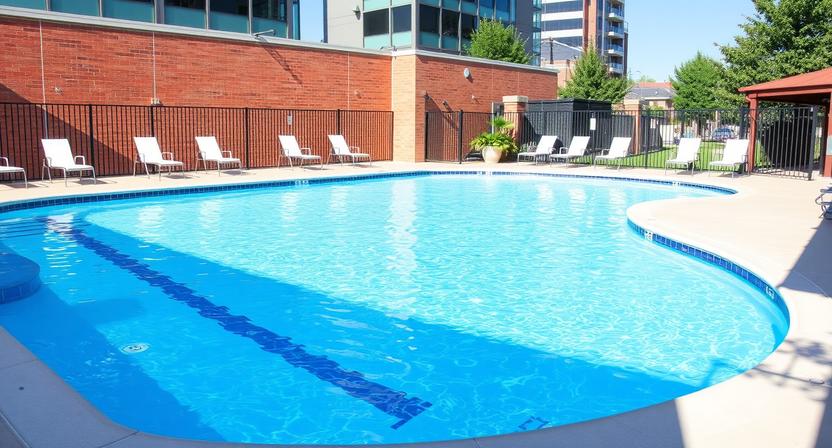
Pool permits in Toronto require zoning review, Pool Fence Enclosure Permit approval, a compliant site plan, and a finished pool enclosure before pool use. City of Toronto rules require a Zoning Applicable Law Certificate before a Pool Fence Enclosure Permit application for submissions made after March 31, 2021. A pool also needs a fence installed under Toronto Municipal Code Chapter 447 – Fences before construction and filling with water.
Toronto pool permit rules apply to outdoor swimming pools, hot tubs, whirlpools, and similar structures used for swimming, wading, or bathing with a depth of 600 mm or more at any point. The Pool Fence Enclosure Permit process checks fence location, gate safety, enclosure design, and access control. Hot tubs, whirlpools, or spas with a permanently attached lockable cover do not need a Pool Fence Enclosure Permit under the City’s stated exception.
A complete Toronto pool permit application needs scaled drawings, property dimensions, pool dimensions, lot line distances, house distances, pool equipment locations, fence height, fence materials, and hard-versus-soft landscaping details. The City of Toronto states that a Zoning Applicable Law Certificate application includes up to three reviews, and the 2026 fee for this pool-related zoning certificate is $214.79.
Pool fence rules in Toronto focus on child safety, restricted access, and inspection before water use. The enclosure must fully surround the pool area, sit at least 1.2 m from the pool edge, stay at least 1 m from easily climbable objects, and include compliant gates. A complete Pool Fence Enclosure Permit application takes about five business days to review when all information is present. The 2026 Pool Fence Enclosure fee is $214.79.
What Are Pool Permits in Toronto?
Pool permits in Toronto are municipal approvals that check zoning compliance, pool fence enclosure safety, site plan details, and access control before an outdoor pool, hot tub, whirlpool, or similar structure is built or used. City of Toronto defines a swimming pool as a private-property structure used for swimming, wading, or bathing with a depth of 60 cm (600 mm) or more at any point. Owners of outdoor pools, hot tubs, whirlpools, and similar structures must apply for a Pool Fence Enclosure Permit to build and maintain compliant fences and gates.
What Is a Toronto Pool Permit?
A Toronto pool permit refers to the approval process required before building and using a regulated pool structure on private property. The process focuses on the pool location, lot line distances, house distance, pool equipment location, fence layout, gate access, and Chapter 447 fence compliance. Toronto requires a fence before a pool is constructed and filled with water, and the fence must meet Toronto Municipal Code Chapter 447 – Fences.
What Is a Pool Fence Enclosure Permit?
A Pool Fence Enclosure Permit is the City approval for the fence, wall, gate, or other enclosure around a pool area. The enclosure must fully surround the pool area and must have no opening except a compliant gate. Toronto Municipal Code Chapter 447 states that no person shall excavate for or erect a swimming pool without first obtaining a swimming pool enclosure permit from the Executive Director.
What Is a Zoning Applicable Law Certificate?
A Zoning Applicable Law Certificate confirms that the proposed pool location, equipment placement, fence layout, and site plan details meet Toronto zoning rules before the fence permit stage. The City of Toronto states that this certificate is required for a Pool Fence Enclosure Permit application through Municipal Licensing and Standards. Required drawings must be scaled, dimensioned, signed, dated, and submitted in PDF format.
Why Does Toronto Use a Two-Step Permit Process?
Toronto uses a two-step pool permit process to separate zoning review from fence enclosure safety review. Step 1 checks the proposed pool against zoning rules through Toronto Building. Step 2 reviews the Pool Fence Enclosure Permit through Municipal Licensing and Standards after zoning approval. The second-stage submission includes the completed application form, approved zoning certificate, and zoning-approved site plan or drawings showing the fence location, height, and materials.
Do You Need a Pool Permit in Toronto?
Pool permits in Toronto are required for most outdoor water structures that meet the City’s swimming pool definition. Toronto Municipal Code Chapter 447 defines a swimming pool as any outdoor structure or thing on private property used for swimming, wading, or bathing where water depth exceeds 600 mm at any point.
When Is a Pool Permit Required?
A pool permit in Toronto is required when an outdoor pool, hot tub, whirlpool, spa, pond, or similar structure holds water deeper than 600 mm and is used for swimming, wading, or bathing. Owners must apply for a Pool Fence Enclosure Permit for outdoor swimming pools, hot tubs, whirlpools, and other structures capable of swimming use.
Toronto also requires a Zoning Applicable Law Certificate before the Pool Fence Enclosure Permit application. This first step checks zoning compliance before the City reviews the pool enclosure, fence, gate, and site plan details.
Do Above-Ground Pools Need a Permit?
Above-ground pools in Toronto need a permit when the water depth exceeds 600 mm at any point. The permit requirement depends on depth and use, not only on whether the pool sits above or below grade.
An above-ground pool wall does not automatically replace a compliant pool fence enclosure. The City reviews enclosure height, access points, climbable supports, gates, and distance from climbable objects during the permit process.
Do Hot Tubs and Spas Need a Permit?
Hot tubs and spas in Toronto need a Pool Fence Enclosure Permit when they meet the City’s swimming pool definition and lack an approved lockable cover. City of Toronto states that a Pool Fence Enclosure Permit is not required for a hot tub, whirlpool, or spa with a permanently attached cover that locks to prevent access when not in use.
This exemption applies to the enclosure permit only when the cover is permanent, attached, and lockable. A removable cover without a fixed locking system does not provide the same stated exception.
Do Ponds and Other Water Features Need a Permit?
Ponds and other water features in Toronto need pool enclosure approval when they meet the City’s definition of a swimming pool. The rule applies to any outdoor structure or thing on private property used for swimming, wading, or bathing where water depth exceeds 600 mm at any point.
A shallow decorative water feature below 600 mm sits outside this depth trigger. A deeper pond, plunge feature, or similar backyard water structure needs review when its depth and use match the swimming pool definition.
What Depth Triggers the Permit Rules?
A 600 mm water depth triggers Toronto pool permit rules when the outdoor structure is capable of swimming, wading, or bathing use. 600 mm equals 60 cm, which is about 24 inches.
This depth threshold applies at any point in the structure, not only at the average depth. A pool, above-ground pool, hot tub, spa, pond, or similar structure with one section deeper than 600 mm enters the City’s pool enclosure rules when it meets the use definition.
What Is the Toronto Pool Permit Process?
The Toronto pool permit process has two main stages: Zoning Applicable Law Certificate review through Toronto Building, then Pool Fence Enclosure Permit review through Municipal Licensing and Standards. City of Toronto requires the zoning certificate before the pool fence permit application for submissions made after March 31, 2021.
What Happens at the Zoning Review Stage?
The zoning review stage checks whether the proposed pool location, pool equipment, setbacks, lot conditions, and site plan meet Toronto zoning and applicable law rules. Toronto Building reviews the submitted drawings before the owner applies for the Pool Fence Enclosure Permit.
A Zoning Applicable Law Certificate application for a pool fence enclosure requires drawings on standard sheet sizes. Drawings must be to scale, fully dimensioned, signed, dated, and submitted in PDF format. The application includes up to three reviews.
What Happens at the Pool Fence Permit Stage?
The Pool Fence Permit stage checks whether the proposed pool enclosure, fence height, fence materials, gate access, and enclosure layout meet Toronto Municipal Code Chapter 447 – Fences. The application goes to Municipal Licensing and Standards after the zoning certificate is approved.
A complete Pool Fence Enclosure Permit application includes the approved Zoning Certificate and the zoning-approved site plan or drawings. These drawings must show the location, height, and materials of the fence. Complete applications take about five business days to review. Missing information or extra review requests extend the timeline.
What Documents Do You Submit?
Toronto pool permit documents include a complete Pool Fence Enclosure Permit application form, the approved Zoning Applicable Law Certificate, and the zoning-approved site plan or drawings. The fence drawings must show the fence location, height, and materials.
The zoning submission also needs clear scaled drawings that show the proposed pool and property layout. Required drawing standards include scale, dimensions, signature, date, and PDF format. These details help reviewers confirm zoning compliance before the fence permit stage.
What Happens After Approval?
After approval, the owner or contractor builds the pool enclosure according to the approved drawings and permit conditions. The approved plan controls the fence position, fence material, gate layout, and pool access points. Toronto requires a swimming pool enclosure that fully surrounds the pool area, with no openings except a compliant gate.
A non-compliant fence design, changed site layout, or missing gate detail creates approval and inspection problems. Property owners seeking a fence that does not comply with the bylaw need an exemption from the local Community Council before relying on that design.
What Happens Before the Pool Can Be Filled?
Before the pool is filled, Toronto requires a fence installed according to Toronto Municipal Code Chapter 447 – Fences. The City states that a pool must not be constructed and filled with water without an installed fence that follows the municipal fence rules.
Pool use starts only after the permanent fencing has been installed, inspected, and confirmed complete by the Executive Director, Municipal Licensing and Standards. Toronto’s Chapter 447 amendment also allows filling with water when temporary fencing meets the bylaw, but the pool area must not be used until the permanent enclosure passes inspection.
What Documents Do You Need for a Toronto Pool Permit?
Toronto pool permit documents need to show zoning compliance, pool location, fence design, property layout, and pool equipment placement. The main submission package includes a Zoning Applicable Law Certificate, a completed Pool Fence Enclosure Permit application form, and a zoning-approved site plan or drawings. The City of Toronto requires the zoning certificate before the pool fence permit stage.
What Site Plan Details Are Required?
Site plan details for a Toronto pool permit must show the full pool layout, property boundaries, pool dimensions, and distances to fixed features. The City of Toronto requires a detailed, fully dimensioned site plan that references a legal survey, shows property lines, shows pool and property dimensions, and lists distances to the house and lot lines.
The site plan also needs the location and dimensions of doors and windows beside the pool area. These details help reviewers check access, visibility, fence placement, and safety separation before the Pool Fence Enclosure Permit stage.
What Property Information Is Required?
Property information for a Toronto pool permit must identify the lot, property lines, existing house, proposed pool, and outdoor layout. The required site plan must reference a legal survey and include property dimensions, lot line distances, house distances, and hard-versus-soft landscaping percentages.
Soft landscaping may include the water surface area of outdoor swimming pools or similar water-holding structures, such as fountains or artificial ponds. This matters because zoning review checks how the proposed pool affects the lot, landscaping balance, and permitted site coverage.
What Fence Drawings Are Required?
Fence drawings for a Toronto pool permit must show the fence location, fence height, and fence materials. The Pool Fence Enclosure Permit application needs the zoning-approved site plan or drawings with these fence details after the Zoning Certificate is approved.
Toronto pool fence drawings must support the enclosure rules under Toronto Municipal Code Chapter 447 – Fences. The enclosure must completely surround the pool area, include no openings except a compliant gate, and meet the minimum enclosure height rules for the property type.
What Pool Equipment Details Are Required?
Pool equipment details for a Toronto pool permit must show the location of the heater, pump, filter, and other pool equipment. The City of Toronto requires the site plan to show pool equipment locations and the distances from that equipment to the lot lines.
These details help reviewers assess zoning placement, setback compliance, neighbour impact, and service layout. Clear equipment information reduces review questions and keeps the zoning review stage aligned with the later Pool Fence Enclosure Permit submission.
What Application Forms Are Required?
Toronto pool permit application forms include the Zoning Applicable Law Certificate submission and the completed Pool Fence Enclosure Permit application form. The zoning submission requires drawings, reports, and forms in PDF format, with drawings drawn to scale, fully dimensioned, signed, and dated.
The Pool Fence Enclosure Permit stage requires three main items: a completed application form, the approved Zoning Certificate, and the zoning-approved site plan or drawings showing fence location, height, and materials. Complete applications take about five business days to review when information is present.
What Site Plan Rules Apply?
Toronto pool site plan rules require a scaled, fully dimensioned plan that shows property lines, pool dimensions, house distances, lot line distances, pool equipment locations, fence details, and hard-versus-soft landscaping percentages. City of Toronto requires drawings on standard sheet sizes, drawn to scale, signed, dated, and submitted in PDF format for the Zoning Applicable Law Certificate stage.
What Distances to Lot Lines Must the Plan Show?
The site plan must show distances from the pool to all relevant lot lines. These measurements help Toronto Building review zoning setbacks, side yard space, rear yard space, and pool placement before the Pool Fence Enclosure Permit stage. The plan must reference a legal survey showing property lines and must include pool and property dimensions.
What Distances to the House Must the Plan Show?
The site plan must show distances from the pool to the house. This measurement helps reviewers check pool placement, access points, door and window locations, and enclosure safety near the dwelling. City of Toronto also requires the plan to show the location and dimensions of any doors and windows beside the pool area.
What Pool Equipment Distances Must the Plan Show?
The site plan must show pool equipment locations and distances from equipment to lot lines. Required equipment details include the heater, pump, filter, and related pool equipment. These measurements help reviewers assess zoning placement, service access, and neighbour-facing impacts such as equipment position near property boundaries.
What Fence and Gate Details Must the Plan Show?
The site plan must show the fence location, fence height, and fence material. Toronto pool enclosure rules require the enclosure to fully surround the pool area, with no openings except a compliant gate. A pool fence and its gates must sit at least 1.2 m from the pool edge and at least 1 m from easily climbable objects such as trees.
Toronto pool gate details must support the Fence Bylaw standards. Swimming pool enclosure gates must use substantial hinges, close by themselves, latch by themselves, and stay locked except when the pool area is in use. Double gates must include a lockable drop bolt.
What Hard and Soft Landscaping Details Must the Plan Show?
The site plan must show the percentage of hard landscaping and soft landscaping. Hard landscaping includes built surfaces such as patios, paving, walkways, and other non-plantable areas. City of Toronto states that soft landscaping may include the water surface area of outdoor swimming pools and similar water-holding structures, including fountains and artificial ponds.
What Pool Fence Rules Apply in Toronto?
Toronto pool fence rules require a complete pool enclosure around the pool area, with no openings except a compliant gate. City of Toronto requires an approved Zoning Certificate and Pool Fence Enclosure Permit before installing a swimming pool enclosure. The enclosure must follow Toronto Municipal Code Chapter 447 – Fences.
What Height Must a Pool Enclosure Have?
A pool enclosure in Toronto must be at least 1.2 metres high for a pool on a single residential property. A pool enclosure must be at least 1.8 metres high for a pool on a multiple residential property or non-residential property. These minimum heights are measured above the highest outside grade within 1 metre of the enclosure.
How Far Must the Fence Be From the Pool?
A pool fence in Toronto must sit at least 1.2 metres horizontally from the pool’s water edge. This separation creates a clear safety space between the pool enclosure and the swimming area. The rule applies to the fence and any gate that forms part of the enclosure.
What Gate Rules Apply?
Toronto pool gates must be supported by substantial hinges, self-closing, self-latching, and locked except when the enclosed pool area is in use. A single gate needs a lockable self-latching device on the inside near the top of the gate, or on the outside at least 1.5 metres above grade. Double gates need one self-closing and lockable self-latching gate, plus a second gate with a lockable drop bolt.
What Climbability Rules Apply?
Toronto pool enclosures must reduce climbing access from the outside. A fence or gate must stay at least 1 metre from any external condition that supports climbing, such as a tree, unless the enclosure is at least 1.8 metres high for at least 1 metre on each side of that condition. The enclosure must have no climbable element between 100 mm and 1.2 metres above grade and must use non-climbable facing material on the outside.
Can the House Form Part of the Enclosure?
A house wall forms part of a Toronto pool enclosure only when it does not give access to the enclosed pool area. Toronto Municipal Code Chapter 447 states that entrances to buildings must be outside the enclosed area, and a building wall used as part of the enclosure must have no access through that wall into the pool area. The City’s guidance explains that a rear door must not open directly into the pool area; a four-sided isolation fence is required where the home otherwise opens into the pool area.
Can an Above-Ground Pool Wall Count as the Fence?
An above-ground pool wall counts as part of the fence only when it meets Toronto’s enclosure standards or qualifies under a specific bylaw exception. Toronto Municipal Code Chapter 447 gives a narrow exception for an above-ground pool erected before July 6, 2000 when the structure meets height, guard, climbability, setback, and gated-access rules. Newer above-ground pools generally need a compliant swimming pool enclosure that fully surrounds the pool area.
When Can the Pool Wall Count as the Enclosure?
The pool wall counts as the enclosure when the above-ground pool meets the Chapter 447 exception. The pool must be at least 1.2 metres above grade, and any platform or deck must have a guard at least 1 metre high. The combined height of the pool structure and guard must not exceed 2.6 metres.
The access point also needs a gated enclosure that follows the swimming pool enclosure rules. This means the ladder, deck, stair, or platform entry still needs controlled access. A high pool wall alone does not replace gate safety.
What Makes a Pool Wall Non-Compliant?
A pool wall becomes non-compliant when it fails height, access, setback, or climbability rules. Chapter 447 requires the outside of the pool structure and guard to be free from elements or attachments that support climbing. The pool structure must also stay at least 1.2 metres from any lot line under the above-ground pool exception.
A wall also fails compliance when a ladder, deck, stair, pump platform, brace, or nearby object creates easy access into the pool area. Toronto requires pool enclosures to have no openings except a compliant gate, and the enclosure must fully surround the pool area.
Do Supports and Struts Affect Compliance?
Supports and struts affect compliance when they create a climbable path on the outside of the above-ground pool wall. Chapter 447 requires the outside of the swimming pool structure and any guard to remain free from any element or attachment that supports climbing.
This rule makes exterior braces, frame supports, deck steps, storage boxes, trees, and movable objects important during review. Toronto’s general pool enclosure rules also require the fence or gate to stay at least 1 metre from easily climbable objects and have nothing climbable between 10 cm and 1.2 metres above the ground.
When Do You Still Need a Separate Fence?
A separate fence is still needed when the above-ground pool wall does not meet Toronto’s enclosure rules or the pre-July 6, 2000 exception. A separate Pool Fence Enclosure Permit is also needed when the pool wall has climbable supports, an uncontrolled ladder, a deck that opens into the pool area, or access from the house without an isolation fence.
Toronto states that properties with a swimming pool must have a pool enclosure that completely encloses the area around the pool. The enclosure has no openings except a compliant gate. A house wall used as part of the enclosure must have no doors or windows opening into the pool area.
What Zoning Rules Affect Pool Permits in Toronto?
Toronto zoning rules affect pool permits through setbacks, pool equipment placement, soft landscaping, lot coverage, and property-specific limits. The Zoning Applicable Law Certificate stage reviews these details before the Pool Fence Enclosure Permit stage. The City requires a fully dimensioned site plan that shows property lines, pool dimensions, distances, equipment locations, fence details, and hard-versus-soft landscaping percentages.
What Setback Rules Apply?
Setback rules for Toronto pool permits depend on the property’s zoning, lot layout, and the proposed pool location. The zoning submission must show distances from the pool to the house and lot lines. These dimensions let Toronto Building check whether the pool location complies with the applicable zoning rules for that property.
Older area-specific zoning rules show why property location matters. Some Toronto zoning pages list accessory-structure setbacks such as 0.4 m, 0.5 m, or 1.0 m in older local zoning contexts, while other rules treat pools separately. The safest permit plan uses the current zoning review process rather than assuming one citywide setback number.
What Pool Equipment Placement Rules Apply?
Pool equipment placement rules require the site plan to show the location of the heater, pump, filter, and other pool equipment. The plan must also show distances from that equipment to the lot lines. These details help reviewers assess zoning placement, neighbour-facing impact, service access, and layout compliance before permit approval.
Equipment placement errors create review delays when the plan omits measurements or places equipment near a restricted yard condition. A clear plan labels each equipment item, shows its distance to every relevant lot line, and keeps the equipment layout consistent with the approved Zoning Applicable Law Certificate drawings.
What Soft Landscaping Rules Apply?
Soft landscaping rules affect Toronto pool permits because the zoning site plan must show the percentage of hard landscaping versus soft landscaping. The City’s pool zoning certificate page states that soft landscaping may include the water surface area of outdoor swimming pools and other ancillary water-holding structures, including fountains and artificial ponds.
A permit plan needs clear surface-area totals for patios, paving, pool decking, planting areas, lawn, garden beds, and the pool water surface. Missing hard-versus-soft landscaping percentages create extra review questions because zoning staff need these figures to confirm compliance.
What Lot Coverage Issues Affect Approval?
Lot coverage issues affect approval when the proposed pool, deck, patio, cabana, equipment pad, enclosure, or accessory structure pushes the property beyond zoning limits. Toronto’s pool zoning certificate page requires property dimensions, pool dimensions, and hard-versus-soft landscaping percentages because the review checks how the proposed work fits the lot.
Some older Toronto zoning contexts list percentage-based limits for accessory buildings, structures, pools, and rear-yard coverage. One older Etobicoke-area zoning source lists 10% for a private swimming pool, including a pool enclosure, and 12% for all accessory buildings and structures. Property-specific zoning review confirms which limits apply to the current address.
What Property Conditions Create Zoning Problems?
Property conditions create zoning problems when the pool plan conflicts with lot lines, house placement, doors, windows, equipment locations, landscaping percentages, easements, or fence access rules. Toronto requires the zoning site plan to reference a legal survey and show property lines, pool and property dimensions, house distances, lot line distances, adjacent doors and windows, equipment locations, fence materials, fence height, and landscaping percentages.
Irregular lots, narrow side yards, corner lots, rear lanes, existing decks, cabanas, retaining walls, mature trees, and tight equipment locations commonly increase review complexity. The Pool Fence Enclosure Permit stage also requires zoning-approved drawings that show fence location, height, and materials, so zoning issues and fence design issues often connect in one permit review.
What Drainage and Grading Rules Affect Pool Permit Approval?
Drainage and grading rules affect pool permit approval when the proposed pool, deck, patio, equipment pad, or yard work changes how water moves across the property. Toronto requires pool zoning drawings to show property dimensions, pool dimensions, distances to lot lines, pool equipment locations, and hard-versus-soft landscaping percentages. These details help reviewers check whether the pool plan fits the lot without creating drainage, grading, ponding, or runoff problems.
Why Does Drainage Matter for a Pool Permit?
Drainage matters for a pool permit because pool construction changes soil levels, hard surfaces, water flow, and yard absorption. A new pool, deck, patio, or equipment pad often reduces open ground and redirects surface water. Toronto’s lot grading guidance states that the existing drainage pattern should be maintained, side yards should drain at surface slopes of at least 1.5%, and grading should not create ponding or erosion on the subject property, neighbouring properties, or rights-of-way.
Pool drainage also matters because pool water contains chemicals. City of Toronto states that chlorine pool water must be dechlorinated before storm sewer discharge, and saltwater pool water must go to a sanitary connection, be absorbed on the property, or be hauled by an approved hauler.
What Grading Issues Delay Approval?
Grading issues delay approval when the pool plan lacks clear slopes, creates ponding, directs runoff toward buildings, or sends water onto neighbouring land. Toronto lot grading guidance states that grading must prevent water accumulation near a building and must not adversely affect adjacent properties. Rear yard slopes should not exceed 10% unless existing grades remain unchanged.
Common delay points include unclear existing grades, missing proposed grades, reverse slopes near the house, blocked side-yard drainage, and patio grades that send water toward a foundation. A plan also creates review concern when drainage swales lack the minimum 1.5% longitudinal slope or when terrace and swale side slopes exceed 33%.
What Site Alteration Details Matter?
Site alteration details matter when excavation, fill, retaining walls, pool decks, patios, or equipment pads change the lot’s drainage pattern. A strong Toronto pool site plan shows existing and proposed grades, pool location, deck limits, hard surface areas, soft landscape areas, drainage direction, and any catch basin or swale location. Toronto’s pool zoning certificate page requires a fully dimensioned plan with hard-versus-soft landscaping percentages, and soft landscaping may include the water surface area of an outdoor swimming pool or similar water-holding structure.
A grading plan also matters where construction creates new ponding risks. Toronto guidance for lot grading plans requires proposed grading that creates no new ponding on the subject property or adjacent properties after construction.
How Does Poor Drainage Affect the Plan?
Poor drainage affects the plan by forcing revisions to pool placement, deck slopes, swales, catch basins, downspouts, or soft landscaping areas. Toronto’s stormwater guidance states that keeping stormwater on site may become unsafe or impractical where runoff reaches neighbouring property, flows toward foundations, causes erosion, creates unstable slope conditions, forms ponding, or raises basement flooding risk.
A pool plan with poor drainage also creates construction and inspection risk. Saturated soil weakens excavation stability, standing water delays base preparation, and runoff near a house increases foundation exposure. A clear drainage route protects the pool shell, decking, fence posts, equipment pad, and neighbouring yards.
What Water Discharge Problems Matter Most?
The main water discharge problems are untreated pool water entering storm sewers, saltwater entering storm sewers, runoff flowing onto neighbouring property, and drainage reaching ravines, valleys, sidewalks, roads, or buildings. Toronto states that pool water must never discharge onto or into ground near a ravine or valley because it causes erosion and vegetation damage.
Chlorine pool water must be dechlorinated before storm sewer discharge. Saltwater pool water must not discharge to the storm sewer because of high chloride levels. Both chlorine and saltwater pool water may discharge onto grass only when the water fully absorbs into the ground on the property and does not flow onto a neighbour’s property.
How Long Do Pool Permits Take in Toronto?
Toronto pool permits usually take about 15 business days across the two main review stages when the submission is complete. The Zoning Applicable Law Certificate review has an expected timeline of 10 business days after the application is accepted and fees are paid. The Pool Fence Enclosure Permit review takes about five business days after a complete application reaches Municipal Licensing and Standards. Missing information or extra review requests extend both timelines.
How Long Does Zoning Review Take?
Zoning review takes about 10 business days after the Zoning Applicable Law Certificate application is accepted and fees are paid. This first stage checks the proposed pool location, property dimensions, lot line distances, house distances, pool equipment placement, fence details, and hard-versus-soft landscaping percentages.
A zoning application includes up to three reviews. Extra review time applies when the drawings omit required measurements, use unclear scales, or fail to match the property survey.
How Long Does Pool Fence Permit Review Take?
Pool Fence Permit review takes about five business days when the application is complete. This second stage starts after the Zoning Certificate is approved. The submission must include the completed Pool Fence Enclosure Permit application form, the approved Zoning Certificate, and zoning-approved drawings showing the fence location, height, and materials.
The review takes longer when information is missing or when City staff request more details. Municipal Licensing and Standards receives the application by email and handles status follow-up through the pool permit contact channel.
What Delays a Pool Permit?
Pool permit delays come from incomplete drawings, missing measurements, unclear fence details, zoning conflicts, and extra information requests. Toronto states that both zoning and pool permit reviews take longer when information is missing or when additional information is requested.
Common delay points include unscaled drawings, missing lot line distances, missing house distances, missing equipment distances, unclear fence materials, missing gate details, and hard-versus-soft landscaping figures that do not match the site plan. These items matter because Toronto requires fully dimensioned drawings and a detailed site plan for the zoning certificate stage.
What Missing Documents Slow Approval?
Missing documents slow approval when the application lacks the Zoning Applicable Law Certificate, the Pool Fence Enclosure Permit application form, or zoning-approved site drawings. Toronto lists these three items as the required pool fence permit package after zoning approval.
Missing site plan details also slow zoning approval. Toronto requires a legal survey reference, property lines, pool and property dimensions, distances to the house and lot lines, adjacent door and window dimensions, equipment locations, equipment distances to lot lines, fence location, fence height, fence material, and hard-versus-soft landscaping percentages.
What Seasonal Factors Change the Timeline?
Seasonal factors change the timeline when spring and summer demand increases permit volume, contractor schedules, survey availability, excavation timing, and inspection demand. Toronto does not publish a separate seasonal pool permit timeline, so the clearest base estimate remains 10 business days for zoning review plus five business days for a complete pool fence permit review.
Peak-season delays often come from incomplete early submissions rather than review time alone. A complete package before the main pool-building season gives reviewers the required zoning certificate drawings, fence drawings, application form, and permit details before excavation, fence installation, and inspection scheduling.
What Fees Apply to Pool Permits in Toronto?
Toronto pool permit fees include the Zoning Applicable Law Certificate fee, the Pool Fence Enclosure Permit fee, and separate project costs for drawings, surveys, electrical work, inspections, and site changes. The two core municipal fees are separate because Toronto reviews zoning first and pool enclosure safety second. The City of Toronto lists the 2026 Zoning Applicable Law Certificate fee for a pool fence enclosure at $214.79. The City’s 2026 user fee schedule lists pool fence enclosures at $214.79 per application for application intake, plan review, and inspection activities.
What Is the Zoning Certificate Fee?
The Zoning Applicable Law Certificate fee is $214.79 in 2026 for a Pool Fence Enclosure zoning review. This fee applies before the Pool Fence Enclosure Permit stage. The zoning submission reviews the proposed pool location, property lines, pool dimensions, house distances, equipment locations, fence details, and hard-versus-soft landscaping percentages.
The zoning certificate application includes up to three reviews. Extra costs may apply when the submission needs new drawings, revised measurements, or added professional review before the plan meets zoning requirements. Toronto requires drawings to be scaled, fully dimensioned, signed, dated, and submitted in PDF format.
What Is the Pool Fence Enclosure Permit Fee?
The Pool Fence Enclosure Permit fee is $214.79 per application in 2026. This fee covers application intake, plan review, and inspection activities for the pool fence enclosure. The 2026 fee schedule shows the 2025 approved rate at $206.53, the inflationary adjustment at $8.26, and the 2026 fee at $214.79.
The Pool Fence Enclosure Permit review starts after the zoning certificate is approved. A complete application must include the application form, the approved Zoning Certificate, and zoning-approved drawings that show the fence location, height, and materials. A complete application takes about five business days to review.
What Drawing and Survey Costs Apply?
Drawing and survey costs apply when the property owner needs a compliant site plan, updated measurements, or a legal survey reference. Toronto requires a detailed site plan that references a legal survey, shows property lines, lists pool and property dimensions, and gives distances to the house and lot lines.
These costs are separate from City permit fees. A homeowner may need a surveyor, designer, pool builder, or permit consultant to prepare the drawings when the existing survey is missing, outdated, unclear, or inconsistent with the proposed pool layout. Extra drawing costs often come from revisions to pool location, equipment placement, fence alignment, landscaping percentages, or grading details.
What Electrical or Inspection Costs Apply?
Electrical costs apply when the pool, hot tub, splash pad, pump, heater, lighting, bonding, receptacle, or pool shed needs regulated electrical work. The Electrical Safety Authority 2026 residential fee guide lists a $92 minimum inspection notification fee. The same guide lists $168 for a pool, including above-ground, inground, and indoor pools, with a maximum of two inspections.
Pool equipment-only work or pool/hot tub bonding-only work is listed at $86 for one visit. A receptacle-only installation for a hot tub or storable pool is also listed at $86 for one visit. A separately inspected pool house or pool shed ranges from $57 for 1–10 outlets to $201 for 41 or more outlets, with non-contractor rates listed separately.
What Extra Costs Are Easy to Miss?
Easy-to-miss pool permit costs include drawing revisions, survey updates, electrical notification fees, pool equipment inspections, fence changes, grading changes, drainage changes, and added site work. These costs usually appear after the first plan review identifies missing details or conflicts between the pool design and zoning, fence, grading, or equipment rules.
Permit budgets should separate fixed City fees from variable project costs. The fixed 2026 City costs are $214.79 for the Zoning Applicable Law Certificate and $214.79 for the Pool Fence Enclosure Permit. Variable costs depend on the property survey, site plan quality, fence design, equipment layout, electrical scope, pool shed scope, and the number of revisions before approval.
What Mistakes Delay Toronto Pool Permits?
Toronto pool permit mistakes delay approval when the application misses required site plan details, fence drawings, setback measurements, pool equipment locations, or hard-versus-soft landscaping percentages. City of Toronto requires a Zoning Applicable Law Certificate before the Pool Fence Enclosure Permit, so errors at the zoning stage delay the fence permit stage too.
Do Incomplete Site Plans Delay Approval?
Incomplete site plans delay approval because Toronto requires a detailed, fully dimensioned plan for the Zoning Applicable Law Certificate review. The plan must reference a legal survey and show property lines, pool dimensions, property dimensions, distances to the house, distances to lot lines, doors and windows beside the pool area, equipment locations, fence details, and landscaping percentages.
Missing measurements create extra review questions. Unscaled drawings, unclear pool placement, missing lot lines, and unsigned or undated PDF drawings slow the application because Toronto requires drawings to be scaled, dimensioned, signed, dated, and submitted in PDF format.
Do Fence Design Errors Delay Approval?
Fence design errors delay approval when the proposed enclosure does not fully surround the pool area, lacks required gate details, or omits fence height and material information. City of Toronto states that a swimming pool enclosure must completely enclose the pool area and have no openings except a gate.
The Pool Fence Enclosure Permit package must include zoning-approved drawings that show fence location, height, and materials. Missing gate location, latch detail, self-closing function, lock detail, or fence material creates a direct review issue at the permit stage.
Do Setback Errors Delay Approval?
Setback errors delay approval when the site plan shows incorrect or missing distances between the pool, lot lines, house, and pool equipment. Toronto requires the zoning plan to show distances from the pool to the house and lot lines, plus distances from equipment to lot lines.
Setback errors often appear on narrow lots, corner lots, irregular lots, and properties with existing decks, sheds, patios, or retaining walls. The zoning review checks the proposed pool against the property’s applicable zoning rules before the fence permit review starts.
Do Missing Equipment Details Delay Approval?
Missing equipment details delay approval because Toronto requires the site plan to show the location of the pool heater, pump, filter, and other pool equipment. The plan must also show the distance from each equipment item to the lot lines.
Equipment omissions create zoning review gaps. Reviewers need equipment location and distance details to assess placement, service layout, and neighbour-facing impacts before issuing the Zoning Applicable Law Certificate.
Does Hard Landscaping Overload Delay Approval?
Hard landscaping overload delays approval when the proposed pool deck, patio, walkway, equipment pad, or paved area conflicts with required soft landscaping information. Toronto requires the pool zoning site plan to show the percentage of hard landscaping and soft landscaping on the property.
Soft landscaping includes permeable or landscaped areas, and Toronto states that the water surface area of an outdoor pool or similar water-holding structure may count as soft landscaping for this review. Missing totals, unclear surface areas, or excessive hard surfaces often trigger drawing revisions before approval.
What Happens If a Pool Does Not Meet Toronto Permit Rules?
A pool that does not meet Toronto permit rules faces permit refusal, correction orders, inspection failure, restricted use, and possible fines. Toronto Municipal Code Chapter 447 – Fences requires a compliant swimming pool enclosure before excavation, construction, filling, or pool use. The enclosure must fully surround the pool area and have no opening except a compliant gate.
Can the City Refuse the Permit?
The City can refuse or revoke a pool fence enclosure permit when the proposed enclosure breaks Chapter 447, conflicts with another applicable law, relies on mistaken or false information, or lacks the required fee payment. The permit review checks the pool location, lot line relationship, adjacent buildings, and full enclosure details before approval.
A refused permit stops the project from moving forward under the submitted plan. The owner needs revised drawings, corrected fence details, zoning alignment, or complete information before the Pool Fence Enclosure Permit proceeds.
Can the City Order Corrections?
The City can order corrections when an officer finds a fence or pool enclosure that does not follow Chapter 447. The officer has authority to issue an order or notice of violation requiring the owner to stop the non-compliant activity or complete work that corrects the violation.
A correction order often relates to missing gates, wrong fence height, climbable fence parts, direct house access to the pool area, incomplete temporary fencing, or an enclosure that does not fully surround the pool. The City also has authority to complete the required work at the owner’s expense when an order or notice of violation remains unresolved.
Can the City Stop Pool Use Before Compliance?
The City can stop pool use before compliance because Toronto rules restrict filling and use before inspection approval. A swimming pool must not be filled with water, or hold collected water, until an officer inspects and confirms a permanent swimming pool enclosure that fully complies with the bylaw.
Temporary fencing allows water filling only when the temporary fence follows the bylaw. Pool use still remains prohibited until permanent fencing is installed and an officer confirms the permanent enclosure. The City states that pool use before inspection creates fine risk.
Can Non-Compliance Lead to Fines?
Non-compliance can lead to fines when a person breaks Chapter 447 or ignores a notice, direction, or order. A convicted person faces a fine of up to $100,000. A corporation, director, or officer involved in the contravention also faces a fine of up to $100,000.
A continuing offence adds daily fine exposure. Chapter 447 sets a maximum daily fine of $10,000 for each day, or part of a day, that the offence continues. Total daily fines may exceed $100,000. The bylaw also adds a special fine equal to the fair market value of any economic advantage gained from the violation.
What Problems Follow a Failed Inspection?
A failed pool inspection delays filling, delays legal pool use, triggers correction work, and adds rework costs. The most direct problem is use restriction: Toronto does not allow pool use until permanent fencing is installed and an officer confirms the enclosure complies with Chapter 447.
Failed inspection problems often include fence rebuilds, gate repairs, latch changes, visibility corrections, removal of climbable objects, revised access control, or new drawings. A failed inspection also creates enforcement risk when the owner leaves the pool filled, uses the pool before approval, or ignores a correction order.
Do Different Pool Types Change the Permit Process?
Different pool types do not change the main Toronto pool permit path when the pool is outdoors and meets the City’s pool definition. Inground pools, above-ground pools, semi-inground pools, and many hot tubs still move through Zoning Applicable Law Certificate review before Pool Fence Enclosure Permit review. Pool type mainly changes the site plan details, fence design, grading review, equipment layout, and possible extra building or electrical approvals. Toronto states that applicants need a Zoning Certificate before applying for a Pool Fence Enclosure Permit, and a pool must not be constructed and filled without a fence installed under Chapter 447 – Fences.
Do Inground Pools Follow the Same Permit Path?
Inground pools follow the same Toronto permit path when they are outdoor pools on private property. The owner first applies for a Zoning Applicable Law Certificate, then submits the approved zoning documents for the Pool Fence Enclosure Permit. The pool itself does not need a separate Toronto building permit, but it remains subject to zoning setbacks, fence rules, and applicable law checks.
Inground pool plans need clear measurements because excavation changes the yard layout. The site plan must show property lines, pool dimensions, distances to the house and lot lines, pool equipment locations, fence height, fence materials, and hard-versus-soft landscaping percentages.
Do Above-Ground Pools Follow the Same Permit Path?
Above-ground pools follow the same permit path when they meet Toronto’s outdoor swimming pool definition. Chapter 447 defines a swimming pool as an outdoor structure on private property used for swimming, wading, or bathing where water depth exceeds 600 mm at any point. This depth rule applies to above-ground pools as well as inground pools.
Above-ground pool walls need extra attention because the wall does not automatically replace a compliant pool enclosure. Chapter 447 includes specific rules for pool wall height, gated access, climbability, and older above-ground pool exceptions. Supports, ladders, decks, and braces often affect compliance.
Do Semi-Inground Pools Create Extra Review Issues?
Semi-inground pools create extra review issues when the pool changes grading, fence height, deck access, retaining walls, or yard drainage. The permit path stays the same, but the drawings need more detail because part of the pool sits below grade and part remains exposed. This affects pool wall height, gate access, climbable conditions, deck connection, and distance from the fence to the pool edge.
Semi-inground pool site plans need clear grade lines, pool wall exposure, deck height, stair access, fence layout, and equipment placement. Toronto’s zoning certificate requirements make these details important because the plan must show dimensions, pool location, fence details, equipment locations, and hard-versus-soft landscaping percentages.
Do Infinity Pools Need More Structural Review?
Infinity pools need more structural review when the design includes raised walls, overflow edges, catch basins, retaining walls, or equipment systems beyond a standard pool layout. The outdoor pool still follows the Zoning Certificate and Pool Fence Enclosure Permit path, but added structures add review points.
Toronto building permit rules require permits for many construction items, including accessory structures over 10 square metres, retaining walls over 1 metre in specified locations, and changes to plumbing or mechanical systems. The City also states that building permit applications are reviewed for Ontario Building Code, Zoning By-law, and Applicable Law compliance.
Do Indoor Pools Follow a Different Permit Path?
Indoor pools follow a different permit path when the pool sits inside a building or requires building work. Chapter 447 focuses on outdoor swimming pools on private property, while indoor pool projects usually involve building construction, structural work, plumbing, mechanical systems, ventilation, waterproofing, and safety review under building permit rules.
Toronto building permits are required for most construction, additions, major renovations, plumbing changes, mechanical changes, and building-use changes. An indoor pool project needs review based on the building work involved, not only the pool basin. The outdoor Pool Fence Enclosure Permit path does not replace building permit review for indoor construction.
How Do You Prepare a Toronto Pool Permit Application Correctly?
A correct Toronto pool permit application starts with accurate property measurements, a complete site plan, early fence compliance checks, and the right permit order. Toronto requires a Zoning Applicable Law Certificate before the Pool Fence Enclosure Permit application. A pool also must not be constructed and filled with water without a fence installed under Toronto Municipal Code Chapter 447 – Fences.
How Do You Gather the Right Property Measurements?
Gather the right property measurements by using a legal survey, measuring the proposed pool location, and recording distances to lot lines, the house, doors, windows, and pool equipment. Toronto requires the zoning site plan to reference a legal survey, show property lines, show pool and property dimensions, and show distances from the pool to the house and lot lines.
Pool equipment measurements need the location of the heater, pump, filter, and other equipment, plus distances from each item to the lot lines. These measurements reduce zoning review questions because the City checks both pool placement and equipment placement before the fence permit stage.
How Do You Build a Compliant Site Plan?
Build a compliant site plan by drawing the full property layout to scale and adding every required pool, fence, equipment, and landscaping detail. Toronto requires drawings on standard sheet sizes, drawn to scale, fully dimensioned, signed, dated, and submitted in PDF format.
A strong Toronto pool site plan shows the pool size, property dimensions, lot line distances, house distances, adjacent door and window locations, equipment locations, fence location, fence height, fence materials, and hard-versus-soft landscaping percentages. Soft landscaping may include the water surface area of an outdoor swimming pool or similar water-holding structure.
How Do You Check Fence Compliance Early?
Check fence compliance early by comparing the proposed enclosure against Toronto Municipal Code Chapter 447 – Fences before submitting the permit package. A swimming pool enclosure means a fence, wall, or other structure that surrounds and restricts access to the pool area.
Pool fence drawings need the fence location, height, and materials. Toronto requires the Pool Fence Enclosure Permit package to include a completed application form, the Zoning Certificate, and zoning-approved site plan or drawings with those fence details.
How Do You Reduce Approval Delays?
Reduce approval delays by submitting the permit package in the correct order with complete drawings, clear dimensions, and matching application details. The correct order is Zoning Applicable Law Certificate first, then Pool Fence Enclosure Permit through Municipal Licensing and Standards after zoning approval.
Common delay checks include missing lot line distances, missing house distances, missing equipment distances, unclear fence materials, missing gate details, unsigned drawings, undated drawings, and hard-versus-soft landscaping totals that do not match the site plan. Toronto’s zoning certificate page requires complete, scaled, dimensioned, signed, dated PDF drawings.
How Do You Align Permit Timing With Construction Timing?
Align permit timing with construction timing by securing the Zoning Applicable Law Certificate before the fence permit submission and before excavation planning. Toronto states that applications submitted after March 31, 2021 need a Zoning Certificate before applying for a Pool Fence Enclosure Permit.
Construction timing needs to account for fence installation before filling the pool. Toronto states that a pool cannot be constructed and filled with water without a fence installed according to Chapter 447 – Fences. The best sequence is survey review, zoning drawings, zoning certificate approval, pool fence permit approval, enclosure installation, inspection, and pool filling after compliance.
Should You Handle Pool Permits Yourself or Use a Contractor?
Toronto pool permits suit homeowner handling only when the owner has accurate property records, a clear legal survey, complete site measurements, and enough time to manage City submissions. Contractor or permit specialist support suits projects with tight setbacks, complex fencing, raised decks, grading changes, equipment placement issues, or missing survey details. City of Toronto requires a Zoning Certificate before the Pool Fence Enclosure Permit, and complete applications need approved zoning documents plus fence drawings that show location, height, and materials.
When Does a Contractor Help With Permit Drawings?
A contractor helps with permit drawings when the pool layout needs accurate dimensions, zoning-ready site details, and fence information in one submission package. Toronto requires drawings to be drawn to scale, fully dimensioned, signed, dated, and submitted in PDF format for the Zoning Applicable Law Certificate stage.
Pool permit drawings need more than a pool outline. The site plan must show lot lines, lot dimensions, lot area, existing and proposed buildings, access doors, hard-versus-soft landscaping, proposed fence details, lockable gate details, and building-wall openings when a building forms part of the enclosure. Missing information delays zoning certificate review and pool fence permit review.
When Does Professional Permit Help Make More Sense?
Professional permit help makes more sense when the property has zoning conflicts, unclear property lines, irregular lot shape, tight side yards, old survey records, raised decks, retaining walls, or complex enclosure design. These conditions increase the risk of revisions because Toronto reviews pool location, equipment placement, fence layout, gate access, and landscaping percentages before permit approval.
Permit help also adds value when the project includes work beyond a standard outdoor pool enclosure. Decks, porches, accessory structures, retaining walls, and construction work inside the property line may trigger separate building-permit checks. Toronto lists Pool Fence Enclosures as a permit category and lists separate permit categories for residential decks, porches, carports, and single-family detached garages or accessory structures.
What Permit Tasks Do Builders Often Handle?
Builders often handle permit drawings, measurement coordination, fence layout planning, and permit package preparation when those tasks form part of the pool contract. A builder usually gathers site measurements, marks the proposed pool location, places pool equipment on the plan, identifies fence and gate locations, and aligns construction timing with permit approval.
Toronto pool fence permit submissions need three core items: a completed Pool Fence Enclosure Permit application form, the approved Zoning Certificate, and zoning-approved site plan or drawings with fence location, height, and materials. The City accepts completed applications by email through Municipal Licensing and Standards.
What Should the Permit Scope Include in a Quote?
The permit scope in a quote should state who handles the Zoning Applicable Law Certificate, who prepares the site plan, who submits the Pool Fence Enclosure Permit, who answers City comments, and who books or manages inspection steps. The quote should also state whether survey updates, drawing revisions, fence redesign, grading notes, electrical coordination, and separate building permits are included or excluded.
A clear pool permit quote should name each document required for submission: legal survey reference, scaled site plan, pool dimensions, lot line distances, house distances, equipment locations, hard-versus-soft landscaping percentages, fence location, fence height, fence materials, and gate details. Toronto states that missing information delays processing, review, and issuance, so the quote should assign responsibility for revisions before work starts.
FAQs About Pool Permits in Toronto
Do You Need a Permit for a Pool in Toronto?
Yes. A pool in Toronto needs a Pool Fence Enclosure Permit when it is an outdoor structure on private property used for swimming, wading, or bathing and the water depth exceeds 600 mm at any point. Toronto also requires an approved Zoning Certificate before the Pool Fence Enclosure Permit application.
Do Above-Ground Pools Need a Permit in Toronto?
Yes. Above-ground pools in Toronto need a permit when the water depth exceeds 600 mm at any point. The permit rule applies to outdoor pools based on depth and use, not only on whether the pool sits above or below ground.
What Is a Zoning Applicable Law Certificate?
A Zoning Applicable Law Certificate confirms that the proposed pool location, site plan, pool equipment, and fence layout meet Toronto zoning rules before the pool fence permit stage. Toronto requires this certificate for a Pool Fence Enclosure Permit application through Municipal Licensing and Standards.
What Fence Rules Apply to Toronto Pools?
Toronto pool fence rules require a complete swimming pool enclosure around the pool area, with no openings except a compliant gate. The enclosure must restrict access to the outdoor pool and follow Toronto Municipal Code Chapter 447 – Fences.
How Long Does a Toronto Pool Permit Take?
A complete Toronto Pool Fence Enclosure Permit review takes about five business days after submission. The review takes longer when the application has missing information or when City staff request added details.
How Much Does a Toronto Pool Permit Cost?
Toronto pool permit costs include two main City fees. The 2026 Zoning Applicable Law Certificate fee is $214.79, and the 2026 Pool Fence Enclosure Permit fee is $214.79 per application. Drawing, survey, electrical, grading, and revision costs are separate project costs.
Can a Pool Wall Count as the Fence?
A pool wall counts as part of the fence only when it satisfies Toronto’s pool enclosure rules. The wall or enclosure must surround and restrict access to the pool. Above-ground pool designs still need compliant access control, gate safety, and non-climbable conditions under Chapter 447.
What Drawings Do You Need for a Pool Permit?
Toronto pool permit drawings need a scaled, fully dimensioned site plan. The plan must show property lines, pool dimensions, distances to the house and lot lines, pool equipment locations, fence location, fence height, fence materials, and hard-versus-soft landscaping details.
What Delays a Toronto Pool Permit?
Toronto pool permit delays come from missing measurements, incomplete drawings, unclear fence details, missing equipment locations, zoning conflicts, and added information requests. A complete application avoids the main delay because the City’s review time increases when information is missing.
What Happens If a Pool Does Not Meet Code?
A pool that does not meet Toronto code faces refused approval, correction work, failed inspection, restricted pool use, and enforcement risk. Chapter 447 requires a compliant swimming pool enclosure that surrounds and restricts access to the outdoor pool.
How Do You Start a Pool Permit Application in Toronto?
Start a Toronto pool permit application by reviewing the property, preparing a zoning-ready site plan, applying for a Zoning Applicable Law Certificate, and then submitting the Pool Fence Enclosure Permit package. City of Toronto requires the zoning certificate before the pool fence permit, and a pool must not be constructed and filled with water without a fence installed under Toronto Municipal Code Chapter 447 – Fences.
How Do You Book a Site Review?
Book a site review with the pool builder, designer, surveyor, or permit consultant before the zoning submission. The review should confirm property lines, pool location, house distance, lot line distance, pool equipment location, fence layout, gate access, and hard-versus-soft landscaping details.
Toronto recommends verifying property line locations with an up-to-date survey before erecting the fence. The Pool Fence Enclosure Permit form states that the owner remains responsible for keeping the fence entirely on the owner’s property and compliant with Chapter 447 and other applicable rules.
How Do You Prepare the Zoning Submission?
Prepare the zoning submission with a scaled, fully dimensioned site plan for the Zoning Applicable Law Certificate. Toronto requires drawings on standard sheet sizes, drawn to scale, fully dimensioned, signed, dated, and submitted by email in PDF format.
The site plan must reference a legal survey and show property lines, pool dimensions, property dimensions, distances to the house and lot lines, nearby doors and windows, pool equipment locations, equipment distances to lot lines, proposed fence location, fence height, fence material, and hard-versus-soft landscaping percentages.
How Do You Submit the Pool Fence Permit Application?
Submit the Pool Fence Permit application after the Zoning Certificate is approved. The submission needs a completed Pool Fence Enclosure Permit application form, the approved Zoning Certificate, and zoning-approved site plan or drawings that show the fence location, height, and materials.
Municipal Licensing and Standards accepts the completed application and attachments by email at MLSPoolPermits@toronto.ca. Complete submissions take about five business days to review, while missing information or added City requests extend the timeline.
How Do You Plan Approval and Build Timing Together?
Plan approval and build timing together by placing the zoning review before excavation, fence installation before filling, and final inspection before pool use. Toronto’s process starts with the Zoning Applicable Law Certificate, then moves to the Pool Fence Enclosure Permit, then fence installation, then inspection.
The pool filling date must follow enclosure compliance. Toronto states that a swimming pool must not be filled with water, or hold water, until the City has inspected and confirmed a permanent swimming pool enclosure that fully complies with the bylaw. The City directs owners to contact 311 to book the inspection.