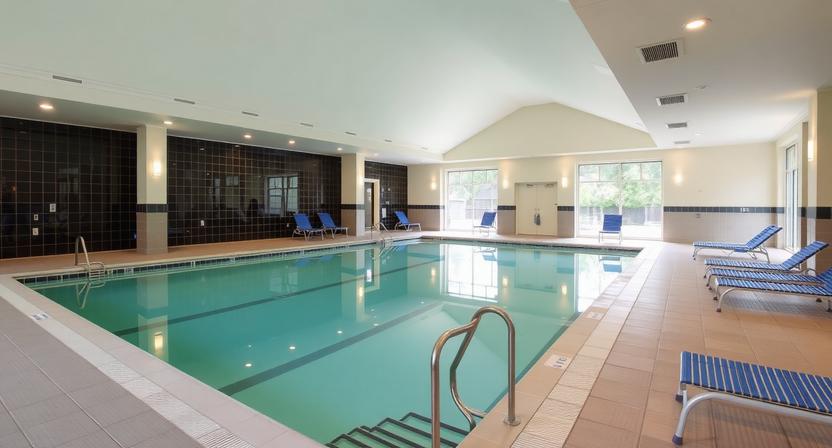
Indoor swimming pools are enclosed pools built inside a home, home addition, basement, pool house, or dedicated pool room. Indoor swimming pools provide year-round swimming, private use, weather protection, fitness access, wellness use, and controlled water conditions. The right indoor swimming pool depends on pool type, room design, dehumidification, ventilation, pool heating, vapour control, waterproof finishes, drainage, water care, safety rules, and long-term operating costs.
Moisture control is the main design issue. Indoor pool guidance sets relative humidity near 50% to 60% to reduce condensation, mould risk, corrosion, and building damage. A separate pool room HVAC system, correct air distribution, negative air pressure, and a protected building envelope help keep pool moisture inside the pool area.
Water care also affects daily use. Health Canada states that pool owners need daily water balance testing for sanitizer level, pH, total alkalinity, and calcium hardness. Clear water still needs proper sanitization because microorganisms survive in untreated or poorly balanced pool water.
Quick Answer
What are indoor swimming pools?
Indoor swimming pools are pools built inside an enclosed space with a pool structure, heating system, filtration system, ventilation, dehumidification, drainage, vapour control, and moisture-resistant interior finishes.
Are indoor swimming pools usable year-round?
Indoor swimming pools are usable year-round when the pool room has correct heating, humidity control, air movement, water treatment, drainage, and building envelope protection.
What is the main indoor pool problem?
The main indoor pool problem is moisture control. Indoor pool rooms produce high humidity. Poor dehumidification or weak vapour control causes condensation, mould risk, corrosion, odour movement, and building envelope damage.
Quick Overview
| Decision Factor | Indoor Swimming Pool Detail |
|---|---|
| Best for | Year-round use, privacy, fitness, wellness, weather protection |
| Not best for | Lowest upfront cost, simple construction, low operating cost |
| Main room need | Dehumidification, ventilation, heating, vapour control |
| Main building risk | Condensation, moisture migration, mould, corrosion |
| Main design value | Controlled pool environment and private swimming |
| Key cost driver | Pool room construction, HVAC, dehumidification, finishes, drainage |
| Long-term focus | Water balance, humidity control, equipment care, building envelope |
What Are Indoor Swimming Pools?
Indoor swimming pools are enclosed pools built inside a moisture-controlled pool room. The pool area needs a pool structure, heating, filtration, ventilation, dehumidification, drainage, vapour control, and waterproof finishes.
An indoor pool room works as a separate wet environment. It contains warm water, humid air, pool chemicals, deck drainage, and mechanical systems. The building envelope around the room protects walls, roof areas, windows, doors, insulation, and framing from moisture movement.
Where are indoor pools built?
Indoor pools are built inside home additions, basements, pool houses, glass enclosures, and purpose-built pool rooms. Each location needs enough space for the pool, walking areas, equipment access, air movement, and drainage.
A basement indoor pool needs careful structural review, waterproofing, drainage, and humidity control. A pool house gives better separation from the main home. A home addition gives more design control because the room, envelope, and mechanical systems are planned together.
What pool types work indoors?
Fibreglass pools, concrete pools, vinyl liner pools, ICF pools, plunge pools, lap pools, and spa-style pools work indoors. The best type depends on room access, pool size, design goals, heating needs, and construction method.
Fibreglass indoor pools use a pre-moulded shell and suit projects with enough access for delivery. Concrete indoor pools suit custom shapes, custom depths, and tiled or plaster finishes. Vinyl liner indoor pools suit flexible layouts and smoother wall surfaces. ICF indoor pools use insulated concrete forms and support heated pool use. Plunge pools suit compact rooms. Lap pools suit long, narrow fitness spaces.
What systems are required?
Indoor swimming pools require pool filtration, pool heating, ventilation, dehumidification, air distribution, drainage, vapour control, waterproof finishes, and an accessible equipment room.
A dehumidifier removes moisture from pool-room air. Ventilation supplies fresh air and removes stale air. Negative pressure keeps pool air from moving into the rest of the home. Air distribution moves warm dry air across windows, exterior walls, corners, and other cold-prone surfaces. The CDC states that chloramines build up in indoor pool air without proper ventilation, which affects air quality for swimmers and nearby users.
A pool heater controls water temperature. Drainage moves splash water and cleaning water away from the floor. Waterproof finishes protect floors, walls, ceilings, doors, and trim. A pool cover reduces evaporation, heat loss, and humidity load.
What makes indoor pools different?
Indoor swimming pools differ from outdoor pools because the pool room must control water, air, heat, humidity, and vapour movement at the same time. The pool is not exposed to rain, snow, leaves, or direct weather, but the enclosed room collects moisture from evaporation.
The main design focus is the building envelope. Walls, roofs, windows, doors, insulation, and seals need protection from humid pool air. Poor air movement leaves cold surfaces below dew point. That creates condensation, staining, mould risk, and corrosion.
What limits indoor pools?
Indoor pools are limited by room size, access, structure, ceiling height, drainage routes, ventilation space, equipment space, and moisture-control design. Existing rooms rarely suit an indoor pool without major changes.
Pool size affects the room footprint, water volume, heating load, and dehumidification load. Large windows increase condensation risk when glazing stays cold. Poorly placed ducts leave dead zones with weak airflow. Weak vapour control allows humid air to enter walls, roof spaces, and insulation. A missing or undersized pool dehumidifier increases moisture damage risk.
What Types of Indoor Swimming Pools Are Available?
Indoor swimming pools are available as fibreglass pools, concrete pools, vinyl liner pools, ICF pools, plunge pools, lap pools, and spa-style pools. The best indoor pool type depends on room access, pool size, structural design, heating demand, finish choice, and long-term moisture control.
| Indoor Pool Type | Main Feature | Best Use |
|---|---|---|
| Indoor fibreglass pool | Pre-moulded shell | Faster installation where access allows |
| Indoor concrete pool | Custom-built structure | Custom shapes, depths, and finishes |
| Indoor vinyl liner pool | Wall system with liner | Flexible shape and smoother surface |
| Indoor ICF pool | Insulated concrete form structure | Heated pools and energy efficiency |
| Indoor plunge pool | Compact pool | Small pool rooms and soaking |
| Indoor lap pool | Long narrow shape | Fitness swimming |
| Indoor spa pool | Warm-water use | Wellness and hydrotherapy-style spaces |
What are indoor fibreglass pools?
Indoor fibreglass pools are one-piece pre-moulded pool shells installed inside a prepared pool room. The shell includes a smooth gelcoat surface, fixed shape, fixed depth, and built-in features such as steps, benches, and ledges.
Indoor fibreglass pools suit projects with clear shell access through the property, roof opening, wall opening, or pool-house entry. Their main limits are transport access, crane access, fixed shell size, and limited custom design.
What are indoor concrete pools?
Indoor concrete pools are custom-built pools formed with shotcrete, gunite, or poured concrete. They suit custom shapes, deeper profiles, tiled finishes, plaster finishes, benches, steps, ledges, and attached spa areas.
Indoor concrete pools suit projects that need a specific size, shape, depth, or architectural finish. Their main limits are higher construction complexity, longer build time, surface maintenance, and moisture protection needs during and after construction.
What are indoor vinyl liner pools?
Indoor vinyl liner pools use a wall-panel structure with a fitted vinyl pool liner. The liner creates the pool surface and gives a smoother feel than many hard pool finishes.
Indoor vinyl liner pools suit homeowners who want flexible shapes, liner pattern choices, and lower upfront structure cost than many custom concrete builds. Their main limits are liner wear, liner replacement, puncture risk, and careful water balance needs.
What are indoor ICF pools?
Indoor ICF pools use insulated concrete forms filled with reinforced concrete. The forms stay in place and add insulation around the pool wall.
Indoor ICF pools suit heated indoor pools because the insulated wall system helps reduce heat loss through the pool structure. Their main limits are specialist design, waterproofing quality, finish choice, and correct integration with the building envelope.
What are indoor plunge and lap pools?
Indoor plunge pools are compact pools used for soaking, cooling, light exercise, and small pool-room layouts. Their smaller water volume reduces space demand and suits basements, pool houses, and home additions with limited room.
Indoor lap pools are long, narrow pools designed for straight-line swimming. They suit fitness use, narrow rooms, and homeowners who need a private exercise pool. Their main limits are room length, lane width, drainage layout, and HVAC load along the full pool surface.
What Benefits Do Indoor Swimming Pools Offer?
Indoor swimming pools offer year-round use, privacy, weather protection, fitness access, therapy-style use, family use, and controlled swimming conditions. The main benefit is a private pool environment that separates swimming from outdoor weather, seasonal closures, and changing air temperatures.
Why does year-round use matter?
Year-round use matters because indoor swimming pools stay usable through winter, rain, snow, wind, and cold outdoor temperatures. A heated pool room controls air temperature, water temperature, humidity, and air movement.
ASHRAE-based natatorium design guidance places indoor pool relative humidity near 50% to 60% to support comfort and reduce condensation risk. Stable humidity control and dehumidification keep the room suitable for regular use across all seasons.
Why does privacy matter?
Privacy matters because indoor swimming pools place swimming inside a controlled room, pool house, basement, or home addition. The enclosed layout reduces outside visibility, weather exposure, noise transfer from nearby properties, and limits public access.
Private indoor pool design supports family swimming, fitness routines, wellness use, and supervised use in one controlled space. Lockable doors, restricted access, pool covers, and clear sightlines improve everyday safety planning.
Why does weather protection matter?
Weather protection matters because indoor swimming pools remove direct exposure to rain, snow, wind, falling leaves, and strong sunlight. The pool water stays cleaner than many outdoor pools because less debris enters the water.
A protected pool room reduces weather delays, seasonal opening work, outdoor cover handling, and storm-related cleaning. The main trade-off is mechanical control. Dehumidification, ventilation, and building envelope protection replace the natural drying effect of outdoor air.
Why does fitness access matter?
Fitness access matters because indoor swimming pools support regular swimming without seasonal limits. Lap pools, swim-current pools, and compact exercise pools give homeowners a private space for low-impact movement, cardio training, and water-based exercise.
The Canadian 24-Hour Movement Guidelines recommend at least 150 minutes of moderate-to-vigorous physical activity per week for adults. A private indoor pool helps support regular activity when outdoor pools, gyms, or public swim times do not fit the household schedule.
Why does controlled water matter?
Controlled water matters because indoor swimming pools use heating, filtration, circulation, sanitization, and testing to keep swimming conditions stable. Controlled water temperature supports comfort. Controlled water balance protects swimmers, pool surfaces, heaters, pumps, and finishes.
Health Canada states that pool owners need daily water-balance testing for sanitizer levels, pH, total alkalinity, and calcium hardness. Proper sanitization matters because clear pool water still contains microorganisms without correct treatment.
CDC indoor pool guidance states that chloramines collect in indoor pool air without proper ventilation. Correct ventilation, fresh-air supply, and air movement help control odours and protect indoor air quality.
What Design Options Are Available for Indoor Swimming Pools?
Indoor swimming pools offer design options for shape, size, depth, entry style, pool finish, and room style. The right design depends on the pool room footprint, ceiling height, access route, structural support, HVAC layout, drainage, humidity control, and household use.
| Design Option | Indoor Pool Examples |
|---|---|
| Shape | Rectangle, plunge, lap, freeform, spa-combination |
| Size | Compact plunge, medium family pool, narrow lap pool |
| Depth | Shallow sitting depth, sport depth, lap depth, deeper custom depth |
| Entry | Steps, benches, tanning ledge, ladder, beach-style entry where space allows |
| Finish | Gelcoat, vinyl liner, plaster, tile, pebble, PVC membrane |
| Room style | Home addition, basement pool, pool house, conservatory-style enclosure |
What pool shapes work indoors?
Indoor pool shapes include rectangle pools, plunge pools, lap pools, freeform pools, and spa-combination pools. Rectangle shapes suit most indoor rooms because they use space well and support simple deck drainage.
Plunge pools suit compact rooms. Lap pools suit long, narrow rooms for fitness swimming. Freeform pools suit larger custom rooms with more deck space. Spa-combination pools suit wellness-focused layouts that need warm-water use and seating areas.
What pool sizes work indoors?
Indoor pool sizes range from compact plunge pools to medium family pools and narrow lap pools. The right size depends on the pool room footprint, walkway space, equipment access, water volume, and dehumidification load.
A compact plunge pool suits small rooms, basements, and pool houses. A medium family pool suits recreation and supervised family use. A narrow lap pool suits straight-line swimming and fitness use.
What depths work indoors?
Indoor pool depths include shallow sitting depth, sport depth, lap depth, and deeper custom depth. The right depth depends on use, safety planning, structure, heating demand, and pool type.
Shallow depths suit seating, children’s use, and light movement. Sport depths suit general swimming and games. Lap depths suit fitness swimming. Deeper custom depths suit larger concrete indoor pools with site-specific structural design.
What entry designs work indoors?
Indoor pool entry designs include steps, benches, tanning ledges, ladders, and beach-style entries where space allows. The right entry design depends on room size, user needs, pool shape, and deck layout.
Built-in steps suit daily use and safe access. Benches support rest, therapy-style use, and social seating. Tanning ledges suit shallow lounging areas. Ladders save space in smaller pools. Beach-style entries need more floor area and a larger pool room.
What finishes work indoors?
Indoor pool finishes include gelcoat, vinyl liner, plaster, tile, pebble, and PVC membrane. The finish depends on pool type, surface feel, design style, water chemistry, and maintenance needs.
Gelcoat suits fibreglass shells. Vinyl liner suits panel-wall pools and gives a smooth surface. Plaster, tile, and pebble suit concrete pools. PVC membranes suit waterproof lining systems. Indoor finishes need correct water balance because warm water and enclosed air increase the need for steady maintenance.
What Room Design Matters for Indoor Swimming Pools?
Indoor swimming pool room design matters because the room controls moisture, heat, air movement, drainage, access, and comfort. A good pool room has enough footprint for the pool, safe walkways, an accessible mechanical room, protected glazing, storage, pool-cover space, and clear drainage routes.
What ceiling height is needed?
Ceiling height needs enough clearance for swimmers, warm air movement, lighting, ducts, and moisture-resistant ceiling finishes. Higher ceilings improve comfort and reduce a closed-in feel.
A practical indoor pool room often needs more height than a standard room because HVAC ducts, air returns, lighting, insulation, and vapour-protected ceiling assemblies take space. Lap pools, diving-free pools, plunge pools, and spa-style pools each need different ceiling clearance.
What floor space is needed?
Floor space needs room for the pool shell, pool deck, walking clearance, drainage slopes, cover storage, and service access. The pool room footprint must include more than the water area.
A clear walkway of about 900 mm to 1,200 mm supports safer movement around many residential pools. Larger clearances suit family use, mobility needs, furniture, maintenance work, and emergency access. Floor drains need planned slopes so splash water moves away from walls, doors, and equipment.
What equipment room is needed?
An equipment room is needed for the pump, filter, heater, dehumidifier, water-treatment equipment, controls, plumbing valves, drains, and electrical access. The room needs enough space for service work and safe chemical handling.
The mechanical room works best when it sits close to the pool area but remains separated from finished living space. Good planning gives technicians access to filters, coils, drains, pumps, controls, and pipework without damaging walls or finishes.
What service access is needed?
Service access is needed for pool cleaning, equipment repair, filter changes, dehumidifier maintenance, duct inspection, cover operation, and water testing. Poor access increases labour time and repair cost.
The design needs clear routes to the equipment room, deck drains, pool cover system, skimmers, return fittings, lighting, windows, doors, and ceiling areas. Storage space also matters for test kits, poles, brushes, pool-cover parts, and safety gear.
What glazing works indoors?
Indoor pool glazing needs strong thermal performance, sealed frames, corrosion-resistant hardware, and controlled air movement across the glass. Windows, skylights, and glass doors create condensation risk when indoor pool air reaches cold surfaces.
Thermal breaks reduce heat transfer through window frames and door systems. Warm dry air from the dehumidification system needs to wash over glazing areas to reduce window sweating. Skylights need careful detailing because warm humid air rises and collects near roof glass.
Why Is Dehumidification Needed for Indoor Swimming Pools?
Dehumidification is needed for indoor swimming pools because warm pool water releases moisture into an enclosed pool room. A dedicated pool dehumidifier, separate HVAC system, negative air pressure, and continuous vapour barrier help control condensation, mould risk, corrosion, odour movement, and building envelope damage. The CDC Model Aquatic Health Code references ASHRAE guidance for negative pressure in indoor pool design, and it links indoor pool air handling with ASHRAE Standard 62.1 for acceptable indoor air quality.
| Dehumidification Factor | Why It Matters |
|---|---|
| Humidity control | Reduces condensation risk |
| Air movement | Moves warm dry air across cold-prone surfaces |
| Negative pressure | Helps keep pool air inside the pool room |
| Separate ductwork | Keeps pool air from mixing with the rest of the building |
| Heat recovery | Reduces energy waste where the system supports it |
| Pool cover | Reduces evaporation and dehumidification load |
What does a pool dehumidifier do?
A pool dehumidifier removes excess moisture from indoor pool air. It helps keep relative humidity within the design range, reduces condensation on windows and walls, and protects the building envelope.
The system also supports comfort. It dries the air, moves conditioned air through ducts, and helps limit damp odours. A well-designed dehumidification system works with ventilation, air distribution, pool heating, and drainage.
What humidity level matters?
Indoor pool humidity usually targets about 50% to 60% relative humidity. This range supports swimmer comfort and helps reduce condensation on cold-prone surfaces.
Humidity above the design range increases moisture load. Water vapour then collects on windows, skylights, exterior walls, metal fixtures, and ceiling areas when surface temperatures fall below the dew point.
What happens without dehumidification?
Indoor swimming pools without dehumidification develop high humidity, condensation, mould risk, corrosion, and moisture damage. Warm humid air moves into walls, roof spaces, insulation, and nearby rooms when the pool area lacks proper containment.
Poor moisture control damages doors, windows, fasteners, rails, grilles, ceiling finishes, wall finishes, and structural materials. Poor indoor pool ventilation also allows chloramines to collect in the air. The CDC states that chloramines build up in indoor pool air without proper ventilation and create an unhealthy environment for swimmers, staff, and spectators.
What does air distribution do?
Air distribution moves warm dry air around the pool room. It directs air across windows, exterior walls, corners, skylights, doors, and other cold-prone surfaces.
Good air movement reduces stagnant zones. It also helps keep glass, frames, ceiling areas, and wall surfaces above the dew point. Poor duct placement leaves cold surfaces wet, even when the dehumidifier has enough capacity.
What does negative air pressure do?
Negative air pressure helps keep humid pool air inside the pool room. The pool area stays slightly lower in pressure than nearby rooms, so air moves into the pool room instead of pushing pool moisture into the rest of the building.
A correct indoor pool setup uses a separate HVAC/dehumidification system, separate ductwork, negative pressure, and a continuous vapour barrier. This containment protects bedrooms, living areas, roof spaces, wall cavities, and insulation from humid pool air.
What Ventilation Is Needed for Indoor Swimming Pools?
Indoor swimming pools need a separate pool-room HVAC system with fresh-air supply, exhaust air, negative air pressure, return air, and planned duct layout. The system removes humid air, supports chloramine control, protects indoor air quality, and reduces condensation on windows, doors, walls, and ceiling surfaces.
Why does fresh air matter?
Fresh air matters because indoor swimming pools need outdoor air to dilute moisture, odours, and airborne disinfection by-products. The CDC Model Aquatic Health Code states that indoor aquatic air-handling systems need outdoor air design based on ASHRAE Standard 62.1. It also lists the placement of outdoor air intakes and supply air locations as required design details.
A good fresh-air supply enters through the dedicated pool-room system, not through open doors or shared house ducts. This keeps the pool room separate from bedrooms, living areas, basements, and attic spaces.
Why does exhaust air matter?
Exhaust air matters because indoor pool air carries moisture and chloramines. The CDC states that chloramines build up in indoor pool air without proper ventilation and create an unhealthy environment for swimmers, spectators, and staff.
A proper exhaust system removes stale air from the pool room and sends it outdoors. Exhaust vents also help remove air near the water surface, where disinfection by-products collect. The CDC Model Aquatic Health Code states that return or exhaust air intakes need placement near aquatic venue surfaces to remove the highest concentration of airborne by-products.
Why does negative pressure matter?
Negative pressure matters because it helps keep humid pool-room air inside the pool area. The CDC Model Aquatic Health Code states that indoor aquatic air-handling design must identify how the system maintains negative air pressure relative to indoor areas outside the pool room or the outside of the facility.
A negative-pressure pool room reduces moisture spread into living areas, wall cavities, roof spaces, and insulation. It also helps control odour movement when paired with separate HVAC, separate ductwork, and a continuous vapour barrier.
Why does odour control matter?
Odour control matters because strong “chlorine smell” often signals airborne chloramines, not clean water. Chloramines form when chlorine reacts with sweat, oils, urine, and other swimmer waste. The CDC states that chloramines irritate the skin, eyes, nose, and respiratory tract when they move from water into indoor air.
Good odour control uses correct water balance, enough fresh air, effective exhaust air, and air mixing near the water surface. Poor ventilation leaves odours trapped in the pool room and increases discomfort during regular swimming.
Why does duct layout matter?
Duct layout matters because air must reach the right areas, not just the centre of the room. The CDC Model Aquatic Health Code states that air distribution design must account for obstacles, deliver outside air to the breathing zone, maintain constant airflow, and flush outside walls and windows to inhibit condensation and mould.
Good duct placement sends warm dry air across windows, skylights, exterior doors, cold corners, and other surfaces at risk of sweating. Low return or exhaust points near the pool surface help draw humid air and by-products away from swimmers. A dedicated pool-room HVAC system keeps this air separate from household return air and protects the wider building envelope.
What Is a Vapour Barrier for Indoor Swimming Pools?
A vapour barrier for indoor swimming pools is a continuous moisture-control layer that limits water vapour movement from the pool room into walls, roof assemblies, insulation, windows, doors, and nearby rooms. It works with the air barrier, dehumidifier, ventilation system, and negative air pressure to protect the building envelope.
The National Research Council Canada states that indoor pool enclosing walls and roofs need barriers against air and vapour movement, or a design that prevents pool air from reaching those assemblies. This reduces hidden condensation inside the structure.
Why does vapour control matter?
Vapour control matters because indoor pool rooms produce warm, humid air every day. The pool water surface acts as a large humidifier, and moisture enters the room whenever the air has a lower dew point than the water surface temperature.
Poor vapour control allows moisture to enter the building envelope. Hidden moisture causes interstitial condensation, wet insulation, corrosion, masonry damage, paint failure, roofing failure, and higher heat loss.
Where does vapour move?
Vapour moves from the pool room into walls, roof spaces, window frames, door frames, ducts, electrical fixtures, conduits, insulation, and adjacent rooms. Air leakage carries far more moisture than slow vapour diffusion, so the air barrier and vapour barrier need continuous detailing.
The National Research Council Canada identifies air leakage through construction joints, window frames, door frames, ducts, electrical fixtures, and conduits as a key path for moisture movement in pool buildings.
What happens in cold weather?
Cold weather increases condensation risk because exterior walls, roof areas, windows, skylights, and doors stay colder than the pool-room air. Condensation forms when a surface temperature falls below the room’s dew point.
Positive pressure worsens vapour migration during cold weather. It pushes humid pool air into walls, roof spaces, insulation, and upper floors. ASHRAE Journal indoor pool guidance recommends slight negative pressure in pool spaces relative to adjacent spaces and outdoors to keep humidity, odours, and contaminants contained.
What surfaces need protection?
Indoor swimming pool surfaces that need protection include exterior walls, interior partitions, ceilings, roofs, windows, skylights, doors, insulation, framing, ducts, trims, fixings, and metal fixtures. These surfaces need moisture-resistant materials, sealed transitions, thermal breaks, and warm air movement.
ASHRAE Journal pool ventilation guidance states that pool enclosures need enough insulation value, thermal breaks, and a vapour barrier to stop moisture migration through walls. It also states that supply air needs to reach exterior glass, walls, and roof surfaces to keep them above the space dew point.
What failures cause damage?
Indoor pool vapour failures include broken vapour barriers, weak air sealing, positive room pressure, cold glazing, missing thermal breaks, poor duct layout, undersized dehumidification, and standard room finishes. These failures allow condensation, mould risk, corrosion, wet insulation, staining, odour movement, and structural damage.
A properly constructed indoor pool envelope needs a continuous vapour barrier, continuous air barrier, separate pool-room HVAC, balanced exhaust, controlled negative pressure, and air movement across cold-prone surfaces. This design keeps humid pool air inside the pool room and protects the rest of the building.
What Finishes Work for Indoor Swimming Pools?
Indoor swimming pool finishes need water resistance, moisture control, slip resistance, corrosion resistance, and sealed transitions. Standard room finishes do not suit pool rooms because warm humid air, splash water, cleaning water, and pool chemicals affect floors, walls, ceilings, windows, doors, metals, and lighting.
| Finish Area | Indoor Pool Requirement |
|---|---|
| Flooring | Slip-resistant, water-resistant, drainable surface |
| Walls | Moisture-resistant materials and sealed transitions |
| Ceiling | Moisture-resistant surface and protected structure |
| Windows | High-performance glazing and warm air movement |
| Doors | Corrosion-resistant hardware and strong seals |
| Metals | Corrosion-resistant fasteners, rails, grilles, and fixtures |
| Lighting | Damp-rated or wet-rated fixtures where required |
What wall finishes work?
Indoor pool wall finishes work best when they resist moisture, clean easily, and seal tightly at corners, windows, doors, and ceiling joints. Suitable choices include tile, sealed cement board systems, PVC wall panels, waterproof wall coatings, and other moisture-rated materials.
Wall finishes need protected joints and sealed penetrations. Gaps around outlets, ducts, trims, frames, and access panels allow humid air to enter the building envelope.
What floor finishes work?
Indoor pool floor finishes need a slip-resistant, water-resistant, and drainable surface. Suitable choices include textured tile, sealed concrete, rubber safety flooring, and other pool-room-rated floor systems.
The floor needs slope toward floor drains. Drainage helps remove splash water, cleaning water, and overflow. Smooth household flooring increases slip risk and water damage risk.
What ceiling finishes work?
Indoor pool ceiling finishes need moisture resistance and structure protection. Suitable choices include moisture-rated ceiling panels, sealed cement board, PVC ceiling systems, and protected painted systems designed for humid rooms.
Ceilings need careful detailing because warm humid air rises. Weak ceiling seals, cold roof areas, and poor air movement increase condensation, staining, mould risk, and hidden moisture damage.
What window materials work?
Indoor pool window materials need high thermal performance, sealed frames, warm-edge detailing, and controlled airflow across the glass. Suitable choices include high-performance glazing, thermally broken frames, corrosion-resistant hardware, and well-sealed door systems.
Windows, skylights, and glass doors need warm dry air movement. Cold glass and weak frame insulation lead to window sweating when surface temperature drops below the dew point.
What metal finishes work?
Indoor pool metal finishes need corrosion resistance. Suitable choices include stainless steel, powder-coated aluminium, protected fasteners, corrosion-resistant rails, sealed grilles, and pool-room-rated fixtures.
Pool air affects metal faster than normal indoor air because humidity and pool chemicals increase corrosion risk. Hardware, hinges, screws, handrails, drains, vents, lighting trims, and door parts need materials rated for humid pool spaces.
What Affects Indoor Swimming Pool Cost?
Indoor swimming pool cost depends on the pool structure, pool room construction, building envelope, dehumidification, ventilation, heating, drainage, moisture-resistant finishes, glazing, equipment room, and permits. Indoor projects cost more than many outdoor pools because the building must control water, air, heat, humidity, and vapour movement.
| Cost Factor | Why It Affects Price |
|---|---|
| Pool structure | Fibreglass, vinyl, concrete, or ICF changes construction cost |
| Building envelope | Walls, roof, insulation, glazing, vapour barrier, and air sealing affect cost |
| Dehumidification | Indoor pool HVAC is a major mechanical cost |
| Heating | Pool water and room air need controlled temperatures |
| Drainage | Floor drains, slope, waterproofing, and overflow control add cost |
| Finishes | Moisture-resistant surfaces cost more than standard room finishes |
| Glazing | Windows and skylights need condensation-resistant design |
| Equipment room | Mechanical access and service space affect layout |
| Permits | Pool enclosure, building work, electrical work, and inspections add required cost |
Does room construction affect cost?
Room construction affects indoor swimming pool cost because the pool needs a protected pool room, not a standard interior room. The room needs a moisture-resistant structure, correct insulation, sealed transitions, drainage, and access for service.
A purpose-built home addition or pool house often gives better control than a converted room. A converted basement or existing room often needs structural changes, waterproofing, vapour control, drainage, and mechanical upgrades before pool work starts.
Does pool type affect cost?
Pool type affects indoor swimming pool cost because each structure uses different materials, labour, finishes, and access needs. Fibreglass pools need shell access and crane planning. Concrete pools need custom forming, reinforcement, waterproofing, and finishing. Vinyl liner pools need wall panels and a fitted liner. ICF pools need insulated forms, reinforced concrete, and waterproof lining.
Pool size, depth, shape, shell weight, room access, and finish choice change the final cost. Larger water volume also increases heating, filtration, dehumidification, and long-term energy demand.
Does dehumidification affect cost?
Dehumidification affects indoor swimming pool cost because the pool room needs a dedicated system to remove moisture from the air. A pool dehumidifier is not optional in a high-humidity indoor pool room.
The system cost depends on pool surface area, water temperature, room temperature, target humidity, duct layout, fresh-air supply, exhaust air, drainage, controls, and service access. A larger pool surface releases more moisture, which increases the required dehumidification capacity.
Does heating affect cost?
Heating affects indoor swimming pool cost because both pool water and room air need controlled temperatures. The pool heater, room heating system, insulation level, glazing area, pool cover, and operating schedule all affect energy demand.
Warm water increases evaporation. Higher evaporation increases humidity load and dehumidification demand. A pool cover helps reduce heat loss, evaporation, and mechanical load when the pool is not in use.
Does finishing affect cost?
Finishing affects indoor swimming pool cost because the room needs materials rated for moisture, splash water, cleaning, and pool air. Standard drywall, trim, flooring, hardware, lighting, and doors do not suit many indoor pool environments.
Cost rises when the design includes slip-resistant flooring, sealed wall systems, moisture-resistant ceilings, high-performance glazing, corrosion-resistant hardware, damp-rated lighting, waterproof transitions, and floor drainage. These finishes protect the building envelope and reduce long-term repair risk.
How Are Indoor Swimming Pools Installed?
Indoor swimming pools are installed through site review, room design, pool construction, mechanical setup, inspection, and water balancing. The process connects the pool shell with the building envelope, HVAC design, vapour barrier, drainage, electrical bonding, waterproof finishes, and safe startup.
What happens during planning?
Indoor swimming pool planning starts with a full site review. The review checks room location, access, structural support, ceiling height, drainage routes, equipment space, pool size, pool depth, and intended use.
Permit planning also starts early. Toronto requires a Zoning Certificate before a Pool Fence Enclosure Permit application, and the city states that a pool cannot be constructed and filled with water without a required fence installed under its pool fence rules. Local rules set the final permit path for building work, pool enclosures, electrical work, mechanical systems, and inspections.
What happens during room design?
Indoor pool room design sets the room footprint, pool position, walkway space, mechanical room, storage space, pool cover space, floor drains, and service access. The room layout also plans windows, doors, skylights, thermal breaks, and moisture-resistant finishes.
The design team details the building envelope before construction starts. The envelope needs insulation, air sealing, a continuous vapour barrier, protected glazing, and duct routes that move warm dry air across cold-prone surfaces.
What happens during pool construction?
Indoor pool construction starts with excavation, slab work, or structural preparation. The builder then installs the pool shell, wall system, reinforcement, waterproofing, drains, skimmers, returns, plumbing lines, and equipment connections.
The construction method depends on the pool type. Fibreglass pools need shell access and setting space. Concrete pools need forming, reinforcement, shell construction, waterproofing, and finishing. Vinyl liner pools need wall panels and liner fitting. ICF pools need insulated concrete forms, reinforcement, concrete placement, and waterproof lining.
What happens during mechanical setup?
Mechanical setup installs the pool heater, pump, filter, sanitizer, dehumidifier, ventilation ducts, fresh-air supply, exhaust air, controls, drains, and electrical systems. The pool room needs a separate HVAC/dehumidification system because indoor pool air carries heat, moisture, and disinfection by-products.
The CDC Model Aquatic Health Code links indoor aquatic ventilation design with ASHRAE Standard 62.1 and includes outdoor air, exhaust, air distribution, and negative-pressure design for indoor pool spaces. Electrical Safety Authority guidance in Ontario also ties pools and hot tubs to the Ontario Electrical Safety Code, which makes electrical design and bonding part of the installation process.
What happens before startup?
Indoor pool startup happens after construction, mechanical setup, waterproof finishes, pool cover installation, and inspections. The startup process checks the pool shell, fittings, drains, plumbing, electrical bonding, heater, filtration, dehumidifier, ventilation, controls, and drainage.
Water startup includes filling, circulation testing, leak checks, chemical adjustment, sanitizer setup, and water balancing. Health Canada states that pool owners need daily testing for sanitizer levels, pH, total alkalinity, and calcium hardness to keep swimmers safe.
What Maintenance Is Needed for Indoor Swimming Pools?
Indoor swimming pool maintenance needs regular water testing, filtration care, dehumidifier service, ventilation checks, finish inspection, pool cover care, and heating system checks. Indoor pools need steady maintenance because warm water, enclosed air, humidity, and pool chemicals affect water quality, equipment, and the pool room.
| Maintenance Area | Indoor Pool Requirement |
|---|---|
| Water testing | Sanitizer, pH, alkalinity, and calcium hardness |
| Filtration | Pump, filter, baskets, returns, and circulation |
| Dehumidifier | Filters, coils, drains, airflow, and controls |
| Ventilation | Exhaust, supply air, ductwork, and pressure balance |
| Room finishes | Condensation, corrosion, mould, and surface damage checks |
| Pool cover | Reduces evaporation, heat loss, and humidity load |
| Heating | Pool water temperature and room air temperature checks |
What water testing is needed?
Water testing needs daily checks for sanitizer levels, pH, total alkalinity, and calcium hardness. Health Canada states that pool owners must test water balance daily for these four measures to keep swimmers safe.
Sanitizer controls disease-causing microorganisms. pH affects sanitizer performance and swimmer comfort. Total alkalinity helps stabilize pH. Calcium hardness helps protect pool surfaces, heaters, and fittings. Health Canada also states that clear pool water still contains microorganisms, so proper sanitization remains necessary.
What dehumidifier care is needed?
Dehumidifier care needs regular checks for filters, coils, drains, airflow, sensors, and controls. A clean pool dehumidifier removes moisture from the air and helps reduce condensation on windows, doors, walls, ceilings, and metal fixtures.
Blocked filters, dirty coils, poor airflow, and clogged drains reduce moisture removal. Weak dehumidification increases relative humidity, window sweating, corrosion risk, mould risk, and building envelope damage.
What ventilation care is needed?
Ventilation care needs checks for fresh-air supply, exhaust air, ductwork, return air, and pressure balance. The pool room needs steady air movement and slight negative pressure to keep humid pool air out of nearby rooms.
Dirty grilles, blocked ducts, weak exhaust, and poor return-air placement reduce air quality. Poor ventilation also allows pool odours and disinfection by-products to collect above the water surface.
What finish care is needed?
Finish care needs regular checks for condensation, corrosion, mould marks, loose seals, stained surfaces, cracked grout, peeling coatings, and damaged waterproof transitions. Indoor pool finishes protect the room from splash water and humid air.
Floors need slip-resistant surfaces and open drains. Walls need sealed joints around windows, doors, ducts, and trims. Ceilings need moisture-resistant surfaces because warm humid air rises and collects near roof areas.
What equipment care is needed?
Equipment care needs checks for the pump, filter, baskets, returns, heater, sanitizer system, valves, drains, sensors, and controls. Good circulation moves treated water through the whole pool and supports even heating.
The pool cover also needs cleaning and inspection. A working pool cover reduces evaporation, heat loss, and dehumidification load when the pool is not in use. Pool water temperature and room air temperature need steady checks because higher water temperature increases evaporation and humidity load.
How Does Year-Round Use Work for Indoor Swimming Pools?
Year-round use works through controlled water heating, room heating, dehumidification, ventilation, pool cover use, building envelope protection, and energy controls. An indoor swimming pool stays usable in winter because the pool room manages heat, humidity, air quality, and moisture movement at the same time.
| Year-Round Factor | Why It Matters |
|---|---|
| Water heating | Keeps swimming conditions usable in winter |
| Room heating | Supports comfort and reduces condensation risk |
| Dehumidification | Controls indoor moisture load |
| Ventilation | Supports air quality and odour control |
| Pool cover | Reduces evaporation and heat loss |
| Building envelope | Protects structure from moisture migration |
| Energy controls | Controls operating cost and system load |
What water temperature matters?
Water temperature matters because it controls swimmer comfort, evaporation rate, and heating demand. Warmer pool water increases evaporation, which raises the dehumidification load and pool water heating requirement. Pool design guidance states that lower relative humidity increases evaporation and adds load to the dehumidifier and pool heater.
Private family pools, lap pools, plunge pools, and spa-style pools use different water temperature targets. Fitness swimming usually uses cooler water than warm-water wellness use. The final setting needs to match pool use, room temperature, humidity control, and energy limits.
What room temperature matters?
Room temperature matters because the pool room air must support comfort and reduce evaporation. ASHRAE-based pool design guidance states that air temperature in public and institutional pools is often maintained 2°F to 4°F above water temperature to reduce evaporation and swimmer chill, without exceeding comfort limits.
A stable room air temperature also protects surfaces. Cold windows, skylights, doors, and exterior walls sweat when their surface temperature falls below the dew point. Warm dry air movement across these surfaces reduces condensation risk.
What humidity control matters?
Humidity control matters because indoor pool water releases moisture into the enclosed room every day. ASHRAE-related natatorium guidance places indoor pool relative humidity near 50% to 60% for swimmer comfort, energy control, and condensation reduction.
The dehumidifier removes moisture from the air. The building envelope blocks vapour movement into walls, roof spaces, and insulation. Correct negative pressure helps keep humid pool air inside the pool room.
What cover use matters?
Pool cover use matters because an uncovered pool keeps releasing moisture and heat when no one swims. A pool cover reduces evaporation, heat loss, dehumidification load, and heating demand.
Natatorium energy guidance states that evaporation forms a major part of annual pool water heating demand. Pool water heating recovery or a pool cover supports energy control under ASHRAE Energy Standard 90.1 pathways.
What energy use matters?
Energy use matters because year-round indoor swimming pools run several systems together. Pool water heating, room heating, dehumidification, ventilation, pumps, filtration, lighting, and controls all affect operating cost.
Good energy control starts with a right-sized dehumidification system, insulated building envelope, high-performance glazing, sealed doors, pool cover use, and planned ventilation. The CDC states that chloramines collect in indoor pool air without proper ventilation, so energy control must still keep enough fresh air and exhaust for air quality.
What Problems Happen With Indoor Swimming Pools?
Indoor swimming pool problems usually come from poor dehumidification, weak ventilation, poor vapour control, cold surfaces, low air movement, poor drainage, high water temperature, uncovered water, and poor water balance. These problems increase condensation, mould risk, corrosion, odour movement, and hidden building envelope damage.
Can condensation damage the room?
Condensation damages an indoor pool room when warm humid air touches cold walls, windows, ceilings, roof areas, or metal fixtures. The National Research Council Canada states that design and construction flaws in indoor pool enclosing walls and roofs increase the risk of building materials being damaged by concealed winter condensation.
Condensation affects visible finishes and hidden assemblies. Water stains, peeling coatings, wet insulation, timber decay, metal rust, and roof or wall damage signal poor moisture control.
Can pool air spread into the house?
Pool air spreads into the house when the pool room lacks containment. Humid air moves through doors, wall gaps, ducts, electrical openings, ceiling penetrations, and pressure leaks.
A contained pool room uses an airlock, separate HVAC/dehumidification system, separate ductwork, negative air pressure, and a continuous vapour barrier. A pool-room containment guide lists these measures as ways to keep high-moisture pool air inside the pool area.
Can mould form?
Mould forms when indoor pool humidity, condensation, and surface moisture stay high. Wet walls, ceilings, trims, insulation, and cold corners create growth conditions.
The EPA moisture-control guide states that long-term high humidity supports mould growth on building surfaces. Indoor pool rooms reduce this risk through dehumidification, warm air movement, sealed finishes, drainage, and regular checks for damp marks.
Can metal corrode?
Metal corrodes in indoor pool rooms when moisture and pool air affect fasteners, rails, grilles, door hardware, lighting trims, and exposed fixtures. Condensation speeds up corrosion on cold or poorly protected surfaces.
Corrosion-resistant metals, sealed fixtures, warm air movement, and stable relative humidity reduce damage risk. A protected pool room also needs correct water balance, since poor pool chemistry increases stress on metal parts and mechanical equipment.
Can windows sweat?
Windows sweat when glass or frames fall below the pool-room dew point. Warm humid air then condenses on glazing, skylights, doors, and frames.
A pool-room dehumidification source states that indoor pool humidity is commonly set between 50% and 60% RH; higher humidity increases condensation on walls and surfaces. Warm dry air needs to move across windows and cold-prone surfaces to reduce sweating.
Poor window design increases the problem. High-performance glazing, thermal breaks, sealed frames, and planned air distribution help keep glass surfaces warmer and drier.
What Safety Rules Matter for Indoor Swimming Pools?
Indoor swimming pool safety rules focus on restricted access, controlled doors, safe covers, slip-resistant surfaces, protected drains, safe chemical storage, and active supervision. Local pool enclosure bylaws, building codes, and inspection rules set the exact requirements for each project.
Do indoor pools need barriers?
Indoor pools need barriers that restrict unsupervised access to the water. Health Canada states that fences help prevent drowning in unsecured backyard pools, and the Lifesaving Society Canada recommends restricted access with a latching gate and four-sided fencing.
Toronto states that a pool fence must completely surround the pool, with no opening except a compliant gate. Toronto also states that a building wall used as part of the pool enclosure must not have doors or windows opening into the pool area.
Do doors need control?
Indoor pool doors need controlled access through lockable doors, self-closing hardware, alarms where specified, and clear separation from living areas. Door control matters because indoor pools often sit beside basements, hallways, recreation rooms, pool houses, or home additions.
Toronto Municipal Code Chapter 447 states that every single pool-enclosure gate must be self-closing and equipped with a lockable, self-latching device. The code also states that the gate must stay locked except when the enclosed area is in use.
Do covers improve safety?
Pool covers improve safety when they restrict access, reduce open-water exposure, and match the pool type. Safety covers also reduce evaporation, heat loss, and humidity load, which supports indoor pool moisture control.
A pool cover does not replace supervision, door control, barriers, or local enclosure rules. The Lifesaving Society Canada states that water toys and flotation aids are not substitutes for supervision, and children need adult supervision at all times around pool water.
Do floors need slip control?
Indoor pool floors need slip-resistant surfaces, clear drainage, and safe walking routes. Splash water, wet feet, cleaning water, and condensation increase slip risk in a pool room.
Safer indoor pool rooms use slip-resistant flooring, deck slope, floor drains, handrails, clear walkways, and good lighting. Drain covers also need secure fitting and regular inspection because damaged or loose covers create safety risks around pool outlets and drainage points.
Do chemicals need safe storage?
Pool chemicals need secure storage in a cool, dry, well-ventilated area away from children, pets, heat, sunlight, moisture, and incompatible materials. The Canadian Centre for Occupational Health and Safety states that pool products need original containers, good ventilation, and separation between oxidizers and acids.
Transport Canada CANUTEC states that chlorine products need cool, dry, well-ventilated storage away from direct sunlight, heat sources, moisture, flammable materials, ammonia, acids, alkalis, ethanol, and methanol. A separate ventilated chemical area protects swimmers, household members, and service staff.
What Permits Apply to Indoor Swimming Pools?
Indoor swimming pool permits include zoning review, pool fence enclosure permits, building permits, electrical permits or inspections, and mechanical review for HVAC, heating, ventilation, and dehumidification work. The project scope determines the required permit path.
Are pool permits needed?
Pool permits are needed when local rules classify the project as a regulated pool installation. Toronto defines a swimming pool as anything on private property used for swimming, wading, or bathing with a water depth of 60 cm or more at any point.
An indoor swimming pool project also needs zoning and construction review when it includes a new addition, pool house, basement alteration, structural work, drainage, plumbing, or mechanical systems. Toronto states that a building permit is required for most construction, demolition, additions, and major renovations under the Building Code Act.
Are pool fence permits needed?
Pool fence permits are needed in Toronto before a pool is built and filled with water. Toronto requires applicants to obtain a Zoning Certificate before applying for a Pool Fence Enclosure Permit.
Toronto also states that a pool cannot be constructed and filled with water without a fence installed under Toronto Municipal Code Chapter 447 – Fences. This rule applies before water enters the pool.
Are building permits needed?
Building permits are needed when an indoor swimming pool project includes construction, demolition, a home addition, a pool house, structural change, basement work, foundation work, plumbing, heating, or major renovation work. Toronto states that building permits give formal permission to start work after plans are reviewed for the Ontario Building Code, zoning bylaws, and other applicable laws.
Toronto also lists building permits for work such as structural or material alterations, installing or modifying heating or plumbing systems, excavating, constructing foundations, and basement work with structural, heating, plumbing, foundation, underpinning, or entrance changes.
Are electrical inspections needed?
Electrical inspections are needed for pool-related electrical work in Ontario. Electrical Safety Authority materials state that pool and spa or hot-tub installations usually need both a building permit and an electrical permit, and that the electrical permit is the Notification of Work filed with ESA.
Pool electrical work includes bonding, GFCI protection, pool pumps, heaters, lighting, controls, outlets, and equipment-room wiring. ESA states that the Ontario Electrical Safety Code requires conductive parts in and around pool water to be bonded together to reduce shock risk.
Are HVAC permits needed?
HVAC permits are needed when the project installs or modifies heating, ventilation, dehumidification, ductwork, exhaust, or plumbing systems as part of a regulated building permit scope. Toronto lists installing or modifying heating and plumbing systems among work types that require a building permit.
An indoor pool HVAC design often includes a dedicated pool-room dehumidifier, fresh-air supply, exhaust air, negative pressure, return air, ventilation ducts, condensate drains, controls, and pool-room heating. These systems need coordination with the building envelope, vapour barrier, drainage, and electrical design before inspection.
What Sites Suit Indoor Swimming Pools?
Indoor swimming pools suit sites with enough structure, drainage, access, ceiling height, equipment space, and moisture-control design. The strongest sites are purpose-built pool houses and home additions because the building envelope, HVAC, vapour barrier, and drainage are designed around pool humidity from the start.
| Site Type | Indoor Pool Fit |
|---|---|
| Dedicated pool house | Strong fit with separate HVAC and envelope design |
| Home addition | Strong fit with purpose-built moisture control |
| Basement pool | Site-dependent; structure, drainage, access, and humidity control matter |
| Converted room | Weak fit unless rebuilt for pool humidity |
| Small indoor room | Stronger fit for plunge pools or swim spas |
| Long narrow room | Stronger fit for lap pools |
| Glass enclosure | Site-dependent; condensation and heat loss need careful design |
Do basements suit indoor pools?
Basements suit indoor pools only when structure, drainage, access, humidity control, and mechanical space are suitable. A basement pool needs strong slab design, waterproofing, floor drains, service routes, and a separate dehumidification system.
Basement access also matters. Large pool shells, excavation equipment, plumbing, ducts, and service parts need a clear route into the space.
Do pool houses suit indoor pools?
Pool houses suit indoor swimming pools because they separate pool humidity from the main home. A dedicated pool house gives better control over HVAC, negative pressure, vapour barriers, drainage, glazing, and service access.
This site type also supports safer chemical storage, separate equipment rooms, wider walkways, and better pool-cover storage.
Do home additions suit indoor pools?
Home additions suit indoor swimming pools because the room is designed around the pool from the start. The builder sets the pool footprint, ceiling height, drainage routes, equipment room, insulation, air sealing, and moisture-resistant finishes before construction.
A purpose-built addition also helps protect the main house. Separate pool-room HVAC, controlled access doors, and a continuous vapour barrier reduce moisture spread into living areas.
Do small rooms suit indoor pools?
Small rooms suit compact indoor pools, including plunge pools, swim spas, and spa-style pools. Small pool rooms need careful planning because equipment, walkways, drainage, and air movement still need space.
A compact pool reduces water volume and surface area. This helps lower heating demand and dehumidification load compared with larger indoor pools.
Do existing rooms suit indoor pools?
Existing rooms rarely suit indoor swimming pools without major changes. Standard rooms lack the drainage, structure, vapour control, ventilation, dehumidification, and moisture-resistant finishes needed for pool humidity.
A converted room needs review for walls, roof areas, windows, doors, floors, insulation, ducts, electrical systems, and service access. Poor conversion work increases condensation, mould risk, corrosion, odour movement, and building envelope damage.
How Do Indoor Swimming Pools Compare?
Indoor swimming pools compare by location, structure, use, and sanitation system. Indoor describes an enclosed pool setting. Outdoor, plunge, lap, ICF, and saltwater describe different pool locations, sizes, construction methods, or water-treatment systems.
| Comparison | Indoor Pool Difference |
|---|---|
| Indoor vs outdoor | Indoor pools provide weather protection and year-round use but need HVAC and dehumidification |
| Indoor vs plunge | Indoor describes location; plunge describes compact size and use |
| Indoor vs lap | Indoor describes enclosure; lap describes long narrow fitness use |
| Indoor vs ICF | Indoor describes location; ICF describes insulated concrete construction |
| Indoor vs saltwater | Indoor describes enclosure; saltwater describes sanitation system |
How do they compare with outdoor pools?
Indoor swimming pools provide year-round use, privacy, weather protection, and controlled swimming conditions. Outdoor pools depend more on seasonal weather, outdoor temperature, debris exposure, and local climate.
Indoor pools need a dedicated pool room, dehumidification, ventilation, heating, vapour control, and moisture-resistant finishes. Outdoor pools need less building-envelope protection because outdoor air disperses humidity.
How do they compare with plunge pools?
Indoor swimming pools describe pool location. Plunge pools describe compact pool size and use.
An indoor plunge pool is a small pool built inside an enclosed space. It suits small pool rooms, basements, pool houses, soaking, light exercise, and wellness use. Its smaller water volume reduces space demand, heating load, and dehumidification load compared with larger indoor pools.
How do they compare with lap pools?
Indoor swimming pools describe enclosed pool placement. Lap pools describe a long, narrow pool shape for straight-line swimming.
An indoor lap pool suits fitness use, private workouts, narrow rooms, and regular exercise. It needs enough room length, lane width, deck clearance, air movement, drainage, and HVAC capacity along the full water surface.
How do they compare with ICF pools?
Indoor swimming pools describe pool location. ICF pools describe a construction method using insulated concrete forms and reinforced concrete.
An indoor ICF pool suits heated pool use because the insulated wall system helps reduce heat loss through the pool structure. The project still needs dehumidification, ventilation, vapour control, waterproof finishes, and building-envelope protection.
How do they compare with saltwater pools?
Indoor swimming pools describe an enclosed pool setting. Saltwater pools describe a sanitation system that uses a salt chlorine generator to produce chlorine from dissolved salt.
An indoor saltwater pool still needs chlorine testing, pH control, ventilation, dehumidification, humidity control, and corrosion-resistant materials. Saltwater sanitation does not replace pool-room HVAC, vapour barriers, drainage, or building-envelope protection.
Who Are Indoor Swimming Pools Best For?
Indoor swimming pools are best for homeowners who want year-round swimming, privacy, fitness access, wellness use, and weather protection. They are not best for the lowest upfront cost, lowest operating cost, or simple construction because the pool room needs HVAC, dehumidification, ventilation, vapour control, drainage, and moisture-resistant finishes.
| Homeowner Need | Fit |
|---|---|
| Year-round swimming | Strong fit |
| Privacy | Strong fit |
| Fitness use | Strong fit with lap design |
| Wellness use | Strong fit with plunge or spa-style design |
| Weather protection | Strong fit |
| Lowest upfront cost | Weak fit |
| Lowest operating cost | Weak fit |
| Simple construction | Weak fit |
Are they best for year-round use?
Indoor swimming pools are best for year-round use because the pool room protects swimming from cold weather, rain, snow, wind, and seasonal closures. Controlled water temperature, room temperature, humidity, and air movement keep the pool usable through winter.
Are they best for privacy?
Indoor swimming pools are best for privacy because swimming takes place inside a controlled room, pool house, basement, or home addition. The enclosed setting reduces outside visibility and supports restricted access through lockable doors, pool-room separation, and safety covers.
Are they best for fitness?
Indoor swimming pools are best for fitness when the design includes a lap pool, swim-current system, or exercise-friendly depth. A long narrow layout supports straight-line swimming and regular low-impact exercise.
Fitness-focused designs need enough room length, lane width, clear deck space, heating, ventilation, and dehumidification capacity. A small room suits a compact exercise pool or swim spa better than a full lap pool.
Are they best for wellness?
Indoor swimming pools are best for wellness use when the design includes a plunge pool, spa-style pool, warm-water zone, seating bench, or hydrotherapy-style layout. Warm water, privacy, and weather protection support regular relaxation and light movement.
Wellness-focused rooms need strong humidity control because warmer water increases evaporation. A pool cover, dedicated dehumidifier, ventilation, and corrosion-resistant finishes reduce moisture load.
Are they best for low budgets?
Indoor swimming pools are not best for low budgets because the pool needs both a swimming system and a protected indoor environment. Major cost areas include pool room construction, building envelope design, dehumidification, ventilation, heating, drainage, permits, and moisture-resistant finishes.
A lower-budget homeowner usually gets better value from an outdoor pool, above-ground pool, or compact seasonal pool. An indoor pool suits projects that prioritize private year-round use over the lowest total cost.
What Mistakes Increase Indoor Swimming Pool Cost?
Indoor swimming pool mistakes increase cost when homeowners compare only pool construction cost and ignore dehumidification, ventilation, vapour barriers, air sealing, drainage, heating, moisture-resistant finishes, permits, water care, pool covers, and long-term operating cost.
Is ignoring dehumidification a mistake?
Ignoring dehumidification is a major indoor swimming pool mistake. Warm pool water releases moisture into the pool room every day. An undersized or missing pool dehumidifier increases condensation, mould risk, corrosion, odour movement, and repair cost.
A larger water surface, warmer water, and uncovered pool increase moisture load. The dehumidification system needs correct capacity, duct layout, drainage, controls, and service access.
Is ignoring vapour control a mistake?
Ignoring vapour control is a costly indoor pool mistake. Warm humid air moves into walls, roofs, insulation, windows, doors, and nearby rooms when the vapour barrier and air barrier are weak.
Poor vapour control leads to hidden condensation, wet insulation, damaged finishes, timber decay, corrosion, and structural repair. The building envelope needs continuous air sealing, thermal breaks, negative pressure, and protected cold-prone surfaces.
Is using standard room finishes a mistake?
Using standard room finishes is a mistake because indoor pool rooms carry moisture, heat, splash water, and pool chemicals. Standard drywall, household flooring, basic trim, standard lighting, and untreated hardware break down faster in humid pool conditions.
The room needs slip-resistant flooring, sealed wall systems, moisture-resistant ceilings, high-performance glazing, corrosion-resistant hardware, damp-rated or wet-rated lighting, and waterproof transitions.
Is skipping drainage a mistake?
Skipping drainage is a mistake because splash water, cleaning water, condensation, and overflow need controlled routes away from walls, doors, floors, and equipment. Poor drainage increases slip risk, staining, floor damage, odour, and mould risk.
A good indoor pool room needs floor slope, floor drains, waterproofing, overflow planning, equipment-room drainage, and safe access for cleaning and maintenance.
Is comparing quotes poorly a mistake?
Comparing quotes poorly is a mistake because the lowest pool shell price rarely shows the full indoor swimming pool cost. A complete quote needs pool structure, room construction, HVAC, dehumidification, ventilation, vapour control, drainage, finishes, heating, permits, equipment, water care, pool cover, and warranty details.
A clear comparison checks what each contractor includes, excludes, guarantees, and services after installation. Missing items turn into change orders, repair work, higher energy use, and higher long-term maintenance cost.
How Do You Compare Indoor Swimming Pool Quotes?
Indoor swimming pool quotes need comparison across pool type, pool size, building envelope, dehumidification, ventilation, heating, drainage, finishes, equipment, permits, and warranties. A complete quote shows the full indoor pool system, not only the pool shell.
| Quote Item | What to Check |
|---|---|
| Pool type | Fibreglass, concrete, vinyl liner, ICF, plunge, lap, or spa-style |
| Pool size | Length, width, depth, water volume, and use |
| Building envelope | Walls, roof, insulation, vapour barrier, air barrier, and glazing |
| Dehumidification | Capacity, ductwork, controls, drainage, service access, and energy recovery |
| Ventilation | Fresh air, exhaust air, negative pressure, and odour control |
| Heating | Pool water heating and room air heating |
| Drainage | Floor drains, slope, waterproofing, and overflow route |
| Finishes | Floor, wall, ceiling, doors, windows, and corrosion-resistant fixtures |
| Equipment | Pump, filter, heater, sanitizer, automation, and cover |
| Permits | Pool enclosure, building, electrical, mechanical, and inspections |
| Warranty | Pool structure, HVAC, finishes, waterproofing, equipment, and labour |
What pool details matter?
Pool details matter because the pool type sets the structure, finish, build method, access needs, and long-term maintenance. Compare whether the quote covers fibreglass, concrete, vinyl liner, ICF, plunge, lap, or spa-style construction.
The quote needs exact length, width, depth, water volume, entry design, benches, steps, ledges, pool cover, filtration, sanitizer, and intended use. A fitness pool, family pool, plunge pool, and spa-style pool place different loads on heating, drainage, ventilation, and dehumidification.
What HVAC details matter?
HVAC details matter because an indoor swimming pool needs dedicated moisture and air-quality control. Compare the pool-room dehumidifier, fresh-air supply, exhaust air, duct placement, return air, controls, drainage, service access, and energy-recovery details.
The quote needs a clear plan for negative air pressure and separate pool-room ductwork. Indoor pool air contains moisture and disinfection by-products. The CDC states that chloramines collect in indoor pool air without proper ventilation, and the CDC Model Aquatic Health Code links indoor aquatic ventilation design with ASHRAE Standard 62.1.
What envelope details matter?
Envelope details matter because the building envelope protects walls, roofs, insulation, windows, and doors from humid pool air. Compare insulation, vapour barrier, air barrier, thermal breaks, glazing, door seals, ceiling assemblies, and moisture-resistant construction details.
The quote needs written details for air sealing, vapour control, condensation control, and airflow across windows or cold-prone surfaces. Missing envelope details increase the risk of condensation, mould, corrosion, wet insulation, and hidden repair work.
What finish details matter?
Finish details matter because a pool room needs moisture-resistant, drainable, and corrosion-resistant materials. Compare floor surfaces, wall systems, ceiling finishes, windows, doors, lighting, handrails, drains, grilles, fixings, and sealed transitions.
The quote needs slip-resistant flooring, floor drains, waterproofing, high-performance glazing, corrosion-resistant hardware, damp-rated or wet-rated lighting where required, and sealed joints around ducts, doors, windows, and trims.
What warranty details matter?
Warranty details matter because indoor swimming pools include several systems with different failure risks. Compare warranty coverage for the pool structure, waterproofing, liner or finish, HVAC, dehumidifier, heater, pump, filter, sanitizer, automation, cover, labour, and service response.
Permit and inspection responsibilities also need clear wording. Toronto requires a Zoning Certificate before a Pool Fence Enclosure Permit, and the city states that a pool cannot be constructed and filled with water without the required fence installed. ESA materials state that pool and spa installations usually need both building and electrical permits, and pool electrical work includes safety requirements such as GFCI protection near pool walls.
How Do Indoor Swimming Pools Affect Comfort?
Indoor swimming pools affect comfort through humidity, air temperature, water temperature, and airflow. A comfortable indoor pool room keeps swimmers warm, limits stuffy air, reduces odour, and prevents cold surfaces from sweating.
Does humidity affect comfort?
Humidity affects comfort because high moisture makes the pool room feel heavy, damp, and warm. Low humidity increases evaporation from the water and skin, which creates a cooler feeling after swimming.
A common indoor pool humidity target is about 50% to 60% relative humidity. This range supports comfort, reduces condensation risk, and helps protect walls, windows, ceilings, and metal fixtures.
Does air temperature affect comfort?
Air temperature affects comfort because swimmers lose heat when they leave the water. The pool room air needs to stay warm enough for comfort without increasing humidity load.
A stable room temperature also protects the building envelope. Cold air near windows, skylights, doors, and exterior walls increases condensation risk when humid pool air touches those surfaces.
Does water temperature affect comfort?
Water temperature affects comfort because different pool uses need different warmth levels. Lap swimming usually needs cooler water than wellness, plunge, or spa-style use.
Warmer water increases evaporation, humidity load, heating demand, and dehumidification demand. A balanced setting keeps swimmers comfortable while reducing strain on the HVAC system.
Does airflow affect comfort?
Airflow affects comfort because moving air controls humidity, odour, and surface condensation. Good air distribution moves warm dry air across windows, exterior walls, corners, doors, and ceiling areas.
Poor airflow creates damp zones, window sweating, stale odours, and uneven room comfort. A dedicated pool-room HVAC system uses supply air, return air, exhaust air, and negative pressure to keep the pool area comfortable and contained.
How Do Indoor Swimming Pools Affect Energy Use?
Indoor swimming pools affect energy use through dehumidification, water heating, room heating, ventilation, pool cover use, glazing, pumps, lighting, and controls. The largest energy loads usually come from keeping warm water and warm air stable while removing moisture from the pool room.
Does dehumidification use energy?
Dehumidification uses energy because the system removes water vapour from the indoor pool room air. Warm pool water releases moisture all day, and the pool dehumidifier must reduce that moisture to control condensation, corrosion, mould risk, and building damage.
A larger water surface, warmer water, higher air movement over the pool, and no pool cover increase the dehumidification load. A right-sized dehumidification system, balanced ventilation, and regular cover use reduce the load.
Does water heating use energy?
Water heating uses energy because the pool heater replaces heat lost through evaporation, ventilation, radiation, convection, and conduction. Natural Resources Canada lists pool heat loss routes as evaporation, convection, long-wave radiation, and conduction through the pool structure.
Warmer water increases evaporation. Higher evaporation then increases both pool heating demand and dehumidification demand. A stable water temperature, insulated pool structure, efficient heater, and pool cover reduce wasted heat.
Does a cover reduce heat loss?
A pool cover reduces heat loss by limiting evaporation when the pool is not in use. The U.S. Department of Energy states that covering a pool is the single most effective way to reduce pool heating costs, with possible savings of 50% to 70%. It also states that indoor pool covers reduce evaporation and reduce the need to ventilate indoor air and replace it with unconditioned outdoor air.
A fitted indoor pool cover also reduces humidity load, heat loss, chemical loss, and dehumidifier runtime. This makes the cover part of both comfort control and energy control.
Does glazing affect heat loss?
Glazing affects heat loss because windows, skylights, and glass doors lose more heat than insulated walls. Cold glass also increases condensation risk when humid pool air touches surfaces below the dew point.
Indoor pool glazing needs high-performance glass, thermally broken frames, sealed doors, and warm air movement across the glass. Large glass areas raise heating demand, dehumidification demand, and condensation-control needs unless the design includes strong insulation, air sealing, and planned air distribution.
How Do Indoor Swimming Pools Affect the Building?
Indoor swimming pools affect the building through condensation, vapour migration, corrosion, and air pressure. The pool room needs a protected building envelope, continuous vapour barrier, continuous air barrier, separate HVAC/dehumidification, and controlled negative pressure to keep humid pool air contained. NRC Canada states that indoor pool walls and roofs face damage risk when design or construction flaws allow concealed winter condensation.
Does condensation damage structures?
Condensation damages structures when warm humid pool air touches cold walls, roofs, windows, doors, ceiling areas, or metal fixtures. Water then forms on visible surfaces or inside hidden assemblies.
NRC Canada states that concealed condensation in indoor pool enclosing walls and roofs damages building materials, and this damage is often severe, hard to investigate, and costly to repair.
Does vapour migration affect walls?
Vapour migration affects walls when humid pool air moves into insulation, framing, roof spaces, window openings, door frames, ducts, outlets, and joints. The risk increases when the vapour barrier or air barrier has gaps.
NRC Canada states that enclosing walls and roofs around indoor pools need barriers against air and vapour movement, or a design that stops pool air from reaching those assemblies.
Does corrosion affect fixtures?
Corrosion affects fixtures because indoor pool rooms contain moisture, warmth, and pool-air by-products. Fasteners, handrails, grilles, door hardware, lighting trims, ducts, and metal frames need corrosion-resistant materials.
Condensation speeds up metal damage when surfaces stay wet. ASHRAE pool ventilation guidance states that pool enclosures need enough insulation, thermal breaks, and vapour barriers to prevent surface condensation and moisture migration.
Does air pressure affect moisture movement?
Air pressure affects moisture movement because positive pressure pushes humid pool air into nearby rooms, walls, roof spaces, and insulation. Negative pressure helps keep pool air inside the pool room.
The CDC Model Aquatic Health Code requires indoor aquatic ventilation design to identify how the system maintains negative air pressure relative to surrounding indoor areas or outdoors.
A good indoor pool building design uses separate pool-room HVAC, exhaust air, fresh-air supply, negative pressure, a continuous vapour barrier, and warm air distribution across cold-prone surfaces. This setup reduces condensation, vapour migration, corrosion, mould risk, and hidden building damage.
How Do Indoor Swimming Pools Affect Resale?
Indoor swimming pools affect resale through room condition, mechanical system quality, operating cost, and permit compliance. A well-maintained indoor pool room supports buyer confidence. A damp, poorly ventilated, non-compliant, or expensive-to-run pool reduces buyer interest and increases inspection risk.
Does room condition matter?
Room condition matters because buyers and inspectors check for condensation, staining, mould marks, corrosion, odour, loose finishes, and moisture damage. NRC Canada states that indoor pool enclosing walls and roofs face damage risk when design or construction flaws allow concealed winter condensation.
A resale-ready indoor swimming pool needs clean surfaces, dry windows, sealed joints, working drains, corrosion-resistant fixtures, and no visible moisture damage. Strong room condition shows that the building envelope protects the home from pool humidity.
Does mechanical system quality matter?
Mechanical system quality matters because buyers assess the dehumidifier, ventilation, heating, filtration, pump, heater, controls, and service records. An indoor pool with weak HVAC raises concerns about humidity, odour, condensation, and long-term repair cost.
The CDC Model Aquatic Health Code links indoor aquatic ventilation design with ASHRAE Standard 62.1 and includes negative-pressure design for indoor aquatic spaces. A resale-ready indoor pool needs clear evidence that air, moisture, and odour control systems work correctly.
Does operating cost matter?
Operating cost matters because indoor swimming pools need year-round water heating, room heating, dehumidification, ventilation, pumps, lighting, and water care. Buyers often compare the lifestyle value of private swimming with the monthly cost of energy, maintenance, and service.
Redfin reports that pools add value in some markets, but the result varies by location, pool type, materials, and neighbourhood expectations. It also lists annual maintenance averages of $1,200 to $1,800 for pools.
Does permit compliance matter?
Permit compliance matters because buyers, lenders, insurers, and inspectors look for lawful pool construction, electrical safety, enclosure compliance, and completed inspections. Missing permits create resale delays, extra review, insurance issues, and possible correction work.
Toronto requires a Zoning Certificate before a Pool Fence Enclosure Permit application. Toronto also states that a pool cannot be constructed and filled with water without a fence installed under the city’s pool fence rules.
A resale-ready indoor swimming pool needs documented pool permits, building permits, electrical inspections, mechanical work, structural review, and inspection records where the project scope requires them.
FAQs About Indoor Swimming Pools
Are indoor swimming pools worth it?
Indoor swimming pools are worth it for homeowners who want year-round swimming, privacy, fitness access, wellness use, and weather protection. They offer less value when the main goal is the lowest upfront cost or lowest operating cost.
Are indoor swimming pools expensive?
Indoor swimming pools are expensive compared with many outdoor pools because the project includes a pool structure, pool room, building envelope, HVAC, dehumidification, ventilation, heating, drainage, permits, and moisture-resistant finishes.
What types of indoor swimming pools are available?
Indoor swimming pools are available as fibreglass pools, concrete pools, vinyl liner pools, ICF pools, plunge pools, lap pools, and spa-style pools. The right type depends on room access, size, use, heating demand, and design needs.
Do indoor pools need dehumidifiers?
Indoor pools need dehumidifiers because warm pool water releases moisture into the enclosed pool room. A pool dehumidifier helps control humidity, condensation, mould risk, corrosion, and building damage.
Do indoor pools need ventilation?
Indoor pools need ventilation to bring in fresh air, remove stale air, control odours, and support indoor air quality. The CDC states that chloramines build up in indoor pool air without proper ventilation.
Do indoor pools need vapour barriers?
Indoor pools need vapour barriers and air barriers to reduce moisture movement into walls, roofs, insulation, windows, and nearby rooms. A protected building envelope reduces hidden condensation and long-term moisture damage.
Do indoor pools cause condensation?
Indoor pools cause condensation when warm humid air touches cold windows, doors, walls, ceilings, roof areas, or metal fixtures. Correct dehumidification, air movement, insulation, thermal breaks, and vapour control reduce condensation risk.
Do indoor pools smell like chlorine?
Indoor pools smell like chlorine when chloramines collect in the air. Chloramines form when chlorine reacts with swimmer waste, and the CDC links chloramine buildup to poor ventilation in indoor pool spaces.
Are indoor pools usable year-round?
Indoor pools are usable year-round when the pool room has water heating, room heating, dehumidification, ventilation, drainage, humidity control, and building envelope protection.
Are indoor pools hard to maintain?
Indoor pools need steady maintenance for water balance, filtration, heating, dehumidification, ventilation, covers, and room finishes. Health Canada states that pool owners need daily water-balance testing for sanitizer levels, pH, total alkalinity, and calcium hardness.
What size indoor pool is best?
The best indoor pool size depends on room footprint, user needs, ceiling height, access, dehumidification load, and budget. Plunge pools suit compact rooms. Lap pools suit long narrow rooms. Medium family pools suit recreation and supervised family use.
Are indoor lap pools practical?
Indoor lap pools are practical when the room has enough length, lane width, deck clearance, drainage, heating, and HVAC capacity. They suit fitness swimming and private low-impact exercise.
Are indoor plunge pools practical?
Indoor plunge pools are practical for small pool rooms, basements, home additions, and pool houses. Their compact size reduces space demand, water volume, heating load, and dehumidification load compared with larger pools.
Can indoor pools use saltwater systems?
Indoor pools can use saltwater systems, but saltwater pools are not chlorine-free. A salt chlorine generator produces chlorine from dissolved pool salt, so the pool still needs sanitizer testing, pH control, ventilation, and corrosion-resistant materials.
Do indoor pools need permits?
Indoor pools need permits when local rules require pool enclosure approval, building review, electrical inspection, HVAC review, structural review, or zoning approval. Toronto requires a Zoning Certificate before a Pool Fence Enclosure Permit, and a pool cannot be constructed and filled with water without the required fence installed under city pool fence rules.