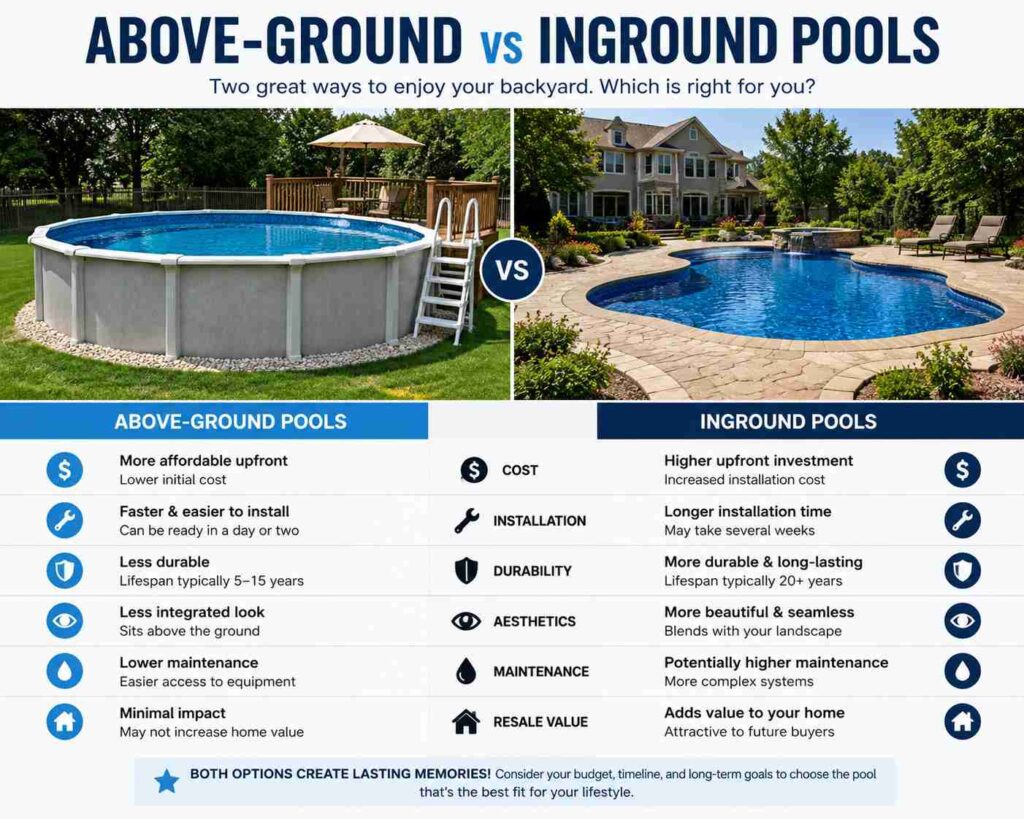
Above-Ground vs Inground Pools

Above-Ground vs Inground Pools: Cost, Installation, Maintenance and Backyard Fit

Above-ground vs inground pools compares two major backyard pool categories by price, installation work, lifespan, maintenance, design options, yard fit, safety rules, and long-term value. Above-ground pools suit lower budgets, faster setup, simpler yards, and seasonal use. Inground pools suit permanent backyard design, stronger property integration, longer lifespan, and more custom pool features.

Above-ground pool cost usually starts lower because the structure needs less excavation, less site work, and simpler equipment. Inground pool cost usually starts higher because the project includes excavation, plumbing, electrical work, backfill, decking, fencing, inspections, and a more permanent structure. The better choice depends on budget, yard layout, ownership timeline, maintenance capacity, permit requirements, and the planned use of the pool.

Quick Answer

Which is better, above-ground or inground?

Above-ground vs inground pools depends on budget, yard layout, ownership length, design goals, and maintenance expectations. Above-ground pools are better for lower upfront cost and faster setup. Inground pools are better for long-term use, durability, design integration, and custom backyard planning.

Which pool costs less?

Above-ground pools cost less to install than inground pools because they need less excavation, less structural work, and faster setup. A Canadian pool source lists above-ground pools at about $3,000 to $12,000, compared with a minimum of $20,000 for inground pools in its guide. A 2026 comparison guide lists above-ground pools at $4,000–$12,000 installed without decking, while inground pools usually range from $60,000 to $120,000+ by type, size, and features.

Which pool lasts longer?

Inground pools usually last longer than above-ground pools. Current comparison sources commonly list above-ground pools at about 7–15 years, while inground pools last for decades and often fall in the 20–50 year range, depending on material, installation quality, water care, climate, and maintenance.

Quick Overview
Factor Above-Ground Pools Inground Pools
Upfront cost Lower Higher
Installation time Faster Slower
Excavation Limited Required
Design flexibility Limited Higher
Lifespan Shorter Longer
Yard integration Lower Higher
Maintenance Similar core tasks Similar core tasks, often larger scale
Access Ladder or deck Built-in steps, deck, coping
Property value Lower impact Higher potential impact
Best use Lower-cost seasonal swimming Permanent backyard pool design

What are above-ground pools?

Above-ground pools are raised backyard pools installed on a prepared base instead of inside a full excavated hole. They suit lower budgets, faster setup, flat yards, and seasonal swimming. Common systems include steel-frame pools, resin-frame pools, and hard-sided pools with a vinyl liner, filter system, ladder, and cover.

How are above-ground pools built?

Above-ground pools are built by levelling the ground, preparing a stable pool base, assembling the frame or wall system, fitting the liner, connecting the pump and filter, adding the ladder, and filling the pool. Ground levelling matters because uneven support places pressure on the frame, wall, liner, and base.

What materials are used?

Above-ground pool materials include steel, resin, aluminium, vinyl liners, plastic fittings, pumps, filters, ladders, and covers. Steel-frame pools often lower upfront cost but need corrosion checks. Resin-frame pools resist rust better but usually cost more. Hard-sided pools use stronger wall panels and a liner for longer seasonal use.

What shapes are common?

Above-ground pool shapes are usually round or oval. Round pools often cost less because the shape spreads water pressure evenly and uses simpler framing. Oval pools provide more swimming length but need more side support and installation work.

What sizes are common?

Above-ground pool sizes range from small family pools to larger round or oval layouts. Common sizes include small round pools for cooling, medium round pools for family use, and oval pools for longer swimming space. Size affects water volume, filter capacity, ladder type, cover size, maintenance time, and deck cost.

What limits above-ground pools?

Above-ground pools have limits in depth, shape, design integration, access, and lifespan. Most use ladders or added decks instead of built-in steps and coping. They usually look less permanent than inground pools and fit best on flat yards. Seasonal use, liner care, frame corrosion, filter capacity, and winter protection affect long-term value.

What are inground pools?

Inground pools are permanent backyard pools built below ground level with excavation, structure, plumbing, electrical work, equipment, coping, decking, fencing, and inspections. They suit long-term use, stronger yard integration, deeper designs, built-in features, and custom backyard planning.

How are inground pools built?

Inground pools are built by excavating the site, preparing the base, installing the pool structure, adding plumbing lines, completing electrical work, placing equipment, backfilling, finishing the pool edge, and completing inspections. The project often includes decking, coping, fencing, drainage, and landscape repair.

What materials are used?

Inground pool materials include fibreglass, vinyl liner, and concrete systems. Fibreglass pools use a one-piece factory shell. Vinyl liner pools use wall panels, a floor base, and a fitted liner. Concrete pools use reinforced concrete, gunite, or shotcrete with a finished interior surface.

What shapes are common?

Inground pool shapes include rectangular, freeform, kidney, L-shaped, plunge, lap, and custom layouts. Fibreglass pools come in pre-moulded shapes. Vinyl liner pools offer flexible shapes through panel systems. Concrete pools offer the widest range of custom shapes and depths.

What sizes are common?

Inground pool sizes range from compact plunge pools to larger family pools and long lap pools. Size affects excavation, water volume, equipment capacity, heater size, decking area, cover size, fencing layout, and maintenance cost.

What limits inground pools?

Inground pools are limited by budget, yard access, soil, slope, groundwater, utility lines, setbacks, permits, and construction time. Tight access affects excavation and material delivery. Poor soil or high groundwater affects drainage and structure. Local rules affect pool fencing, equipment pads, inspections, and final approval.

Which pool costs less?

Above-ground pools cost less than inground pools because they need less excavation, less structural work, and faster installation. Inground pools cost more because the project usually includes excavation, grading, backfill, drainage, plumbing, electrical work, decking, fencing, equipment, and inspections.

Are above-ground pools cheaper?

Above-ground pools are cheaper than inground pools for most backyard projects. Their lower cost comes from a simpler frame, liner, base preparation, ladder, pump, and filter system. Optional deck access, fencing, electrical work, ground levelling, and winter care still affect the final price.

Are inground pools more expensive?

Inground pools are more expensive because they are permanent structures built below grade. The higher cost comes from excavation, plumbing, electrical work, equipment pads, backfill, coping, decking, fencing, inspections, and landscape repair.

What hidden costs affect above-ground pools?

Hidden above-ground pool costs include ground levelling, base material, electrical work, fencing, ladders, steps, decks, covers, filter upgrades, liner repair, frame repair, water delivery, winter kits, and landscaping repair.

What hidden costs affect inground pools?

Hidden inground pool costs include excavation changes, rock removal, soil disposal, grading, drainage, retaining walls, crane access, backfill, equipment pads, electrical work, bonding, decking, coping, fencing, permits, inspections, covers, water delivery, and landscape repair.

What budget range fits each pool?

Above-ground pool budgets fit lower upfront spending and seasonal use. Inground pool budgets fit permanent backyard design, longer use, and higher property integration. Maintenance still applies to both types. NerdWallet states that pool maintenance often costs $50 to $100 per hour on average for both in-ground and above-ground pools, while opening or closing a pool often costs around $200 to $300. Treat these figures as broad planning references, not fixed local quotes.

Cost Area Above-Ground Pool Inground Pool
Pool structure Lower Higher
Site work Ground levelling and base prep Excavation, grading, backfill, drainage
Equipment Pump, filter, ladder, cover Pump, filter, heater, lights, automation
Decking Optional but often needed for access Common for finished design
Fencing May be required Usually required
Repairs Liner, frame, filter Surface, liner, shell, equipment
Long-term cost Lower start, shorter life Higher start, longer use

Which pool installs faster?

Above-ground pools install faster than inground pools because they need less excavation, less structural work, fewer construction stages, and lower inspection load. Inground pools take longer because the project includes excavation, plumbing, electrical work, structural installation, decking, fencing, and inspections.

Why do above-ground pools install faster?

Above-ground pools install faster because the structure is assembled on a prepared base. The process usually includes ground levelling, base preparation, frame assembly, liner fitting, pump and filter setup, ladder installation, and filling.

Why do inground pools take longer?

Inground pools take longer because the pool sits below grade. The process includes excavation, grading, drainage, plumbing, electrical work, structural placement, backfill, coping, decking, fencing, inspections, and final finishing.

What site work slows installation?

Site work slows installation when the yard has tight access, slope, rock, clay, groundwater, poor drainage, trees, buried utilities, or limited equipment space. These conditions add grading, soil removal, drainage work, retaining walls, crane access, or hand labour.

What inspections affect installation?

Inspections affect installation when the project needs approval for fencing, gates, setbacks, electrical work, bonding, plumbing, drainage, or final pool enclosure compliance. Missing drawings, permit revisions, and failed inspections add delays.

What weather delays happen?

Weather delays happen when rain, freezing temperatures, soft ground, high groundwater, snow, or extreme heat affects excavation, base preparation, concrete work, backfill, decking, or finishing. Inground pool installation has higher weather sensitivity because more work happens below grade.

Installation Factor Above-Ground Pool Inground Pool
Site prep Levelling and base prep Excavation, grading, drainage
Structure Assembled on prepared ground Built or placed below grade
Time position Faster Longer
Labour Lower Higher
Inspection load Usually lower Usually higher
Weather sensitivity Medium Higher

Which pool needs less maintenance?

Above-ground pools and inground pools need similar core maintenance tasks. Both need water testing, skimming, vacuuming, filter care, chemical balance, and seasonal care where winter closing applies. Inground pools often involve larger water volume and more equipment. Above-ground pools often need more access effort when there is no surrounding deck.

Is water care similar?

Water care is similar for both pool types. Above-ground pools and inground pools need sanitizer testing, pH control, alkalinity checks, calcium hardness checks, debris removal, and filter maintenance.

Is cleaning access different?

Cleaning access is different because above-ground pools often use a ladder or partial deck. This makes edge cleaning harder when the pool has no full deck. Inground pools often have coping, patio space, or a full deck, which gives easier access around the pool edge.

Is equipment care different?

Equipment care is different by scale. Above-ground pools often use smaller pumps, filters, ladders, covers, and simpler systems. Inground pools often use larger pumps, filters, heaters, lights, automation, and sanitizer systems.

Is liner care different?

Liner care matters more for above-ground pools and vinyl liner inground pools. The liner needs gentle cleaning, proper water balance, leak checks, wrinkle checks, and protection from sharp objects. Fibreglass and concrete inground pools use different surface care instead.

Is winter care different?

Winter care depends on climate, pool type, equipment, and installation. Canadian outdoor pools often need winter closing, cover installation, plumbing protection, equipment shutdown, and water balancing before freeze conditions. Above-ground pools need frame, liner, wall, and cover protection. Inground pools need plumbing, skimmer, return, equipment pad, cover, and water-level protection.

Maintenance Task Above-Ground Pool Inground Pool
Water testing Required Required
Skimming Required Required
Vacuuming Required Required
Filter care Required Required
Chemical balance Required Required
Winter closing Climate-dependent Climate-dependent
Surface care Liner and wall care Surface depends on material
Access for cleaning Harder without a deck Easier with deck/coping

Which pool lasts longer?

Inground pools last longer than above-ground pools because they use more permanent structures and lower structural exposure. Above-ground pools have shorter frame, wall, and liner life because the structure sits above grade and faces more sun, wind, ice, and seasonal movement.

What is above-ground pool lifespan?

Above-ground pool lifespan is usually shorter than inground pool lifespan. Frame corrosion, liner wear, wall movement, sun exposure, pool cover use, water balance, and seasonal closing all affect how long the pool lasts.

What is inground pool lifespan?

Inground pool lifespan is usually longer because the main structure sits below grade and is built for permanent use. Fibreglass pools, vinyl liner pools, and concrete pools still need material-specific care. Vinyl liners need replacement. Concrete surfaces need resurfacing. Fibreglass shells need gelcoat and water balance care.

What affects frame life?

Frame life depends on material, installation quality, drainage, corrosion control, ground movement, and winter care. Steel-frame pools need rust checks. Resin-frame pools resist corrosion better, but joints, rails, uprights, ladders, and base plates still need inspection.

What affects pool surface life?

Pool surface life depends on water balance, cleaning method, sun exposure, freeze-thaw movement, cover use, and surface material. Vinyl liners need protection from punctures, wrinkles, fading, and poor chemistry. Concrete surfaces need brushing and resurfacing. Fibreglass gelcoat needs balanced water and gentle care.

What affects equipment life?

Equipment life depends on correct sizing, clean water, filter care, winterization, and protected storage. Pumps, filters, heaters, salt cells, covers, ladders, and valves last longer when seasonal closing removes water from vulnerable parts and protects the equipment pad.

Lifespan Factor Above-Ground Pool Inground Pool
Structure Shorter frame or wall lifespan Longer structural lifespan
Surface Liner replacement or patching Material-specific care
Equipment Smaller system replacement Larger system replacement
Weather exposure Higher wall/frame exposure Lower structural exposure
Long-term ownership More temporary More permanent

Which pool fits the yard better?

Yard fit depends on space, grade, access, soil, drainage, fencing, setbacks, and long-term design goals. Above-ground pools fit flat yards, lower-cost seasonal use, and temporary swimming. Inground pools fit finished landscapes, sloped yards, custom layouts, and permanent backyard design.

What pool fits small yards?

Small yards fit small above-ground pools, plunge pools, or compact inground pools. The right choice depends on setbacks, fence space, access, equipment placement, and remaining usable patio area.

What pool fits flat yards?

Flat yards fit both above-ground pools and inground pools. A flat, open yard reduces grading, retaining work, drainage changes, and installation cost. Above-ground pools usually offer the lower-cost option for flat yards.

What pool fits sloped yards?

Sloped yards fit inground pools, semi-inground pools, or engineered pool designs. Slopes need planned grading, drainage, retaining walls, deck height control, and structural support. Above-ground pools suit sloped yards only when base preparation stays safe and stable.

What pool fits narrow yards?

Narrow yards fit rectangular inground pools, lap pools, or narrow above-ground pools. Long, straight layouts use narrow space more efficiently than wide round designs.

What pool fits finished landscapes?

Finished landscapes fit inground pools better because the pool can connect with patios, coping, steps, seating areas, lighting, planting, drainage, and outdoor living zones. Above-ground pools have less design integration, unless the project adds a planned deck and landscape screen.

Yard Condition Better Fit
Flat open yard Above-ground pool or inground pool
Small yard Small above-ground pool, plunge pool, or compact inground pool
Sloped yard Inground, semi-inground, or engineered pool
Narrow yard Rectangular inground, lap pool, or narrow above-ground pool
Tight access Above-ground or panel-built inground pool
Finished landscape Inground pool
Temporary use Above-ground pool
Long-term design Inground pool

Which pool gives better design options?

Inground pools give better design options because they support more shapes, depths, entry styles, finishes, features, and landscape integration. Above-ground pools offer simpler design choices, usually with round or oval shapes, liner finishes, exterior walls, ladders, and optional deck access.

Which pool has more shapes?

Inground pools have more shapes than above-ground pools. Common inground shapes include rectangular, freeform, kidney, L-shaped, plunge, lap, and custom layouts. Above-ground pools are usually round or oval because these shapes support the raised wall structure.

Which pool has more depths?

Inground pools have more depth options because the structure is built or placed below grade. They support shallow zones, deeper swimming areas, sport depths, and custom depth transitions. Above-ground pools have limited depth because wall height and liner design restrict the structure.

Which pool has better deck integration?

Inground pools have better deck integration because the pool edge connects directly with coping, patios, walkways, stairs, drainage, landscaping, and outdoor seating. Above-ground pools need a raised deck or platform for better access and visual integration.

Which pool has better feature options?

Inground pools have better feature options because they support built-in steps, tanning ledges, benches, spas, lighting, water features, automatic covers, and custom edges. Above-ground pools have fewer built-in options and rely more on ladders, decks, covers, and exterior accessories.

Which pool has better visual finish?

Inground pools have better visual finish because they support more materials and landscape details. Finish options include vinyl liner, fibreglass gelcoat, plaster, tile, pebble, coping, stone, concrete, and integrated lighting. Above-ground pools usually depend on liner style, exterior wall finish, and deck screening.

Design Factor Above-Ground Pool Inground Pool
Shape options Usually round or oval Rectangular, freeform, custom, plunge, lap
Depth options Limited Wider range
Entry options Ladder or deck stairs Steps, tanning ledges, benches
Finish options Liner and exterior wall Liner, gelcoat, plaster, tile, pebble
Landscape integration Lower Higher
Custom features Limited Higher

Which pool is safer?

Pool safety depends on access control, fencing, gates, ladders, covers, supervision, slip control, and local enclosure rules. Above-ground pools add ladder and deck-access risks. Inground pools add open-edge, depth, coping, and patio-slip risks.

Does pool height affect access?

Pool height affects access because above-ground pools have raised walls. Raised walls reduce direct ground-level entry, but ladders, decks, steps, and nearby climbable objects create access points.

Removable ladders and locked deck gates improve access control when the pool is not in use.

Does fencing matter?

Fencing matters because a secure barrier limits unsupervised access. A safe pool enclosure includes a fence height set by local rules, non-climbable design, clear gate placement, and no gaps that allow easy entry.

Local enclosure rules decide fence height, gate hardware, setback checks, inspections, and permit needs.

Do ladders matter?

Ladders matter because they control entry into above-ground pools. A fixed ladder creates constant access. A removable ladder or lockable ladder reduces access when swimming is finished.

Deck stairs also need safe treads, handrails, gate control, and slip-resistant surfaces.

Do gates matter?

Gates matter because they control entry into the pool area. Self-closing gates and self-latching gates reduce access risk when people forget to close the gate.

Gate latches need secure height, smooth operation, and regular checks.

Do covers matter?

Pool covers matter because they reduce debris, support winter care, and help limit access when designed for safety use. A safety cover needs correct anchors, fit, load rating, and maintenance.

Supervision remains the main safety control during swimming. Barriers, gates, covers, ladders, deck access, and slip control support safety, but they do not replace active adult supervision.

What permits and rules apply?

Pool permits and rules depend on the municipality, pool depth, pool location, fence design, setbacks, utility lines, and inspection process. Above-ground pools and inground pools both need local rule checks before installation because fencing, access control, and site placement affect safety and approval.

Are permits needed?

Permits are needed when the municipality requires approval for a pool enclosure, zoning review, fence location, or related site work. Toronto requires a Zoning Applicable Law Certificate before applying for a Pool Fence Enclosure Permit for an outdoor pool or hot tub.

Are fences needed?

Fences are needed when local enclosure rules apply. Toronto states that a pool enclosure must completely enclose the pool area and cannot have openings except a gate that complies with the Fence Bylaw. Toronto also states that a pool cannot be constructed and filled with water until a fence is installed under Toronto Municipal Code Chapter 447 – Fences.

Are setbacks checked?

Setbacks are checked during zoning review. The Zoning Applicable Law Certificate process reviews pool placement and required drawings before the Pool Fence Enclosure Permit application. Setback issues may require design changes before approval.

Are inspections needed?

Inspections are needed to confirm the pool enclosure follows the approved permit and safety rules. Toronto says a complete Pool Fence Enclosure Permit application takes about 5 business days to review, with longer timing when information is missing or extra details are requested.

Are utility locates needed?

Utility locates are needed before excavation, fence posts, deck posts, trenching, grading, or equipment-pad work. Utility locates reduce the risk of damaging buried gas, hydro, water, telecom, or drainage services before either above-ground pool or inground pool installation begins.

Pool rule planning should include zoning review, fence permits, gates, setbacks, inspections, utility locates, drawings, and permit fees in the first budget. This prevents delays, redesigns, unsafe access, and compliance issues after installation starts.

Which pool adds more value?

Inground pools usually add more value than above-ground pools when the pool is well maintained, safely fenced, permitted, and integrated with the yard. Above-ground pools usually have lower resale impact because they are less permanent and easier to remove. HGTV notes that above-ground pools generally add no value to a home, while inground pool value depends on property type, market demand, climate, condition, and buyer preference.

Do above-ground pools add value?

Above-ground pools usually add limited value because they are viewed as temporary backyard features. Their main value comes from lower-cost seasonal use, not permanent property improvement. A clean, safe, well-placed above-ground pool may improve buyer appeal for some households, but it usually has weaker resale impact than an inground pool.

Do inground pools add value?

Inground pools add more value when buyers want a permanent pool and the yard design supports outdoor living. Canadian real estate guidance states that an inground pool may increase property value, but the gain is often conditional and usually depends on neighbourhood demand, property type, climate, upkeep, and installation quality.

Does pool condition matter?

Pool condition matters because buyers treat poor condition as a future repair cost. Clear water, a clean liner or surface, working equipment, safe decking, strong coping, a good cover, and maintenance records support value. Leaks, worn liners, frame corrosion, rough surfaces, stained finishes, and unsafe access reduce buyer confidence.

Does yard design matter?

Yard design matters because the pool must fit the property. Inground pools usually support stronger value when the pool connects with patios, landscaping, fencing, seating, lighting, drainage, and outdoor living zones. Above-ground pools need planned deck access and landscape screening to look more integrated.

Does buyer demand matter?

Buyer demand matters because pools add value only when local buyers want the feature. Warm-weather markets, higher-end properties, larger lots, and neighbourhoods where pools are common usually support stronger demand. Smaller yards, cold-climate concerns, safety concerns, and high maintenance expectations may reduce appeal.

Value Factor Above-Ground Pool Inground Pool
Permanent yard value Lower Higher
Buyer appeal Mixed Stronger where pools are desired
Removal impact Easier to remove Permanent structure
Maintenance concern Lower starting cost Higher ongoing responsibility
Resale impact Usually limited Condition and market dependent

Which pool is better for each use?

Above-ground pools are better for lower-cost family use, temporary swimming, and simple seasonal cooling. Inground pools are better for fitness swimming, entertaining, long-term ownership, permanent backyard design, and higher-end landscapes.

Which pool suits families?

Above-ground pools suit families that want lower-cost seasonal swimming. Inground pools suit families that want more space, built-in steps, deeper layouts, stronger deck integration, and long-term backyard use.

Which pool suits kids?

Above-ground pools suit small children’s recreation when the pool has compliant safety controls. Key safety features include a secure barrier, self-closing gate, controlled ladder access, non-slip deck surfaces, and active supervision.

Which pool suits fitness?

Inground lap pools suit fitness because the long, straight shape supports repeat swimming, private workouts, and low-impact exercise. Above-ground pools suit basic movement and play, but they usually lack the length needed for steady lap swimming.

Which pool suits entertaining?

Inground pools suit entertaining because they connect better with patios, coping, decks, seating, lighting, landscaping, and outdoor dining areas. Custom features such as benches, ledges, spas, and water features support a planned entertainment space.

Which pool suits long-term ownership?

Inground pools suit long-term ownership because they provide a more permanent structure, stronger yard integration, and more design options. Above-ground pools suit shorter-term use because they cost less, install faster, and are easier to remove.

Use Case Better Fit
Lower-cost family use Above-ground pool
Temporary swimming Above-ground pool
Small children’s recreation Above-ground pool with compliant safety controls
Fitness swimming Inground lap pool
Entertaining Inground pool
Permanent backyard design Inground pool
Simple seasonal cooling Above-ground pool
Higher-end landscape Inground pool

Which pool fits Canadian weather?

Canadian weather fits above-ground pools and inground pools when the installation includes winterization, freeze-thaw protection, water-level control, winter covers, and protected equipment. Inground pools handle long-term cold-climate use better because the structure sits below grade. Above-ground pools need more care around the frame, wall, liner, ladder, and cover because these parts stay exposed to wind, snow, ice, and temperature shifts.

Which pool needs winter closing?

Above-ground pools and inground pools need winter closing in most Canadian climates. Seasonal closing protects the water, liner, surface, plumbing, pump, filter, heater, cover, and equipment pad before freezing weather begins.

A proper winterization process includes water balancing, debris removal, water-level adjustment, plumbing-line protection, equipment shutdown, cover installation, and final safety checks.

Which pool handles freeze-thaw better?

Inground pools handle freeze-thaw movement better when the structure, drainage, backfill, water level, and cover system are installed correctly. Fibreglass, vinyl liner, and concrete inground pools still need protection from ice expansion, groundwater pressure, and seasonal soil movement.

Above-ground pools face more direct freeze-thaw stress because the wall, frame, liner, and ladder stay above grade. Frame corrosion, liner movement, wall pressure, and cover strain need regular checks.

Which pool needs a winter cover?

Above-ground pools and inground pools need a winter cover or safety cover during the closed season. A cover limits debris, sunlight, water contamination, and unsafe access.

Snow load matters because heavy snow places weight on the cover, anchors, frame, deck, or pool wall. Safety covers need correct fit, secure anchoring, and load-rated installation.

Which equipment needs protection?

Pool equipment needs protection before freezing temperatures arrive. Key items include plumbing lines, pump, filter, heater, salt cell, chlorinator, valves, skimmers, returns, main drain lines, cover system, and equipment pad.

Above-ground pools often need pump storage and filter storage in a dry, protected place. Inground pools need plumbing blowout, line plugs, equipment shutdown, and pad protection.

Which structure needs more care?

Above-ground pool structures need more winter care because the frame, wall, liner, ladder, and exterior supports stay exposed. Steel-frame pools need corrosion checks. Resin-frame pools need joint, rail, and base-plate checks. Hard-sided pools need wall movement and liner inspection.

Inground pool structures need care around water level, hydrostatic pressure, plumbing lines, deck movement, coping, surface condition, and seasonal opening. Spring opening checks water balance, cover condition, filter pressure, equipment seals, plumbing leaks, and visible winter damage.

When is above-ground better?

Above-ground pools are better when the homeowner needs lower installation cost, faster setup, temporary use, flat-yard placement, and simple seasonal swimming. They suit projects where budget, speed, and easy removal matter more than permanent design integration.

Is above-ground better for low budgets?

Above-ground pools are better for low budgets because they need less excavation, less structural work, and simpler installation than inground pools. Decking, fencing, electrical work, and ground levelling still need budget space.

Is above-ground better for fast setup?

Above-ground pools are better for fast setup because the structure is assembled on a prepared base. The project usually needs ground levelling, base preparation, frame assembly, liner fitting, filter connection, ladder installation, and filling.

Is above-ground better for temporary use?

Above-ground pools are better for temporary use because they are easier to remove than inground pools. This suits homeowners who want seasonal swimming without a permanent backyard structure.

Is above-ground better for flat yards?

Above-ground pools are better for flat yards because a level site reduces base preparation, frame stress, liner movement, and installation cost. Sloped yards often need grading, drainage, or retaining work before safe setup.

Is above-ground better for simple swimming?

Above-ground pools are better for simple swimming when the main goal is cooling, family play, or seasonal recreation. They have fewer design options than inground pools, but they meet basic swimming needs at a lower starting cost.

Above-Ground Pool Is Better When Reason
Budget is limited Lower installation cost
Setup needs to be faster Less construction work
The yard is flat Easier base preparation
Long-term permanence is not needed Easier removal
Simple swimming is enough Fewer design needs

When is inground better?

Inground pools are better when the homeowner needs long-term use, custom design, strong yard integration, deeper swimming areas, fitness layouts, higher-end finishes, and stronger resale appeal. They suit permanent backyard plans where structure, function, and property design matter more than the lowest starting cost.

Is inground better for long-term use?

Inground pools are better for long-term use because they use a more permanent structure than above-ground pools. Fibreglass, vinyl liner, and concrete pools support longer ownership when installation, drainage, water care, and winter closing are managed correctly.

Is inground better for custom design?

Inground pools are better for custom design because they offer more shapes, depths, entries, finishes, and built-in features. Concrete pools give the most design freedom. Fibreglass pools offer pre-moulded feature layouts. Vinyl liner pools offer flexible shapes with liner finish choices.

Is inground better for property integration?

Inground pools are better for property integration because the pool edge connects with coping, patios, decking, landscaping, lighting, drainage, and outdoor living areas. This creates a more finished backyard than most above-ground pool layouts.

Is inground better for deeper pools?

Inground pools are better for deeper pools because below-grade construction supports wider depth options. Inground pool layouts can include shallow zones, sport depths, deeper swimming areas, tanning ledges, steps, and lap layouts.

Is inground better for resale appeal?

Inground pools are better for resale appeal when the pool is well maintained, safely fenced, permitted, and matched to buyer demand. Strong resale appeal depends on pool condition, yard design, maintenance records, fencing, and local market expectations.

Inground Pool Is Better When Reason
Long-term use matters More permanent structure
Design flexibility matters More shapes, depths, and features
Yard integration matters Better connection with patios and landscaping
Fitness use matters Lap and deeper designs are possible
Higher finish matters More premium surface and coping options

What mistakes increase costs?

Above-ground vs inground pool mistakes increase costs when homeowners compare only the pool price and ignore the finished project cost. The real budget includes site preparation, decking, fencing, permits, access, maintenance, winter care, replacement parts, and long-term use.

Above-ground vs inground pool mistakes usually come from comparing only the pool price and ignoring site preparation, decking, fencing, permits, access, maintenance, winter care, replacement parts, and long-term use.

Is choosing by price only a mistake?

Choosing by price only is a mistake because the lowest pool price does not show the total installed cost. A cheap above-ground pool still needs ground levelling, base material, electrical work, safe access, fencing where required, water care, and winter protection. A cheaper inground pool quote may exclude excavation changes, drainage, decking, covers, or permit costs.

Is ignoring deck cost a mistake?

Ignoring deck cost is a mistake because deck access often turns a low-cost pool into a larger project. Above-ground pools may need stairs, railings, gates, or a raised deck for safe entry. Inground pools often need coping, patio space, drainage, retaining edges, and finished hardscaping.

Is ignoring fence cost a mistake?

Ignoring fence cost is a mistake because local enclosure rules may require a compliant fence, gate, latch, permit, and inspection. Pool fencing affects both above-ground pools and inground pools when municipal rules apply.

Is ignoring maintenance a mistake?

Ignoring maintenance is a mistake because both pool types need water testing, skimming, vacuuming, filter care, chemical balance, opening, closing, and repairs. Above-ground pools need liner, frame, ladder, cover, and filter care. Inground pools need surface, equipment, plumbing, and seasonal care.

Is ignoring lifespan a mistake?

Ignoring lifespan is a mistake because above-ground pools usually have a shorter frame, wall, and liner life. Inground pools cost more upfront but often support longer use, stronger yard integration, and better long-term value.

Cost-increasing mistakes include:

  • Comparing only the pool price.
  • Leaving out site preparation.
  • Ignoring decking and safe access.
  • Ignoring fencing, gates, permits, and inspections.
  • Missing electrical work and bonding.
  • Underestimating maintenance and water care.
  • Forgetting winter care and seasonal closing.
  • Ignoring replacement parts such as liners, frames, pumps, filters, covers, and heaters.
  • Choosing a pool that does not fit the yard, use, or ownership timeline.

How do you compare quotes?

Pool quotes should be compared by the final installed price, not only the pool structure price. A fair comparison checks site prep, equipment, electrical work, decking, fencing, permits, warranty, and exclusions for both above-ground pools and inground pools.

What must above-ground quotes include?

Above-ground pool quotes must include the frame, wall, liner, ladder, pump, filter, base material, ground levelling, electrical needs, cover, water care, access deck if needed, and local enclosure compliance.

What must inground quotes include?

Inground pool quotes must include the shell, liner, concrete, or wall system, plus excavation, grading, drainage, plumbing, electrical work, bonding, equipment pad, pump, filter, heater, lights, automation, coping, decking, fencing, permits, inspections, and surface finish.

What costs are often excluded?

Excluded costs often include landscaping, water delivery, winter kits, retaining walls, drainage fixes, rock removal, soil disposal, covers, electrical upgrades, fence changes, permit fees, and repair work after installation.

What warranty terms matter?

Warranty terms must show coverage for the frame, liner, shell, surface, equipment, structure, leaks, labour, and installation defects. The quote should separate manufacturer warranty from installer warranty.

What final price should be compared?

The final price should include the full installed pool, safe access, required permits, enclosure compliance, equipment, electrical work, decking, water startup, winter care needs, and all exclusions. This gives a clearer comparison between above-ground pool cost and inground pool cost.

Quote Item Above-Ground Pool Inground Pool
Pool structure Frame, wall, liner, ladder Shell, liner, concrete, or wall system
Site prep Ground levelling, base material Excavation, grading, drainage
Equipment Pump, filter, ladder, cover Pump, filter, heater, lights, automation
Electrical Power needs and bonding Electrical work and bonding
Decking Optional access deck Coping, patio, hardscape
Fencing Local enclosure compliance Local enclosure compliance
Permits Municipality-dependent Municipality-dependent
Warranty Frame, liner, equipment Structure, surface, equipment, labour
Exclusions Landscaping, water, winter kit Landscaping, retaining walls, covers

How does pool type affect insurance?

Pool type affects home insurance through structure classification, replacement value, liability risk, access control, fencing, and safety equipment. Above-ground pools are sometimes treated as less permanent property, while inground pools are often treated as a more permanent structure. Canadian insurance guidance notes that pools increase liability risk, replacement cost, and potential water-damage exposure.

Does fencing affect insurance?

Fencing affects insurance because it reduces unsupervised pool access and supports safety compliance. Health Canada recommends a pool fence at least 1.2 metres high, with a self-closing and self-latching gate, and says local rules should be checked before building a pool fence.

Does liability coverage matter?

Liability coverage matters because pool owners face higher injury risk around water, decks, ladders, and wet surfaces. Canadian insurance guidance states that homeowners may be held liable for injuries linked to pool use, including incidents involving guests. Higher liability limits or an umbrella policy may be reviewed before installation.

Does pool access affect risk?

Pool access affects risk because ladders, decks, gates, low barriers, poor lighting, and open entry points increase the chance of unsupervised access. Above-ground pools need controlled ladder or deck access. Inground pools need secure perimeter fencing, safe coping, non-slip deck areas, and clear entry points.

Does safety equipment matter?

Safety equipment matters because insurers and municipalities assess risk controls, not only pool type. Useful controls include a compliant pool fence, locked gate, self-closing gate, self-latching gate, safety cover, pool alarm, rescue hook, life ring, clear lighting, and non-slip deck surface.

Insurance value improves when the pool is disclosed to the insurer, the enclosure meets local rules, liability coverage matches the risk, and safety equipment stays in place.

How does pool type affect energy use?

Pool type affects energy use through water volume, pump size, pump runtime, heater use, cover use, wind exposure, and season length. Above-ground pools often use less energy because many models are smaller and seasonal. Inground pools often use more energy because they are larger, heated more often, and may include lights, automation, water features, and longer pump cycles.

Does pool size affect heating?

Pool size affects heating because larger water volume needs more energy to warm and maintain temperature. Larger surface area also increases evaporation, which is a major source of pool heat loss. Inground pools often have higher heating demand than smaller above-ground pools because they hold more water and are used for longer seasons.

Does pump size affect power use?

Pump size affects power use because oversized or older single-speed pumps use more electricity than needed for basic filtration. Natural Resources Canada states that an ENERGY STAR certified in-ground pool pump uses up to 65% less energy, on average, than a standard model. ENERGY STAR states that variable-speed and multi-speed pool pumps help cut energy costs by matching pump speed to filtration and pool-use needs.

Does a pool cover reduce heat loss?

A pool cover reduces heat loss by cutting evaporation when the pool is not in use. The U.S. Department of Energy states that pool covers are the most effective way to reduce pool heating costs, with possible savings of 50%–70%. Covers also reduce evaporation in indoor pools, which lowers ventilation demand.

Does wind exposure increase cost?

Wind exposure increases cost because moving air speeds evaporation and heat loss from the pool surface. A pool in an open, windy yard needs more heating than a sheltered pool with a fitted cover. Wind screens, fencing, landscape placement, and regular cover use reduce heat loss without changing the pool structure.

Energy use stays lower when the pool size matches the intended use, the pump is efficient, the heater is sized correctly, the cover is used often, and the pool layout reduces wind exposure.

How does pool type affect maintenance time?

Pool type affects maintenance time through water volume, deck access, surface material, equipment size, debris load, and seasonal closing needs. Above-ground pools often have smaller water volume, but cleaning takes longer when there is no full deck. Inground pools often have larger water volume, but coping and patio access make cleaning easier.

Does pool size change cleaning time?

Pool size changes cleaning time because larger pools have more surface area, more water, more debris, and longer vacuuming needs. Smaller above-ground pools often take less time to skim and vacuum. Larger inground pools need more time for brushing, water testing, filter care, and chemical balancing.

Does deck access change cleaning time?

Deck access changes cleaning time because full access around the pool edge makes skimming, brushing, vacuuming, and cover handling easier. Above-ground pools without decks are harder to clean around the outside edge. Inground pools usually have coping, patios, or hardscape paths that improve cleaning access.

Does surface type change care?

Surface type changes care because each pool material needs different cleaning. Vinyl liner pools need gentle brushing and liner checks. Fibreglass pools need gelcoat care and water balance control. Concrete pools need more brushing because plaster, pebble, and aggregate surfaces hold more dirt, algae, and scale.

Does winter closing change time?

Winter closing changes maintenance time in Canadian climates because outdoor pools need seasonal protection. Above-ground pools need liner, frame, ladder, wall, pump, filter, and cover care. Inground pools need plumbing-line protection, equipment shutdown, water-level control, safety cover fitting, and equipment-pad checks.

Maintenance time stays lower when the pool size fits actual use, access is clear, the surface is easy to clean, the filter system is sized correctly, and seasonal opening and closing are planned before winter.

How does pool type affect removal?

Pool type affects removal through structure depth, access, demolition work, backfill needs, landscaping repair, and permit rules. Above-ground pool removal is usually easier because the pool sits on the ground. Inground pool removal is harder because the structure sits below grade and often needs demolition, drainage planning, engineered backfill, compaction, and yard restoration.

Is above-ground pool removal easier?

Above-ground pool removal is easier because the frame, wall, liner, ladder, pump, filter, and cover can be dismantled above grade. Removal still affects the yard when the pool base leaves compacted soil, sand, gravel, dead grass, drainage changes, or deck damage.

Is inground pool removal harder?

Inground pool removal is harder because the pool structure sits below grade. Removal may include draining, cutting concrete or fibreglass, removing liners or wall systems, disconnecting plumbing and electrical lines, breaking the shell, managing drainage, adding fill, compacting soil, and restoring the yard.

Does removal affect landscaping?

Pool removal affects landscaping because access routes, demolition, fill, compaction, and grading disturb lawns, patios, planting beds, fences, decks, and drainage paths. Above-ground pools often leave a circular or oval base mark. Inground pools leave a larger excavation area that needs stable backfill and surface restoration.

Does removal need permits?

Pool removal may need permits when demolition, excavation, backfilling, grading, drainage changes, or structural removal is involved. Rules vary by municipality. Toronto’s demolition permit guidance says approved permit drawings must be reviewed before work starts, the permit card must be posted on site, and inspections must be arranged at the right construction stages. Utility approvals may also be required.

Utility locates are needed before digging, excavation, fence-post removal, deck removal, trenching, or grading. Ontario One Call says homeowners must submit a locate request at least 5 business days before digging so buried infrastructure owners can mark public utility lines.

FAQs About Above-Ground vs Inground Pools

Are above-ground pools cheaper than inground pools?

Above-ground pools are cheaper than inground pools because they need less excavation, less structural work, and faster setup. Current cost guidance states that in-ground pools are typically much more expensive than above-ground pools, although price changes by size, material, and features.

Inground pools are better for long-term use, custom design, yard integration, and resale appeal. Above-ground pools are better for lower budgets, faster setup, simple seasonal swimming, and easier removal.

Above-ground pools need permits when local rules require approval for pool enclosures, fences, setbacks, or inspections. Rules vary by municipality, so the permit need depends on pool depth, placement, access, and local safety rules.

Inground pools need local approval when the municipality requires zoning review, pool enclosure approval, fence permits, inspections, or related site-work permits. Toronto requires a Zoning Applicable Law Certificate before a Pool Fence Enclosure Permit application.

Above-ground pools need fencing when local enclosure rules apply. Toronto states that a pool cannot be constructed and filled with water without a fence installed under Toronto Municipal Code Chapter 447 – Fences.

Inground pools usually add more value than above-ground pools when they are well maintained, safely fenced, permitted, and matched to buyer demand. Above-ground pools usually have lower resale impact because they are less permanent and easier to remove.

Above-ground pools install faster because they need ground levelling, base preparation, frame assembly, liner fitting, and equipment setup. Inground pools take longer because they need excavation, plumbing, electrical work, structural installation, decking, fencing, and inspections.

Inground pools last longer than above-ground pools in most cases. Comparison guidance commonly lists above-ground pools at about 7–15 years, while inground pools can last for decades, depending on material, care, installation quality, and climate.

Above-ground pools and inground pools need similar core care, including water testing, skimming, vacuuming, filter care, and chemical balance. Above-ground pools may be harder to clean around the perimeter without a surrounding deck.

Small above-ground pools, plunge pools, and compact inground pools fit small yards. Above-ground pools suit lower budgets and temporary use. Compact inground pools suit permanent design and stronger yard integration.

Above-ground pools are better for lower-cost family use and simple seasonal swimming. Inground pools are better for long-term family use because they offer more depth options, built-in steps, seating, and stronger deck integration.

Inground pools usually handle Canadian winters better when winterization, drainage, water level, safety cover, and equipment protection are managed correctly. Above-ground pools need extra care for frame corrosion, liner wear, wall movement, snow load, ice expansion, pump storage, and filter storage.

Above-ground pools often have lower lifetime cost when the homeowner wants seasonal use and accepts shorter lifespan. Inground pools cost more upfront but may deliver better long-term value through longer use, permanent yard integration, and stronger design options.

Neither pool type is automatically safer. Pool safety depends on barriers, fencing, self-closing gates, self-latching gates, ladder control, safety covers, supervision, lighting, and slip control. Above-ground pools need controlled ladder or deck access. Inground pools need secure perimeter fencing and safe deck surfaces.

Inground pools are usually better for resale when the pool is well maintained, permitted, safely fenced, and integrated into the landscape. Above-ground pools usually have limited resale impact because they are more temporary and easier to remove.

Scroll to Top

    Your Name *

    Email Address *

    Preferred method of communication*

    Enter you phone number *

    Your address*

    Your demands and expectations