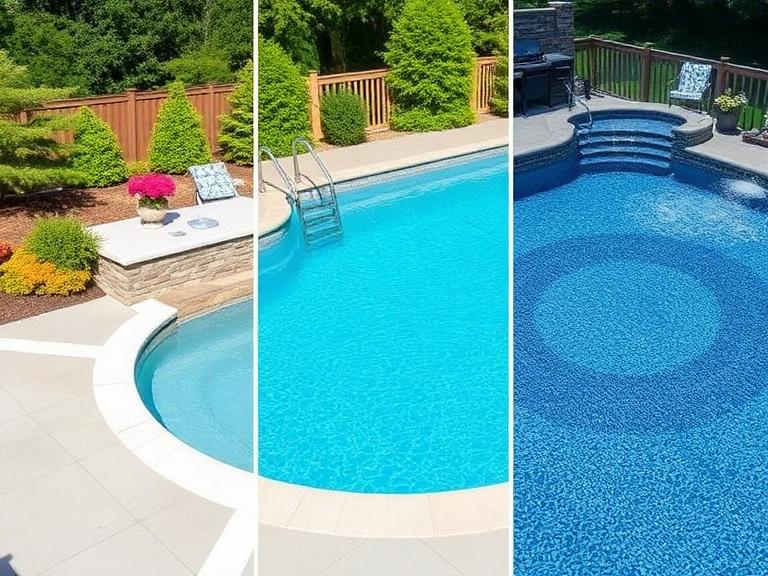
Fibreglass vs vinyl vs concrete pools compares three major inground pool materials by cost, installation time, design flexibility, maintenance, surface feel, repair needs, Canadian climate fit, and long-term ownership value.
Fibreglass pools fit homeowners who want faster installation, a smooth gelcoat surface, and lower maintenance. Vinyl liner pools fit homeowners who want a lower upfront cost, smooth liner surface, and flexible pool shapes. Concrete pools fit homeowners who want custom design, custom depth, complex shapes, and premium finishes such as plaster, tile, pebble, or aggregate.
Quick Answer
Which pool material is best?
Fibreglass pools are best for low maintenance and faster installation. Vinyl liner pools are best for lower upfront cost and flexible layouts. Concrete pools are best for custom design, custom depth, and high-end finishes.
Which pool costs less?
Vinyl liner pools usually have the lowest upfront cost. Fibreglass pools sit in the middle because the factory-moulded shell and installation process balance material cost and labour time. Concrete pools usually cost the most because they need more labour, structural work, surface finishing, and construction time.
Which pool lasts longest?
Concrete pools have a long structural life, but they need resurfacing during ownership. Fibreglass pools have a long shell life and lower surface maintenance because of the smooth gelcoat finish. Vinyl liner pools have a long wall structure life, but the vinyl liner needs replacement during ownership.
Quick Overview
| Decision Factor | Fibreglass Pool | Vinyl Liner Pool | Concrete Pool |
|---|---|---|---|
| Upfront Cost | Medium | Lower | Higher |
| Long-Term Cost | Very Low | High (Liner changes) | Very High (Resurfacing) |
| Installation Speed | Faster (2–3 Weeks) | Medium (6–10 Weeks) | Slower (3–5 Months) |
| Durability | High (25–30+ years) | Low (Liner 5–10 years) | Very High (10–20 years+) |
| Design Flexibility | Limited to shell designs | Flexible | Highest |
| Maintenance Level | Lower | Medium | Higher |
| Customization | Limited Models | Moderate (Shapes) | Unlimited |
| Surface Feel | Smooth | Soft/Slick | Rough/Hard (Depends on finish) |
| Repair Cycle | Gelcoat care | Liner replacement | Resurfacing |
| Best Use | Low-maintenance ownership | Lower initial budget | Custom design |
What are the main pool materials?
Fibreglass, vinyl liner, and concrete are the three main inground pool materials. Each material changes the pool cost, installation time, maintenance level, surface feel, design options, and repair cycle.
What is a fibreglass pool?
A fibreglass pool uses a factory-moulded pool shell with a smooth gelcoat surface. The shell arrives as one pre-made piece and sits inside an excavated hole.
Fibreglass pools suit homeowners who want faster installation, lower surface care, and a smooth non-porous finish. Shape, size, depth, and built-in features depend on available shell designs.
What is a vinyl liner pool?
A vinyl liner pool uses structural wall panels with a fitted vinyl liner over the floor and walls. The liner creates the pool’s visible surface.
Vinyl liner pools suit homeowners who want lower upfront cost, smooth surface feel, and flexible layout options. The main long-term cost is liner replacement after wear, fading, wrinkles, or damage.
What is a concrete pool?
A concrete pool uses gunite or shotcrete to form a reinforced pool shell on site. The surface then receives a finish such as plaster, tile, pebble, or aggregate.
Concrete pools suit homeowners who want custom shape, custom depth, built-in benches, beach entries, tanning ledges, or premium finishes. The main long-term cost is resurfacing.
What makes each pool material different?
Each pool material differs by structure, surface, design limits, labour needs, and renewal work. Fibreglass pools use a pre-built shell. Vinyl liner pools use wall panels and a replaceable liner. Concrete pools use a formed shell built on site.
Material choice affects these ownership factors:
| Factor | Fibreglass Pool | Vinyl Liner Pool | Concrete Pool |
|---|---|---|---|
| Structure | One-piece shell | Wall panel system | Reinforced concrete shell |
| Surface | Gelcoat | Vinyl liner | Plaster, tile, pebble, or aggregate |
| Design Range | Pre-set shell designs | Flexible layouts | Fully custom |
| Main Repair Cycle | Gelcoat care | Liner replacement | Resurfacing |
| Best Fit | Low-maintenance ownership | Lower initial budget | Custom design |
What do all three pool types share?
Fibreglass, vinyl liner, and concrete pools all need proper excavation, plumbing, electrical work, pool equipment, water care, fencing, permits, and seasonal maintenance.
Each inground pool type also needs safe access, correct drainage, a stable base, balanced water chemistry, and regular inspection. The material changes the build method and surface care, not the need for safe construction and long-term maintenance.
How do fibreglass, vinyl and concrete pools compare?
Fibreglass, vinyl liner, and concrete pools compare by installation speed, upfront cost, maintenance level, design freedom, and long-term ownership needs. Fibreglass pools rank highest for speed and low maintenance. Vinyl liner pools rank highest for lower initial cost. Concrete pools rank highest for custom design.
Which pool installs fastest?
Fibreglass pools install fastest because the pool shell arrives as one factory-moulded unit. The main site work includes excavation, base preparation, shell placement, plumbing, backfill, coping, decking, and startup.
Vinyl liner pools take more time because crews build the wall panel system, prepare the floor, install plumbing, and fit the vinyl liner.
Concrete pools take the longest because crews form the shape on site, apply gunite or shotcrete, allow curing, and add the final plaster, tile, pebble, or aggregate finish.
Which pool costs less upfront?
Vinyl liner pools cost less upfront because the wall panel system and vinyl liner reduce initial material and finishing costs. Fibreglass pools sit in the middle because the pre-built shell cost replaces some on-site labour. Concrete pools cost more upfront because the structure, labour, finish, and construction time increase the total project price.
Main upfront cost drivers include excavation, equipment, decking, fencing, landscaping, site access, drainage, soil conditions, and permit requirements.
Which pool needs less maintenance?
Fibreglass pools need less maintenance because the smooth gelcoat surface is non-porous and easier to brush. The surface limits algae grip and reduces heavy cleaning demands.
Vinyl liner pools need moderate maintenance because the liner needs careful water balance, stain control, tear prevention, and replacement during ownership.
Concrete pools need more maintenance because plaster, aggregate, and some textured finishes have more surface porosity. These surfaces need more brushing, closer water balance, and future resurfacing.
Which pool gives more design freedom?
Concrete pools give the most design freedom because crews form the pool shell on site. Concrete suits custom shapes, custom depths, beach entries, vanishing edges, tanning ledges, integrated spas, and premium finishes.
Vinyl liner pools give strong design flexibility because the wall system supports many layouts, including rectangular pools, Roman ends, and freeform pools.
Fibreglass pools give less design freedom because each pool must match a pre-set shell design, size, and depth.
Which pool fits long-term ownership?
Fibreglass pools fit long-term ownership for homeowners who want lower cleaning effort, a smooth surface, and fewer major surface renewals.
Vinyl liner pools fit long-term ownership for homeowners who want lower starting cost and accept future liner replacement as part of the budget.
Concrete pools fit long-term ownership for homeowners who want a fully custom pool and accept higher maintenance, higher surface care, and future resurfacing.
What is a fibreglass pool?
A fibreglass pool is an inground pool made from a factory-moulded fibreglass shell. The shell includes a smooth gelcoat surface, built-in steps, benches, ledges, and a pre-set shape.
Fibreglass pools suit homeowners who want faster installation, lower maintenance, and a smooth surface that feels comfortable underfoot. The main trade-off is design choice. Each pool must match an available shell model.
How does a fibreglass pool shell work?
A fibreglass pool shell works as one pre-built structure. The manufacturer builds the pool in a mould, adds structural layers, and finishes the surface with gelcoat.
The shell arrives at the property in one piece. Installers excavate the yard, prepare the base, lower the shell into place, connect plumbing, complete backfill, and finish the surrounding coping and decking.
The gelcoat surface creates a smooth, non-porous finish. This surface reduces dirt grip, limits algae attachment, and lowers brushing needs compared with rougher pool surfaces.
What shapes are available?
Fibreglass pool shapes come from pre-set shell designs. Common shapes include rectangular pools, freeform pools, Roman-end pools, kidney-shaped pools, and compact plunge-style layouts.
Many shell models include built-in steps, benches, tanning ledges, and shallow seating zones. Shape choice depends on the manufacturer’s catalogue, yard size, and delivery access.
What sizes are available?
Fibreglass pool sizes range from small backyard pools to larger family pools. Common residential models include compact pools for tight yards, medium pools for family use, and longer models for exercise or lap-style swimming.
Size choice depends on the available shell catalogue, site access, crane placement, setback rules, and the planned pool area. A large shell needs enough delivery space through the street, driveway, side yard, or crane lift zone.
What benefits does fibreglass provide?
Fibreglass provides lower surface maintenance, faster installation, and a smooth swimming surface. The factory-built shell reduces on-site construction time because the main pool structure arrives ready for placement.
Key benefits include:
| Benefit | What It Means for Ownership |
|---|---|
| Smooth Gelcoat Surface | Softer surface feel and easier cleaning |
| Non-Porous Finish | Less algae grip and lower brushing demand |
| Factory-Moulded Shell | More controlled shell quality before installation |
| Faster Installation | Less on-site build time than concrete |
| Built-In Features | Steps, benches, and ledges included in many models |
| Lower Surface Care | Fewer routine surface demands than rougher finishes |
What limits does fibreglass have?
Fibreglass has limits in shape choice, depth choice, shell size, delivery access, and built-in feature placement. The pool must match an existing factory mould.
A restricted side yard, narrow driveway, steep grade, overhead wires, tight road access, or limited crane space creates access challenges. Large shells need clear delivery planning before excavation starts.
Main limits include:
| Limit | Why It Matters |
|---|---|
| Pre-Set Shapes | Custom shapes are not formed on site |
| Pre-Set Depths | Deep-end and slope options depend on shell design |
| Transport Size Limits | Large shells need proper road and delivery access |
| Crane Access | Tight yards need careful lift planning |
| Fixed Feature Locations | Steps, benches, and ledges stay where the shell design places them |
| Gelcoat Repair Needs | Chips, fading, or surface damage need proper repair methods |
What is a vinyl liner pool?
A vinyl liner pool is an inground pool built with structural wall panels and a fitted vinyl liner. The liner forms the visible pool surface across the walls, floor, steps, and corners.
Vinyl liner pools suit homeowners who want lower upfront cost, custom shapes, smooth surface feel, and many liner colour and liner pattern choices. The main long-term cost is liner replacement.
How does a vinyl liner pool work?
A vinyl liner pool works through a framed wall system and a replaceable surface layer. Installers build the pool shape with wall panels, prepare the floor base, add plumbing, install fittings, and fit the vinyl liner into place.
The vinyl liner locks into a track near the pool edge. Water pressure holds the liner tight against the walls and floor. The liner creates a smooth surface and protects the pool structure from direct water contact.
A common planning range for liner replacement is 7–12 years, depending on water balance, sun exposure, winter care, liner thickness, and physical damage.
What wall systems are used?
Vinyl liner pools use structural wall systems that support the pool shape and hold the liner in place. Common wall materials include polymer panels, steel panels, aluminium panels, and concrete wall systems.
| Wall System | Main Use |
|---|---|
| Polymer Panels | Resist corrosion and suit many residential layouts |
| Steel Panels | Provide strong structural support |
| Aluminium Panels | Resist rust and reduce panel weight |
| Concrete Wall Systems | Support stronger custom builds and complex layouts |
The wall system affects strength, cost, shape options, and long-term repair needs.
What liner patterns are available?
Vinyl liner patterns include solid colours, tile borders, mosaic effects, stone-look designs, dark blue finishes, light blue finishes, and grey-toned finishes. Many liners combine a decorative border with a floor pattern.
Liner colour affects the look of the water. Darker liners create a deeper water colour. Lighter liners create a brighter pool appearance. Pattern choice also affects how visible dirt, seams, fading, and wrinkles appear over time.
Common vinyl liner options include:
| Liner Choice | Visual Effect |
|---|---|
| Light Blue Liner | Bright, clear water look |
| Dark Blue Liner | Deeper water tone |
| Grey Liner | Modern, cooler water tone |
| Tile-Border Liner | Classic inground pool style |
| Stone-Look Liner | Natural pool edge effect |
| Mosaic Liner | Decorative floor and wall detail |
What benefits does vinyl provide?
Vinyl provides lower upfront cost, smooth surface feel, flexible shape options, and wide design choice. The wall panel system supports rectangular pools, Roman-end pools, freeform pools, kidney-shaped pools, and custom layouts.
Key benefits include:
| Benefit | What It Means for Ownership |
|---|---|
| Lower Upfront Cost | Lower starting price than many fibreglass and concrete projects |
| Custom Shapes | More layout freedom than pre-set fibreglass shells |
| Smooth Surface | Comfortable feel underfoot and against skin |
| Liner Patterns | Wide choice of colours, borders, and floor designs |
| Replaceable Surface | New liner refreshes the pool’s appearance |
| Flexible Sizing | Wall systems support many yard layouts |
What limits does vinyl have?
Vinyl liner pools have limits in liner durability, puncture resistance, fading, wrinkle control, and long-term replacement cost. The vinyl liner needs careful protection from sharp objects, pets, toys, poor water balance, and harsh winter movement.
Main limits include:
| Limit | Why It Matters |
|---|---|
| Liner Replacement | Adds a planned future ownership cost |
| Tears and Punctures | Sharp objects damage the liner surface |
| Fading | Sun, chemicals, and age change liner colour |
| Wrinkles | Water balance, groundwater, or movement affects liner fit |
| Seam Visibility | Some patterns show seams more than others |
| Chemical Sensitivity | Poor water balance shortens liner life |
Vinyl liner pools reduce the first project cost, but long-term budgeting must include liner care, water balance, winter closing, and liner replacement.
What is a concrete pool?
A concrete pool is an inground pool built on site with a reinforced concrete shell. The shell is shaped with steel reinforcement and sprayed concrete, then finished with plaster, tile, pebble, or aggregate.
Concrete pools suit homeowners who need custom shape, custom depth, premium finishes, and built-in features. The trade-off is higher pool cost, longer installation time, higher maintenance, and future resurfacing.
How does a concrete pool work?
A concrete pool works through a site-built structure. Crews excavate the yard, install steel reinforcement, place plumbing lines, and spray gunite or shotcrete over the frame.
The concrete shell then needs curing before the final surface finish is applied. The finish creates the visible pool surface and affects texture, colour, cleaning needs, and swimmer comfort.
Main construction stages include:
| Build Stage | Purpose |
|---|---|
| Excavation | Creates the pool shape and depth |
| Steel Reinforcement | Strengthens the concrete shell |
| Plumbing Rough-In | Connects drains, returns, skimmers, and equipment |
| Gunite or Shotcrete Application | Forms the concrete pool shell |
| Curing Period | Strengthens the structure before finishing |
| Surface Finish | Adds plaster, tile, pebble, or aggregate |
| Startup | Balances water and prepares the pool for use |
What is gunite?
Gunite is a dry-mix concrete sprayed through a hose with water added at the nozzle. Crews shape gunite by hand after application, which helps form curves, steps, benches, ledges, and custom depths.
Shotcrete is a wet-mix concrete sprayed onto the reinforced frame. Both methods create a strong concrete pool shell. Pool builders select the method based on design, crew process, site needs, and engineering requirements.
What finishes are available?
Concrete pool finishes include plaster, tile, pebble finish, and aggregate finish. Each finish changes the pool’s surface feel, colour, grip, cleaning needs, and renewal cycle.
| Finish | Surface Result | Ownership Note |
|---|---|---|
| Plaster | Smooth to lightly textured surface | Needs careful water balance and future resurfacing |
| Tile | Premium surface with strong colour choice | Higher material and labour cost |
| Pebble Finish | Textured, durable surface | Rougher feel than plaster or vinyl |
| Aggregate Finish | Decorative textured surface | Strong design value with higher surface care |
| Quartz Finish | Harder plaster-based finish | Better stain resistance than basic plaster |
What benefits does concrete provide?
Concrete provides the highest design freedom among the three main inground pool materials. Builders form the pool on site, so the design is not limited to a factory shell or standard wall layout.
Key benefits include:
| Benefit | What It Means for the Pool Design |
|---|---|
| Custom Shape | Supports rectangular, freeform, geometric, and complex layouts |
| Custom Depth | Supports shallow lounging zones, deep ends, and sport-pool profiles |
| Built-In Features | Supports benches, steps, tanning ledges, beach entries, and spas |
| Premium Finishes | Supports plaster, tile, pebble, quartz, and aggregate |
| Luxury Design Options | Supports vanishing edges, raised walls, and detailed water features |
| Long Structural Life | Reinforced shell supports long-term use with proper care |
What limits does concrete have?
Concrete pools have higher upfront cost, longer build time, more surface care, and planned resurfacing needs. The site-built process needs skilled labour, curing time, finish work, inspections, decking, and equipment setup.
Main limits include:
| Limit | Why It Matters |
|---|---|
| Higher Upfront Cost | Labour, steel, concrete, finish, and custom work raise project price |
| Long Build Time | Forming, spraying, curing, and finishing extend the project schedule |
| More Brushing | Textured and porous finishes need more surface cleaning |
| Closer Water Balance | Poor chemistry damages plaster and other mineral finishes |
| Resurfacing Cycle | Plaster, pebble, and aggregate finishes need renewal over time |
| Rougher Surface Options | Some finishes feel more abrasive than fibreglass or vinyl liner |
| Higher Repair Complexity | Cracks, stains, hollow spots, and finish wear need specialist repair |
Concrete pools provide the most custom design control, but they need the highest budget, longest planning window, and strongest long-term maintenance plan.
Which pool costs more?
Concrete pools cost more than fibreglass pools and vinyl liner pools because they need more labour, more site-built structure, and a separate finish. Vinyl liner pools usually start lower. Fibreglass pools sit in the mid-range. Canadian cost guides place many vinyl liner pools around $45,000–$90,000+, fibreglass pools around $55,000–$120,000+, and concrete pools from about $70,000 to $150,000+, with custom projects rising higher.
| Cost Area | Fibreglass Pool | Vinyl Liner Pool | Concrete Pool |
|---|---|---|---|
| Pool Structure | Shell cost | Wall and liner system | Concrete shell |
| Labour | Lower to medium | Medium | Higher |
| Surface Cost | Gelcoat included | Liner included | Finish required |
| Future Repair | Gelcoat repair | Liner replacement | Resurfacing |
| Maintenance Cost | Lower | Medium | Higher |
What affects fibreglass pool cost?
Fibreglass pool cost depends on the pool shell, size, delivery access, crane access, excavation, backfill, equipment, decking, fencing, and landscaping. A small fibreglass pool costs less than a large shell because it needs less excavation, less water volume, less decking, and less handling time.
Canadian fibreglass cost ranges often sit around $55,000–$100,000+, depending on shell size, access, and site preparation. Crane access, rocky soil, narrow side yards, and complex lifts raise the final price.
What affects vinyl liner pool cost?
Vinyl liner pool cost depends on the wall panel system, pool size, shape, liner grade, liner pattern, excavation, equipment, coping, decking, fencing, and drainage. Custom shapes raise labour and material needs, but the vinyl liner system still keeps the starting cost lower than most concrete pool projects.
Canadian and Ontario cost guides commonly show vinyl liner pools as the lower upfront option, with many projects starting around $45,000–$55,000 and rising with size, features, soil work, and hardscaping.
What affects concrete pool cost?
Concrete pool cost depends on the gunite or shotcrete shell, steel reinforcement, custom depth, custom shape, finish type, labour time, curing, decking, drainage, equipment, and landscaping. Concrete pools rise in price when the design includes deep ends, curved walls, raised edges, integrated spas, beach entries, tile, pebble, or aggregate finishes.
Canadian and Ontario cost guides place concrete pools at the upper end because the structure is built on site and the finish is added separately. Custom concrete projects often exceed $100,000, and premium builds rise beyond $150,000–$200,000+.
What costs appear after installation?
Post-installation pool costs include water care, electricity, seasonal opening, seasonal closing, equipment service, cover replacement, heater service, minor repairs, and surface renewal. These costs differ by pool material because each surface ages in a different way.
Fibreglass pools need gelcoat care when chips, fading, or surface damage appear. Vinyl liner pools need planned liner replacement. Concrete pools need surface repairs and future resurfacing or replastering. Ontario cost guides list yearly ownership costs such as seasonal service, chemicals, electricity, and equipment replacement as part of long-term pool ownership.
What costs change over 10 years?
Ten-year pool costs change most through liner replacement, surface repair, resurfacing, equipment age, heating use, water volume, and maintenance needs. Vinyl liner pools often need a liner replacement within this period. Several Canadian cost guides place liner replacement around 7–12 years, with common replacement costs around $4,000–$7,000.
Fibreglass pools often have lower 10-year surface costs because the gelcoat surface needs less brushing and fewer major renewals. Concrete pools often have higher 10-year costs because plaster and textured finishes need closer water balance, more brushing, and resurfacing planning. Ontario cost guidance lists concrete replastering around 10–15 years, with reported costs around $12,000–$15,000.
Which pool needs less maintenance?
Fibreglass pools need less maintenance than vinyl liner pools and concrete pools because the smooth gelcoat surface is non-porous. Vinyl liner pools need moderate care because the liner needs protection from tears, wrinkles, fading, and chemical damage. Concrete pools need more surface care because plaster, pebble, and aggregate finishes have more texture and porosity.
| Maintenance Task | Fibreglass Pool | Vinyl Liner Pool | Concrete Pool |
|---|---|---|---|
| Brushing | Lower | Medium | Higher |
| Chemical Balance | Standard | Standard | Higher attention |
| Surface Repair | Occasional | Liner repair | Finish repair |
| Algae Control | Easier | Medium | Harder |
| Major Renewal | Gelcoat work | Liner replacement | Resurfacing |
Why does fibreglass need less brushing?
Fibreglass needs less brushing because the smooth gelcoat surface gives algae, dirt, and scale fewer places to grip. The non-porous finish reduces heavy scrubbing needs and supports easier routine cleaning.
Fibreglass pool maintenance still includes water testing, skimming, vacuuming, filter care, and seasonal opening and closing.
Why does vinyl need liner care?
Vinyl liner pools need liner care because the vinyl liner forms the pool’s visible and usable surface. Sharp objects, pets, toys, poor water balance, sunlight, and winter movement damage the liner.
Vinyl liner care focuses on stain control, tear prevention, wrinkle prevention, correct water level, and planned liner replacement. A new liner also refreshes the pool’s colour, pattern, and surface feel.
Why does concrete need more surface care?
Concrete pools need more surface care because plaster, pebble, and aggregate finishes have more texture than fibreglass and vinyl liner surfaces. More texture increases brushing needs and creates more places for algae, scale, and stains to attach.
Concrete pool maintenance needs closer water balance, more brushing, stain control, crack checks, and future resurfacing. Rough or worn finishes increase cleaning time and reduce swimmer comfort.
What water testing is needed?
Pool water testing needs checks for sanitizer, pH, total alkalinity, and calcium hardness. Health Canada says pool and spa owners must test water balance daily, especially during high use. This rule applies to fibreglass pools, vinyl liner pools, concrete pools, spas, inflatable pools, and kiddie pools.
Balanced water protects swimmers, equipment, and pool surfaces. Poor water balance causes cloudy water, algae growth, scale, staining, corrosion, liner damage, and plaster wear.
What maintenance affects long-term cost?
Long-term pool maintenance cost depends on surface renewal, water balance, equipment service, cleaning time, winter care, and repair cycles. Fibreglass pools often keep long-term surface costs lower because the gelcoat needs less brushing and fewer major renewals.
Vinyl liner pools need budget planning for liner replacement. Concrete pools need budget planning for resurfacing, stain repair, crack repair, and finish care. Equipment, covers, heaters, pumps, filters, and seasonal service affect all three pool types.
Which pool installs faster?
Fibreglass pools install faster than vinyl liner pools and concrete pools because the factory-moulded shell arrives ready for placement. Vinyl liner pools sit in the middle because the wall system and liner need site assembly. Concrete pools take the longest because crews form, spray, cure, and finish the shell on site.
| Installation Factor | Fibreglass Pool | Vinyl Liner Pool | Concrete Pool |
|---|---|---|---|
| Main Structure | Pre-built shell | Wall panel system | Site-built concrete shell |
| Site Work Level | Lower to medium | Medium | Higher |
| Placement Stage | Shell lowered into excavation | Walls built and liner fitted | Steel, gunite or shotcrete applied |
| Finish Stage | Gelcoat already included | Vinyl liner installed | Plaster, tile, pebble, or aggregate added |
| Typical Speed | Faster | Medium | Slower |
How long does fibreglass installation take?
Fibreglass pool installation often takes the shortest time because the pool shell is built before it reaches the property. The site work includes design approval, excavation, base preparation, pool placement, plumbing, backfill, coping, decking, fencing, inspection, and startup.
A clear yard, stable soil, simple access, and prepared permits shorten the installation window. Tight access, crane limits, poor drainage, and utility conflicts increase the timeline.
How long does vinyl installation take?
Vinyl liner pool installation takes longer than fibreglass because crews build the structural wall panels on site. The process includes design approval, excavation, wall assembly, floor preparation, plumbing, electrical work, liner fitting, coping, decking, fencing, inspection, and startup.
The liner installation needs accurate wall alignment, clean floor preparation, and correct water filling. Poor soil, groundwater, and complex shapes add more work.
How long does concrete installation take?
Concrete pool installation takes the longest because the pool shell is formed on site with gunite or shotcrete. The build includes design approval, excavation, steel reinforcement, plumbing, concrete application, curing, surface finishing, electrical work, coping, decking, fencing, inspection, and startup.
The curing and finishing stages add time. Plaster, tile, pebble, and aggregate finishes also need skilled labour and careful water startup.
What delays pool installation?
Pool installation delays come from permits, design changes, poor access, soil problems, drainage issues, groundwater, weather, utility conflicts, material lead times, and inspection timing.
Common delays include:
| Delay Factor | Why It Affects the Project |
|---|---|
| Design Approval | Changes affect layout, depth, features, and permit documents |
| Excavation Issues | Rock, clay, roots, and fill soil increase labour |
| Site Access | Narrow yards limit machinery, deliveries, and crane placement |
| Drainage Problems | Poor water movement affects base stability and backfill |
| Electrical Work | Power, bonding, and equipment setup need proper scheduling |
| Fencing Permits | Pool enclosure rules affect approval and final use |
| Inspections | Municipality checks affect the project sequence |
What work happens after the pool is set?
Post-placement pool work includes plumbing, electrical work, backfill, coping, decking, fencing, inspection, water filling, equipment setup, and startup. This stage turns the placed pool structure into a finished and usable inground pool.
Fibreglass pools need shell levelling, plumbing connections, backfill, and deck preparation. Vinyl liner pools need liner fitting, filling, coping, and finish work. Concrete pools need curing, surface finishing, water startup, and careful chemical balancing.
Which pool gives more design freedom?
Concrete pools give the most design freedom because builders form the pool shell on site. Vinyl liner pools offer flexible layouts with wall panel systems. Fibreglass pools have the most design limits because each pool must match a pre-set factory-moulded shell.
| Design Factor | Fibreglass Pool | Vinyl Liner Pool | Concrete Pool |
|---|---|---|---|
| Shape | Pre-set shell shapes | Flexible layouts | Fully custom |
| Depth | Pre-set shell depths | Flexible | Fully custom |
| Steps | Built into shell | Built in or added | Fully custom |
| Benches | Built into shell | Possible | Fully custom |
| Finish | Gelcoat | Liner pattern | Plaster, tile, pebble, aggregate |
Which pool has the most shape options?
Concrete pools have the most shape options because the structure is formed on site. Builders create rectangular pools, freeform pools, Roman-end pools, geometric pools, curved pools, and complex custom shapes.
Vinyl liner pools also support strong shape choice. Wall panel systems support many rectangular, Roman-end, kidney, and freeform layouts.
Fibreglass pools use pre-set shell shapes. The available catalogue controls the final shape, step placement, bench placement, and ledge layout.
Which pool has the most depth options?
Concrete pools have the most depth options because the excavation and shell design are custom. Concrete suits shallow lounging areas, sport-pool profiles, sloped floors, and deep ends.
Vinyl liner pools offer flexible depth options through floor shaping and wall design. Fibreglass pools have fixed depths because the shell arrives pre-moulded.
Which pool has the most finish options?
Concrete pools have the most finish options. Common finishes include plaster, tile, pebble finish, and aggregate finish.
Vinyl liner pools use liner colours and liner patterns for the visible surface. Common looks include tile borders, blue tones, grey tones, mosaic effects, and stone-style patterns.
Fibreglass pools use a smooth gelcoat surface. Colour choice and finish detail depend on the shell model and manufacturer.
Which pool has the most built-in features?
Concrete pools have the most built-in feature options because builders shape each feature during construction. Concrete supports tanning ledges, benches, integrated spas, beach entries, vanishing edges, custom steps, raised walls, and deep-end profiles.
Vinyl liner pools support built-in or added features, depending on the wall system and liner design. Fibreglass pools include built-in features only where the shell design places them.
Which pool has the most limits?
Fibreglass pools have the most design limits because the shell shape, depth, steps, benches, and ledges are factory-set. Delivery access and crane access also limit large shell placement.
Vinyl liner pools have fewer limits than fibreglass, but liner seams, wall systems, and liner fit affect complex layouts. Concrete pools have the fewest design limits, but custom work increases cost, labour, construction time, and maintenance needs.
Which pool feels better to use?
Fibreglass pools and vinyl liner pools usually feel smoother than concrete pools. Fibreglass has a smooth gelcoat surface. Vinyl liner pools have a soft, smooth vinyl surface. Concrete pools feel different based on the finish, such as plaster, tile, pebble, or aggregate.
Which surface feels smoothest?
Fibreglass and vinyl liner surfaces feel smoothest. A smooth gelcoat finish gives fibreglass pools a firm, clean surface underfoot. A smooth vinyl liner gives vinyl liner pools a softer surface feel.
Tile finishes also feel smooth when installed across steps, waterlines, or full pool surfaces. Full tile finishes cost more and need skilled installation.
Which surface feels rougher?
Concrete pool surfaces feel rougher when the finish uses plaster texture, pebble finish, or aggregate texture. These finishes create more grip, but they feel more abrasive than fibreglass or vinyl liner.
Plaster has a smoother feel than many aggregate finishes. Pebble and aggregate finishes give stronger texture and better slip resistance in some areas, but they feel rougher on feet, knees, and hands.
Which surface affects algae growth?
Surface porosity affects algae growth. Fibreglass gelcoat has a smooth, non-porous finish, so algae has fewer places to attach. Vinyl liner also has a smooth surface that limits algae grip when water balance stays correct.
Concrete finishes have more texture and surface pores. Plaster, pebble, and aggregate surfaces hold dirt, scale, and algae more easily. This raises brushing and cleaning needs.
Which surface affects swimmer comfort?
Surface texture affects swimmer comfort. Fibreglass pools and vinyl liner pools feel smoother against feet, hands, and skin. This matters for children, frequent swimmers, and people who use pool steps, benches, and shallow areas often.
Concrete pools vary by finish. Tile and smooth plaster feel more comfortable than rough pebble or aggregate. Textured finishes improve grip in some areas, but they reduce soft surface comfort.
Which surface affects cleaning?
Fibreglass gelcoat is the easiest surface to clean because its smooth finish reduces dirt and algae grip. Vinyl liner also cleans easily, but the liner needs gentle tools to avoid tears and surface wear.
Concrete surfaces need more brushing because texture and porosity trap more debris, stains, and algae. Plaster, pebble, and aggregate finishes need steady water balance, regular brushing, and closer surface checks.
Which pool lasts longer?
Concrete pools and fibreglass pools have the longest structural life, but they age in different ways. Concrete pools have long structural life and need resurfacing. Fibreglass pools have long shell life and need gelcoat care. Vinyl liner pools have long wall life, but the vinyl liner needs replacement during ownership.
| Lifespan Factor | Fibreglass Pool | Vinyl Liner Pool | Concrete Pool |
|---|---|---|---|
| Structure | Long shell life | Long wall life | Long structural life |
| Surface Renewal | Gelcoat repair | Liner replacement | Resurfacing |
| Common Issue | Gelcoat fading or damage | Tears, fading, wrinkles | Cracks, stains, rough surface |
| Ownership Focus | Protect shell | Protect liner | Protect finish |
How long does a fibreglass pool last?
A fibreglass pool lasts about 25–50 years or longer when the shell, base, drainage, and water balance are correct. The fibreglass shell provides the main structure. The smooth gelcoat surface protects the shell and reduces heavy surface care.
Fibreglass pool lifespan depends on shell quality, installation accuracy, backfill support, groundwater control, freeze-thaw movement, and water chemistry.
How long does a vinyl liner pool last?
A vinyl liner pool has a long wall structure life, but the vinyl liner often needs replacement about every 7–15 years. Sun exposure, water balance, liner thickness, pool use, winter closing, and physical damage affect the replacement cycle.
Vinyl liner pool lifespan depends on protecting the liner from tears, fading, wrinkles, leaks, and harsh chemical levels. The wall system stays in place while the liner forms the replaceable surface.
How long does a concrete pool last?
A concrete pool has a long structural life, but the surface needs renewal. Plaster, pebble, and aggregate finishes often need resurfacing about every 10–15 years, depending on water balance, finish type, brushing, staining, and surface wear.
Concrete pool lifespan depends on shell strength, soil stability, drainage, freeze-thaw control, crack repair, and finish care.
What repairs affect lifespan?
Pool repairs affect lifespan by protecting the structure, surface, and water-holding system. Fibreglass pools need gelcoat repair when chips, fading, or surface damage appear. Vinyl liner pools need patching or liner replacement when tears, leaks, fading, or wrinkles appear. Concrete pools need crack repair, stain treatment, plaster repair, and resurfacing.
Major lifespan repairs include:
| Repair Type | Main Pool Type Affected | Why It Matters |
|---|---|---|
| Gelcoat Repair | Fibreglass pool | Protects the shell surface |
| Liner Patching | Vinyl liner pool | Stops leaks and surface damage |
| Liner Replacement | Vinyl liner pool | Restores the full pool surface |
| Crack Repair | Concrete pool | Protects structure and water retention |
| Resurfacing | Concrete pool | Restores worn, stained, or rough finishes |
| Drainage Correction | All pool types | Reduces groundwater and freeze-thaw stress |
What care extends pool life?
Pool care extends pool life through balanced water, proper winterization, clean filters, stable water level, surface cleaning, drainage control, and timely repairs. Fibreglass pools last longer when the gelcoat surface stays protected. Vinyl liner pools last longer when the liner avoids sharp damage and poor water balance. Concrete pools last longer when the finish stays clean, balanced, and repaired.
Key care actions include water testing, pH control, sanitizer control, alkalinity control, calcium hardness control, seasonal opening, winter closing, cover use, equipment service, and surface inspection.
Which pool suits Canadian weather?
Fibreglass pools, vinyl liner pools, and concrete pools all suit Canadian weather when installation, drainage, winterization, and seasonal care are done correctly. Freeze-thaw movement, groundwater, hydrostatic pressure, snow load, and winter closing affect all three pool types.
| Weather Factor | Fibreglass Pool | Vinyl Liner Pool | Concrete Pool |
|---|---|---|---|
| Freeze-Thaw Movement | Needs stable base and backfill | Needs stable wall support and liner protection | Needs crack control and drainage |
| Winter Closing | Required | Required | Required |
| Groundwater Risk | Needs drainage and pressure control | Needs drainage and liner protection | Needs drainage and hydrostatic control |
| Surface Care | Protect gelcoat | Protect vinyl liner | Protect plaster, pebble, or aggregate |
| Cover Use | Safety cover or automatic cover | Safety cover or automatic cover | Safety cover or automatic cover |
| Equipment Protection | Winterized equipment pad | Winterized equipment pad | Winterized equipment pad |
Which pool handles freeze-thaw cycles?
Fibreglass pools handle freeze-thaw cycles well when the shell sits on a stable base with correct backfill and drainage. The one-piece fibreglass shell has a smooth surface and fewer joints than panel-based systems.
Vinyl liner pools handle freeze-thaw cycles through proper wall support, liner care, and winter water levels. Ground movement, ice pressure, or poor drainage damages the vinyl liner, wall panels, and fittings.
Concrete pools handle freeze-thaw cycles through reinforced structure and correct engineering. Poor drainage, soil movement, or water intrusion increases the risk of cracks, stains, rough surfaces, and finish damage.
Which pool needs winter closing?
Every inground pool needs winter closing in most Canadian regions. Winter closing protects the pool structure, surface, plumbing, equipment pad, pump, filter, heater, and water lines from freezing damage.
A proper winter closing includes water lowering, line blowing, equipment draining, winter chemicals, plug installation, cover fitting, and final safety checks. Seasonal opening reverses this process and prepares the pool for safe use.
Which pool surface needs winter care?
Vinyl liner pools need the most surface protection during winter because the liner is thinner than a shell or concrete finish. Sharp ice, low water levels, wrinkles, and poor water balance damage the liner.
Concrete pools need winter care because plaster, pebble, and aggregate finishes react to poor water balance, freezing water, and surface wear. Fibreglass pools need winter care to protect the gelcoat surface from staining, scaling, and physical damage.
Which pool equipment needs protection?
Pool equipment needs winter protection across all three pool types. The pump, filter, heater, chlorinator, salt system, automation system, valves, plumbing lines, and fittings need proper drainage and freeze protection.
The equipment pad needs clear drainage, stable support, and protection from snow load, ice buildup, and standing water. Poor winterization damages seals, pipes, heaters, filters, and electrical components.
Which pool cover works best?
A safety cover works best for most Canadian inground pools because it supports safer winter closure, blocks debris, and handles seasonal snow load when installed correctly. A mesh safety cover drains water through the fabric. A solid safety cover blocks more sunlight and debris but needs water management.
An automatic cover helps reduce heat loss, water evaporation, and debris during the swimming season. Winter use depends on the cover rating, snow load, manufacturer guidance, and local conditions. Safety cover fit, anchor strength, drainage, and snow load rating matter more than pool material.
Which pool suits each buyer?
Fibreglass, vinyl liner, and concrete pools suit different buyers because each material has a different cost, design range, installation process, surface feel, and maintenance cycle. Fibreglass pools suit low-maintenance ownership. Vinyl liner pools suit lower upfront budgets. Concrete pools suit custom design and premium finishes.
| Buyer Need | Best Match | Reason |
|---|---|---|
| Low Maintenance | Fibreglass Pool | Smooth shell and fewer surface demands |
| Lower Upfront Cost | Vinyl Liner Pool | Lower initial material and installation cost |
| Custom Shape | Concrete Pool | Fully formed on site |
| Fast Installation | Fibreglass Pool | Pre-built shell |
| Premium Finish | Concrete Pool | Tile, pebble, plaster, and aggregate options |
| Smooth Surface | Fibreglass or Vinyl | Less abrasive surface feel |
What pool suits low maintenance?
A fibreglass pool suits low maintenance because the smooth gelcoat shell needs less brushing and fewer surface repairs than rougher pool finishes. The non-porous surface reduces algae grip and supports easier cleaning.
What pool suits lower upfront cost?
A vinyl liner pool suits lower upfront cost because the wall panel system and vinyl liner usually cost less at installation than a fibreglass shell or concrete shell. Future budgeting must include liner replacement.
What pool suits custom design?
A concrete pool suits custom design because crews form the pool shell on site. Concrete supports custom shapes, custom depths, deep ends, tanning ledges, integrated spas, beach entries, and vanishing edges.
What pool suits small yards?
A fibreglass pool suits small yards when a compact shell fits the access route and setback rules. Vinyl liner pools also suit small yards because wall panels support flexible layouts. Concrete pools suit small yards that need a fully custom shape, but the higher labour and access needs increase cost.
What pool suits long-term value?
The best long-term value comes from the pool material that matches the property, budget, maintenance plan, and buyer use. Fibreglass pools fit owners who value lower maintenance. Vinyl liner pools fit owners who want lower starting cost and accept liner replacement. Concrete pools fit owners who value custom design, premium finishes, and long structural life.
What permits and safety rules apply?
Pool permits and safety rules depend on the municipality, property zoning, pool location, pool enclosure, setbacks, utility locations, and inspection process. Canadian homeowners need to check local rules before choosing a fibreglass pool, vinyl liner pool, or concrete pool.
Toronto note: Toronto requires an approved Zoning Certificate before a Pool Fence Enclosure Permit application. The City of Toronto states that a pool cannot be constructed and filled with water without a fence installed under Municipal Code Chapter 447 – Fences.
Are pool permits needed?
Pool permits are needed in many Canadian municipalities before pool construction starts. Permit rules differ by city, pool size, pool depth, fence type, property zoning, and accessory structures.
Toronto uses a two-step process for outdoor pools and hot tubs: first apply for a Zoning Certificate, then apply for a Pool Fence Enclosure Permit after zoning approval. The City says complete permit applications take about five business days to review, with longer timelines when information is missing.
Are pool fences needed?
Pool fences are needed for private swimming pools in many Canadian municipalities. The enclosure restricts access, protects children and visitors, and supports legal pool use.
Toronto requires a swimming pool enclosure that completely surrounds the pool area, with no openings except a gate. A property owner needs an approved Zoning Certificate and a Pool Fence Enclosure Permit before installing a swimming pool enclosure.
Are setbacks checked?
Setbacks are checked through zoning review before pool construction. Setbacks control how close the pool, enclosure, equipment, deck, and related structures sit to property lines, easements, buildings, and other regulated areas.
A Zoning Certificate or local zoning review confirms whether the pool location fits municipal rules. This step matters before excavation because a pool placed too close to a lot line or easement causes redesign, delay, or removal risk.
Are inspections needed?
Pool inspections are needed when the municipality requires confirmation that the pool enclosure, gates, fence height, latches, access points, and site work match approved plans.
The inspection process protects public safety before the pool is used. Toronto states that a pool cannot be constructed and filled with water without a compliant fence installed under the City’s fence bylaw.
Are utility locations checked?
Utility locations need checking before excavation, fence posts, deck footings, drainage work, or equipment pad work begins. Ontario One Call says homeowners must submit a public utility locate request at least five business days before digging. The service notifies buried infrastructure owners so locators mark underground cables, pipes, and wires.
Utility locates reduce the risk of damaging gas lines, electrical cables, water lines, telecom lines, sewer lines, and other buried infrastructure. This step matters for pool excavation, fencing, decking, landscaping, and drainage work.
What mistakes increase pool costs?
Pool material mistakes usually come from comparing only the purchase price and ignoring site work, maintenance, repairs, permits, fencing, decking, equipment, and long-term replacement costs.
Common cost mistakes include:
| Mistake | Cost Impact |
|---|---|
| Choosing by Upfront Cost Only | Hides future liner replacement, resurfacing, repairs, and maintenance |
| Ignoring Maintenance Needs | Raises long-term cleaning, chemical, labour, and repair costs |
| Skipping Site Access Checks | Adds crane, labour, excavation, and delivery costs |
| Ignoring Drainage | Increases risk of movement, groundwater pressure, and repair work |
| Comparing Quotes Poorly | Creates missing costs for equipment, decking, fencing, permits, and electrical work |
Is choosing by upfront cost a mistake?
Choosing by upfront cost is a mistake when the quote ignores long-term ownership costs. Vinyl liner pools often cost less at installation, but future liner replacement belongs in the budget.
Fibreglass pools often cost more upfront than vinyl, but the smooth gelcoat shell reduces surface care. Concrete pools often cost more upfront and need future resurfacing, especially with plaster, pebble, or aggregate finishes.
Is ignoring maintenance a mistake?
Ignoring maintenance is a mistake because each pool material has a different care cycle. Fibreglass pools need lower brushing. Vinyl liner pools need liner protection. Concrete pools need closer surface care and water balance.
Poor maintenance raises the risk of algae, staining, scale, liner damage, gelcoat damage, rough finishes, and equipment strain.
Is skipping site access a mistake?
Skipping site access checks is a mistake because delivery, excavation, and machinery access affect the final price. Fibreglass pools need shell delivery space and often need crane access. Vinyl liner pools need room for panel delivery, excavation, and liner fitting. Concrete pools need access for equipment, steel, concrete crews, hoses, and finish work.
Narrow side yards, overhead wires, steep grades, tight driveways, tree roots, and limited staging space increase labour and handling costs.
Is ignoring drainage a mistake?
Ignoring drainage is a mistake because groundwater, hydrostatic pressure, and poor soil movement damage pool structures and surfaces. Drainage affects fibreglass shell support, vinyl wall stability, liner fit, concrete cracks, and surrounding decking.
Proper drainage planning protects the pool base, backfill, equipment pad, deck, and nearby landscaping.
Is comparing quotes poorly a mistake?
Comparing quotes poorly is a mistake because low quotes often exclude major cost items. A clear pool quote must show the full scope, not only the pool structure.
Important quote items include excavation, soil removal, plumbing, electrical work, pool equipment, heater, coping, decking, fencing, permits, landscaping, drainage, startup, and warranty terms. A complete quote separates structure, surface, equipment, labour, and future repair responsibilities.
How do you compare pool quotes?
Pool quotes compare best when each quote lists the same pool structure, site work, equipment, permits, fencing, decking, drainage, warranty, and exclusions. A low quote with missing work creates higher final costs after excavation starts.
| Quote Item | Why It Matters |
|---|---|
| Pool Structure | Confirms material and scope |
| Excavation | Identifies soil and access costs |
| Plumbing and Equipment | Confirms pump, filter, heater, and lines |
| Electrical Work | Confirms power and bonding scope |
| Decking and Coping | Prevents missing hardscape costs |
| Fencing and Permits | Confirms compliance costs |
| Backfill and Drainage | Reduces future movement and water issues |
| Warranty | Separates structure, surface, equipment, and labour |
What must a pool quote include?
A pool quote must include the full project scope for the fibreglass pool, vinyl liner pool, or concrete pool. The quote needs to identify the pool material, size, depth, shape, surface, equipment package, labour, and site work.
A complete quote includes excavation, soil removal, pool placement, plumbing, electrical work, bonding, pump, filter, heater, sanitation system, coping, decking, fencing, permits, backfill, drainage, startup, and warranty terms.
What costs are often excluded?
Excluded pool costs often include permits, pool fencing, utility locates, electrical upgrades, gas lines, decking, landscaping, retaining walls, soil removal, rock excavation, drainage correction, and crane access.
Missing exclusions create budget gaps. Fibreglass pool quotes sometimes exclude crane lifts or access work. Vinyl liner pool quotes sometimes exclude liner upgrades or future replacement costs. Concrete pool quotes sometimes exclude premium finishes, extra curing work, or complex surface details.
What warranty terms matter?
Pool warranty terms matter because each pool type has separate risks. A clear warranty separates structure, surface, equipment, labour, and installation workmanship.
Fibreglass pool warranties need clear terms for the shell and gelcoat surface. Vinyl liner pool warranties need clear terms for the wall system, liner seams, and liner coverage. Concrete pool warranties need clear terms for the shell, plaster, tile, pebble, aggregate finish, cracks, stains, and surface defects.
What site work must be listed?
Site work must list every task that affects the final pool price. Key items include access assessment, excavation, soil removal, grading, drainage, backfill, equipment pad, plumbing trenches, electrical trenches, deck base, and landscaping repair.
Site conditions affect every pool material. Rocky soil, clay soil, high groundwater, tight access, tree roots, sloped yards, and poor drainage increase labour, equipment time, and repair risk.
What questions confirm the final price?
Final price questions confirm whether the pool quote covers the full project or only the pool structure. Each answer must be written into the quote before work starts.
Key questions include:
- Does the quote include excavation, soil removal, and backfill?
- Does the quote include pump, filter, heater, sanitation system, and plumbing lines?
- Does the quote include electrical work, bonding, and equipment connections?
- Does the quote include coping, decking, fencing, and permits?
- Does the quote include drainage work and groundwater control?
- Does the quote include crane access for a fibreglass shell?
- Does the quote include liner grade and liner pattern for a vinyl liner pool?
- Does the quote include plaster, tile, pebble, or aggregate finish for a concrete pool?
- Does the warranty separate structure, surface, equipment, and labour?
- Does the quote list all exclusions in writing?
Which pool type is best overall?
No single pool material is best for every property. Fibreglass pools, vinyl liner pools, and concrete pools each fit a different budget, yard, design goal, and maintenance plan.
Fibreglass pools fit homeowners who prioritize speed and low maintenance. Vinyl liner pools fit homeowners who prioritize lower upfront cost and flexible design. Concrete pools fit homeowners who prioritize custom shape, custom depth, and premium finishes.
Is fibreglass best overall?
Fibreglass is best overall for homeowners who want faster installation, lower maintenance, and a smooth gelcoat surface. The factory-moulded pool shell reduces on-site build time and surface care.
Fibreglass pools work best when the buyer accepts pre-set shell shapes, pre-set depths, fixed bench locations, and site access needs for delivery or crane placement.
Is vinyl best overall?
Vinyl liner is best overall for homeowners who want lower upfront cost, smooth surface feel, and flexible layout options. The wall panel system supports many shapes, sizes, and liner patterns.
Vinyl liner pools work best when the buyer plans for future liner replacement, liner protection, and careful water balance.
Is concrete best overall?
Concrete is best overall for homeowners who want custom design, custom depth, and premium finishes such as plaster, tile, pebble, or aggregate. The site-built concrete shell supports complex shapes, deep ends, tanning ledges, integrated spas, and beach entries.
Concrete pools work best when the buyer accepts higher upfront cost, longer construction time, more brushing, closer water balance, and future resurfacing.
What is the final decision rule?
The final decision rule is to match the pool material to the main ownership priority.
| Main Priority | Best Pool Type | Reason |
|---|---|---|
| Low Maintenance | Fibreglass Pool | Smooth gelcoat shell needs less surface care |
| Fast Installation | Fibreglass Pool | Factory-moulded shell arrives ready for placement |
| Lower Upfront Cost | Vinyl Liner Pool | Wall and liner system starts lower than most other builds |
| Flexible Layout | Vinyl Liner Pool | Wall systems support many shapes and sizes |
| Custom Shape | Concrete Pool | Site-built shell supports full design control |
| Custom Depth | Concrete Pool | Excavation and shell profile are formed on site |
| Premium Finish | Concrete Pool | Plaster, tile, pebble, and aggregate create more finish options |
Fibreglass pools suit owners who value speed and maintenance savings. Vinyl liner pools suit owners who value lower starting cost and layout flexibility. Concrete pools suit owners who value custom design, custom depth, and premium finish control.
How does each pool affect resale?
Pool resale value depends on buyer demand, pool condition, maintenance history, yard design, and local market expectations. Fibreglass pools, vinyl liner pools, and concrete pools add resale value when the pool looks safe, clean, usable, and well matched to the property.
Canadian real estate sources link stronger pool resale value with well-maintained inground pools, high-demand areas, and buyer interest in outdoor living. Some Canadian resale guidance reports about a 7% value lift in markets where pools are desirable, but the result varies by location, condition, climate, and buyer preference.
Does pool material affect buyer demand?
Pool material affects buyer demand when the material changes maintenance expectations, surface condition, and repair risk. Fibreglass pools appeal to buyers who value lower maintenance. Vinyl liner pools appeal to buyers who value a smooth surface and lower starting cost. Concrete pools appeal to buyers who value custom design, premium finishes, and larger outdoor living areas.
Concrete pools often suit high-end properties because custom shapes, tile, pebble, aggregate, and integrated features support a premium yard design. Fibreglass pools suit buyers who want a clean, finished pool with fewer surface demands. Vinyl liner pools suit buyers when the liner looks new, tight, and well cared for.
Does maintenance history affect resale?
Maintenance history affects resale because buyers and inspectors look for proof of safe care, clear water, working equipment, and no hidden repair issues. A pool with records for water testing, opening and closing, equipment service, liner replacement, gelcoat repair, or resurfacing gives buyers more confidence.
A Canadian home inspection reference notes that pool checks often include the pool surface, decking, liner, ladders, railings, pump, heater, electrical systems, cracks, and leaks.
Does pool condition affect value?
Pool condition affects value more than pool material alone. A clean fibreglass shell, tight vinyl liner, or fresh concrete finish supports stronger buyer interest. A damaged surface creates repair concerns and reduces perceived value.
Common value risks include:
| Condition Issue | Pool Type Most Affected | Resale Concern |
|---|---|---|
| Gelcoat Fading or Damage | Fibreglass Pool | Surface repair cost |
| Liner Tears, Fading, or Wrinkles | Vinyl Liner Pool | Liner replacement cost |
| Cracks, Stains, or Rough Finish | Concrete Pool | Resurfacing or repair cost |
| Old Pump, Filter, or Heater | All pool types | Equipment replacement cost |
| Poor Fencing or Safety Gaps | All pool types | Compliance and liability concern |
Does yard design affect value?
Yard design affects value because buyers assess the whole outdoor space, not only the pool. A strong pool layout includes safe access, usable seating, balanced landscaping, compliant pool fencing, good drainage, and enough open space around the pool.
A pool that overwhelms a small yard reduces usable space. A pool that fits the yard, deck, patio, garden, and house layout creates clearer outdoor living value. Decking, coping, lighting, privacy, equipment placement, and safety cover quality all affect buyer perception.
How does each pool affect insurance?
Pool insurance depends more on liability risk, fencing, safety equipment, pool condition, and policy limits than the pool material alone. Fibreglass pools, vinyl liner pools, and concrete pools all add a water hazard to the property, so insurers assess the pool as part of the home’s property coverage and personal liability coverage. Financial Consumer Agency of Canada says home insurance protects the home and belongings against loss or damage, and Insurance Bureau of Canada separates home coverage into personal property and personal liability categories.
Does pool type affect insurance?
Pool type affects insurance when the material changes replacement cost, repair cost, safety risk, or property value. Concrete pools often cost more to repair or replace because of the concrete shell, custom finishes, and resurfacing needs. Fibreglass pools often have a defined shell replacement value. Vinyl liner pools need coverage clarity for the wall system, vinyl liner, and related equipment.
Pool features affect insurance more than pool material. Diving boards, slides, deep ends, raised edges, poor lighting, and unsafe access increase risk. A finished pool with secure fencing, a safe deck, working lighting, and clear maintenance records creates fewer insurance concerns.
Does fencing affect insurance?
Fencing affects insurance because it controls access to the pool area. Canadian insurance guidance links pool coverage to local safety rules, including fencing, gates, pool depth, and signage. Non-compliance with local safety rules creates coverage risk and liability risk.
Pool fencing needs secure gates, proper height, working latches, and no easy access points. Municipal rules set the legal standard, while insurers check whether the pool meets safety expectations.
Does liability coverage matter?
Liability coverage matters because pool injuries create higher legal and financial risk. Personal liability coverage helps protect the homeowner when someone is injured on the property and makes a claim. Umbrella insurance adds liability protection above the regular home policy limit when a claim exceeds the base coverage limit.
Pool owners need to review liability limits with their insurer before construction or purchase. Larger pools, frequent guests, rental properties, slides, diving boards, and deep ends increase the need for stronger liability protection.
Does safety equipment matter?
Safety equipment matters because it reduces accident risk and supports safer pool ownership. Useful safety items include a compliant pool fence, self-closing gate, locking latch, safety cover, rescue hook, life ring, pool alarm, non-slip deck surface, and clear pool rules.
Safety covers help restrict access when the pool is not in use. Automatic covers help reduce open-water exposure during the swimming season. Lighting, clean decking, and safe equipment placement reduce slips, trips, and unsafe access around fibreglass pools, vinyl liner pools, and concrete pools.
How does each pool affect energy use?
Pool energy use depends more on pool size, water volume, heater use, pump type, cover use, and run time than the pool material alone. Fibreglass pools, vinyl liner pools, and concrete pools use energy through the same main systems: pump, filter, heater, lighting, automation, and water features.
Pool material affects energy use indirectly. Concrete pools often use more energy when the design is larger, deeper, or more complex. Fibreglass pools and vinyl liner pools often use less energy when the design is smaller, shallower, and easier to cover.
Does pool size affect energy use?
Pool size affects energy use because larger pools hold more water, need longer circulation, and need more heating energy. A larger inground pool also needs a larger pump, larger filter, and longer heater recovery time after cold nights.
Pool depth matters too. A deep-end pool holds more water than a shallow sport pool with the same length and width. More water volume increases heating time, chemical demand, and circulation load.
Does heating affect energy use?
Pool heating is one of the largest energy factors in pool ownership. Heated water loses energy through evaporation, wind, cooler night air, and uncovered surface area. Outdoor pools lose heat faster when the pool stays uncovered overnight or during cool weather.
A smaller pool, proper heater sizing, wind control, and regular cover use reduce heating demand. Fibreglass, vinyl liner, and concrete pools all need heating plans based on water volume, target temperature, season length, and local climate.
Does pump type affect energy use?
Pump type affects energy use more than pool material. Natural Resources Canada says ENERGY STAR certified in-ground pool pumps use up to 65% less energy than standard models. Certified above-ground pool pumps use up to 40% less energy than standard models.
Hydro-Québec states that a two-speed or variable-speed pool pump saves about 80% on filtration costs compared with a single-speed pump.
Does cover use reduce heat loss?
Cover use reduces heat loss by limiting evaporation. The U.S. Department of Energy states that covering a pool when not in use is the most effective way to reduce pool heating costs, with possible savings of 50%–70%.
A solar cover, safety cover, or automatic cover reduces heat loss, water evaporation, debris, and chemical loss. Cover fit matters. A cover that sits properly over the pool surface gives better heat control than a loose or rarely used cover.
Energy-saving pool decisions include:
| Energy Factor | Lower-Energy Choice | Why It Matters |
|---|---|---|
| Pool Size | Smaller water volume | Reduces heating and circulation demand |
| Pool Depth | Shallower profile | Reduces total water volume |
| Pump Type | Variable-Speed Pump | Cuts filtration electricity use |
| Cover Use | Solar, safety, or automatic cover | Reduces evaporation and heat loss |
| Heating Plan | Proper heater sizing | Reduces wasted run time |
| Water Features | Limited run time | Reduces pump and equipment load |
How does each pool affect water care?
Pool water care depends on surface type, pool volume, sunlight, sanitizer level, pH, total alkalinity, and calcium hardness. Fibreglass pools, vinyl liner pools, and concrete pools all need regular water testing, but each surface reacts differently to poor water balance.
Health Canada says pool owners need to test water balance daily for sanitizer levels, pH, total alkalinity, and calcium hardness, especially during high use. Proper water balance helps reduce microorganisms, algae, staining, scale, and surface damage.
Does surface type affect chemicals?
Surface type affects chemical demand because each pool surface has a different texture and porosity. Fibreglass gelcoat has a smooth, non-porous surface, so dirt and algae have fewer places to attach. Vinyl liner has a smooth surface, but poor chemistry damages colour, flexibility, and liner life.
Concrete surfaces need closer chemical care because plaster, pebble, and aggregate finishes have more texture and porosity. Poor water balance stains concrete finishes, creates scale, roughens plaster, and increases algae growth.
| Water Care Factor | Fibreglass Pool | Vinyl Liner Pool | Concrete Pool |
|---|---|---|---|
| Surface Porosity | Lower | Lower to medium | Higher |
| Algae Grip | Lower | Medium | Higher |
| Chemical Sensitivity | Standard | Higher liner sensitivity | Higher finish sensitivity |
| Stain Risk | Lower to medium | Medium | Higher |
| Scale Risk | Medium | Medium | Higher |
| Surface Damage Risk | Gelcoat fading or damage | Fading, wrinkles, brittleness | Etching, stains, roughness |
Does pool volume affect chemicals?
Pool volume affects chemicals because larger pools need more sanitizer, pH adjustment, alkalinity correction, and calcium hardness control. A larger inground pool also needs longer circulation and more filtration time.
Pool depth, length, width, and water features change total water volume. Deep ends and attached spas increase water volume and raise chemical use. Smaller pools use fewer chemicals, but they react faster to heavy use, rain, heat, and sunlight.
Does sunlight affect chlorine?
Sunlight affects chlorine by reducing sanitizer strength in outdoor pools. Strong sun, high heat, and long uncovered periods increase chlorine loss and raise testing needs.
A pool cover helps reduce sunlight exposure, evaporation, heat loss, and debris. Stabilizer, correct sanitizer levels, and routine testing help maintain safe water during warm weather and high-use periods.
Does pH affect swimmer comfort?
pH affects swimmer comfort because water that is too acidic or too basic irritates eyes and skin. Poor pH also reduces sanitizer performance and damages pool surfaces, equipment, and fittings.
Health Canada includes pH as one of the daily water-balance tests for pool and spa safety. Total alkalinity helps keep pH stable, and calcium hardness helps reduce corrosion, scale, and surface damage.
FAQs About Fibreglass vs Vinyl vs Concrete Pools
Are fibreglass pools better than vinyl liner pools?
Fibreglass pools are better than vinyl liner pools for lower maintenance, faster installation, and fewer surface renewal needs. Vinyl liner pools are better for lower upfront cost, flexible layouts, and liner pattern choice.
Are concrete pools better than fibreglass pools?
Concrete pools are better than fibreglass pools for custom shape, custom depth, deep ends, beach entries, vanishing edges, and premium finishes. Fibreglass pools are better for faster installation, smoother surface feel, and lower routine maintenance.
Are vinyl liner pools cheaper than fibreglass pools?
Vinyl liner pools are cheaper than fibreglass pools at installation in most projects. Vinyl liner pools need future liner replacement, so long-term cost depends on liner life, water care, winterization, and repair needs.
Which pool type is easiest to maintain?
Fibreglass pools are easiest to maintain because the smooth gelcoat surface is non-porous. This surface reduces algae grip, brushing time, and heavy surface cleaning.
Which pool type installs fastest?
Fibreglass pools install fastest because the factory-moulded shell arrives ready for placement. Vinyl liner pools take longer because the wall system and liner are assembled on site. Concrete pools take the longest because the shell is formed, cured, and finished on site.
Which pool type lasts longest?
Concrete pools have the longest structural life when built and maintained correctly. Fibreglass pools also have long shell life with lower surface care. Vinyl liner pools have long wall life, but the vinyl liner needs replacement during ownership.
Which pool type has the lowest lifetime cost?
Fibreglass pools often have the lowest lifetime cost when maintenance, brushing, surface care, and repair cycles are included. Vinyl liner pools start lower but need liner replacement. Concrete pools often cost more over time because they need more surface care and future resurfacing.
Which pool type is best for a small backyard?
Fibreglass pools suit small backyards when a compact shell fits the yard, access route, and setback rules. Vinyl liner pools suit small yards that need flexible layouts. Concrete pools suit small yards that need a fully custom shape.
Which pool type is best for custom design?
Concrete pools are best for custom design because builders form the pool on site. Concrete supports custom shape, custom depth, tanning ledges, integrated spas, beach entries, deep ends, and premium finishes.
Which pool type is best for Canadian winters?
Fibreglass, vinyl liner, and concrete pools all suit Canadian winters when winterization, drainage, water level, cover fit, and equipment protection are handled correctly. Fibreglass pools offer a strong fit for freeze-thaw regions when the shell, base, backfill, and drainage are installed properly.
Which pool type needs resurfacing?
Concrete pools need resurfacing because plaster, pebble, aggregate, and other mineral finishes wear over time. Surface wear, stains, rough texture, cracks, and poor water balance shorten the resurfacing cycle.
Which pool type needs liner replacement?
Vinyl liner pools need liner replacement because the vinyl surface wears, fades, wrinkles, or tears over time. Liner life depends on water balance, sunlight, winter care, liner thickness, and physical damage.
Which pool type feels smoothest?
Fibreglass pools and vinyl liner pools feel smoothest. Fibreglass has a smooth gelcoat surface. Vinyl liner pools have a soft, smooth liner surface. Concrete pools feel rougher when finished with plaster, pebble, or aggregate.
Which pool type adds more property value?
Pool condition, yard design, maintenance history, safety compliance, and local buyer demand affect property value more than pool material alone. Concrete pools support premium design value. Fibreglass pools support lower-maintenance value. Vinyl liner pools support value when the liner is clean, tight, and recently maintained.