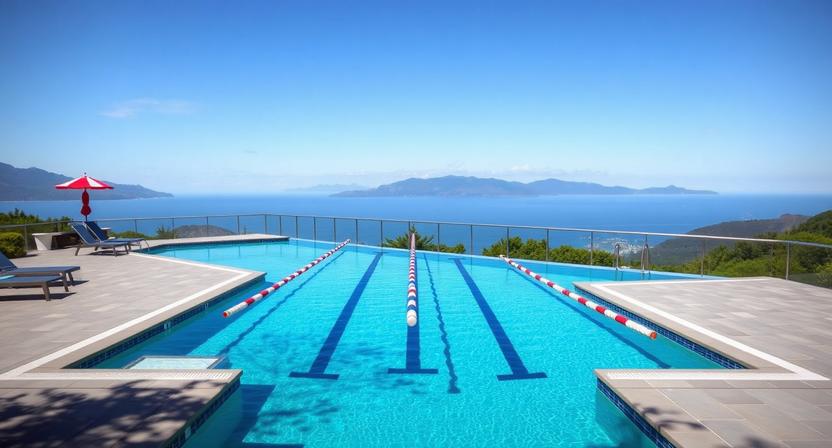
Lap pools are long, narrow swimming pools designed for straight-line swimming, fitness training, low-impact exercise, therapy-style movement, and narrow-yard use. A lap pool usually uses a simple rectangular layout with one clear swimming lane, reduced width, and enough length for repeated swim lengths.
Lap pools suit private workouts, compact backyard layouts, and narrow yards because the design uses linear space instead of wide recreation space. Residential lap-pool guidance commonly lists single-lane widths around 8–10 ft and uniform depths around 3.5–5 ft for home lap swimming.
The right lap pool depends on length, width, depth, material, current system, pool heating, pool cover use, yard access, fencing, permits, and long-term maintenance. Canadian 24-Hour Movement Guidelines recommend at least 150 minutes of moderate-to-vigorous physical activity per week for adults, and a private lap pool supports regular low-impact swimming when the design fits the swimmer’s routine.
Quick Answer
What are lap pools?
Lap pools are long, narrow pools built for swimming repeated lengths in a straight lane. A residential lap pool is usually rectangular, narrow, and designed for one or two swimmers rather than large-group recreation.
What size is a lap pool?
Lap pool size depends on yard space and fitness goals. Residential lap pools often use single-lane widths around 6–10 ft and depths around 3.5–5 ft. Canadian fibreglass lap-style models may range from about 4.8 m to 10.8 m long and about 2 m wide, depending on manufacturer and model.
Are lap pools good for fitness?
Lap pools are good for fitness because the long narrow shape supports repeated swimming, low-impact cardio, aquatic exercise, and structured training without needing a full standard swimming pool.
Quick Overview
| Decision Factor | Lap Pool Detail |
|---|---|
| Best for | Fitness, lap swimming, narrow yards, low-impact exercise, private training |
| Not best for | Diving, large pool parties, wide play areas, freeform leisure layouts |
| Main shape | Long, narrow rectangle |
| Main size value | Straight swimming length with reduced width |
| Main design value | Efficient use of linear yard space |
| Main cost driver | Length, material, heating, covers, current systems, access, decking |
| Long-term focus | Water care, cover use, heating cost, surface care, equipment maintenance |
What Are Lap Pools?
Lap pools are long, narrow swimming pools designed for straight-line swimming, fitness training, low-impact exercise, and private workouts. A typical lap pool uses a rectangular layout with one clear swimming lane and reduced width compared with a standard pool.
How are lap pools different?
Lap pools are different because they prioritize swimming length over wide recreation space. Standard pools often support play, lounging, and large groups. Lap pools support repeated lengths, stroke practice, water walking, and structured exercise.
A lap pool uses a compact linear shape. This makes it useful for narrow yards, side yards, courtyards, and indoor fitness rooms where width is limited.
What are lap pools used for?
Lap pools are used for straight-line swimming, low-impact cardio, private training, aquatic exercise, and therapy-style movement. The long lane helps swimmers repeat lengths without needing a full-size public pool.
Lap pools also support regular fitness routines at home. They work well for adults who want private exercise, controlled water conditions, and a simple pool shape.
What shape defines lap pools?
A long narrow rectangle defines most lap pools. This shape creates a clear swimming lane with enough length for repeated turns.
A single-lane lap pool usually has a narrow width for one swimmer. Wider designs support two swimmers or more stroke clearance. The rectangular layout also helps simplify covers, lane markers, heating, and deck planning.
What materials are used?
Lap pools use fibreglass, concrete, vinyl liner, and ICF construction. Each material affects length, width, depth, finish, installation method, and cost.
Fibreglass lap pools use pre-moulded long shells where access allows delivery. Concrete lap pools suit custom length, width, depth, and finishes. Vinyl liner lap pools use a wall system with a fitted liner. ICF lap pools use insulated concrete forms and suit heated pools where energy control matters.
Indoor lap pools need dehumidification, ventilation, heating, vapour control, and moisture-resistant finishes. Outdoor lap pools need fencing, drainage, heating, covers, water care, and winter planning in cold climates.
What limits lap pools?
Lap pools are limited by yard length, access, width, depth, heating demand, cover size, and user needs. They do not suit diving, large pool parties, wide play areas, or freeform leisure layouts.
A lap pool also needs enough room for safe entry, turn space, side walkways, equipment, fencing, and maintenance access. Short lap pools increase turn frequency. Narrow lanes reduce stroke clearance. Long pools increase excavation, water volume, heating load, and cover cost.
What Benefits Do Lap Pools Offer?
Lap pools offer fitness use, private workouts, narrow-yard placement, efficient rectangular design, lower water volume than many standard pools, and low-impact exercise. Their long, narrow shape creates straight swimming space without needing a wide recreation pool.
Why do they suit fitness?
Lap pools suit fitness because they are built for repeated swimming in a straight line. The long lane supports stroke practice, low-impact cardio, aquatic exercise, and structured training.
Better Homes & Gardens describes lap pools as long, narrow, typically rectangular inground pools designed for swimming laps and suitable for small yards. This shape supports fitness use because the swimmer gets a clear path instead of a wide play area.
Why do they suit narrow yards?
Lap pools suit narrow yards because their long rectangular layout uses linear space. A single-lane design often needs less width than a standard backyard pool while still giving enough length for repeated swimming.
A narrow-yard lap pool works along a fence line, side yard, courtyard edge, or long patio zone. This layout keeps more room for walkways, planting, seating, and service access.
Why is the layout efficient?
Lap pool layout is efficient because the design places most of the pool area into usable swimming length. The simple rectangle reduces wasted shape space and supports covers, lane markers, straight edges, and clear deck planning.
A rectangular lap pool also fits modern yards well. It aligns with fences, retaining walls, patios, and home additions. This makes the pool easier to place in compact linear spaces.
Why is water volume lower?
Water volume is lower when a lap pool uses reduced width and a simple single-lane layout. A long pool still holds more water as length increases, but a narrow design uses less water than a wide standard pool with similar length.
Lower water volume reduces fill water, chemical dosing, heating load, and some cleaning work. Water care still matters. Health Canada states that pool owners need daily water testing for sanitizer levels, pH, total alkalinity, and calcium hardness.
Why does private training matter?
Private training matters because a home lap pool gives swimmers a controlled space for regular exercise without public pool schedules, shared lanes, or travel time. This supports consistent training, therapy-style movement, and low-impact exercise.
The Canadian 24-Hour Movement Guidelines recommend at least 150 minutes of moderate-to-vigorous physical activity per week for adults. A private lap pool supports that routine when the design includes suitable length, depth, water temperature, cover use, and safe access.
What Types of Lap Pools Are Available?
Lap pools are available as fibreglass, concrete, vinyl liner, ICF, indoor, and resistance lap pools. The best type depends on yard access, fitness goals, swim length, heating needs, finish choice, installation method, and long-term maintenance.
| Lap Pool Type | Main Feature | Best Use |
|---|---|---|
| Fibreglass lap pool | Pre-moulded long shell | Faster installation where access allows |
| Concrete lap pool | Site-built custom structure | Custom length, width, depth, and finish |
| Vinyl liner lap pool | Wall system with fitted liner | Flexible shape and lower inground entry cost |
| ICF lap pool | Insulated concrete form structure | Heated pools and energy efficiency |
| Indoor lap pool | Enclosed fitness pool | Year-round private swimming |
| Resistance lap pool | Current system in a smaller footprint | Fitness where full lap length is limited |
What are fibreglass lap pools?
Fibreglass lap pools are pre-moulded long pool shells designed for straight-line swimming. They suit faster installation where the site has enough access for delivery, lifting, and placement.
A fibreglass lap pool usually has a smooth gelcoat surface, fixed length, fixed width, fixed depth, and built-in entry features. The main limits are shell size, transport access, crane access, and fewer custom changes.
What are concrete lap pools?
Concrete lap pools are site-built pools made for custom length, width, depth, and finish. They suit projects that need a specific swim lane, custom depth profile, tile finish, plaster finish, or integrated design.
A concrete lap pool gives strong design control. The main limits are longer construction time, higher labour needs, waterproofing detail, surface maintenance, and higher finish complexity.
What are vinyl liner lap pools?
Vinyl liner lap pools use a wall system with a fitted vinyl liner. They suit flexible rectangular layouts and lower inground entry cost compared with many custom concrete projects.
A vinyl liner lap pool has a smooth surface and liner pattern choices. The main limits are liner wear, puncture risk, liner replacement, and careful water balance.
What are ICF lap pools?
ICF lap pools use insulated concrete forms filled with reinforced concrete. The forms stay in place and add insulation around the pool walls.
An ICF lap pool suits heated pools because the insulated wall system helps reduce heat loss through the pool structure. The project still needs waterproofing, a finished pool surface, plumbing, heating, drainage, and permit review.
What are indoor lap pools?
Indoor lap pools are enclosed fitness pools built inside a pool room, home addition, basement, or pool house. They support year-round private swimming when the room has correct heating, ventilation, dehumidification, drainage, vapour control, and moisture-resistant finishes.
An indoor lap pool needs more building planning than an outdoor pool. The room must control humidity, condensation, air quality, and building-envelope moisture risk.
What are resistance lap pools?
Resistance lap pools use a current system, swim jets, or tethered swimming setup to support exercise in a smaller footprint. They suit fitness where full lap length is limited.
A resistance lap pool needs proper pump sizing, current control, service access, electrical planning, and swimmer clearance. It works best when the current system matches the swimmer’s training level.
What Sizes Are Common for Lap Pools?
Lap pool sizes usually range from short residential exercise pools to longer single-lane pools for stronger swim training. Residential size guidance often lists single-lane widths around 6–10 ft, two-lane widths around 16–20 ft, and depths around 3.5–5 ft for home lap use.
| Size Factor | Common Residential Direction | Main Use |
|---|---|---|
| Short lap pool | Around 15–25 ft where space is limited | Compact exercise and frequent turns |
| Medium lap pool | Around 30–45 ft | Better residential lap swimming |
| Long lap pool | Around 50–75 ft where space allows | Stronger uninterrupted swimming |
| Single-lane width | Around 6–10 ft | One swimmer |
| Two-lane width | Around 16–20 ft | Two swimmers or more space |
| Depth | Around 3.5–5 ft | Exercise, walking, and swimming |
What length is common?
Lap pool length commonly ranges from 15–75 ft in residential settings. Short lap pools around 15–25 ft suit compact exercise, resistance systems, and frequent turns. Medium lap pools around 30–45 ft suit better home lap swimming. Long lap pools around 50–75 ft suit stronger uninterrupted swimming where yard length allows.
What width is common?
Lap pool width commonly ranges from 6–10 ft for one swimmer. Wider lap pools around 16–20 ft suit two swimmers, wider stroke clearance, or more exercise space. A single-lane pool keeps the footprint narrow and works well for side yards, long yards, and compact linear layouts.
What depth is common?
Lap pool depth commonly ranges from 3.5–5 ft for residential swimming, walking, and aquatic exercise. A uniform depth gives steady footing and simple swimming conditions. Deeper designs raise water volume, heating demand, excavation scope, and construction cost.
What size suits one swimmer?
A single swimmer suits a lap pool around 6–10 ft wide with enough length for the swimmer’s routine. A compact pool around 15–25 ft suits light exercise and frequent turns. A longer pool around 30–45 ft gives better residential lap use.
What size suits two swimmers?
Two swimmers suit a wider lap pool around 16–20 ft. Extra width gives more stroke clearance and safer lane separation. The pool also needs enough deck space, entry access, cover width, and filtration capacity for the larger water area.
What Design Options Are Available for Lap Pools?
Lap pools offer design options for shape, entry, depth profile, covers, heating, training features, lighting, and pool surrounds. The best lap pool design supports straight swimming, safe access, steady water temperature, and a clear training routine.
| Design Option | Lap Pool Examples |
|---|---|
| Shape | Rectangle, long narrow rectangle, courtyard lap layout |
| Entry | Steps, ladder, bench step, deck-level entry |
| Depth profile | Uniform exercise depth or shallow-to-medium profile |
| Covers | Automatic cover, safety cover, thermal cover |
| Heating | Gas heater, electric heat pump, solar where suitable |
| Training features | Swim tether, current system, pace clock, lane marker |
| Lighting | Underwater lighting and path lighting |
| Surround | Pavers, concrete, stone, composite deck, narrow walkway |
What shapes work best?
Rectangle shapes work best for lap pools because they create a straight swimming lane. A long narrow rectangle gives swimmers a clear route for repeated lengths, turns, and stroke rhythm.
A courtyard lap layout also works when the pool follows a patio edge, fence line, or long outdoor wall. Simple straight edges help with covers, coping, lane markers, lighting, and drainage.
What entries work best?
Lap pool entries work best when they keep the swim lane clear. Good options include steps, ladders, bench steps, and deck-level entry.
Steps suit daily use and safer entry. Ladders save space in narrow pools. Bench steps add a resting point without taking too much swimming length. Deck-level entry creates a clean edge where the pool connects with pavers, concrete, stone, or composite decking.
What covers work best?
Automatic covers, safety covers, and thermal covers work best for lap pools. A long pool benefits from a cover that reduces debris, evaporation, heat loss, and cleaning time.
An automatic cover suits frequent use because it opens and closes with less handling. A safety cover helps restrict access when the pool is not in use. A thermal cover supports heated pools by reducing heat loss.
What heating works best?
Lap pool heating works best when the heater matches pool length, water volume, cover use, and workout schedule. Gas heaters, electric heat pumps, and solar heating all suit different site conditions.
A gas heater supports faster heating. An electric heat pump supports steady seasonal heating where outdoor conditions suit it. Solar heating gives supplemental heat where sun exposure is strong. A fitted pool cover reduces heat loss and supports better energy control.
What features support training?
Training features support lap swimming by improving pace, resistance, visibility, and routine. Useful options include a swim tether, current system, pace clock, lane marker, underwater lighting, and path lighting.
A current system supports resistance training where full pool length is limited. A lane marker helps keep stroke direction straight. A pace clock supports timed sets. Clear lighting improves early morning and evening swim safety.
What Yard Layouts Work for Lap Pools?
Lap pools work best in narrow yards, side yards, long yards, courtyards, and indoor rooms with enough straight-line space. The best layout provides a clear swim lane, safe access, drainage, fencing, equipment space, and maintenance clearance.
| Site Condition | Lap Pool Fit |
|---|---|
| Narrow yard | Strong fit with long rectangular layout |
| Side yard | Strong fit where setbacks and access allow |
| Small yard | Site-dependent; short lap or resistance pool fits some sites |
| Long yard | Strong fit |
| Courtyard | Good fit with compact lap design |
| Indoor room | Strong fit with dehumidification and ventilation |
| Sloped yard | Site-dependent; retaining and drainage need planning |
| Tight access | Material-dependent; vinyl or concrete often fits better than large shells |
Do narrow yards suit lap pools?
Narrow yards suit lap pools because the long rectangular layout uses length instead of width. A single-lane lap pool fits beside fences, garden walls, patios, and side setbacks when access and enclosure rules allow it.
A narrow layout needs enough stroke clearance, walkway space, drainage, fencing, and equipment access. A simple rectangle also supports easier cover use and straight swimming.
Do side yards suit lap pools?
Side yards suit lap pools where setbacks, access, utility lines, and drainage routes allow construction. A side-yard lap pool uses unused linear space and keeps more of the main backyard open.
Access matters most in side yards. Tight gates, fences, trees, overhead wires, and narrow paths affect excavation, shell delivery, plumbing, electrical work, and equipment placement.
Do small yards suit lap pools?
Small yards suit lap pools only when the design uses a short lap layout, compact resistance system, or narrow rectangular pool. A full-length lap pool needs more linear space than many small lots provide.
A small-yard design needs careful checks for pool length, turn space, fencing, deck clearance, drainage, and cover storage. Resistance lap pools suit some smaller sites because a current system reduces the need for full swim length.
Do long yards suit lap pools?
Long yards suit lap pools because they provide the straight-line space needed for repeated swimming. A long yard supports better swim length, smoother stroke rhythm, and fewer turns.
A long-yard layout also separates the pool from dining, lounge, garden, and play zones. This keeps the fitness pool focused without taking over the full outdoor space.
Do indoor rooms suit lap pools?
Indoor rooms suit lap pools when the room has dehumidification, ventilation, heating, drainage, vapour control, and moisture-resistant finishes. An indoor lap pool supports year-round private swimming and controlled workout conditions.
An indoor layout needs a protected building envelope, separate pool-room HVAC, safe access, pool cover planning, and daily water care. Poor moisture control increases condensation, corrosion, mould risk, and building damage.
What Affects Lap Pool Cost?
Lap pool cost depends on length, width, material, yard access, heating, cover choice, current systems, decking, fencing, and permits. Longer pools need more excavation, structure, water, covers, coping, and maintenance. Wider pools need more material, more water volume, and more surrounding deck space.
| Cost Factor | Why It Affects Price |
|---|---|
| Length | Longer pools need more excavation, structure, liner or shell, and water |
| Width | Wider lanes increase structure, water volume, and decking |
| Material | Fibreglass, vinyl, concrete, and ICF have different cost structures |
| Access | Tight side yards raise labour, equipment, or crane needs |
| Heating | Fitness use needs reliable water temperature |
| Cover | Long covers add cost but reduce heat loss and debris |
| Current system | Swim jets and resistance systems add equipment cost |
| Decking | Long pool edges increase coping and walkway scope |
| Fencing and permits | Local enclosure rules add required compliance cost |
Does length affect cost?
Length affects lap pool cost because a longer pool needs more excavation, base preparation, structure, shell, liner, plumbing, water, coping, and cover material. Longer pools also increase heating load, filtration time, and winter closing work.
A short lap pool lowers the footprint but increases turn frequency. A longer lap pool improves swim rhythm but raises the installed cost.
Does width affect cost?
Width affects lap pool cost because wider lanes need more structure, more water, more decking, and larger covers. A single-lane lap pool usually costs less than a two-lane pool because it uses less width.
Extra width improves stroke clearance and comfort. It also increases excavation, liner or shell size, heating demand, and fencing scope.
Does material affect cost?
Material affects lap pool cost because fibreglass, vinyl liner, concrete, and ICF pools use different construction methods. Fibreglass lap pools use pre-moulded shells. Vinyl liner lap pools use wall panels and a fitted liner. Concrete lap pools use site-built structure and custom finishes. ICF lap pools use insulated concrete forms and reinforced concrete.
Custom materials, special finishes, deeper profiles, and complex structures raise the final price. Standard rectangular layouts keep the project simpler.
Does heating affect cost?
Heating affects lap pool cost because fitness use needs steady water temperature. Gas heaters, electric heat pumps, and solar systems have different installation costs, operating costs, and site needs.
Longer lap pools hold more water. More water raises the heating load. A fitted thermal cover reduces heat loss and supports lower operating cost.
Does cover choice affect cost?
Cover choice affects lap pool cost because long pools need larger cover systems. Automatic covers, safety covers, and thermal covers have different material, track, motor, installation, and maintenance costs.
A pool cover adds upfront cost but reduces debris, evaporation, heat loss, and cleaning time. Heated lap pools benefit most from a cover because heat loss affects daily fitness use.
How Are Lap Pools Installed?
Lap pools are installed through site review, design, utility locates, permits, excavation, base preparation, pool shell or structure work, plumbing, electrical bonding, heating, cover installation, decking, fencing, inspection, water filling, and water balancing. The process depends on pool length, width, material, yard access, setbacks, heating needs, and local pool enclosure rules.
What happens during site review?
Lap pool site review checks yard length, pool width, slope, soil condition, side-yard access, overhead clearance, equipment location, drainage routes, setback rules, and fence placement. The review confirms whether the site suits a fibreglass lap pool, concrete lap pool, vinyl liner lap pool, ICF lap pool, or indoor fitness layout.
Utility locates come before digging. Ontario One Call states that homeowners need to submit a locate request at least 5 business days before digging, and utility companies mark buried lines on the property.
What happens during design?
Lap pool design sets the usable swim length, lane width, depth, entry type, cover system, heating system, equipment location, decking, fencing, and service access. The design also includes a site plan with property lines, setbacks, pool location, enclosure layout, gate location, drainage, and equipment area.
Toronto requires an approved Zoning Certificate before a Pool Fence Enclosure Permit application. The city states that a pool cannot be constructed and filled with water without a fence installed under Toronto Municipal Code Chapter 447 – Fences.
What happens during excavation?
Lap pool excavation creates the long, narrow pool trench and service areas for plumbing, drainage, and equipment connections. The excavation stage includes soil removal, grading, base preparation, compaction, access management, and groundwater or rock handling where present.
Long lap pools need careful level control because length affects shell support, structure accuracy, waterline finish, cover alignment, and deck drainage.
What happens during structure work?
Lap pool structure work depends on the pool material. Fibreglass lap pools need shell placement on a prepared base. Concrete lap pools need forming, reinforcement, shotcrete or poured concrete, waterproofing, and finish work. Vinyl liner lap pools need wall panels, floor base, coping, and liner fitting. ICF lap pools need insulated concrete forms, reinforcement, concrete placement, and waterproof lining.
This stage also includes plumbing, returns, skimmers, drains, electrical bonding, heater connections, filtration equipment, cover tracks, coping, and deck preparation. Electrical Safety Authority guidance states that electrical equipment within 3 m of the inside walls of a pool needs GFCI protection unless suitably separated.
What happens before startup?
Lap pool startup happens after fencing, inspections, equipment checks, water filling, circulation testing, leak checks, heater setup, cover testing, and water balancing. The final check confirms that the pool, deck, enclosure, gates, equipment, electrical work, and drainage are ready for use.
Health Canada states that pool owners need daily water-balance testing for sanitizer levels, pH, total alkalinity, and calcium hardness. This applies to lap pools and other residential swimming pools.
What Maintenance Is Needed for Lap Pools?
Lap pool maintenance needs regular water testing, cleaning, filtration care, cover care, heater checks, surface care, and winterization. A lap pool supports fitness use best when the water stays balanced, the surface stays clean, and the equipment runs on a steady maintenance schedule.
| Maintenance Area | Lap Pool Requirement |
|---|---|
| Water testing | Sanitizer, pH, alkalinity, and calcium hardness |
| Cleaning | Skimming, brushing, vacuuming, and debris removal |
| Filtration | Pump, filter, baskets, returns, and circulation |
| Cover care | Track, fabric, drainage, heat retention, and debris control |
| Heating care | Heater inspection, thermostat, and operating settings |
| Surface care | Depends on fibreglass, vinyl, concrete, tile, or plaster |
| Winterization | Protects plumbing, equipment, waterline, cover, and fittings |
What water testing is needed?
Water testing needs daily checks for sanitizer levels, pH, total alkalinity, and calcium hardness. Health Canada states that pool and spa water must be tested daily for these water-balance measures. This applies to lap pools and other residential swimming pools.
Health Canada also states that clear water still contains microorganisms when it lacks proper sanitization. Correct sanitizer levels reduce bacteria and viruses to safer levels.
What surface care is needed?
Surface care depends on the lap pool material. Fibreglass lap pools need gelcoat cleaning and stain checks. Vinyl liner lap pools need liner inspection for wrinkles, tears, fading, and punctures. Concrete lap pools need brushing, plaster checks, tile checks, and surface-scale control.
Water balance affects every surface. Poor pH, low sanitizer, high calcium, or low alkalinity damages finishes, heaters, fittings, and pool equipment.
What cover care is needed?
Cover care protects water quality, heat retention, and daily usability. A lap pool cover needs regular checks for track alignment, fabric wear, drainage, anchors, rollers, and debris buildup.
Long lap pool covers need more care than many smaller covers because length adds track, fabric, and handling stress. A working cover reduces debris, evaporation, heat loss, and cleaning time.
What heater care is needed?
Heater care keeps the lap pool ready for routine fitness use. Maintenance includes heater inspection, thermostat checks, flow checks, vent checks, operating settings, and service access.
A heated lap pool needs a stable water temperature for regular workouts. Cover use reduces heat loss and lowers heater run time.
What winter care is needed?
Winter care protects the lap pool during freezing conditions. Winterization includes water balancing, cleaning, waterline adjustment, line protection, equipment draining, winter plugs, cover fitting, and heater shutdown.
Cold weather damages plumbing, pumps, heaters, fittings, covers, and waterline surfaces when water freezes inside equipment or pipes. A proper winter closing protects the pool structure and reduces spring repair needs.
How Do Lap Pools Support Fitness?
Lap pools support fitness through swim length, lane width, exercise depth, resistance systems, heating, cover use, and lighting. A well-designed lap pool supports repeated swimming, low-impact cardio, water walking, stroke practice, and private training. Canadian 24-Hour Movement Guidelines recommend at least 150 minutes of moderate-to-vigorous aerobic physical activity per week for adults.
| Fitness Factor | Why It Matters |
|---|---|
| Length | Longer pools reduce turn frequency |
| Width | Wider lanes improve stroke clearance |
| Depth | Uniform depth supports swimming and water exercise |
| Current system | Adds resistance training in shorter pools |
| Heating | Supports more consistent workout conditions |
| Cover | Keeps water cleaner and warmer for routine use |
| Lighting | Supports safer early or late swims |
Does length affect training?
Length affects training because longer lap pools reduce turn frequency and support smoother swim rhythm. A short pool suits compact exercise, stroke drills, water walking, and frequent turns. A longer pool suits uninterrupted swimming and more structured lap sets.
Does depth affect exercise?
Depth affects exercise because uniform water depth supports swimming, walking, stretching, and low-impact movement. Residential lap pool depth often sits around 3.5–5 ft for swimming and aquatic exercise.
A steady depth helps swimmers keep rhythm and footing. Deeper profiles increase water volume, excavation, heating load, and maintenance needs.
Do current systems help?
Current systems help when full lap pool length is limited. A swim-current system creates resistance so the swimmer trains in place inside a shorter pool.
A current system needs correct pump sizing, flow control, swimmer clearance, electrical planning, and service access. It works best when the resistance level matches the swimmer’s fitness routine.
Do covers support routine use?
Pool covers support routine use by keeping water cleaner and warmer between workouts. A cover reduces debris, evaporation, heat loss, and cleaning time.
A thermal cover helps heated lap pools hold water temperature. An automatic cover supports frequent use because it opens and closes with less handling.
Does heating support training?
Heating supports training by keeping the lap pool at a stable water temperature. Consistent water temperature helps swimmers follow a regular routine through cool mornings, evenings, spring, and autumn.
A heated lap pool also needs a cover, pump, filter, and heater sized for the pool volume. Good heating control reduces wasted energy and supports reliable workout conditions.
What Heating Options Work for Lap Pools?
Lap pool heating options include electric heat pumps, gas heaters, solar heating, thermal covers, automatic covers, and efficient pool pumps. The right heating setup depends on pool volume, pool length, wind exposure, indoor or outdoor placement, cover use, swim routine, and energy goals.
Can lap pools be heated?
Lap pools can be heated with an electric heat pump, gas heater, or solar heating where site conditions support the system. Electric heat pumps suit steady seasonal heating. Gas heaters suit faster heat-up. Solar heating supports extra heat where sun exposure is strong.
Pool volume affects heating demand. A longer lap pool holds more water, so the heater needs more time and energy to raise the water temperature. Natural Resources Canada lists pool heat loss routes as evaporation, convection, long-wave radiation, and conduction through the pool structure.
Does a cover reduce heat loss?
A pool cover reduces heat loss by limiting evaporation from the water surface. Less evaporation means lower heat loss, lower water loss, and lower heating demand.
The U.S. Department of Energy states that covering a pool when not in use is the most effective way to reduce pool heating costs, with possible savings of 50% to 70%. It also states that indoor pool covers reduce evaporation and reduce the need to ventilate indoor air and replace it with unconditioned outdoor air.
Does pool length affect heating?
Pool length affects heating because longer lap pools hold more water and expose more surface area. More water raises the total heat needed to reach a set temperature. More surface area increases evaporation and heat loss.
A long lap pool benefits from a fitted thermal cover or automatic cover. A cover helps keep water warmer between swims and supports more stable daily training conditions.
Does indoor placement reduce weather impact?
Indoor placement reduces weather impact because the lap pool is protected from wind, outdoor temperature swings, rain, snow, and direct debris. Indoor placement helps keep swim conditions stable for year-round use.
An indoor lap pool still needs humidity control, dehumidification, ventilation, vapour control, and a protected building envelope. A cover reduces evaporation, heat loss, and dehumidification load when the pool is not in use.
Does pump choice affect energy use?
Pump choice affects energy use because a lap pool pump controls filtration, circulation, heating flow, and cleaning cycles. A right-sized variable-speed pump uses lower speeds for routine filtration and higher speeds only when needed.
ENERGY STAR states that certified in-ground pool pumps use 20% less energy than standard pumps, while certified above-ground pool pumps use 11% less energy than standard pumps. Variable-speed pumps also match pump speed to pool tasks, which supports lower operating cost and steady water circulation.
What Problems Happen With Lap Pools?
Lap pool problems usually come from choosing too short a length, too narrow a lane, poor access, weak heating plans, no cover, poor drainage, poor water balance, or expecting family-play use from a fitness-focused pool. These problems reduce swim comfort, increase operating cost, and create installation delays.
Do lap pools feel too short?
Lap pools feel too short when the swim length does not match the swimmer’s training routine. Short pools increase turn frequency and reduce stroke rhythm.
A compact lap pool suits light exercise, water walking, and resistance systems. Longer pools suit repeated lap swimming and stronger uninterrupted training.
Do lap pools feel too narrow?
Lap pools feel too narrow when the lane width limits arm movement, stroke clearance, or passing space. Single-lane pools suit one swimmer. Wider pools suit two swimmers or users who need more side clearance.
A narrow lap pool still needs safe entry, side access, deck clearance, and enough width for comfortable swimming.
Does heating cost rise?
Heating cost rises when the lap pool is long, uncovered, exposed to wind, or used through cooler seasons. More water volume increases heating demand. More exposed surface area increases heat loss.
A thermal cover or automatic cover reduces evaporation and heat loss. Stable heating supports regular fitness use without wasting energy between swims.
Do covers cost more?
Lap pool covers cost more when the pool is long, wide, automated, or shaped for a custom track system. Long rectangular pools need more cover fabric, track length, hardware, and installation work.
A cover adds upfront cost, but it reduces debris, evaporation, heat loss, and cleaning time. Heated lap pools benefit most from cover use.
Does access become difficult?
Access becomes difficult when side yards, gates, trees, fences, sheds, slopes, or overhead wires limit excavation and pool placement. Tight access raises labour time, equipment needs, shell delivery cost, and soil removal work.
A fibreglass lap pool needs enough access for a long shell. Concrete, vinyl liner, or ICF lap pools often suit tighter sites because the structure is built on site.
What Safety Rules Matter for Lap Pools?
Lap pool safety rules focus on a compliant pool enclosure, restricted access, self-closing gates, self-latching gates, anti-slip decking, safe entries, handrails, lighting, covers, and supervision. A long, narrow lap pool still needs full safety planning because the pool has open water, wet surfaces, electrical equipment, and controlled access points.
Do lap pools need fencing?
Lap pools need fencing when local pool enclosure rules apply. Toronto states that a pool cannot be constructed and filled with water without a fence installed under Toronto Municipal Code Chapter 447 – Fences. Toronto also requires a Zoning Certificate before a Pool Fence Enclosure Permit application.
Health Canada recommends a pool fence at least 1.2 m high all the way around the pool. The same guidance recommends a self-closing gate, self-latching gate, child-resistant latch height, and locked gate when the pool is not in use.
Do lap pools need covers?
Lap pools benefit from pool covers for safety control, debris reduction, heat retention, and reduced evaporation. A safety cover helps restrict access when the pool is not in use.
A pool cover does not replace fencing, gate hardware, restricted access, or supervision. Health Canada advises locked gates and controlled access around pools because children use nearby objects to climb over barriers.
Do narrow decks need slip control?
Narrow decks need slip control because lap pools often have long, slim walkways beside the swim lane. Wet surfaces raise slip risk during entry, turns, maintenance, and night use.
A safer lap pool deck uses anti-slip decking, clear drainage, stable coping, path lighting, and enough walking clearance. Long pool edges also need safe movement space for swimmers, service work, cover handling, and supervision.
Do steps need handrails?
Lap pool steps need safe entry support through stable steps, clear edges, handrails, and lighting. Handrails help users enter and leave the pool with better control, especially when the deck and steps are wet.
Entry design matters more in narrow pools because compact decks leave less recovery space after a slip. Steps, ladders, bench steps, and deck-level entries need traction, visibility, and clear access.
Do children need restricted access?
Children need restricted access around lap pools at all times. Restricted access means a compliant enclosure, locked gate, self-closing gate, self-latching gate, safe cover use, clear sightlines, and active adult supervision.
Health Canada advises keeping toys, garden furniture, and tools away from pool fences because children use these items to climb over barriers. This safety rule applies to lap pools, standard pools, plunge pools, and other residential pool types.
What Permits Apply to Lap Pools?
Lap pool permits include a Zoning Applicable Law Certificate, Pool Fence Enclosure Permit, setback review, site-plan review, utility locates, electrical inspection, and final inspection. Local rules set the exact approval path, but lap pools usually need enclosure approval before construction and filling.
Are pool permits needed?
Pool permits are needed when a lap pool meets the local definition of a regulated swimming pool. Toronto requires a Zoning Applicable Law Certificate for a Pool Fence Enclosure Permit application through Municipal Licensing and Standards.
A permit review checks the pool location, fence layout, gate details, setbacks, equipment area, and site plan before construction starts.
Are pool fences needed?
Pool fences are needed when local pool enclosure rules apply. Toronto states that a pool cannot be constructed and filled with water without a fence installed under Toronto Municipal Code Chapter 447 – Fences.
A lap pool fence needs compliant height, enclosure location, materials, restricted access, and gate hardware. Self-closing and self-latching gate hardware help control access to the pool area.
Are setbacks checked?
Setbacks are checked during zoning and site-plan review. A lap pool site plan needs to show property lines, pool location, existing structures, proposed fence, gates, equipment, drainage, and distance from lot lines.
Setback review matters because lap pools use long rectangular layouts. The pool length affects side-yard clearance, rear-yard placement, equipment location, service access, and drainage routes.
Are inspections needed?
Inspections are needed before a lap pool is filled and used. Toronto’s pool enclosure process requires the required fence before a pool is constructed and filled with water.
Electrical checks also matter. Electrical Safety Authority guidance states that electrical equipment located within 3 m of the inside walls of a pool needs GFCI protection unless suitably separated.
Are utility locates needed?
Utility locates are needed before excavation for a lap pool, fence posts, equipment pads, drainage, gas lines, or electrical routes. Ontario One Call states that homeowners need to submit a locate request at least 5 business days before digging, and utility companies mark buried lines on the property.
A complete lap pool permit plan includes the Zoning Applicable Law Certificate, Pool Fence Enclosure Permit, setbacks, site plan, fence details, gate hardware, utility locates, electrical inspection, and final inspection.
How Do Lap Pools Compare?
Lap pools compare by use, shape, length, water volume, exercise value, and sanitation system. Lap pools focus on straight swimming and fitness, while plunge pools, standard pools, swim spas, indoor pools, and saltwater pools describe different sizes, layouts, locations, or water-care systems.
| Comparison | Lap Pool Difference |
|---|---|
| Lap vs plunge | Lap pools are long for swimming; plunge pools are compact for cooling and soaking |
| Lap vs standard pool | Lap pools prioritize straight swimming over wide play space |
| Lap vs swim spa | Lap pools use physical length; swim spas use current resistance in a compact unit |
| Lap vs indoor pool | Lap describes use and shape; indoor describes location |
| Lap vs saltwater | Lap describes pool design; saltwater describes sanitation |
How do they compare with plunge pools?
Lap pools are long, narrow pools built for repeated swimming. Plunge pools are compact pools built for cooling, soaking, sitting, and small-yard relaxation.
A lap pool suits fitness routines, stroke practice, water walking, and low-impact exercise. A plunge pool suits patios, courtyards, compact yards, and warm-water soaking where swimming length is not the main goal.
How do they compare with standard pools?
Lap pools prioritize straight swimming over wide play space. A standard pool supports more recreation, wider swimming zones, larger groups, and family play.
A lap pool uses a long rectangular layout with reduced width. This design suits narrow yards and private training. A standard pool needs more width, more open water, more decking, and more yard space.
How do they compare with swim spas?
Lap pools use physical length for swimming. Swim spas use current resistance in a compact unit.
A lap pool gives the swimmer a real lane and turn space. A swim spa keeps the swimmer in one place against a current. Swim spas suit limited spaces where full lap length does not fit.
How do they compare with indoor pools?
Lap pools describe pool shape and use. Indoor pools describe pool location.
An indoor lap pool combines both concepts. It gives straight-line fitness swimming inside a controlled pool room. This layout needs heating, dehumidification, ventilation, vapour control, drainage, and moisture-resistant finishes.
How do they compare with saltwater pools?
Lap pools describe pool design. Saltwater pools describe sanitation.
A saltwater lap pool uses a salt chlorine generator to produce chlorine from dissolved salt. It still needs water testing, pH control, filtration, cover care, heating checks, and surface maintenance.
Who Are Lap Pools Best For?
Lap pools are best for homeowners who want fitness swimming, narrow-yard use, low-impact exercise, private training, and a compact linear pool design. They are not best for diving, large pool parties, or wide family play.
| Homeowner Need | Fit |
|---|---|
| Fitness swimming | Strong fit |
| Narrow yard use | Strong fit |
| Low-impact exercise | Strong fit |
| Private training | Strong fit |
| Compact linear design | Strong fit |
| Diving | Weak fit |
| Large pool parties | Weak fit |
| Wide family play | Weak fit |
Are they best for fitness?
Lap pools are best for fitness swimming because their long, narrow shape supports repeated lengths, stroke practice, water walking, and structured exercise. The straight swimming lane helps create a private training space at home.
Are they best for narrow yards?
Lap pools are best for narrow yards because the long rectangular layout uses linear space instead of wide yard space. A single-lane lap pool fits beside fences, side yards, garden walls, and long patios where setbacks and access allow installation.
Are they best for low-impact exercise?
Lap pools are best for low-impact exercise because water supports the body while swimmers move, walk, stretch, and train. This makes lap pools useful for cardio, joint-friendly movement, and therapy-style exercise.
Are they best for families?
Lap pools are not best for families that need wide play space, pool games, diving, or large social use. They suit families that value fitness, private swimming, narrow-yard design, and supervised exercise more than open recreation space.
Are they best for low budgets?
Lap pools are not best for low budgets when the project includes long length, heating, covers, decking, fencing, permits, and custom construction. A compact lap pool or resistance pool reduces space needs, yet the final cost still depends on material, access, heating, cover system, and site work.
What Mistakes Increase Lap Pool Cost?
Lap pool mistakes increase cost when homeowners compare only pool length and ignore width, depth, access, cover systems, heating, decking, fencing, permits, maintenance, drainage, and long-term energy use. A longer pool does not always create a better fitness pool when the design lacks practical support systems.
Is choosing too much length a mistake?
Choosing too much length is a mistake when the pool becomes larger than the yard, budget, swim routine, or maintenance plan supports. Extra length increases excavation, structure, water volume, heating demand, cover size, fencing scope, and deck work.
A longer lap pool suits stronger uninterrupted swimming. It adds less value when the swimmer mainly needs light exercise, water walking, or short daily workouts.
Is choosing too little length a mistake?
Choosing too little length is a mistake when the pool forces constant turns and breaks stroke rhythm. Short lap pools suit compact exercise, but they feel limited for stronger swim training.
A smaller site may suit a resistance lap pool instead. A current system adds swim resistance where full lap length does not fit.
Is ignoring covers a mistake?
Ignoring covers is a mistake because long lap pools lose heat, water, and chemicals through evaporation. A fitted thermal cover, safety cover, or automatic cover reduces debris, heat loss, evaporation, cleaning time, and heating demand.
A cover adds upfront cost but supports routine fitness use. Heated lap pools benefit most because stable water temperature matters for regular training.
Is ignoring heating a mistake?
Ignoring heating is a mistake when the lap pool is used for early mornings, evenings, spring, autumn, or indoor year-round routines. Cold water reduces comfort and limits consistent training.
Heating cost depends on pool volume, cover use, wind exposure, water temperature, and heater type. A right-sized gas heater, electric heat pump, or solar-assisted system keeps the pool usable without oversized equipment.
Is ignoring permits a mistake?
Ignoring permits is a mistake because missing approvals delay construction, filling, inspection, and resale. Lap pool permits often involve zoning, setbacks, pool enclosure, fence height, gate hardware, utility locates, electrical inspection, and final inspection.
Toronto requires a Zoning Applicable Law Certificate before a Pool Fence Enclosure Permit application. Toronto also states that a pool cannot be constructed and filled with water until a fence is installed under the City’s fence rules.
How Do You Compare Lap Pool Quotes?
Lap pool quotes need comparison across length, width, depth, material, access, heating, cover systems, current systems, decking, fencing, permits, water care, winter care, and warranty coverage. A complete quote shows the full installed lap pool cost, not only the pool shell or pool length.
| Quote Item | What to Check |
|---|---|
| Length | Usable swim length and turn space |
| Width | Single-lane or two-lane clearance |
| Depth | Uniform depth, exercise depth, or custom profile |
| Material | Fibreglass, vinyl, concrete, ICF, or prefabricated system |
| Access | Side-yard width, machine access, crane access, and overhead clearance |
| Heating | Heater type, expected use, cover strategy, and energy needs |
| Cover | Automatic, safety, or thermal cover scope |
| Current system | Swim jets, pump size, controls, and service access |
| Decking | Walkway width, coping, slip resistance, and drainage |
| Fencing and permits | Enclosure, gates, zoning, setbacks, and inspections |
| Water care | Pump, filter, sanitizer, startup chemicals, and testing |
| Winter care | Cover, plugs, closing method, and equipment protection |
| Warranty | Structure, surface, equipment, cover, heater, and installation exclusions |
What size details matter?
Size details matter because lap pool length, width, and depth affect fitness use, comfort, water volume, excavation, heating, cover size, and cost. Compare usable swim length, turn space, single-lane width, two-lane clearance, uniform depth, and exercise depth.
A short lap pool suits compact exercise and frequent turns. A longer lap pool suits smoother swimming. A wider lane improves stroke clearance but increases water volume, decking, and cover scope.
What material details matter?
Material details matter because fibreglass, vinyl, concrete, ICF, and prefabricated systems use different installation methods. Compare shell size, liner type, concrete finish, waterproofing, insulation, surface care, repair terms, and installation access.
A fibreglass lap pool needs delivery and crane access. A concrete lap pool supports custom length, width, and depth. A vinyl liner lap pool supports flexible rectangular layouts. An ICF lap pool supports heated pool use where insulation matters.
What fitness details matter?
Fitness details matter because a lap pool needs to match the swimmer’s training routine. Compare usable lane length, lane width, depth, entry location, lane marker, pace clock, swim tether, current system, lighting, and cover strategy.
A current system needs pump size, controls, service access, and swimmer clearance. A fitness-focused quote also needs heating details because regular training depends on stable water temperature.
What equipment details matter?
Equipment details matter because the pump, filter, heater, sanitizer, cover system, current system, drains, returns, skimmers, and controls affect daily use. Compare model numbers, capacity, energy rating, service space, warranty terms, and winter protection.
Electrical scope needs clear wording. Electrical Safety Authority guidance states that electrical equipment within 3 m of the inside walls of a pool needs GFCI protection unless it is suitably separated.
What warranty details matter?
Warranty details matter because lap pools include structure, surface, equipment, covers, heaters, current systems, decking, and installation work. Compare coverage for the shell, liner, concrete finish, waterproofing, pump, filter, heater, cover, controls, current system, labour, exclusions, transfer terms, and service response.
Permit responsibility also needs written detail. Toronto requires a Zoning Certificate before a Pool Fence Enclosure Permit, and the city states that a pool cannot be constructed and filled with water without a fence installed under Toronto Municipal Code Chapter 447 – Fences. Ontario One Call states that homeowners need to submit a locate request at least 5 business days before digging.
How Do Lap Pools Affect Comfort?
Lap pools affect comfort through width, depth, heating, and entry design. A comfortable lap pool gives enough stroke clearance, steady exercise depth, stable water temperature, and safe access for regular swimming.
Does width affect stroke space?
Width affects stroke space because swimmers need room for arm movement, body alignment, and lane control. A single-lane lap pool around 6–10 ft wide suits one swimmer. A wider lap pool gives better clearance for two swimmers or broader strokes.
Narrow lanes reduce comfort when swimmers touch the pool wall, lane edge, or another person. Wider lanes improve stroke rhythm and reduce interrupted movement.
Does depth affect exercise?
Depth affects exercise because water level changes how swimmers move, walk, and train. A residential lap pool depth around 3.5–5 ft supports swimming, water walking, and low-impact exercise.
Uniform depth gives steady footing and simple movement. Deeper profiles increase water volume, heating demand, and maintenance needs.
Does heating affect use?
Heating affects use because stable water temperature supports regular workouts. A heated lap pool suits early mornings, evenings, spring, autumn, and indoor fitness routines.
Cold water reduces comfort and shortens swim time. A fitted thermal cover or automatic cover helps keep water warmer between training sessions.
Does entry design affect access?
Entry design affects access because swimmers need safe, simple movement into and out of the pool. Steps, ladders, bench steps, and deck-level entries each suit different pool widths and user needs.
Steps support easier entry. Ladders save swim-lane space. Bench steps add a resting point. Deck-level entries create a clean connection between the lap pool and surrounding deck, pavers, or walkway.
How Do Lap Pools Affect Energy Use?
Lap pools affect energy use through pool length, water volume, heating, cover use, pump efficiency, and indoor or outdoor placement. Longer pools hold more water and expose more surface area, so heating, filtration, and cover planning matter for daily fitness use.
Does length increase water volume?
Length increases water volume because a longer lap pool holds more water when width and depth stay the same. More water needs more energy for heating, more time for circulation, and more chemical dosing.
Natural Resources Canada lists pool heat loss through evaporation, convection, long-wave radiation, and conduction through the pool structure. More surface area increases exposure to these heat-loss paths.
Does a cover reduce heat loss?
A pool cover reduces heat loss by limiting evaporation from the water surface. Less evaporation lowers heat loss, water loss, chemical loss, and heater runtime.
The U.S. Department of Energy states that pool covers are the most effective way to reduce pool heating costs, with possible savings of 50% to 70%. It also states that indoor pool covers reduce evaporation and lower the need to ventilate indoor air and replace it with unconditioned outdoor air.
Does heating support daily use?
Heating supports daily use because regular swimmers need steady water temperature for morning, evening, spring, autumn, and indoor training routines. A heated lap pool works best with a thermal cover, right-sized heater, stable pump flow, and clear operating schedule.
Heating demand rises with larger pool volume, uncovered water, wind exposure, and higher target temperature. Pool covers help keep heated water stable between swim sessions.
Does indoor placement change operating cost?
Indoor placement changes operating cost because the pool avoids wind, snow, rain, outdoor temperature swings, and debris. Indoor placement also adds dehumidification, ventilation, humidity control, and building-envelope protection.
Indoor lap pool covers reduce evaporation and lower the amount of indoor air that needs exhaust and replacement. Efficient pool pumps also matter. ENERGY STAR states that certified in-ground pool pumps use 20% less energy than standard pumps, while certified above-ground pool pumps use 11% less energy than standard pumps.
How Do Lap Pools Affect Resale?
Lap pools affect resale through fitness use, pool condition, yard design, and permit compliance. A clean, compliant, well-placed lap pool supports buyer interest when it adds a clear fitness purpose without taking too much yard space.
Does fitness use matter?
Fitness use matters because lap pools serve a clear buyer need: private swimming, low-impact exercise, and regular training. This gives the pool a stronger purpose than a general decorative water feature.
Real-estate data shows that pool value depends on market, home type, climate, lot size, and buyer demand. Realtor.com reported that homes with pools had a 54% listing price premium in April 2025, though pool homes were also often larger and located in higher-priced areas.
Does pool condition matter?
Pool condition matters because buyers check the pool surface, coping, deck, cover, heater, pump, filter, sanitizer, and water quality. A poorly maintained lap pool raises repair concerns and lowers buyer confidence.
CREA advises buyers to check pool maintenance history, filter upkeep, sanitation system condition, heating-system condition, warranty status, and water use records before buying a home with a pool.
Does yard design matter?
Yard design matters because a lap pool needs to fit the lot without removing too much usable outdoor space. A strong layout keeps room for walkways, planting, seating, drainage, fencing, and service access.
A narrow rectangular lap pool adds resale appeal when it turns unused linear space into a fitness area. Poor placement reduces yard function, blocks movement, or creates drainage and maintenance issues.
Does permit compliance matter?
Permit compliance matters because buyers, inspectors, lenders, and insurers review pool safety and legal status. Missing permits, failed inspections, or non-compliant enclosures create resale delays and correction costs.
Toronto requires an approved Zoning Certificate and a Pool Fence Enclosure Permit for a swimming pool enclosure. The city also states that a pool cannot be constructed and filled with water without a fence installed under Toronto Municipal Code Chapter 447 – Fences.
How Do Lap Pools Affect Winter Care?
Lap pools affect winter care through plumbing protection, equipment shutdown, heater care, cover support, waterline control, and freeze protection. Cold Canadian winters make proper winterization important for long pools because plumbing, covers, heaters, fittings, and waterline surfaces need protection from freeze damage.
Do lap pools need winter closing?
Lap pools need winter closing in freezing climates. Winter closing protects the pool structure, plumbing lines, pump, filter, heater, skimmers, returns, cover system, and waterline.
A proper closing process includes water testing, cleaning, waterline adjustment, line protection, equipment draining, winter plugs, and secure cover fitting.
What happens to plumbing?
Lap pool plumbing needs protection before freezing weather. Water left inside pipes, returns, skimmers, drains, pumps, filters, and heater lines expands when frozen and damages fittings or equipment.
Winter care includes draining lines, clearing water from plumbing, adding winter plugs where needed, and protecting exposed equipment. Long lap pools may have longer plumbing runs, so line protection needs careful planning.
What happens to the cover?
Lap pool covers protect the water, pool edge, and pool surface during winter. A winter cover reduces debris, limits sunlight, protects the waterline, and helps keep the closed pool safer.
Long lap pool covers need careful tension, anchor checks, fabric inspection, drainage, and snow-load control. Heavy snow, ice, and standing water need safe removal to reduce stress on the cover system and coping.
What happens to the heater?
Lap pool heaters need shutdown and protection before freezing weather. Gas heaters, electric heat pumps, and connected plumbing need draining, power control, and service checks based on manufacturer instructions.
Heater winter care protects internal parts from freezing, corrosion, scale, and blocked flow. Heated lap pools that stay open later in the season still need a freeze plan for cold nights, power loss, cover use, and equipment protection.
FAQs About Lap Pools
Are lap pools worth it?
Lap pools are worth it for homeowners who want fitness swimming, private training, low-impact exercise, and narrow-yard pool design. They offer less value for diving, wide play space, large pool parties, or freeform leisure use.
What size is a lap pool?
A lap pool is usually long, narrow, and rectangular. Residential lap pools often range from 30–75 ft long, with single-lane widths around 6–10 ft and depths around 3.5–5 ft.
How long should a lap pool be?
A lap pool should be long enough for the swimmer’s fitness routine. Shorter lap pools around 15–25 ft suit compact exercise and frequent turns. Longer lap pools around 30–75 ft support stronger uninterrupted swimming.
How wide should a lap pool be?
A lap pool should be around 6–10 ft wide for one swimmer. A two-lane lap pool often needs around 16–20 ft of width for two swimmers or more stroke clearance.
How deep should a lap pool be?
A lap pool should often be around 3.5–5 ft deep for residential swimming, water walking, and exercise. Uniform depth supports steady movement and simple pool use.
Are lap pools good for small yards?
Lap pools are good for some small yards when the site has enough straight-line space. Short lap pools or resistance pools suit compact lots better than full-length lap pools.
Are lap pools good for narrow yards?
Lap pools are good for narrow yards because the long rectangular shape uses length instead of width. This layout works well along side yards, fences, patios, and linear garden zones where setbacks and access allow installation.
Can lap pools be heated?
Lap pools can be heated with gas heaters, electric heat pumps, or solar heating where the site supports the system. A pool cover helps reduce heat loss and heating cost.
Can lap pools be indoors?
Lap pools can be indoors when the room has heating, ventilation, dehumidification, drainage, vapour control, and moisture-resistant finishes. Indoor placement supports year-round swimming, but it adds humidity control and building-envelope planning.
Can lap pools use saltwater systems?
Lap pools can use saltwater systems. A salt chlorine generator produces chlorine from dissolved salt, so the pool still needs sanitizer testing, pH control, filtration, equipment care, and surface maintenance.
Are lap pools easy to maintain?
Lap pools need regular maintenance for water testing, filtration, cleaning, cover care, heating, and winterization. Health Canada states that pool and spa water needs daily testing for sanitizer levels, pH, total alkalinity, and calcium hardness.
Do lap pools need permits?
Lap pools need permits when local pool enclosure, zoning, building, or electrical rules apply. Toronto requires a Zoning Certificate before a Pool Fence Enclosure Permit application.
Do lap pools need fencing?
Lap pools need fencing when local enclosure rules apply. Toronto states that a pool cannot be constructed and filled with water without a fence installed under Toronto Municipal Code Chapter 447 – Fences.
What is the difference between a lap pool and a plunge pool?
A lap pool is a long, narrow pool built for straight-line swimming and fitness. A plunge pool is a compact pool built for cooling, soaking, sitting, and small-yard relaxation.
What is the difference between a lap pool and a swim spa?
A lap pool uses physical length for swimming. A swim spa uses a current system that lets the swimmer train in place inside a smaller unit.