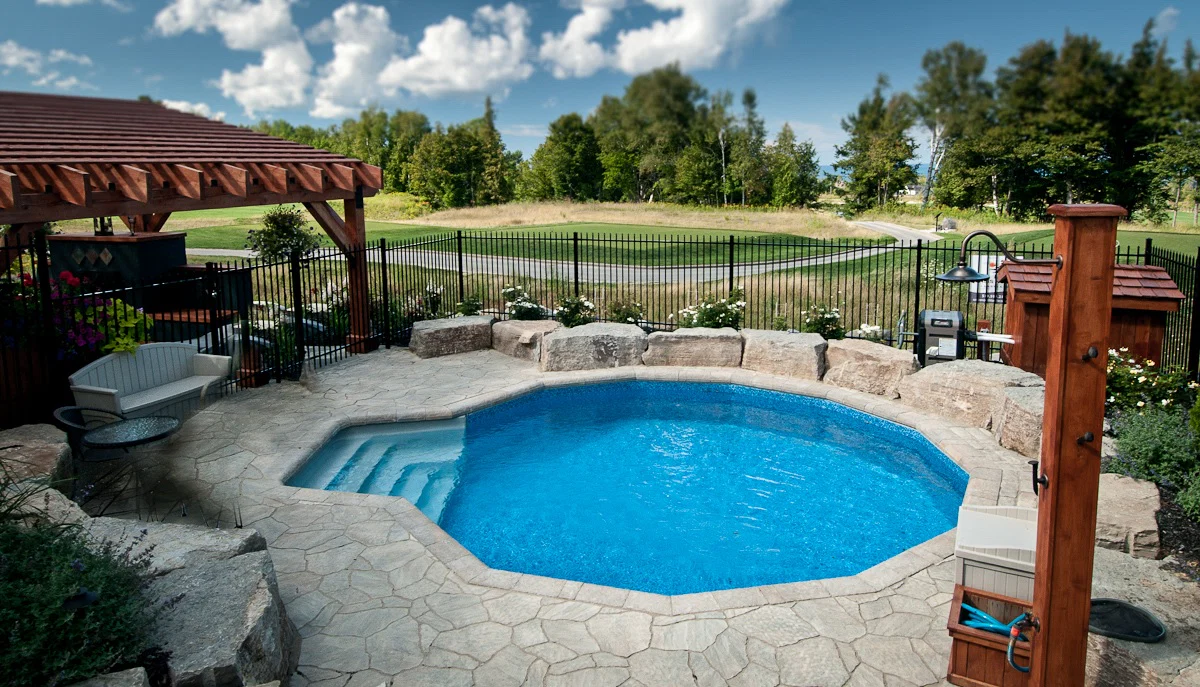
Semi-inground pool installation in Toronto is the process of planning and building a partially recessed swimming pool with site review, layout planning, excavation, pool wall installation, base preparation, plumbing, electrical work, deck integration, fencing, finishing, and startup. This type of pool installation combines the visual appeal of an inground pool with the lower build cost and installation flexibility of an above-ground pool.
The full project scope depends on yard slope, site access, soil conditions, pool size, deck design, drainage, and Toronto permit and bylaw requirements. A semi-inground pool is a practical option for sloped yards, mid-range budgets, deck-level access, and properties that need a more permanent finish than a standard above-ground pool.
A complete Toronto semi-inground pool installation plan addresses cost, design, construction process, regulatory compliance, deck connection, and long-term maintenance requirements from the start. Strong planning improves structural performance, site fit, and long-term pool use.
What Is Semi-Inground Pool Installation in Toronto?
Semi-inground pool installation in Toronto is the design and construction of a partially buried pool that sits between a full above-ground pool and a full inground pool. Toronto and Canadian market pages describe it as a lower-profile pool system that blends into the yard more easily than a standard above-ground pool and works especially well with decking, landscaping, and sloped lots.
What Is a Semi-Inground Pool?
A semi-inground pool is a pool installed partly below grade and partly above grade. Canadian pool sources describe it as a hybrid format that combines the built-in look of an inground pool with a lower-cost and more flexible installation approach. Toronto semi-inground pages also position it as a good fit for tighter city yards and backyards that need more landscape integration than a standard raised pool.
Is a Semi-Inground Pool the Same as an On-Ground Pool?
In Canadian pool-market language, yes, an on-ground pool is often another name for a semi-inground pool. Multiple Canadian sources use the two terms together for pools designed to sit partly in the ground rather than fully above it. Some sellers use on-ground as the sales label and semi-inground as the technical description, but the market meaning usually overlaps.
What Makes a Semi-Inground Pool Different From an Above-Ground Pool?
A semi-inground pool differs from an above-ground pool because it is built for partial burial and a more permanent, built-in look. Canadian and Toronto sources describe semi-inground systems as stronger than typical above-ground pools, with heavier steel wall panels, deeper wall options, and better integration with decks and graded yards. Toronto and Canadian pages also stress that a semi-inground pool is not simply an above-ground pool dropped into a hole.
What Makes a Semi-Inground Pool Different From an Inground Pool?
A semi-inground pool differs from an inground pool because part of the structure stays raised above grade instead of being fully buried. That raised profile reduces some site and finish work, gives the pool a lower cost position than many full inground builds, and makes it a strong fit for sloped terrain or yards where a full inground shell is not the best match. Toronto and Canadian pages position it as the middle option between a standard above-ground pool and a fully built-in inground pool.
What Parts Form a Semi-Inground Pool System?
A semi-inground pool system usually includes structural wall panels, a prepared or concrete bottom, a vinyl liner, support braces or cables, entry steps, and the surrounding decking or exterior finish that completes the raised portion of the pool. Canadian semi-inground sources describe common systems with 14-gauge galvanized steel wall panels, vinyl liners, wall supports, and deck-ready coping or exterior finishing materials such as wood, vinyl, or aluminum cladding. Some systems also support a deep end, custom step layouts, and standard pool equipment such as skimmers, return jets, pumps, and filters.
Why Is a Semi-Inground Pool a Good Fit for Toronto?
A semi-inground pool is a strong fit for Toronto because it works well on sloped yards, sits below many full inground pool budgets, supports fast installation, creates clean deck-level access, and suits the smaller backyard pattern seen across many city lots. Toronto and Canadian pool pages position it as the middle option between a standard above-ground pool and a full inground pool, with stronger landscape integration than a basic raised pool and less site work than many full inground builds.
Is a Semi-Inground Pool Better for Sloped Yards?
Yes. A semi-inground pool is better for many sloped yards because the structure can sit partly into the slope instead of forcing a full cut-and-fill approach across the whole yard. Current Canadian guidance describes on-ground or semi-inground pools as one of the smartest options for sloped sites, especially when the goal is to balance cost and appearance without the heavier retaining and excavation work tied to many full inground builds.
Is a Semi-Inground Pool Better for Lower Budgets?
Yes. A semi-inground pool is usually better for lower budgets than a full inground pool. Recent Canadian sources place many semi-inground pools well below the price of a full inground installation because they need less excavation, less structural work, and less site preparation. Canadian retail and installer pages also position semi-inground pool kits as options that fit a wider budget range.
Is a Semi-Inground Pool Better for Faster Installation?
Yes. A semi-inground pool is usually better for faster installation than a full inground pool. Recent installer guidance states that many semi-inground projects are swim-ready in about 5 to 7 days after site preparation, while broader inground-pool planning guides place many full inground projects closer to 8 to 12 weeks once construction and finishing are included.
Is a Semi-Inground Pool Better for Deck-Level Access?
Yes. A semi-inground pool is a strong fit for deck-level access because the raised portion of the pool can align with a surrounding deck more easily than a full inground shell. Canadian comparison pages state that the height of a semi-inground pool can be adjusted to meet a patio or deck, and Toronto-area deck pages position semi-inground pools as a natural match for composite or PVC decking. Toronto installer pages also highlight built-in stair access and landscape integration around the exposed pool wall.
Is a Semi-Inground Pool Better for Smaller Backyards?
Yes. A semi-inground pool is a strong fit for many smaller Toronto backyards. A Toronto semi-inground page states that these pools are becoming more popular as backyard sizes get smaller in the city and surrounding area. Recent Canadian guidance adds that the partially buried profile takes up less visual space than a standard above-ground pool and creates a more integrated look in tighter yards.
How Much Does Semi-Inground Pool Installation Cost in Toronto?
Semi-inground pool installation in Toronto usually sits between a standard above-ground pool budget and a full inground pool budget. Current Ontario builder data places semi-inground pools around CAD 10,000 to 30,000 as a category, while current Canadian semi-inground pool kits start around CAD 6,999 to 13,999 before Toronto/GTA installation, electrical work, fencing, decking, and landscaping. Current Toronto/GTA installation-only pricing for comparable raised-pool projects runs about CAD 2,500 to 5,500+, excluding the pool kit, electrical work, fencing, decking, and landscaping, so real Toronto installed budgets usually move into the mid-teens to low-30s, with larger decks and upgraded finishes pushing the total higher.
What Is the Average Semi-Inground Pool Cost?
The clearest published market range for a semi-inground pool is CAD 10,000 to 30,000 in Ontario, with entry-level Canadian kits starting near CAD 6,999 to 9,999 and larger packages reaching about CAD 13,999 before local installation and finishing costs are added. Toronto-area sellers also describe a semi-inground pool as slightly less expensive than a full inground pool because the standard package does not include a concrete deck.
What Changes the Final Semi-Inground Pool Price?
The final semi-inground pool price changes with pool size, shape, yard access, slope, clay, roots, rock, permit requirements, burial depth, decking, landscaping, and utility work for electrical service and heating. Current Toronto/GTA installation guidance and Canadian pool-cost references repeat the same pattern: tighter access, harder ground conditions, and more finish work raise the total quickly.
How Much Do Excavation and Base Work Add?
Excavation and base work usually add several thousand dollars to a Toronto semi-inground pool project. Current Toronto/GTA installation-only pricing for raised-pool labour and basic site preparation runs about CAD 2,500 to 5,500+, and that pricing still excludes electrical work, fencing, decking, and landscaping. A 2026 North American semi-inground cost guide separately prices excavation at US$400 to 1,500 and early pool construction/base work at US$1,000 to 3,000, which supports the same result: partial burial and base preparation are major cost layers, and Toronto projects usually land higher when the yard has slope, clay, roots, rock, or difficult access.
How Much Do Decking and Landscaping Add?
Decking and landscaping often become the largest upgrade layer after the pool itself. Current Ontario builder pricing places basic concrete decking around CAD 3,000 to 8,000, paver or stone decking around CAD 8,000 to 25,000, and wood or composite decking around CAD 10,000 to 30,000. Landscaping cost varies with walkways, lighting, planting, and exterior finishing, and current Canadian semi-inground systems are specifically marketed for custom exterior finishing with aluminum, vinyl, or wood side paneling.
How Much Do Plumbing, Electrical, and Heating Add?
Current semi-inground installer specs in Ontario budget about CAD 1,500 for electrical work, with extra cost if a sub-panel is required, and about CAD 1,000 for natural gas installation. Heater cost then sits on top of that utility work where it is not already bundled into the package. Current Canadian retail pricing for electric pool heaters runs from about CAD 629 to CAD 2,349 before installation. GTA heating guidance also states that gas lines or heavy-duty electrical conduits should be planned before the patio is finished, because late heater decisions create rework costs.
What Ongoing Ownership Costs Should You Expect?
Ongoing ownership costs usually include maintenance, chemicals, electricity, water, seasonal service, and periodic repairs. Current Ontario builder data places annual maintenance and cleaning around CAD 1,200 to 3,000 and water and utility bills around CAD 500 to 2,500. Current Toronto service pricing places full-service pool care around CAD 150 to 400 per month, weekly service around CAD 100 to 150 per visit, and seasonal opening and closing around CAD 250 to 500. A quality pool cover reduces heating, cleaning, and chemical costs, so heated semi-inground pools usually sit at the higher end of the annual cost range when they stay open for a longer season.
What Design Options Can a Semi-Inground Pool Use?
A semi-inground pool supports flexible design choices in Toronto because the pool can sit partly above grade, partly below grade, and integrate directly with decking, landscaping, and exterior finishing materials. Current Toronto and Canadian market pages show the same design pattern: multiple shapes, multiple sizes, variable wall heights, a wide vinyl liner selection, different entry systems, and customizable exposed-wall finishes.
What Shapes Can a Semi-Inground Pool Use?
A semi-inground pool uses standard and semi-custom shapes such as round, oval, kidney, octagon, and rectangular layouts. Toronto and Canadian pages also describe straight or rounded wall panels, which gives the pool a broader design range than a basic round above-ground pool.
What Sizes Fit a Toronto Backyard?
Many Toronto backyards fit compact and mid-size semi-inground pool layouts. Current Canadian product pages show common sizes such as 12 × 18 ft, 12 × 24 ft, 14 × 28 ft, 15 × 30 ft, and 18 × 33 ft, which suit narrower city lots and medium suburban yards.
What Wall Heights and Depth Options Can You Choose?
Current semi-inground systems show more than one wall height tier. Standard steel systems often use 42-inch walls, while many Canadian semi-inground kits use 52-inch walls. Some rectangle-focused systems also offer 48-inch, 54-inch, and 60-inch wall options, with shallow-end water depths that rise with the wall height. That range gives the buyer more control over the final depth and swim feel.
What Liner Patterns and Colours Can You Choose?
A semi-inground pool uses the same broad vinyl liner design logic seen in other vinyl-based pool systems. Current Canadian liner pages show very large pattern catalogues, including tiled-border and borderless looks, mosaic-style visuals, blues, greys, tans, and other decorative finishes. The market signal is clear: the liner is one of the main visual design choices in a semi-inground pool project.
What Steps, Ladders, and Entry Features Can You Add?
A semi-inground pool supports multiple entry features, including staircases, ladders, gated entries, combo entries, step ladders, and deck-connected access systems. Toronto and Canadian sources show both pool-integrated stair access and aftermarket resin or stainless-hardware entry systems designed for strength, ease of use, and durability.
What Exterior Panels and Finishes Can You Add?
The exposed outer wall of a semi-inground pool supports custom exterior finishes such as aluminum, vinyl, and wood side paneling. Toronto-area pages also describe stained wood finishes in different colours and note the use of quality exterior wood such as red pine. That exterior finish layer is one of the main reasons a semi-inground pool can look more built-in and landscape-ready than a basic raised pool.
What Deck and Landscape Features Work Best?
Semi-inground pools work best with decking, patios, walkways, retaining walls, privacy features, and planting that visually integrates the raised pool wall into the yard. Current Toronto and Canadian sources position the semi-inground format as a strong match for multi-level outdoor layouts because the exposed structure supports deck transitions, exterior cladding, and landscape framing more easily than a basic above-ground pool.
Why Do Semi-Inground Pools Work Well With Decks?
Semi-inground pools work well with decks because the raised wall creates a natural connection point for deck framing and deck-level entry. GTA deck builders state that elevated pools suit composite or PVC decking, and Canadian semi-inground sources note that the exposed pool wall supports a cleaner built-in look than a standard raised pool.
What Deck Layouts Work Best Around a Semi-Inground Pool?
The strongest deck layouts are full-wrap decks, side-platform decks, and split-level decks that match the exposed wall height and the yard slope. A full-wrap deck creates the most built-in appearance. A side-platform deck lowers cost and preserves yard space. A split-level deck works best on grade changes because it creates smoother transitions between the house, the pool, and the rest of the yard. Toronto and Canadian sources also show that raised pool walls support multiple entry points and feature zones more easily than a flush patio layout.
What Patio and Stone Features Can You Add?
A semi-inground pool pairs well with interlock patios, natural-stone walkways, stone steps, and retaining walls. GTA landscaping sources position patios, walkways, and retaining walls as the main hardscape features that organize traffic flow, support elevation changes, and create usable lounging space around a pool. Paver-deck sources also emphasize drainage, comfort, and clean integration with surrounding landscaping.
What Privacy and Screening Features Can You Add?
The strongest privacy features are solid fencing, evergreen hedges, trees, metal privacy screens, trellis panels, pergolas, and cabanas. Toronto and Canadian pool-landscaping sources repeatedly recommend layered screening with taller perimeter planting, medium shrubs, and structural screens where nearby homes overlook the yard. That mix improves privacy without making the pool area feel closed off.
What Landscaping Works Best Around a Raised Pool Edge?
The best landscaping around a raised pool edge uses the exposed wall as part of the design rather than trying to hide it completely. Current Canadian semi-inground sources promote aluminum, vinyl, or wood side paneling on the exposed wall, while GTA landscaping sources support that edge with garden beds, edging, retaining walls, and stepped transitions that make the raised profile look intentional. Semi-inground pool pages also note that the raised sides support built-in-style details such as bar space, water features, seating zones, and multi-level yard composition.
How Does Semi-Inground Pool Installation Work?
Semi-inground pool installation in Toronto follows the same core build sequence used across current Canadian semi-inground pool systems: consultation, site review, layout planning, partial excavation, wall installation, base preparation, plumbing, electrical setup, liner installation, pool fill, backfilling, decking, fencing, and startup. Current semi-inground installation guides describe a faster build path than a full inground pool because the pool is only partly recessed and uses a modular steel wall and vinyl liner system.
What Happens During Consultation and Site Review?
The consultation sets the pool size, shape, burial depth, decking plan, and budget. The site review checks the yard slope, soil conditions, layout, levelling, drainage, and machine access before excavation starts. Semi-inground installation guides place those checks at the front of the project because the pool height and the yard grade need to work together.
What Happens During Layout and Design Planning?
Layout planning marks the pool footprint, confirms dimensions, sets the final position, and reserves space for the equipment pad, deck, and circulation area around the pool. Current guides describe precise measuring and stakeout work before digging so the pool stays level, drains properly, and aligns with the surrounding landscape plan.
What Happens During Excavation and Ground Preparation?
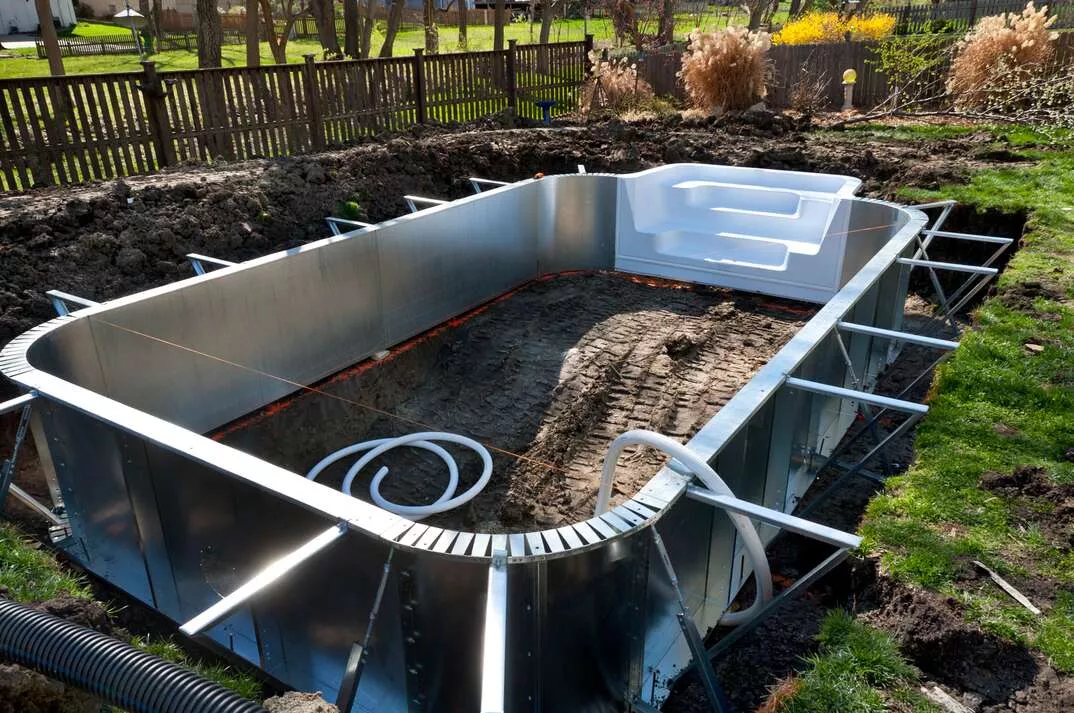
Excavation removes only enough soil to recess the pool partly into the yard. Current semi-inground guides describe a partial excavation rather than a full-depth inground dig, with many installs cut about 24 to 36 inches deep and some technical guides listing 24 inches as the common recommended depth. Ground preparation then removes roots and clumps, levels the area, and compacts the base before the structure goes in.
What Happens During Pool Wall and Base Installation?
Pool wall installation assembles the structural steel wall panels, braces, and support pieces around the excavated perimeter. The base installation then creates a stable, smooth floor so the pool stays level and supported. Current Canadian guides describe bolted galvanized steel panels, wall bracing, a stable footing, and a smooth sand base or similar prepared floor before the liner stage.
What Happens During Plumbing and Electrical Setup?
Plumbing connects the skimmer, returns, and filtration equipment. Electrical setup connects the pump, filter system, lights, and optional heater where included. Current installation timelines place plumbing and electrical work immediately after the structure is set and levelled, with backfilling often starting during the same phase to secure the pool walls.
What Happens During Liner Installation and Pool Fill?
Liner installation fits the vinyl liner over the prepared base and into the retaining track at the top of the wall. The pool fill starts right after that so the liner sets into its final shape. Current technical guidance states that the vinyl liner is snapped into the retaining track and that the liner-installation procedure itself usually takes about 4 to 6 hours, followed by careful filling instructions to protect the liner’s appearance and service life.
What Happens During Decking, Fencing, and Startup?
Decking and surrounding finish work turn the semi-inground structure into a usable backyard layout. Current guides describe close coordination between the pool crew and the deck or patio build so framing, backfilling, and finishing happen in the right order. Startup then covers filter-system setup, water balancing, and owner orientation on the pump, filtration system, and optional features. Many current semi-inground installations are described as swim-ready within 5 to 7 days, weather permitting.
Do You Need Permits for Semi-Inground Pool Installation in Toronto?
Yes. A semi-inground pool in Toronto follows the same outdoor-pool approval path as other residential pools. The City requires an approved Zoning Applicable Law Certificate first and a Pool Fence Enclosure Permit after that. A pool cannot be built and filled with water until the required pool enclosure is in place under Chapter 447 – Fences.
When Is a Pool Permit Required?
A Pool Fence Enclosure Permit is required when an outdoor swimming pool or similar outdoor structure used for swimming is 600 mm deep or more at any point. That rule applies to a semi-inground pool because it is still an outdoor pool structure. Toronto’s fence page defines a swimming pool at that 60 cm (600 mm) threshold and requires owners of outdoor pools to apply for the permit.
What Pool Fence and Enclosure Rules Apply?
Toronto requires a complete pool enclosure that fully surrounds the pool area. The enclosure cannot have openings except for a compliant gate, and the house cannot open directly into the pool area. The City shows this as a four-sided isolation fence requirement, which means a fence is often needed between the rear door of the house and the pool.
What Zoning and Site Plan Rules Apply?
Toronto requires a Zoning Applicable Law Certificate before the fence-permit application, and the site plan must be detailed enough for zoning and fence review. The City requires a plan showing property lines, pool dimensions, distances to the house and lot lines, adjacent doors and windows, pool equipment location, proposed fence location, height, and material, and the percentage of hard versus soft landscaping. Toronto’s pool-permit FAQ states that proposed pool setbacks are measured from the property lines to the water’s edge of the pool, and proposed enclosure setbacks are measured from the enclosure to the water’s edge.
What Drainage and Grading Rules Apply?
Toronto requires the lot to be graded so water drains properly and does not create recurrent ponding or unstable soil conditions. The City’s lot-grading guidance states that the existing drainage pattern should be maintained and that side yards should drain at surface slopes of at least 1.5% to positive drainage outlets. Toronto’s Property Standards rules add that yards must direct surface water away from building walls, and swimming pool drainage must not be discharged onto City-owned land, walkways, stairs, entrance ways, any road allowance, or directly or indirectly into the sewage system.
How Do Permits Affect the Build Timeline?
Permits affect the project at the front end. Toronto’s FAQ states that, after the zoning certificate application is accepted and fees are paid, the expected review time is 10 business days. After the zoning certificate is issued, a complete Pool Fence Enclosure Permit application takes about 5 business days to review. Missing information delays both reviews, and the City’s FAQ states that incomplete site plans slow the processing and issuance of both approvals.
How Long Does Semi-Inground Pool Installation Take in Toronto?
A semi-inground pool in Toronto usually moves faster than a full inground pool once approvals and scheduling are complete. Current semi-inground installation guidance places the main on-site pool installation at about 5 to 7 days, while the full project usually runs longer once design, permit approval, decking, fencing, and finish work are added. A practical full-project allowance is often about 2 to 6 weeks, depending on scope.
How Long Does Design and Planning Take?
A practical allowance for design and planning is about several days to 2 weeks for a straightforward semi-inground pool layout. Current semi-inground guides show this stage covering site assessment, marking and measuring, drainage review, and integrated deck planning before excavation starts. Broader pool-planning guidance places planning and permitting in the 1 to 4 week range, which supports a short front-end planning window for simpler semi-inground projects.
How Long Does Permit Approval Take?
In Toronto, the permit path usually adds about 15 business days once complete submissions are accepted and fees are paid. The City states an expected review time of 10 business days for the Zoning Applicable Law Certificate and about 5 business days for a complete Pool Fence Enclosure Permit application after the zoning certificate is issued. Missing information extends both review periods.
How Long Does Excavation and Pool Installation Take?
Excavation and core pool installation usually take about 5 to 7 days on a standard semi-inground project. Current semi-inground installation guidance breaks that into Day 1 for pool delivery, assembly, and levelling, Days 2 to 3 for plumbing, electrical work, and backfilling, and Days 4 to 5 for liner installation, pool fill, and filter-system setup, with most pools swim-ready by the end of Week 1.
How Long Do Decking and Finishing Take?
Decking and finishing usually add about 1 to 4 weeks when they are part of the contract. The exact length depends on whether the project uses a simple side platform, a full-wrap deck, or added patio, fencing, and landscaping work. Semi-inground planning guides treat the deck as an integrated part of the project, not an afterthought, so finish work often extends beyond the pool’s 5-to-7-day swim-ready window.
What Delays a Semi-Inground Pool Project?
The main delays are incomplete permit submissions, weather, difficult yard access, slope and drainage corrections, and material or contractor scheduling issues. Toronto’s permit FAQ states that missing information delays review, while current pool-construction delay guides identify weather, permit timing, supply-chain issues, and contractor availability as the most common schedule risks. Semi-inground installation guides also show that slope, soil conditions, and accurate levelling matter at the start of the job, so site problems often delay the project before the pool structure goes in.
Is a Semi-Inground Pool Better Than an Above-Ground or Inground Pool?
A semi-inground pool is better for some Toronto property goals and weaker for others. Current Canadian and Toronto-area pages place semi-inground pools in the middle of the market: they look more built-in than many above-ground pools, cost less than many full inground pools, and work especially well on sloped yards and with integrated decking. The same sources place inground pools above semi-inground systems for full customization, while above-ground pools stay the lowest-cost option in many budget-led projects.
Is a Semi-Inground Pool Better Than an Above-Ground Pool for Appearance?
Yes. A semi-inground pool is usually better than an above-ground pool for appearance because part of the structure is buried, the profile sits lower in the yard, and the exposed wall supports wood, vinyl, or aluminum finishing. Current Canadian sources describe semi-inground pools as more discreet, more refined, and easier to blend into the landscape than a traditional above-ground pool.
Is a Semi-Inground Pool Better Than an Inground Pool for Budget?
Yes. A semi-inground pool is usually better than an inground pool for budget. Current Canadian comparison pages state that semi-inground pools are cheaper than inground pools, with published starting prices around CAD 10,000, while Toronto- and Ontario-area inground pool costs sit much higher once excavation, structure, and full finishing are included.
Is an Inground Pool Better Than a Semi-Inground Pool for Customization?
Yes. An inground pool is better than a semi-inground pool for customization because full inground systems support more freedom in shape, size, depth, and integrated features. Toronto-area builder pages present inground pools as the custom-design tier of the market, while semi-inground systems still rely more heavily on kit-based wall systems and preset product lines.
Is an Above-Ground Pool Better Than a Semi-Inground Pool for Lowest Cost?
Yes. An above-ground pool is usually better than a semi-inground pool for the lowest cost. Current Toronto-area and Canadian pages describe above-ground pools as the most cost-effective option for buyers working within a tighter budget, while semi-inground pools add cost through partial burial, added base work, and more integrated finishing.
Which Pool Type Fits the Property Best?
The best pool type depends on the property goal. A semi-inground pool fits a yard that needs better appearance than an above-ground pool, lower cost than a full inground pool, and stronger performance on sloped or smaller sites. An above-ground pool fits the lowest-budget path. An inground pool fits the property that prioritizes full customization and a more permanent built-in design.
What Maintenance Does a Semi-Inground Pool Need?
A semi-inground pool needs regular cleaning, stable water balance, protection for the vinyl liner and exposed wall system, periodic repair, and full seasonal opening and closing. Most Toronto-area semi-inground pools use a durable vinyl liner with wall panels, so the maintenance pattern matches vinyl pool care rather than concrete pool care. Ontario service pages list the core work as regular cleaning, water testing, chemical balancing, equipment inspection, leak detection, liner replacement, and seasonal opening and closing.
How Do You Clean a Semi-Inground Pool?
Clean a semi-inground pool by skimming debris, emptying baskets, brushing the walls and floor with a soft-bristle vinyl brush, and vacuuming after brushing. A current Canadian pool liner maintenance guide sets that as the weekly routine for a vinyl-lined pool and adds monthly checks for waterline stains and small pinholes. Toronto-area service pages also position weekly cleaning as standard maintenance for local pools.
How Do You Protect the Liner and Wall System?
Protect the liner and wall system through balanced water chemistry, gentle cleaning tools, fast patching of small tears, and strong winter protection. A current Canadian liner-care guide says not to drain the pool completely, to use vinyl-safe tools, to inspect for pinholes monthly, and to fit a winter cover at closing. Toronto and Canadian sources also warn against direct contact from chlorine or bromine tablets because they stain or bleach vinyl liners. Toronto semi-inground pages describe these pools as using a durable vinyl liner with wall panels, so liner protection directly protects the visible structure and finish quality.
What Water Balance Matters Most?
The main water balance points are free chlorine, pH, total alkalinity, and calcium hardness. Health Canada says pool owners need to test sanitizer level, pH, total alkalinity, and calcium hardness daily. A current vinyl liner pool chemistry guide sets practical target ranges at pH 7.2 to 7.8, total alkalinity 80 to 120 ppm, calcium hardness 150 to 250 ppm, and free chlorine 1.0 to 2.0 ppm. A Canadian liner-care guide tightens the weekly operating target to pH 7.4 to 7.6 and free chlorine 1 to 3 ppm for liner protection and swimmer comfort.
What Repairs Are Common With Semi-Inground Pools?
The most common repairs are liner patching, leak detection, liner replacement, equipment repair, and repairs around fittings such as the skimmer and return lines. Ontario service pages list leak detection, liner replacement, equipment repair, and seasonal service as standard pool-maintenance work. Toronto-area repair pages identify vinyl leaks and tears as common issues and show that underwater vinyl patch kits are a standard repair path for smaller damage. Toronto leak-detection pages also publish vinyl skimmer replacement as a routine local repair service.
What Seasonal Opening and Closing Work Is Required?
Seasonal opening and closing are required in Toronto because the pool and plumbing must be protected from freeze damage. Toronto and southern Ontario winterizing guides say pool closing usually starts when the water temperature drops below 15°C and includes a final cleaning, water balancing, winter chemicals, lower water level, plumbing-line clearing, pump and filter winterization, and secure cover installation. A Canadian winterizing guide adds that the water is lowered to just below the return lines, the lines are blown clear, the pump and filter are drained, and chlorine floaters or loose tablets are not left in the pool because they can stain the liner. Toronto-area opening guidance places spring openings from April 15 through early June, while Ontario spring-maintenance guidance says many pools open as early as early April depending on weather.
How Do You Choose a Toronto Semi-Inground Pool Installer?
A strong Toronto semi-inground pool installer proves regular semi-inground or on-ground pool work, explains the full wall, base, and deck system clearly, handles permits and difficult site conditions, shows real past projects and public reviews, states warranty and workmanship coverage in writing, and has direct Toronto and GTA experience. Current Toronto and Canadian market pages repeat those same proof points across the strongest installers and semi-inground systems.
Does the Installer Build Semi-Inground or On-Ground Pools Regularly?
Yes. A strong installer shows repeated semi-inground or on-ground pool work, not only general pool installation work. Current Canadian specialist pages explicitly present on-ground and semi-inground pools as a core service category, which is a stronger qualification signal than a contractor that only lists broad pool services.
Does the Installer Explain the Wall, Base, and Deck System Clearly?
Yes. A strong installer explains the exact wall panel, base, and deck connection before the contract is signed. Current semi-inground product pages describe common systems through 14-gauge galvanized steel wall panels and vinyl liners, while GTA deck pages state that semi-inground pools sit partially above grade and pair best with composite or PVC decking for a balanced, durable transition.
Does the Installer Handle Permits and Site Conditions?
Yes. A strong installer handles Toronto permits, zoning review, fence-enclosure rules, drainage, and slope-related site conditions early. The City of Toronto requires an approved Zoning Certificate and a Pool Fence Enclosure Permit for an outdoor pool enclosure, and the municipal code requires plans that show the pool location, lot lines, and enclosure details. Installer pages and local pool-cost guidance also treat slope, access, and ground conditions as major cost and planning factors in semi-inground work.
Does the Installer Show Past Semi-Inground Pool Projects and Reviews?
Yes. A strong installer shows real project photos, completed backyard work, and visible public review signals. Current Toronto/GTA pool and landscape pages use project galleries, public review references, and volume claims such as hundreds of 5-star reviews or thousands of completed projects to prove market track record.
Does the Installer Offer Warranty and Workmanship Coverage?
Yes. A strong installer states warranty and workmanship coverage in writing. Current market pages show several forms of coverage, including lifetime warranties on semi-inground wall systems, 5-year labour warranties, and separate warranties on equipment or structural components. Written terms matter because the owner needs clear coverage for the pool structure, installation work, and related systems.
Does the Installer Have Toronto and GTA Experience?
Yes. Toronto and GTA experience matters because local projects deal with tighter lots, older neighbourhood access limits, sloped yards, zoning review, and fence-enclosure compliance. Current local pages repeatedly present Toronto and GTA service coverage, years of experience, and broad project volume as core trust signals for pool and backyard construction work.
Frequently Asked Questions About Semi-Inground Pool Installation in Toronto
How Much Does a Semi-Inground Pool Cost in Toronto?
Published Canadian semi-inground pool kit pricing starts near CAD 6,999 to 9,999, with larger packages around CAD 13,999. Recent Toronto/GTA installation pricing for comparable partially buried raised-pool projects adds about CAD 2,500 to 5,500+ before electrical work, fencing, decking, and landscaping, so full Toronto budgets often move into the mid-teens and higher.
Is a Semi-Inground Pool Cheaper Than an Inground Pool?
Yes. Published comparison pages place a semi-inground pool below a full inground pool on upfront price. One Canadian comparison page lists a typical semi-inground pool at about CAD 16,000 to 22,000 and an inground pool at about CAD 35,000 to 50,000, while another current seller states that semi-inground pools cost less than inground pools because a full concrete deck is not included in the standard scope.
Is a Semi-Inground Pool Good for a Sloped Yard?
Yes. Current Canadian sources position the semi-inground pool as a strong fit for sloped terrain because the structure sits partly below grade and integrates into uneven land more easily than many flat-base pool formats. Recent Canadian guidance describes that terrain fit as one of the main reasons homeowners choose the semi-inground format.
How Long Does Semi-Inground Pool Installation Take?
Current semi-inground installation guidance places the main on-site pool installation at about 5 to 7 days after site preparation and scheduling. Toronto’s permit path adds front-end time because the City expects about 10 business days for the Zoning Certificate review and about 5 business days for a complete Pool Fence Enclosure Permit review after zoning approval.
Do You Need a Permit for a Semi-Inground Pool in Toronto?
Yes. Toronto requires an approved Zoning Certificate and a Pool Fence Enclosure Permit for an outdoor pool enclosure. Toronto’s fence rules also require a complete pool enclosure with no openings except a compliant gate.
Can a Semi-Inground Pool Work With a Deck?
Yes. A semi-inground pool works well with a deck because the raised wall supports direct deck integration and smoother entry transitions than many flush patio layouts. Current Toronto/GTA deck guidance states that elevated pools suit composite or PVC decking, and Toronto semi-inground pages show staircase access, stone patios, and integrated landscape features around the pool.
What Shapes Can a Semi-Inground Pool Use?
Current Canadian and Toronto-area pages show round, oval, kidney, octagon, and rectangular semi-inground layouts. Toronto-area sellers also state that semi-inground pools come with straight or round wall-panel options, which expands the design range beyond a basic round above-ground pool.
What Is Included in Semi-Inground Pool Installation?
Current installation guides describe semi-inground pool installation as site review, layout planning, partial excavation, ground preparation, wall installation, base preparation, plumbing, electrical setup, liner installation, pool fill, backfilling, and the final coordination of decking, fencing, and startup. Product pages also show the core hardware package through the wall system, vinyl liner, and standard pool components.
Is a Semi-Inground Pool Better Than an Above-Ground Pool?
For appearance and landscape integration, yes. Current Canadian pages describe the semi-inground pool as more elegant, easier to integrate into the yard, and more discreet than a standard above-ground pool. Above-ground pools still hold the lowest-cost position in the market.
What Maintenance Does a Semi-Inground Pool Need?
A semi-inground pool needs the same core care pattern as a vinyl-lined pool: regular skimming, soft brushing, vacuuming, water testing, chemical balancing, liner inspection, and full seasonal opening and closing. Toronto service pages offer weekly maintenance plus opening and closing packages, and Canadian winterizing guidance recommends closing the pool once water temperature is consistently below 15°C to protect the liner, equipment, and plumbing.
How Do You Get a Quote for Semi-Inground Pool Installation in Toronto?
Getting a quote for semi-inground pool installation in Toronto usually starts with a site visit, then moves to layout and design review, a written cost estimate, and a draft permit and build timeline. Toronto pool-estimate guidance states that a proper estimate defines budget, scope, and schedule before construction starts, while Toronto pool-planning pages show that early site checks are used to confirm access, slope, drainage, and utility constraints before pricing is finalized.
How Do You Book a Site Visit?
You book a site visit by contacting the installer and arranging an on-site pool assessment. Toronto pool-planning pages state that the assessment is used to review the yard size, grade, drainage, access for equipment, and the space needed for the pool, deck, fence, and equipment pad. Local Toronto pool pages also promote a free site assessment as the first step before the estimate is prepared.
How Do You Get a Design and Cost Estimate?
You get a design and cost estimate after the installer turns the site information into a proposed pool layout and written project scope. Toronto estimate guidance states that a detailed pool estimate should clarify cost, schedule, and scope, while local semi-inground specialists position the consultation stage as the point where the pool is customized and the buyer chooses the final system and accessories. For a semi-inground pool, the estimate usually needs to price the pool kit, excavation, base work, electrical work, decking, fencing, and any landscaping separately so the full installed cost is clear.
How Do You Plan the Permit and Build Timeline?
You plan the permit and build timeline by separating approvals from physical construction. In Toronto, the outdoor-pool approval path usually starts with the Zoning Applicable Law Certificate and then moves to the Pool Fence Enclosure Permit. The City states that, after acceptance and fee payment, the expected review time is 10 business days for the zoning certificate and about 5 business days for a complete pool-fence application. Current semi-inground installation guidance then places the core on-site pool installation at about 5 to 7 days after approvals, scheduling, and site preparation are complete.