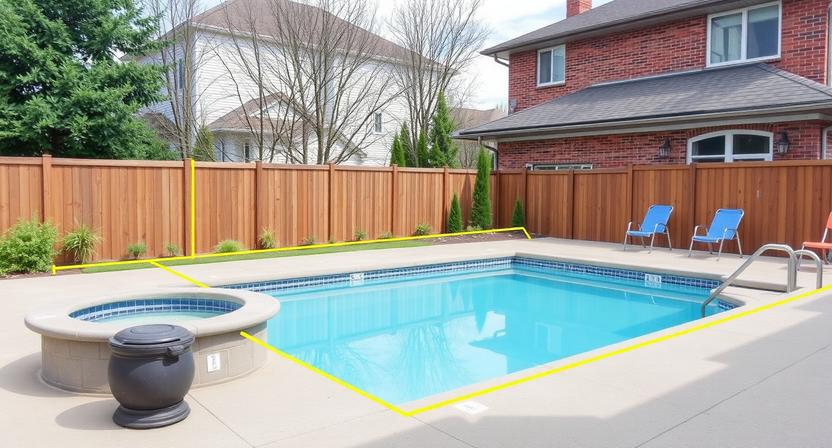
Toronto pool setback requirements define the minimum distance between an outdoor swimming pool and the applicable lot line. The required distance depends on the lot type, pool location, yard location, and whether the property contains a residential building other than an apartment building or an apartment building. Toronto’s outline identifies these setback rules as a key zoning issue before pool construction, site plan approval, and pool fence permit review.
Residential Zone rules set different setbacks for rear yards, side yards, corner lots, and through lots. The standard minimum rear yard setback for an outdoor pool is 1.2 metres. Some corner lots require a 3.0-metre rear yard setback. Some through lots require a 25.0-metre rear yard setback where an adjacent lot fronts on the rear lot line. The minimum side yard setback is the greater of 1.2 metres or the required side yard setback for the residential building. The City’s zoning chapter lists the 25.0-metre through-lot rule for an outdoor swimming pool or similar water-holding ancillary structure.
Toronto pool setbacks are measured from the water’s edge, not from the deck, coping, fence, or excavation line. This measurement point matters because a small error may cause a site plan to fail zoning review. A pool shown too close to a lot line may need relocation, redesign, or a zoning review correction before the Pool Fence Enclosure Permit moves forward.
Pool setbacks connect directly to Toronto’s pool permit process. The City requires an approved Zoning Certificate and Pool Fence Enclosure Permit before installing a swimming pool enclosure. Toronto also requires the pool enclosure to completely surround the pool area, and the pool fence must sit at least 1.2 metres from the pool edge.
A correct Toronto pool setback check starts with the lot type, yard type, building type, and water’s-edge location. The site plan should show property lines, pool dimensions, water’s-edge setbacks, house distance, equipment location, fence location, pool enclosure distance, and hard-versus-soft landscaping. These measurements help confirm zoning compliance before excavation, pool installation, fence approval, and final inspection.
What Are Toronto Pool Setback Requirements?
Toronto pool setback requirements are zoning rules that set the minimum distance between an outdoor swimming pool and the applicable lot line. The required setback depends on the yard location, lot type, building type, and water’s-edge position. Toronto’s outline identifies rear yard, side yard, corner lot, through lot, apartment-building lot, and zoning review rules as the main setback issues before pool construction.
What Is a Pool Setback in Toronto?
A pool setback in Toronto is the required distance between the pool water’s edge and a property line. The setback rule confirms where the pool sits on the lot before zoning approval, excavation, pool installation, fence layout, and inspection.
Toronto requires a detailed pool site plan for the Zoning Applicable Law Certificate. The plan must show property lines, pool and property dimensions, distances to the house and lot lines, pool equipment locations, fence details, and hard-versus-soft landscaping percentages.
Why Does Toronto Measure Pool Setbacks From the Water’s Edge?
Toronto measures pool setbacks from the water’s edge because the water surface defines the regulated pool location for zoning review. The City’s pool fence enclosure application FAQ states that proposed pool setbacks must be measured from the property lines to the water’s edge of the pool.
This measurement separates pool setbacks from fence setbacks. The same City FAQ states that pool enclosure setbacks are measured from the pool enclosure to the water’s edge of the pool. A site plan should show both measurements clearly to avoid zoning and pool fence permit delays.
Why Do Pool Setback Rules Matter Before Construction?
Pool setback rules matter before construction because setback errors delay zoning review, fence permit review, excavation, and installation. Toronto requires a Zoning Certificate before a Pool Fence Enclosure Permit for applications submitted after March 31, 2021. The City also states that a pool cannot be constructed and filled with water without a fence installed under Toronto Municipal Code Chapter 447 – Fences.
A pool shown too close to a lot line may need a revised site plan, a new layout, or further zoning review before the project moves forward. Early measurement from the water’s edge reduces redesign, permit delay, and construction timing problems.
What Is the Short Answer on Toronto Pool Setbacks?
Toronto pool setbacks depend on the lot type, yard location, and building type, and measurements must start from the water’s edge. The outline states that the standard rear yard setback for an outdoor pool in the Residential Zone category is 1.2 metres, with larger rules for some corner lots and through lots. The standard side yard setback is the greater of 1.2 metres or the required side yard setback for the residential building.
What Rear Yard Setback Rules Apply?
Toronto rear yard setback rules set the minimum distance between the pool water’s edge and the rear lot line. The required distance depends on the lot type and whether the lot has a residential building other than an apartment building or an apartment building. Toronto’s sample pool enclosure drawing states that all pool setbacks must be measured from the water’s edge of the pool.
What Is the Standard Rear Yard Setback for a Pool?
The standard rear yard setback for a pool in Toronto is 1.2 metres on a lot with a residential building other than an apartment building. This rule applies in standard rear yard cases that are not through-lot or specified corner-lot cases. The 1.2-metre distance is measured from the water’s edge to the rear lot line.
What Rear Yard Setback Applies on a Corner Lot?
A 3.0-metre rear yard setback applies on a Toronto corner lot when an adjacent lot fronts on the street that abuts the side lot line of the corner lot. This rule applies to an outdoor swimming pool or similar water-holding ancillary structure on a lot with a residential building other than an apartment building.
What Rear Yard Setback Applies on a Through Lot?
A 25.0-metre rear yard setback applies on some Toronto through lots when the lot has a residential building other than an apartment building and an adjacent lot fronts on the street that abuts the rear lot line of the through lot. This larger setback protects the street-facing relationship behind the through lot.
What Rear Yard Setback Applies on a Lot With an Apartment Building?
A 4.5-metre rear yard setback applies on a lot with an apartment building in standard cases. A 7.5-metre rear yard setback applies when the apartment-building lot is a through lot. These rules apply to an outdoor swimming pool or similar ancillary water structure with a total water surface area greater than 3.0 square metres.
When Is No Minimum Rear Yard Setback Required?
No minimum rear yard setback is required when the water surface area is small enough to fall under Toronto’s stated exception. A lot with a residential building other than an apartment building has no minimum rear yard setback when the water surface area is 1.0 square metre or less. A lot with an apartment building has no minimum rear yard setback when the water surface area is 3.0 square metres or less.
What Side Yard Setback Rules Apply?
Toronto side yard setback rules set the minimum distance between the pool water’s edge and the side lot line. In the Residential Zone category, the required side yard setback depends on whether the lot has a residential building other than an apartment building, whether the lot is a corner lot, whether the lot has an apartment building, and whether the water surface area falls under a small-water-feature exception.
What Is the Standard Side Yard Setback for a Pool?
The standard side yard setback for a Toronto pool is the greater of 1.2 metres or the required side yard setback for the residential building. This rule applies on a lot with a residential building other than an apartment building. The setback must be measured from the pool water’s edge to the side lot line, not from the deck, coping, fence, or excavation line.
Why Is the Minimum Side Yard Setback the Greater of 1.2 Metres or the Main Building Rule?
The minimum side yard setback uses the greater distance to keep the pool aligned with both pool-specific and building-specific zoning controls. A pool cannot use a smaller side yard distance when the main residential building requires a larger side yard setback. This prevents the pool from being placed closer to the side lot line than the zoning rule allows for that property.
What Side Yard Setback Applies on a Corner Lot?
The side yard setback on a Toronto corner lot is the required side yard setback for the residential building plus 1.5 metres from the side lot line abutting a street. This corner-lot rule applies to an outdoor swimming pool or similar ancillary water structure on a lot with a residential building other than an apartment building. Corner lots need careful review because the street-facing side lot line creates a larger setback condition.
What Side Yard Setback Applies on a Lot With an Apartment Building?
The side yard setback on a lot with an apartment building is 4.5 metres in standard cases. A larger 7.5-metre setback applies on a corner lot from the side lot line abutting a street. These rules apply to an outdoor swimming pool or similar water-holding ancillary structure on a lot with an apartment building.
When Is No Minimum Side Yard Setback Required?
No minimum side yard setback is required when the water surface area falls under Toronto’s small-water-feature exception. On a lot with a residential building other than an apartment building, no minimum side yard setback is required when the water surface area is 1.0 square metre or less. On a lot with an apartment building, no minimum side yard setback is required when the water surface area is 3.0 square metres or less.
How Do Corner Lots Change Pool Setbacks?
Corner lots change Toronto pool setbacks because one side lot line also abuts a street. This creates larger setback rules for some outdoor swimming pools and similar water-holding structures. In the Residential Zone category, a corner lot with a residential building other than an apartment building may need a 3.0-metre rear yard setback and a street-side side yard setback equal to the required residential building setback plus 1.5 metres.
What Rear Yard Setback Rule Applies on a Corner Lot?
A 3.0-metre rear yard setback applies on some Toronto corner lots when an adjacent residential building fronts on the street that abuts the side lot line of the corner lot. This rule applies to an outdoor swimming pool or similar ancillary structure used to hold water on a lot with a residential building other than an apartment building. The distance should be measured from the water’s edge to the rear lot line.
What Side Yard Setback Rule Applies on a Corner Lot?
The side yard setback on a Toronto corner lot is the required minimum side yard setback for the residential building plus 1.5 metres from the side lot line abutting a street. This rule applies to an outdoor swimming pool or similar ancillary water structure in the Residential Zone category on a lot with a residential building other than an apartment building.
Why Do Adjacent Street-Facing Lots Change the Rule?
Adjacent street-facing lots change the rule because a corner lot has higher visibility, access, and street-edge impact than an interior lot. Toronto’s zoning text links the larger rear yard rule to an adjacent residential building that fronts on the street beside the corner lot. The side yard rule also increases the setback where the side lot line abuts a street, which keeps the pool farther from the street-facing edge.
What Corner-Lot Mistakes Delay Approval Most?
Corner-lot mistakes delay approval most when owners use the standard 1.2-metre setback without checking the corner-lot rule. Other common mistakes include measuring from the coping or deck instead of the water’s edge, omitting the street-side side lot line, ignoring an adjacent street-facing residential building, leaving pool equipment off the plan, and confusing pool setbacks with pool fence distances.
Toronto zoning review needs clear site-plan measurements before pool fence approval. A corner-lot site plan should show the water’s-edge setback, street-side side lot line, rear lot line, house location, pool equipment, fence layout, and adjacent street-facing lot condition before construction starts.
How Do Through Lots Change Pool Setbacks?
Through lots change Toronto pool setbacks because the rear lot line also relates to a street-facing condition. A standard rear yard pool setback is not always enough on a through lot. Toronto zoning rules set a larger rear yard setback when an adjacent lot fronts on the street that abuts the rear lot line of the through lot.
What Is a Through Lot?
A through lot is a lot that has frontage or street relationship on two opposite sides. This lot type creates a front-facing condition at both ends of the property. The rear yard may affect streetscape, privacy, access, and neighbouring lot relationships more than a standard interior lot.
Why Does a Through Lot Need a Larger Rear Yard Setback?
A through lot needs a larger rear yard setback because the rear lot line may function like a street-facing edge. Toronto zoning uses the larger rule to keep an outdoor swimming pool or similar water-holding structure farther from that rear street-facing condition.
Pool placement on a through lot needs closer review because the site plan must show the correct lot lines, pool location, and water’s-edge distance before zoning approval. Toronto’s pool permit guidance requires a site plan with property lines, pool dimensions, and distances to lot lines.
When Does the 25.0-Metre Rear Yard Setback Apply?
The 25.0-metre rear yard setback applies to an outdoor swimming pool or similar water-holding ancillary structure on a through lot in the Residential Zone category when an adjacent lot fronts on the street that abuts the rear lot line of the through lot. Toronto’s zoning provisions list rear and side yard setback rules for outdoor swimming pools and similar ancillary water structures.
The 25.0-metre distance must be measured from the water’s edge of the pool, not from the coping, deck, fence, or excavation line. Toronto’s sample pool enclosure guidance states that pool setbacks are measured from the water’s edge.
What Site Conditions Make Through-Lot Compliance Harder?
Through-lot compliance becomes harder when the pool area has a short rear yard depth, a street-facing rear lot line, irregular lot shape, existing decks, sheds, patios, mature trees, pool equipment, or limited fence layout options. These features reduce the space available for the 25.0-metre setback and may force a different pool size, location, or layout.
Permit delays often happen when the site plan treats a through lot like a standard rear yard lot. A through-lot plan should show the rear lot line, street relationship, water’s-edge measurement, pool equipment location, fence enclosure, and any structures that affect zoning review.
How Do Apartment Building Lots Change Pool Setbacks?
Apartment building lots change Toronto pool setbacks because outdoor swimming pools and similar water-holding structures follow larger rear yard and side yard distances than standard residential pool cases. Toronto’s Residential Zone rules list separate setback standards for lots with an apartment building, including 4.5 metres, 7.5 metres, and a no-minimum exception for small water surface areas.
What Rear Yard Setback Applies on a Lot With an Apartment Building?
A 4.5-metre rear yard setback applies on a lot with an apartment building in standard cases. This rule applies to an outdoor swimming pool or similar ancillary structure used to hold water, such as a fountain or artificial pond, when the water surface area is greater than 3.0 square metres. The setback should be measured from the water’s edge to the rear lot line.
What Side Yard Setback Applies on a Lot With an Apartment Building?
A 4.5-metre side yard setback applies on a lot with an apartment building in standard cases. A larger side yard rule applies when the side lot line abuts a street on a corner lot. The pool site plan should show the pool water’s edge, side lot line, building location, and pool equipment location before zoning review.
When Does the 7.5-Metre Rule Apply?
The 7.5-metre rule applies on apartment-building lots in two main cases. A 7.5-metre rear yard setback applies on a through lot. A 7.5-metre side yard setback applies on a corner lot from the side lot line that abuts a street. These larger setbacks address street-facing and through-lot conditions.
When Does the 4.5-Metre Rule Apply?
The 4.5-metre rule applies on apartment-building lots in standard rear yard and side yard cases. It applies when the lot is not using the larger 7.5-metre rule and the pool or similar water structure has a water surface area greater than 3.0 square metres. This rule creates a larger separation than standard detached-house pool cases.
When Is No Minimum Setback Required on These Lots?
No minimum setback is required on apartment-building lots when the water surface area is 3.0 square metres or less. This exception applies to an outdoor swimming pool or similar ancillary structure used to hold water, such as a fountain or artificial pond. Larger water surfaces must follow the applicable 4.5-metre or 7.5-metre setback rule.
Do Small Water Features Follow the Same Setback Rules?
Small water features do not always follow the same Toronto pool setback rules when their water surface area falls below the zoning threshold. Toronto’s Residential Zone rules treat an outdoor swimming pool and a similar ancillary structure used to hold water, such as a fountain or artificial pond, differently when the water surface area is very small.
When Does a Pool or Similar Water Structure Have No Minimum Setback?
A pool or similar water structure has no minimum setback when its water surface area is at or below the zoning exception for that lot type. Toronto’s Residential Zone rules state that no minimum rear yard or side yard setback is required on a lot with a residential building other than an apartment building when the water surface area is 1.0 square metre or less. The same rule uses 3.0 square metres or less for lots with an apartment building.
What Water Surface Area Trigger Applies on Standard Residential Lots?
The water surface area trigger on standard residential lots is 1.0 square metre. A lot with a residential building other than an apartment building has no minimum rear yard or side yard setback when the outdoor swimming pool or similar water-holding ancillary structure has a water surface area of 1.0 square metre or less. Larger water surfaces must follow the applicable rear yard and side yard setback rules.
What Water Surface Area Trigger Applies on Apartment-Building Lots?
The water surface area trigger on apartment-building lots is 3.0 square metres. A lot with an apartment building has no minimum rear yard or side yard setback when the outdoor swimming pool or similar water-holding ancillary structure has a water surface area of 3.0 square metres or less. Larger water surfaces must follow the 4.5-metre or 7.5-metre setback rules, depending on the yard and lot condition.
What Counts as a Similar Ancillary Structure Containing Water?
A similar ancillary structure containing water means an outdoor structure used to hold water in a way that Toronto zoning treats with pool-style setback rules. Toronto’s zoning text gives fountains and artificial ponds as examples of similar ancillary structures used to hold water. These structures must be reviewed by water surface area, lot type, yard location, and setback rule before placement.
How Do Toronto Pool Equipment Setbacks Work?
Toronto pool equipment setbacks work through the Zoning Applicable Law Certificate site plan review. The site plan must show the location of pool equipment, including the heater, pump, and filter, plus distances from that equipment to lot lines. These measurements help the City review equipment placement before the Pool Fence Enclosure Permit stage.
What Rules Apply to Pool Equipment in the Side Yard?
Pool equipment in the side yard must be shown on the site plan with its distance to the side lot line. Toronto requires pool permit drawings to show equipment location and distances to lot lines. Where equipment includes a ground-mounted heating device, Toronto’s Residential Zone rule allows side yard placement if the device is no closer to the side lot line than the lesser of 0.9 metres or the required minimum side yard setback for the residential building.
What Rules Apply to Pool Equipment in the Rear Yard?
Pool equipment in the rear yard must be shown on the site plan with its distance to the rear lot line. Toronto’s pool zoning certificate page does not give one universal rear-yard setback number for every pump, filter, or heater. It requires the equipment location and lot-line distances so zoning staff can review the exact property, yard condition, and equipment layout.
Why Does Equipment Location Matter on the Site Plan?
Equipment location matters on the site plan because pumps, heaters, filters, and equipment pads affect zoning review, service access, neighbour impact, and construction layout. Toronto requires a fully dimensioned site plan showing property lines, pool dimensions, house distances, lot line distances, equipment locations, fence details, and hard-versus-soft landscaping percentages. Missing equipment data creates a zoning review gap.
What Equipment Placement Errors Cause Zoning Problems?
Equipment placement errors cause zoning problems when the site plan omits the heater, pump, filter, equipment pad, or lot-line distances. Errors also occur when equipment is placed too close to a side lot line, left off the drawing, shown without dimensions, or moved after zoning approval. A permit-ready plan labels each equipment item, gives exact distances to lot lines, and keeps equipment placement consistent with the approved Zoning Applicable Law Certificate drawings.
What Site Plan Details Must Show Pool Setbacks?
Toronto pool setback site plans must show the pool location, property lines, lot dimensions, pool dimensions, house distances, lot line distances, pool equipment distances, pool enclosure distances, and water’s-edge measurements. The City of Toronto requires a detailed, fully dimensioned site plan for the Zoning Applicable Law Certificate and Pool Fence Enclosure Permit review.
What Distances to Lot Lines Must the Site Plan Show?
The site plan must show the pool setbacks from the property lines to the water’s edge of the pool. The City of Toronto FAQ states that proposed pool setbacks must be measured from the property lines to the water’s edge. The plan must also show lot lines, lot dimensions, lot area, and a legal survey reference to establish the property boundaries.
What Distances to the House Must the Site Plan Show?
The site plan must show distances from buildings and access doors to the proposed pool. Toronto requires all existing and proposed buildings on the lot, building dimensions, access doors from buildings, and the location and dimensions of doors and windows in any building beside the pool area. These details help reviewers check pool placement, access control, and building-wall conditions before approval.
What Pool Equipment Distances Must the Site Plan Show?
The site plan must show pool equipment locations and distances from lot lines to the equipment. Toronto lists heat pump and filter equipment in its FAQ, while the zoning certificate page also refers to equipment such as a heater, pump, and filter. Equipment distances matter because zoning review checks placement before the fence permit review.
What Fence and Enclosure Distances Must the Site Plan Show?
The site plan must show pool enclosure setbacks from the pool enclosure to the water’s edge of the pool. Toronto’s FAQ states that the plan must show the proposed pool enclosure fence setbacks, plus the location, height, and material of the proposed fence. The plan must also show the location, height, and type of lockable gates, including whether the gates are self-closing or latching.
Why Does the City Need Water’s-Edge Measurements?
The City needs water’s-edge measurements because Toronto measures pool setbacks from the water’s edge, not from the deck, coping, excavation line, or fence. Toronto’s sample pool enclosure drawing states that all setbacks must be measured from the water’s edge of the pool. This measurement prevents confusion between pool setbacks and pool fence enclosure setbacks during zoning review and permit approval.
How Do Pool Setback Rules Connect With Toronto Pool Permits?
Toronto pool setback rules connect directly with pool permits because the Zoning Applicable Law Certificate checks zoning compliance before the Pool Fence Enclosure Permit review starts. Pool setbacks show whether the proposed outdoor swimming pool meets the required distance from the lot lines, measured from the water’s edge. Toronto requires a zoning certificate before applying for a pool fence enclosure permit.
Why Do You Need a Zoning Applicable Law Certificate First?
You need a Zoning Applicable Law Certificate first because Toronto uses it to confirm zoning and applicable law compliance before the pool fence permit stage. The City states that a Zoning Applicable Law Certificate is required for a Pool Fence Enclosure Permit application through Municipal Licensing and Standards. Drawings must be drawn to scale, fully dimensioned, signed, and dated.
How Do Pool Setbacks Affect the Pool Fence Enclosure Permit?
Pool setbacks affect the Pool Fence Enclosure Permit because the approved site plan must show that the pool location meets zoning rules before the fence enclosure is reviewed. The fence permit stage relies on the approved Zoning Certificate and zoning-approved drawings. Toronto also requires the pool enclosure to completely surround the pool area, with no openings except a compliant gate.
What Happens if the Pool Does Not Meet the Zoning By-law?
A pool that does not meet the zoning by-law may need a revised layout, corrected site plan, zoning relief, or a different pool location before the permit process continues. Toronto’s zoning review confirms compliance before the enclosure permit application moves forward, so a setback conflict stops or delays the permit path until the zoning issue is resolved.
How Do Setback Errors Delay the Permit Timeline?
Setback errors delay the permit timeline by forcing site plan corrections during the zoning review stage. Common errors include measuring from the coping instead of the water’s edge, using the wrong lot type, missing corner-lot or through-lot rules, omitting pool equipment distances, or confusing pool setbacks with pool fence enclosure distances. Toronto requires the zoning certificate before the pool fence permit, so any setback error delays the full approval sequence.
What Other Toronto Rules Affect Pool Setbacks?
Other Toronto rules affect pool setbacks when soft landscaping, drainage, grading, pool enclosure placement, and existing backyard structures change the final pool layout. A pool may meet the basic rear yard or side yard setback and still face zoning or permit issues if the site plan omits landscaping percentages, drainage direction, fence distance, equipment location, decks, sheds, or patios.
How Do Soft Landscaping Rules Affect Pool Placement?
Soft landscaping rules affect pool placement because Toronto zoning review checks how much of the lot remains as soft landscaping after the pool, deck, patio, and hard surfaces are added. The City of Toronto states that a pool zoning site plan must show the percentage of hard landscaping and soft landscaping. The City also states that soft landscaping may include the water surface area of an outdoor swimming pool or similar water-holding structure, such as a fountain or artificial pond.
How Do Drainage and Grading Affect Pool Location?
Drainage and grading affect pool location because pool construction changes surface water flow, soil levels, deck slopes, and water discharge routes. Toronto’s lot grading guidance states that existing drainage patterns should be maintained, side yards should drain at surface slopes of at least 1.5%, and drainage swale longitudinal slopes should not be less than 1.5%.
Pool water discharge also affects site planning. Toronto states that a permit or agreement is required to discharge private water into the sewer system. Pool drainage, backwash, saltwater discharge, and stormwater runoff should not create ponding, erosion, or flow onto neighbouring property.
How Do Fence Enclosure Rules Affect the Final Layout?
Fence enclosure rules affect the final layout because the pool fence has separate distance rules from the pool setback. Toronto requires the pool enclosure to fully surround the pool area, sit at least 1.2 metres from the pool edge, and stay at least 1 metre from easily climbable objects.
Pool setback measurements use the water’s edge to the lot line. Pool enclosure measurements use the fence location and its distance from the water’s edge. A site plan should show both sets of measurements to avoid confusing zoning setbacks with fence enclosure rules.
How Do Existing Decks, Sheds, and Patios Affect Compliance?
Existing decks, sheds, and patios affect compliance because they change usable yard space, hard landscaping totals, climbability, access routes, and fence layout. A deck beside the pool may create direct access into the enclosed area. A shed, patio, retaining wall, or equipment pad may reduce available setback space or create a climbable object near the enclosure.
Accessory structures may also trigger separate review. Toronto treats accessory structures such as sheds and cabanas through separate permit guidance, and pool site plans need to show existing and proposed buildings, equipment, fencing, and landscaping. A pool layout should account for every existing structure before zoning review, fence approval, excavation, or installation.
What Mistakes Cause Pool Setback Problems in Toronto?
Toronto pool setback problems usually come from wrong measurement points, missed corner-lot rules, missing pool equipment distances, confusion between pool setbacks and pool fence distances, and older property-specific zoning conditions. A permit-ready plan should show setbacks from the water’s edge, not from the coping, deck, fence, or excavation line.
Do Owners Measure From the Wrong Point?
Owners often measure from the wrong point when they measure from the deck edge, coping, pool wall, fence line, or excavation line instead of the water’s edge. Toronto’s sample pool enclosure drawing states that all setbacks must be measured from the water’s edge of the pool.
This mistake affects rear yard setbacks, side yard setbacks, corner-lot setbacks, and through-lot setbacks. A small measurement error may require a revised site plan before zoning approval.
Do Corner-Lot Rules Get Missed Too Often?
Corner-lot rules get missed often because a side lot line may also abut a street. Toronto pool setback rules include larger conditions for some corner lots, including a 3.0-metre rear yard setback in specific cases and a larger street-side side yard setback.
Corner-lot errors usually happen when the plan uses the standard 1.2-metre pool setback without checking the street-facing side lot line. A correct plan labels the front lot line, rear lot line, side lot line abutting a street, and water’s-edge distance.
Do Equipment Locations Get Left Off the Plan?
Equipment locations get left off the plan when owners show the pool but omit the heater, pump, filter, heat pump, chlorinator, or equipment pad. Toronto requires the pool zoning site plan to show pool equipment locations and distances from lot lines to the equipment.
Missing equipment distances create a zoning review gap. The City needs those measurements to check placement, service access, neighbour-facing impacts, and consistency with the final pool layout.
Do Fence Distances Get Confused With Pool Setbacks?
Fence distances get confused with pool setbacks when owners treat the pool enclosure distance as the same measurement as the pool setback. Toronto’s pool setback measurements run from the property line to the water’s edge. Pool enclosure measurements show the distance from the fence or enclosure to the water’s edge.
This distinction matters because Toronto pool fence rules require zoning-approved drawings that show fence location, height, and materials. A plan that shows only the fence route without the water’s-edge setback may delay approval.
Do Former By-laws Still Affect Some Properties?
Former by-laws may still affect some Toronto properties when site-specific exceptions, legacy zoning areas, or prevailing bylaw sections apply. Toronto’s zoning pages include site-specific exceptions and older zoning information, which means some properties need address-level zoning review instead of a general setback assumption.
A safe setback check uses the exact property address, current zoning category, lot type, and any site-specific exception. This avoids relying on a general 1.2-metre rule when a corner lot, through lot, apartment-building lot, or property-specific rule changes the required setback.
FAQs About Toronto Pool Setback Requirements
What Is the Minimum Rear Yard Setback for a Pool in Toronto?
The minimum rear yard setback for a Toronto pool is usually 1.2 metres on a lot with a residential building other than an apartment building. Some corner lots need 3.0 metres, and some through lots need 25.0 metres. Measurements start from the water’s edge of the pool.
What Is the Minimum Side Yard Setback for a Pool in Toronto?
The minimum side yard setback for a Toronto pool is the greater of 1.2 metres or the required side yard setback for the residential building. On some corner lots, the side yard setback from the side lot line abutting a street is the required side yard setback for the building plus 1.5 metres.
How Are Pool Setbacks Measured in Toronto?
Toronto pool setbacks are measured from the water’s edge to the applicable lot line. They are not measured from the coping, deck, fence, excavation line, or pool equipment. Toronto’s pool fence enclosure guidance also separates pool setbacks from pool enclosure setbacks, which measure the fence distance from the water’s edge.
What Setback Rule Applies on a Corner Lot?
A Toronto corner lot may need a larger pool setback when a side lot line abuts a street or an adjacent lot fronts that street. The rear yard setback may be 3.0 metres in specific corner-lot cases, and the street-side side yard setback may be the residential building setback plus 1.5 metres.
What Setback Rule Applies on a Through Lot?
A Toronto through lot may need a 25.0-metre rear yard setback when an adjacent lot fronts on the street that abuts the rear lot line of the through lot. This rule applies to an outdoor swimming pool or similar ancillary water-holding structure in the Residential Zone category.
Do Above-Ground Pools Follow the Same Setback Rules?
Above-ground pools follow Toronto pool setback rules when they qualify as an outdoor swimming pool or similar water-holding structure under the zoning rule. The measurement still starts from the water’s edge, not from the outside wall, frame, ladder, or deck.
Do Small Water Features Need the Same Setbacks?
Small water features do not always need the same setbacks. On a lot with a residential building other than an apartment building, no minimum rear or side yard setback applies when the water surface area is 1.0 square metre or less. On a lot with an apartment building, the no-minimum threshold is 3.0 square metres or less.
What Happens if a Pool Does Not Meet Toronto Setback Rules?
A pool that does not meet Toronto setback rules may need a revised site plan, a new pool location, zoning relief, or further review before permit approval. Toronto requires a Zoning Certificate before a Pool Fence Enclosure Permit, so setback errors delay the full permit sequence.
How Do You Start a Setback Check for a Toronto Pool Project?
Start a setback check for a Toronto pool project by confirming the lot type, measuring all pool setbacks from the water’s edge, preparing a complete zoning site plan, and aligning the pool, fence, and equipment layout before submission. Toronto requires a Zoning Applicable Law Certificate before a Pool Fence Enclosure Permit, so setback accuracy affects the full permit path.
How Do You Confirm the Lot Type First?
Confirm the lot type first by checking whether the property is an interior lot, corner lot, through lot, or a lot with an apartment building. Toronto pool setbacks change by lot condition. A standard residential rear yard pool setback differs from some corner-lot and through-lot rules, and apartment-building lots use separate setback distances.
Lot type should be verified before choosing the pool location. A site plan that treats a corner lot or through lot like a standard residential lot may fail zoning review and delay the Pool Fence Enclosure Permit.
How Do You Measure From the Water’s Edge Correctly?
Measure from the water’s edge correctly by marking the inside pool water line and measuring from that line to the applicable lot line. Toronto’s sample pool enclosure drawing states that all setbacks must be measured from the water’s edge of the pool, not from the coping, deck, fence, excavation line, or equipment pad.
Water’s-edge measurements should show the rear yard setback, side yard setback, corner-lot setback, through-lot setback, and any small-water-feature exception. These measurements keep pool setbacks separate from pool enclosure distances, which measure the fence from the water’s edge.
How Do You Prepare the Site Plan for Zoning Review?
Prepare the site plan for zoning review with a legal survey reference, property lines, pool dimensions, water’s-edge setbacks, house distances, pool equipment locations, fence details, and hard-versus-soft landscaping percentages. Toronto requires a detailed, fully dimensioned site plan for the Zoning Applicable Law Certificate review.
The site plan should show the pool location in relation to lot lines and buildings, plus the distances needed for zoning review. Missing setback dimensions, unclear lot lines, or equipment without lot-line distances create review delays before the pool fence permit stage.
How Do You Align Setbacks With Fence and Equipment Layout?
Align setbacks with fence and equipment layout by checking the pool water’s-edge setbacks, pool enclosure distance, pool equipment placement, and gate route together. Toronto requires a pool enclosure to completely surround the pool area, with no opening except a gate, and the fence must support safe access control before filling or use.
Pool equipment should be shown with distances to lot lines. Pool fencing should show location, height, materials, gate details, and distance from the water’s edge. A coordinated layout reduces conflicts between zoning setbacks, fence enclosure rules, pool equipment placement, drainage, and construction timing.